

TL;DR:
- Most people prefer purpose-built neighborhood apps over one generalist platform like Nextdoor.
- For safety, safety-alert apps like Neighbors by Ring or Citizen work best, while Buy Nothing excels at item exchanges.
The best Nextdoor alternatives for most people are a small bundle of purpose-built apps rather than one generalist replacement. Here is the short version:
- Neighbors by Ring — best for real-time safety alerts and camera-based incident reports
- Buy Nothing Groups — best for free item exchanges within a few blocks
- Facebook Groups — best for rapid adoption where neighbors already use Facebook
- Meetup — best for organizing recurring in-person events and local interest groups
- Reddit (local subreddits) — best for open, moderated civic discussion at the city or neighborhood level
- OfferUp — best for buying and selling secondhand goods locally
- Closeby — best for finding verified local services with stronger privacy defaults
- Citizen — best for live incident maps and crowdsourced public safety awareness
- Peanut — best for parents seeking local peer support and meetups
- Alignable — best for small-business owners who want local referral networks
TL;DR: Match the app to the job. If you need safety alerts, use Neighbors or Citizen. For free stuff, use Buy Nothing. For events, use Meetup. For everything else, a local subreddit or Facebook Group usually covers it.
Table of Contents
- How do the top Nextdoor alternatives compare at a glance?
- Platform profiles: what each app actually does
- How to choose the right neighborhood platform for your needs
- Why purpose-built tools outperform one generalist app
- Key Takeaways
- The real problem with replacing Nextdoor
- Ag-plumbing serves Pittsburgh homeowners directly
- FAQ
How do the top Nextdoor alternatives compare at a glance?
| Platform | Best for | Key features | Privacy / data | Moderation & verification | Cost | Reach | Mobile / desktop |
|---|---|---|---|---|---|---|---|
| Nextdoor | General neighborhood feed | Groups, classifieds, safety, recommendations | Ad-funded; address verification required | Address-verified neighbors; local moderators | Free | Hyperlocal | Both |
| Neighbors by Ring | Safety alerts | Camera footage, incident reports, alerts | Owned by Amazon/Ring; footage sharing | Community moderation; no address verification | Free | Hyperlocal | Mobile-first |
| Buy Nothing Groups | Free item exchange | Gifting posts, local groups | Facebook-dependent (legacy); standalone app available | Community stewards; invite-only | Free | Hyperlocal | Both |
| Facebook Groups | General community | Groups, events, messaging, marketplace | Ad-funded; Meta data practices | Group admin moderation; no address verification | Free | Local to national | Both |
| Meetup | Events and in-person groups | RSVPs, recurring events, group pages | Moderate data collection | Organizer-led moderation | Free/paid tiers | Local to national | Both |
| Reddit (local subreddits) | Open civic discussion | Threaded posts, moderation tools, voting | Moderate; no real-name required | Elected/volunteer moderators; strong tools | Free | City/neighborhood | Both |
| OfferUp | Buy/sell used items | Listings, messaging, ratings | Moderate; account required | Seller/buyer ratings; limited moderation | Free (fees on sales) | Local to regional | Mobile-first |
| Craigslist | Simple classifieds | Listings, housing, services, jobs | Minimal data collection; anonymous posting | Minimal; flag-based | Free (some paid posts) | Local | Desktop-first |
| Closeby | Verified local services | Verified tradespeople, recommendations | Privacy-forward design | Verification-first model | Free | Local | Both |
| Citizen | Real-time safety alerts | Live incident maps, push alerts, crowdsourced reports | Collects location data | Crowdsourced; no address verification | Free/premium | City-level | Mobile-first |
| Peanut | Parents and families | Groups, messaging, local meetups | Moderate | Community guidelines; moderated groups | Free | Local to national | Mobile-first |
| Alignable | Local business networking | Referrals, business profiles, Q&A | Business-focused; moderate | Business verification | Free/paid tiers | Local to national | Both |
| Mighty Networks | Private paid communities | Groups, events, courses, memberships | Privacy-forward; no ads | Host-controlled moderation | Paid (from ~$33/mo) | Any scale | Both |
| Angi | Hiring local contractors | Reviews, quotes, hiring workflow | Moderate; account required | Pro verification and reviews | Free to search | Local | Both |
Platform profiles: what each app actually does
Safety and incident apps
Neighbors by Ring surfaces camera footage and community incident reports in real time. It pulls directly from Ring doorbell cameras, which gives it a visual edge no other neighborhood safety app matches. The Amazon/Ring ownership is the main privacy trade-off: footage can be shared with law enforcement under certain conditions. Free to use; works best in areas with high Ring camera density.
Citizen goes broader. It maps incidents across a city using crowdsourced reports and 911 scanner data, then pushes alerts to your phone. The live map is genuinely useful during active situations. A premium tier adds a personal safety feature. Neither app verifies that reporters are actual neighbors, so treat unverified reports as leads, not facts.
For a deeper look at neighborhood safety apps and how camera-based alerting differs from structured emergency coordination, PubSafe’s breakdown is worth reading.
Free item exchange
Buy Nothing Groups (and the related Buy Nothing Project) run on a gifting-economy model: you post items you want to give away, neighbors claim them, and nothing changes hands except goodwill. The original groups lived inside Facebook; a standalone Buy Nothing app now exists for those who want out of Meta’s ecosystem. Membership is hyperlocal by design, often limited to a few blocks, which keeps the community tight and the trust high.
General community and social
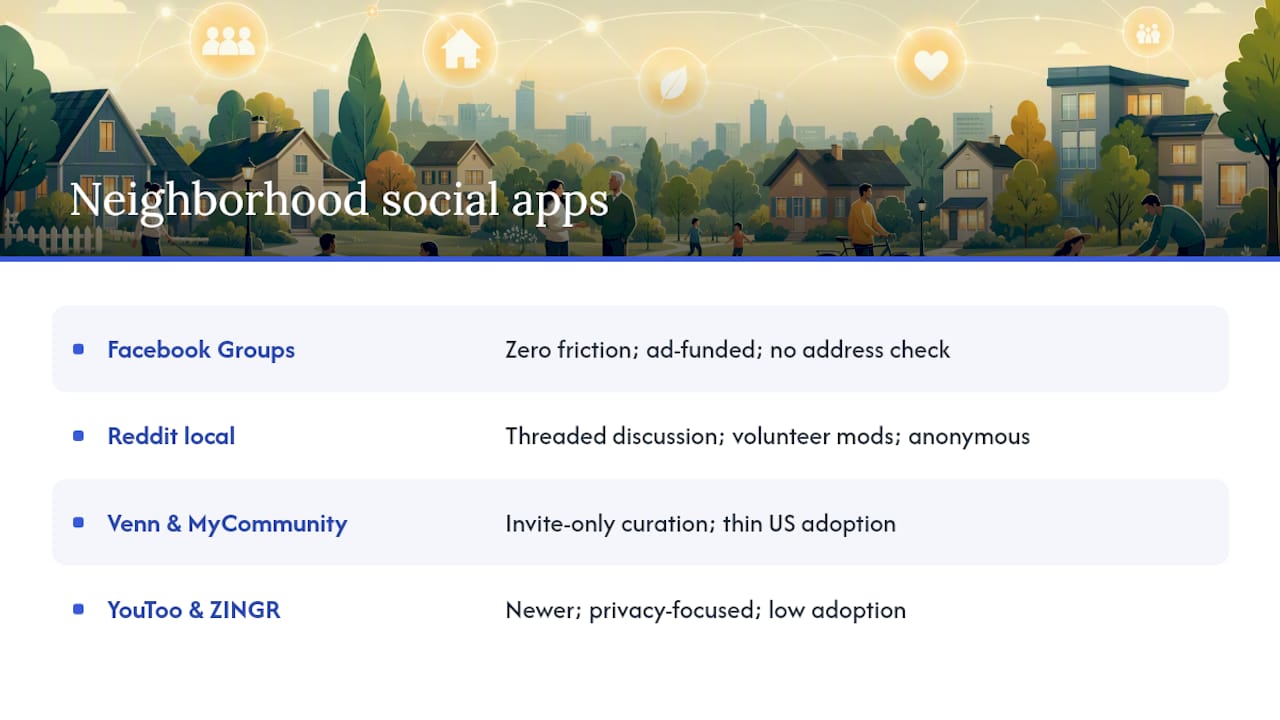
Facebook Groups is the path of least resistance for most neighborhoods. If your neighbors are already on Facebook, a local group requires zero onboarding friction. The trade-off is Meta’s ad-funded data model and group admin moderation that varies wildly in quality. No address verification means anyone can join a “local” group.
Reddit local subreddits (r/Pittsburgh, r/Chicago, etc.) offer something Facebook Groups rarely does: structured, threaded discussion with elected volunteer moderators and community voting. Content quality tends to be higher because low-effort posts get downvoted. The anonymity cuts both ways: it protects privacy but also removes accountability.
Venn and MyCommunity.Today sit in a similar space. Venn focuses on small, curated affinity groups with invite-only access. MyCommunity.Today leans toward publisher-style neighborhood news and announcements. Both are thinner on active US adoption than Facebook Groups or Reddit, but worth knowing if you want a less ad-heavy feed.
YouToo and ZINGR are newer entrants in the hyperlocal social space. Neither has the adoption base of the established players yet, but both position themselves as privacy-friendlier alternatives to Nextdoor’s ad model.
Events and in-person organizing
Meetup is the strongest option here. It has been running local interest groups since 2002, and its RSVP and recurring-event infrastructure is purpose-built in a way that Facebook Events is not. Organizers can charge for events or keep them free. The platform is not hyperlocal by default, so you will find groups at the city or metro level rather than the block level.
Marketplaces and classifieds
OfferUp is the cleaner, mobile-first experience for buying and selling used items locally. Seller ratings and in-app messaging make transactions feel safer than Craigslist. Facebook Marketplace adds social profile context to listings, which some buyers find reassuring. Craigslist remains the widest-reach option for housing, services, and jobs, with minimal friction and near-zero data collection. It is desktop-first and looks like it was designed in 2003, because it was. That simplicity is a feature for many users.
Local services
Angi (formerly Angie’s List) is the go-to for hiring vetted contractors. Pro verification and a review system give it more accountability than a Nextdoor recommendation thread. Closeby takes a different angle: it emphasizes verification and privacy from the start, making it a better fit for users who want to find local tradespeople without feeding their data into an ad machine.

When you find a contractor through any platform, verifying their credentials independently is worth the extra step. Ag-plumbing’s guide on types of plumbing services for homeowners explains what to look for before hiring.
Parent communities
Peanut is built specifically for parents to find local peer support, join groups by parenting stage, and organize meetups. It fills a gap that Nextdoor’s general feed handles poorly: nuanced, supportive conversation among people at the same life stage.
Business networking
Alignable connects small business owners for referrals and local Q&A. It is not a neighborhood app in the residential sense, but for a local business owner who wants to replace Nextdoor’s business section, it is the most purpose-built option available.
Paid and private community platforms
Mighty Networks lets you build a private, membership-driven community with structured content, events, and courses. Pricing starts around $33 per month for the host. It suits neighborhood associations or civic groups that want a clean, ad-free space and are willing to pay for it.
Almabase, Higher Logic Vanilla, and Hivebrite are enterprise-grade platforms used by organizations to host private member communities. They are overkill for a residential neighborhood but relevant for HOAs, civic associations, or alumni groups that need membership management at scale.
Bettermode, Threado, Helprace, Communifire, and Kahootz Extranet occupy a similar enterprise-to-mid-market range. Bettermode and Threado lean toward customer community management. Helprace adds a support-desk layer. Communifire and Kahootz Extranet are built for organizational intranets and extranet collaboration rather than residential neighborhoods.
Open-source and self-hosted platforms
Elgg, phpFox, Open Source Social Network, SkaDate, and mooSocial give organizations the ability to host their own community software. The upside is full control over data and moderation. The downside is that you need technical resources to set it up and maintain it. Vaave and AlumnForce are self-hosted alumni network platforms that can be repurposed for tight-knit community groups.
Collaboration and team platforms repurposed for community
Bitrix24, eXo Platform, Zoho Connect, Tribe, HumHub, Yammer (now Microsoft Viva Engage), and Disciple are primarily team collaboration tools. Some neighborhood associations use them for structured group communication, file sharing, and announcements. Microsoft Viva Engage (formerly Yammer) works best inside organizations already on Microsoft 365. Disciple has a stronger community-first design than most of this group.
Meta for Business, Hootsuite, and monday.com AI Work Platform are management layers, not community platforms. They help organizations publish and coordinate across channels. Snapchat for Business and daily.dev are audience-specific: Snapchat skews young and visual; daily.dev is a developer community platform with no neighborhood use case.
How to choose the right neighborhood platform for your needs
Start with one question: what do you actually need the app to do?
- Safety alerts → Neighbors by Ring or Citizen
- Free item exchange → Buy Nothing Groups
- Buy/sell → OfferUp, Facebook Marketplace, or Craigslist
- Events and in-person groups → Meetup
- Civic discussion → local subreddit
- Hiring a contractor → Angi or Closeby
- Parent community → Peanut
- Private neighborhood association → Mighty Networks or a self-hosted platform
Once you know the job, check these signals before committing to a platform:
- Verification model. Does the platform confirm you live where you say you do? Address verification (Nextdoor’s model) or community steward approval (Buy Nothing’s model) both work. No verification at all is a red flag for a hyperlocal app.
- Moderation structure. Who handles disputes and removes bad content? Volunteer moderators with clear guidelines beat algorithmic feeds with no human oversight.
- Privacy and data practices. Ad-funded platforms (Nextdoor, Facebook) monetize your activity. Subscription or invite-only models (Mighty Networks, Buy Nothing standalone app) generally collect less.
- Active local adoption. A platform with no active neighbors in your zip code is useless regardless of its features. Check whether a local group already exists before signing up.
- Parent company. Neighbors by Ring is owned by Amazon. Facebook Groups is Meta. Both carry data-sharing implications that go beyond the app itself.
High-trust neighborhood groups tend to use at least two verification signals — address verification plus invite or moderator approval — and limit membership size to reduce noise.
Pro Tip: Before fully committing to a new platform, spend two weeks as a passive observer. Check whether neighbors actually post, how quickly posts get responses, and whether the moderation feels consistent. A quiet group with no recent activity is a stronger signal than any feature list.
Why purpose-built tools outperform one generalist app
The case for using a bundle of specialized apps rather than a single Nextdoor replacement is well-supported. Purpose-built neighborhood apps for parenting, item exchange, and safety frequently produce better outcomes than expecting one general platform to serve every need.
The reason is structural. A platform optimized for safety alerts (Neighbors by Ring) needs different design choices than one optimized for free item exchange (Buy Nothing) or civic discussion (Reddit). When one app tries to do all three, it usually does each one worse.
Nextdoor’s own algorithm shift illustrates this. After the platform deprioritized crime-related content, some cities recorded measurable increases in real-world community organizing, including a measurable increase in block party permit applications in some areas. Reducing the fear-based content that a generalist feed tends to amplify pushed people toward actual offline connection.
The “local paradox” in hyperlocal platforms explains why this happens: proximity amplifies real-world consequences. A dispute that would stay abstract on a national platform can spill into your actual street when the participants live three houses apart. That dynamic requires different moderation governance than broad social networks use.
Three practical bundles that work well together:
- Safety + services + exchange: Neighbors by Ring (alerts) + Closeby (verified tradespeople) + Buy Nothing (free items)
- Parents + events + civic: Peanut (parent groups) + Meetup (in-person events) + local subreddit (broader discussion)
- Business owner: Alignable (referrals) + Facebook Groups (local awareness) + Angi (service marketplace)
Pro Tip: When evaluating a platform for your neighborhood, check whether it is subscription-funded or ad-funded. Modern community platforms are moving toward subscription or invite-only models to reduce toxic engagement. An ad-funded feed has a structural incentive to surface content that provokes reaction, which is exactly what most neighborhoods do not need.
How this list was built
These platforms were selected based on SERP consensus across top-ranking comparison pages, feature match against common neighborhood use cases (safety, classifieds, events, parenting, services), and privacy and moderation signals. Platforms with no meaningful US adoption or no public feature information were grouped rather than profiled individually. No platform paid for inclusion.
Key Takeaways
No single app replaces Nextdoor completely; the strongest approach is a small bundle of purpose-built tools matched to your specific neighborhood needs.
| Point | Details |
|---|---|
| Bundle beats one app | Purpose-built apps for safety, exchange, and events consistently outperform a single generalist platform. |
| Verification matters | High-trust groups use at least two verification signals, such as address confirmation plus moderator approval. |
| Ad model shapes content | Ad-funded platforms have a structural incentive to surface reactive content; subscription models tend to produce calmer feeds. |
| Match app to job | Safety alerts go to Neighbors or Citizen; free items to Buy Nothing; events to Meetup; civic talk to a local subreddit. |
| Ag-plumbing for local services | For Pittsburgh-area homeowners who find a plumber through a neighborhood app, Ag-plumbing offers 30 years of verified local service as a direct alternative to unvetted recommendations. |
The real problem with replacing Nextdoor
Most people searching for Nextdoor alternatives are not looking for a better version of the same thing. They are looking for something that does one specific job well, without the ad-heavy feed, the inconsistent moderation, and the occasional neighbor dispute that critics argue Nextdoor’s design actively amplifies.
The conventional wisdom says: find the app with the most features and the biggest local user base. That logic works for productivity software. It fails for neighborhood platforms, because the feature that matters most is not events or classifieds or safety alerts. It is trust. And trust is harder to scale than a feature set.
A Buy Nothing group with 200 active members on your block will serve you better than a Nextdoor neighborhood with 2,000 members who mostly argue about parking. A local subreddit with strong volunteer moderators will produce better civic discussion than any algorithmically ranked feed, regardless of which company built it.
The platforms worth your time in 2026 are the ones that have made a deliberate design choice about what they are for, and stuck to it.
Useful sources and methodology
These sources informed the platform selection and editorial stance in this article:
| Source | Why it was useful |
|---|---|
| Nextdoor algorithm shift — NWESP | Documents measurable offline engagement increases after content prioritization changes |
| Solving social media’s local paradox — SSIR | Scholarly analysis of why hyperlocal moderation requires different governance than broad social networks |
| Closeby Blog: Best Neighborhood Apps | Supports the purpose-built tool strategy with practical platform comparisons |
| Nextdoor isn’t so neighborly — Half the Story | Analysis of ad-driven design and moderation failures on hyperlocal platforms |
| PubSafe: Best Neighborhood Safety Apps | Categorization of safety app types (camera-based vs. emergency coordination) |
| Why Users Are Leaving Nextdoor — MyGladstone | User-reported reasons for leaving: moderation problems and ad dissatisfaction |
| CB Insights: Nextdoor alternatives | Market-level competitor coverage for completeness |
| Capterra: Best Nextdoor Alternatives | SERP-consensus platform list and user review signals |
Methodology: Platforms were selected by cross-referencing SERP consensus across top-ranking comparison pages, matching features to common neighborhood use cases (safety, classifieds, events, parenting, local services), and weighting privacy and moderation signals. Platforms with no meaningful US adoption were grouped rather than profiled individually. No platform paid for inclusion.
Ag-plumbing serves Pittsburgh homeowners directly
There are plenty of routes to finding a local plumber: Nextdoor recommendations, Angi listings, Facebook Group posts, or a Craigslist search. Each of those routes hands you a name and a phone number. What they cannot do is guarantee the work.
Ag-plumbing brings 30 years of hands-on experience to Pittsburgh, PA and the surrounding areas, covering drain cleaning, sewer repair, hydro jetting, leak repair, fixture repair, and general plumbing for residential and commercial properties. No algorithm, no unverified neighbor tip, and no marketplace listing replaces that track record. When a neighborhood app points you toward a plumber, it is worth knowing exactly who you are calling. Book a service visit with Ag-plumbing or go straight to plumbing repair in Pittsburgh to get a quote for your specific job.
FAQ
What is the best alternative to Nextdoor?
There is no single best replacement. For safety alerts, Neighbors by Ring or Citizen works best. For free item exchange, Buy Nothing Groups is the strongest option. For general neighborhood discussion, a local subreddit or Facebook Group covers most needs.
What is the Nextdoor controversy?
Users and critics point to inconsistent moderation, an ad-heavy feed that rewards sensational content, and privacy concerns tied to its data practices. Some accounts describe the platform amplifying neighborhood disputes rather than resolving them.
Who are Nextdoor’s main competitors?
The closest direct competitors for general neighborhood networking are Facebook Groups and local subreddits. For specific use cases, Neighbors by Ring (safety), Buy Nothing Groups (item exchange), Meetup (events), and Closeby (local services) each compete on a narrower but better-executed feature set. CB Insights tracks a broader set of adjacent platforms across the market.
What is the most popular neighborhood app?
Nextdoor remains the largest dedicated neighborhood platform by reach in the US. Facebook Groups has a larger raw user base but is not purpose-built for neighborhoods. For safety-specific use, Neighbors by Ring has strong adoption in areas with high Ring camera density.
Can I find a reliable local plumber through a neighborhood app?
You can get recommendations through Nextdoor, Facebook Groups, or Angi, but always verify credentials independently. For Pittsburgh homeowners, Ag-plumbing offers 30 years of local plumbing service across residential and commercial properties, which is a more reliable starting point than an unverified app recommendation.
Recommended
- Top 8 bbb.org Alternatives 2026 – AG-Plumbing
- Top 3 Ratedpeople.com Alternatives Plumbing Providers 2026 – AG-Plumbing
- Facebook.com Alternatives for Pittsburgh Plumbers (2026) – AG-Plumbing
- Best MapQuest.com Alternatives for Pittsburgh Homeowners & Plumbers – AG-Plumbing
