
Most Pittsburgh homeowners compare plumbing quotes and assume the lowest price means the best deal. But price alone rarely tells you about the training behind the work, the safety standards followed, or whether the plumber will stand behind the job. That gap is exactly where plumbing unions come in. The United Association (UA) sets strict training and certification standards that directly shape the quality you receive. This guide breaks down what plumbing unions are, how they operate in Pittsburgh, what they mean for your wallet, and when hiring a union plumber makes the most sense for your property.
Table of Contents
- What is a plumbing union?
- How plumbing unions work in Pittsburgh
- The roles and training of union plumbers
- Benefits of hiring a union plumber in Pittsburgh
- Plumbing union membership: costs, wages, and trade-offs
- When does a union plumber make sense for your project?
- Trusted union and non-union plumbing solutions for Pittsburgh
- Frequently asked questions
Key Takeaways
| Point | Details |
|---|---|
| Definition | A plumbing union is an organization representing plumbers and pipefitters to set industry standards. |
| Local structure | Pittsburgh is served by UA Locals 27, 354, and 449, offering expert training and representation for local plumbers. |
| Training and quality | Union plumbers receive extensive training and certification, leading to higher quality and safer plumbing work. |
| Homeowner advantage | Hiring a union plumber ensures reliability, code compliance, and warranty protection for your property. |
| Cost vs. value | Union work may cost more, but typically adds long-term value through better workmanship and fewer call-backs. |
What is a plumbing union?
A plumbing union is a labor organization that represents plumbers, pipefitters, and related tradespeople. Think of it as a professional body with real teeth. It negotiates wages, enforces safety rules, funds training programs, and gives workers a collective voice when disputes arise.
The United Association is the dominant national union in this trade. As the UA defines it, a plumbing union represents plumbers, pipefitters, and related tradespeople while setting standards for training, wages, safety, and benefits. The UA serves roughly 395,000 members across North America, making it one of the largest building trades unions on the continent.
Here is what a plumbing union typically does for its members and the industry:
- Negotiates collective bargaining agreements with contractors
- Funds and administers apprenticeship programs
- Sets minimum wage and benefit floors
- Enforces workplace safety standards
- Provides legal representation and dispute resolution
- Maintains journeyman certification records
“The UA’s mission is to train the most highly skilled workforce in the industry, ensuring members can handle any project safely and to code.” — United Association
For you as a homeowner or property manager, this structure means that when you hire a union plumber, you are hiring someone whose skills have been verified by an independent organization, not just by the contractor who employs them.
How plumbing unions work in Pittsburgh
Pittsburgh has a strong union tradition, and the plumbing trades are no exception. The city is served by three primary UA locals, each with its own specialty and geographic focus.
According to the UA local directory, Pittsburgh’s key plumbing-related locals include Local 27, Local 354, and Local 449. Here is a quick breakdown:
| Local | Primary trade | Focus area |
|---|---|---|
| Local 27 | Plumbers | Residential and commercial plumbing |
| Local 354 | Plumbers and pipefitters | Western PA commercial and industrial |
| Local 449 | Steamfitters and pipefitters | HVAC, industrial, and mechanical systems |
Each local runs its own training facility, dispatches workers to contractors, and negotiates separate agreements. When a contractor bids on a union job, they agree to hire from the local’s dispatch list and pay the negotiated wage scale.
For homeowners, the practical interaction is straightforward. You hire a plumbing contractor. If that contractor is a union shop, the plumbers they send are dispatched through the local and carry current union credentials. You can also work with professional plumbers in Pittsburgh who operate independently but still meet high professional standards.
Property managers overseeing multifamily buildings or commercial spaces often find that Pittsburgh plumbing services from union contractors simplify compliance with city codes and inspection requirements. For day-to-day issues, understanding the plumbing repairs Pittsburgh homeowners need most often can help you decide which type of contractor fits the job.
The roles and training of union plumbers
Union membership is not a title you buy. It is earned through years of structured work and study. The UA runs one of the most rigorous apprenticeship programs in the skilled trades.
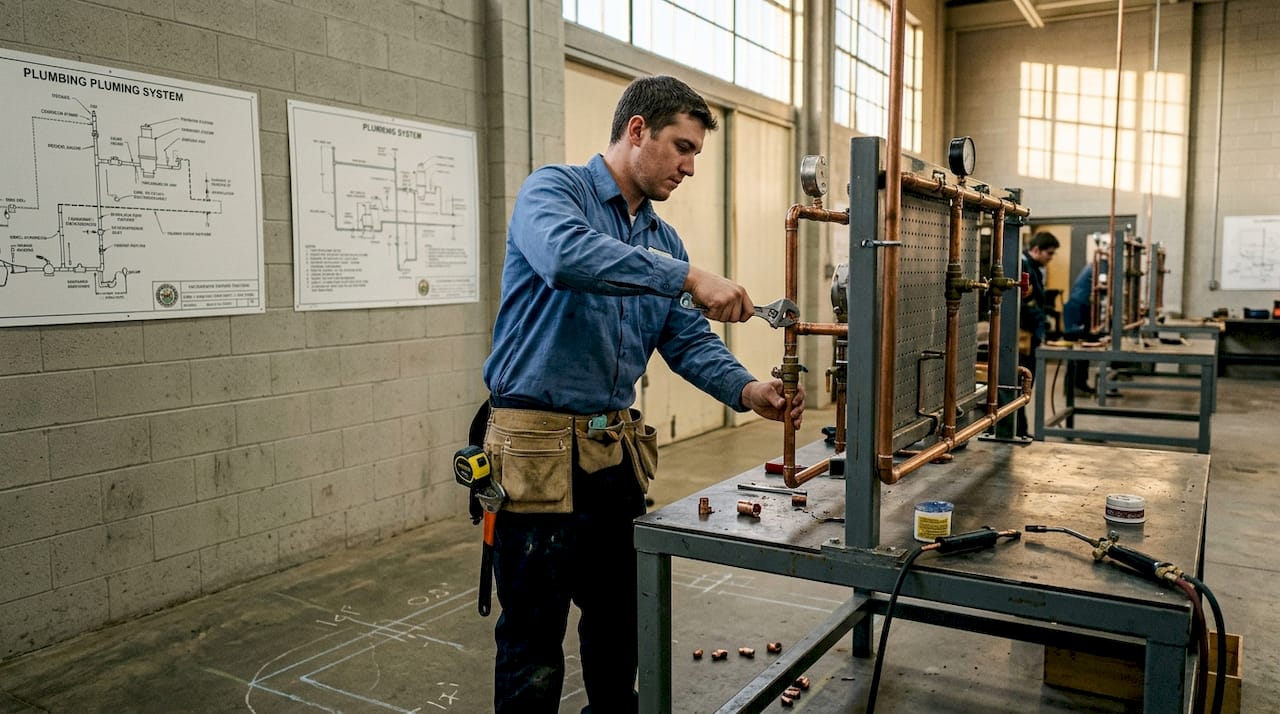
The UA’s apprenticeship model provides structured five-year programs, advanced training centers, journeyman certification, safety standards, and worker representation. Apprentices earn a paycheck from day one while attending classroom instruction on codes, blueprints, pipe systems, and safety. By year five, they sit for journeyman certification exams.
Local 449 in Pittsburgh operates a 75,000 square foot training center, one of the largest in the region. That facility runs hands-on simulations for gas lines, steam systems, and complex pipe configurations that apprentices would rarely encounter in the field during early years.
Here is how union and non-union plumber training compare:
| Factor | Union plumber | Non-union plumber |
|---|---|---|
| Apprenticeship length | 5 years, structured | Varies, often informal |
| Certification | UA journeyman card required | No universal standard |
| Ongoing education | Mandatory continuing training | Optional |
| Safety training | OSHA and UA standards | Employer-dependent |
| Wage progression | Defined scale by year | Negotiated individually |
Pro Tip: Before any plumber starts work on your property, ask to see their union card or journeyman certificate. A legitimate union plumber will have a current, dated credential from their local. If they hesitate, that is worth noting. You can also verify credentials through certified plumbing services that maintain transparent licensing records.
Benefits of hiring a union plumber in Pittsburgh
The training gap between union and non-union plumbers shows up in real ways on your property. UA Local 449 confirms that union plumbers deliver trained, certified professionals for reliable, code-compliant work with higher quality standards, warranties, and safety protocols.
Here is what that means in practice for Pittsburgh property owners:
- Code compliance: Union plumbers know Pittsburgh’s local codes cold. That matters enormously for permit approvals and resale inspections.
- Insurance and liability: Union contractors carry proper insurance, reducing your exposure if something goes wrong.
- Warranty on work: Many union shops back their labor with written warranties, giving you recourse if a repair fails.
- Safety record: Union job sites have lower injury rates because safety training is mandatory, not optional.
- Accountability: If a union plumber does substandard work, you have a formal grievance path through the local.
The wage data tells part of the story too. Union workers earn roughly 18% more in median weekly wages than their non-union counterparts, which reflects both skill level and the investment in ongoing training.
For larger renovation projects or anything involving permits, hiring reliable plumbers in Pittsburgh with verifiable credentials protects your investment. Projects involving underground lines or older infrastructure especially benefit from sewer repair expertise backed by formal training.
Plumbing union membership: costs, wages, and trade-offs
Union membership is not free, and the costs flow in both directions. Plumbers pay dues, and contractors pay higher wage scales. Those costs eventually factor into your project quote.
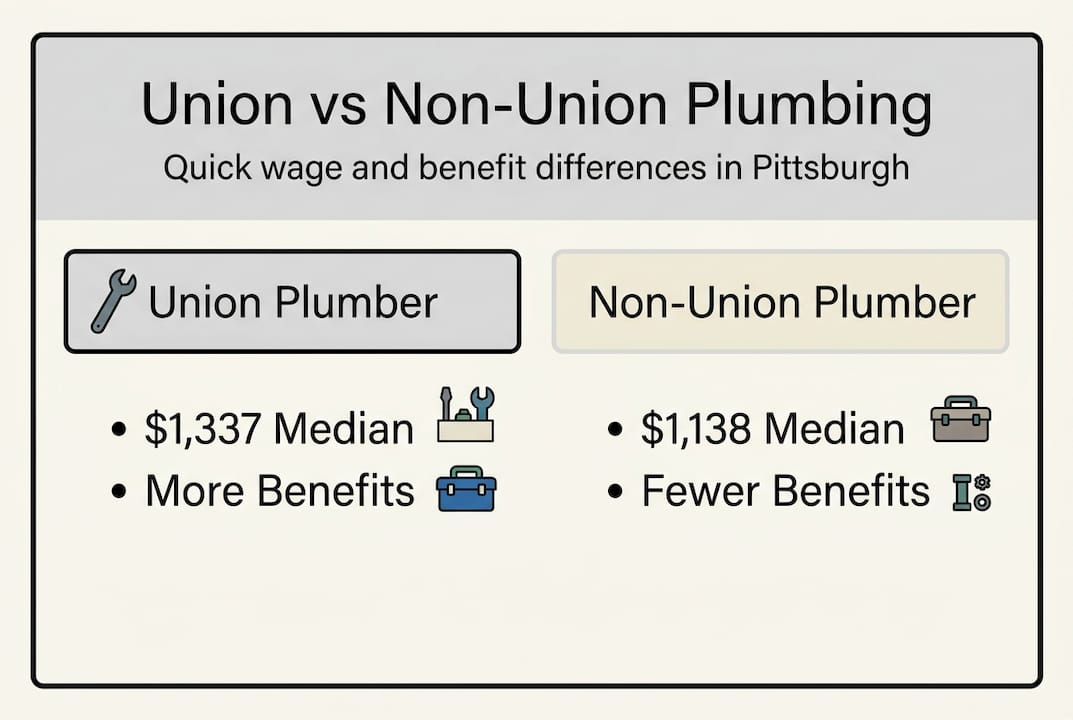
BLS 2024 data shows union workers earn a median of $1,337 per week versus $1,138 for non-union workers, with benefits including health insurance, pension plans, and paid training. Apprentices typically start around $20 per hour, while journeymen can earn over $50 per hour in Pittsburgh’s market. Dues generally run 1 to 2 percent of gross wages and cover training funds, legal representation, and administrative costs.
Here is a wage and benefit comparison:
| Category | Union plumber | Non-union plumber |
|---|---|---|
| Apprentice hourly rate | ~$20/hr | ~$15-18/hr |
| Journeyman hourly rate | $50+/hr | $30-45/hr |
| Health insurance | Included via union fund | Employer-dependent |
| Pension | Defined benefit plan | Rare |
| Paid training | Yes | Rarely |
The trade-offs for homeowners are real. Here is an honest numbered list:
- Higher upfront cost: Union labor rates are typically higher, which raises your project quote.
- Less scheduling flexibility: Union contractors work within dispatch rules, which can slow response times for small jobs.
- Jurisdiction limits: Some union agreements restrict which locals can work in specific areas or project types.
- Contractor pool: Not every Pittsburgh contractor is a union shop, which limits your options if you specifically want union labor.
- Value over time: The higher upfront cost often pays off through fewer callbacks, better code compliance, and longer-lasting work.
For a balanced view of union vs non-union trade-offs, the decision usually comes down to project size, budget, and how much risk you are willing to carry.
When does a union plumber make sense for your project?
Not every leaky faucet needs a journeyman pipefitter. But some projects genuinely benefit from union-level credentials and oversight.
Projects where union plumbers add the most value:
- Historic home remodels where code compliance is complex and inspectors are strict
- Large multifamily buildings where liability exposure is high
- Commercial tenant buildouts requiring permit sign-offs
- Gas line installations or major sewer replacements
- Any project where your insurance policy specifies licensed and certified contractors
As skilled trades research confirms, unions dominate large commercial and public projects, while residential work often remains non-union. That is not a quality judgment. It is a market reality.
Pro Tip: Before starting a major renovation, call your homeowner’s insurance provider and ask whether they require union or licensed contractors for covered repairs. Some policies have specific language that affects your claim eligibility.
For smaller jobs like fixture swaps, toilet replacements, or minor drain repairs, a qualified non-union plumber can absolutely get the job done. The key is verifying credentials either way. You can search for top plumbing services in Pittsburgh to compare options and find contractors who meet your project’s specific requirements.
To reach a union local directly, contact UA Local 27, Local 354, or Local 449 through the UA’s national directory. They can confirm which contractors in your area are currently dispatching union workers.
Trusted union and non-union plumbing solutions for Pittsburgh
Understanding the union landscape helps you make smarter decisions, but at the end of the day, you need a plumber you can trust to show up, do the work right, and stand behind it.
At AG Heating, Cooling & Plumbing, we bring 30 years of Pittsburgh plumbing experience to every job, whether it is a routine repair or a complex system overhaul. Our team stays current with local codes, licensing requirements, and best practices so your project passes inspection the first time. Explore our local plumbing repair experts page to see the full range of services we offer, or browse our guide to types of plumbing services to find exactly what your property needs. Ready to schedule? Contact us today and let’s get your plumbing sorted.
Frequently asked questions
How can I verify if my plumber is part of a union in Pittsburgh?
Ask to see the plumber’s union card and cross-check with your local UA branch. Union-trained plumbers hold current UA-issued credentials that can be verified through official local listings.
Do union plumbers cost more than non-union plumbers?
Yes, union plumbers typically charge higher rates, but the work comes with better training, certification, and guarantees. Union plumbers earn roughly 18% more in median weekly wages, reflecting the added skill and accountability they bring.
Are plumbing unions required for every residential plumbing job?
No. Small residential projects frequently use non-union contractors without any issue. Unions dominate commercial and public projects, but most routine home repairs do not require union labor.
What qualifications do union plumbers have?
Union plumbers complete a five-year apprenticeship with classroom and hands-on training, then pass journeyman certification exams. They also complete mandatory continuing education to keep their credentials current.
Recommended
- What do professional plumbers do in Pittsburgh? 2026 – AG-Plumbing
- Tips for hiring a plumber in Pittsburgh: 5 key criteria – AG-Plumbing
- How cleanouts in plumbing save 67% of Pittsburgh homeowners – AG-Plumbing
