
TL;DR:
- To prevent backflow contamination, install appropriate backflow preventers or air gaps at every cross-connection and schedule annual certified testing. Most failures occur due to improper device selection or lack of regular maintenance, emphasizing the importance of correct installation and routine checks. Regular testing and proper device choice protect water supplies from health hazards caused by reverse flow.
To prevent backflow contamination, install an appropriate backflow preventer or an air gap at every cross-connection in your plumbing, then schedule annual certified testing for any testable assembly. Contaminated water flowing backward into your drinking supply is not a theoretical risk — it happens when pressure drops or reverses, and the consequences range from foul-tasting water to serious illness.
Three things you can do right now:
- Screw a hose-bib vacuum breaker onto every outdoor faucet where a garden hose connects.
- Never leave a hose submerged in a bucket, pool, or chemical solution — that is a live cross-connection.
- If you already have an RPZ or PVB installed, check that the test cocks and shutoff valves are accessible and unobstructed. Annual testing cannot happen if the device is buried in a shrub or boxed in.
Pro Tip: When a new device is installed, confirm it has at least two test cocks and isolation valves on both ends. Without those, a certified tester cannot perform the required annual test.
Table of Contents
- What is backflow and how does it contaminate your water?
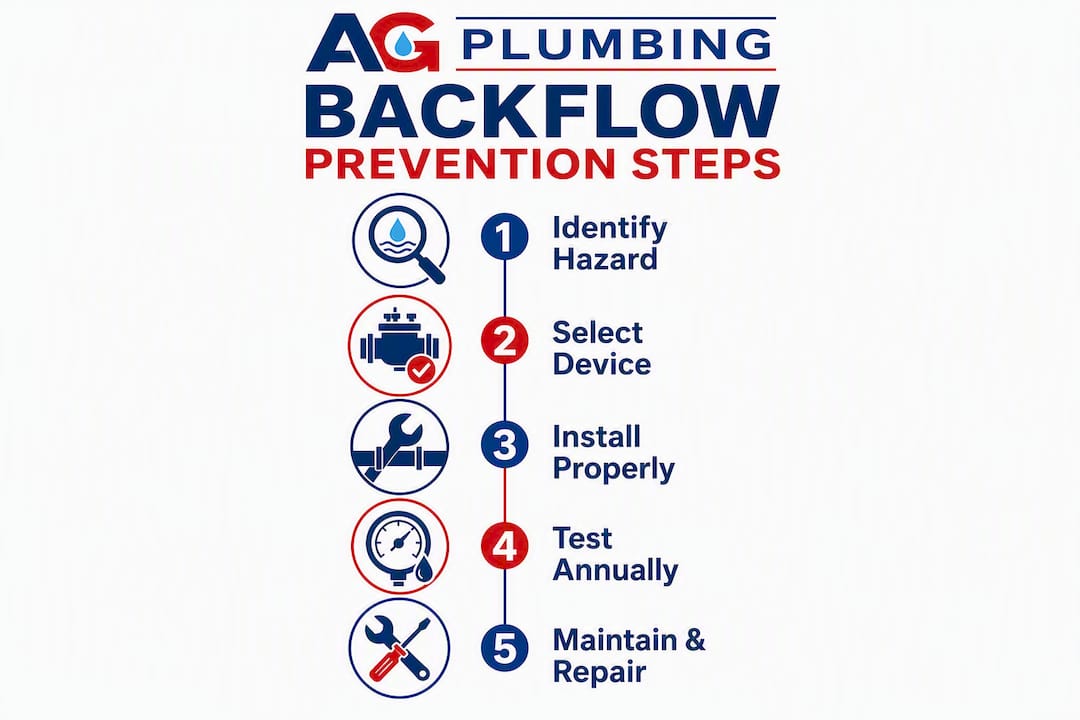
- How do you choose the right backflow preventer?
- Step-by-step installation for each common device
- How to test a backflow preventer: the step-by-step sequence
- Maintenance schedule and troubleshooting common failures
- What U.S. law requires: testing, reporting, and compliance
- When should you hire a pro vs. do it yourself?
- Key Takeaways
- The part most homeowners get wrong
- Ag-plumbing handles backflow prevention for Pittsburgh properties
- Useful sources
- FAQ
What is backflow and how does it contaminate your water?
Backflow is the undesirable reverse flow of non-potable water or other substances back into the clean drinking water supply through a cross-connection in the piping. Two pressure conditions cause it.
Backsiphonage happens when supply pressure drops suddenly — a main break, heavy firefighting demand, or a burst pipe upstream. The resulting negative pressure literally sucks water backward from wherever your hose or pipe is sitting. Backpressure is the opposite: a downstream system (a boiler, irrigation pump, or pressurized chemical tank) builds pressure higher than the supply line and pushes contaminated fluid back upstream.
The two broad prevention approaches are:
- Physical separation (air gap): A vertical gap between the water outlet and the flood rim of a receiving vessel. No moving parts, nothing to fail. Air gaps are recognized as complete protection against both backsiphonage and backpressure.
- Mechanical devices: Vacuum breakers, double check valve assemblies (DCVA), and reduced pressure zone assemblies (RPZ) create a physical barrier inside the pipe. They are effective but require periodic testing because they have springs, seals, and moving parts.
Common household cross-connections worth knowing: irrigation systems tied to the potable supply, boiler fill lines, hoses left in buckets of fertilizer or pool chemicals, and softener drain connections.
How do you choose the right backflow preventer?
Device selection comes down to two factors: hazard level and whether backpressure is possible.
Hazard classification:
- High hazard (health risk — chemicals, pesticides, sewage, boiler water with additives): requires an air gap or an RPZ assembly. No exceptions.
- Low hazard (non-health risk — lawn irrigation with no chemical injection, fire suppression with potable water): a DCVA is generally acceptable.
Pressure condition:
- If backpressure is possible (pumped systems, elevated tanks, boilers), you need an RPZ or DCVA. An AVB or PVB will not protect against backpressure.
- If backsiphonage is the only risk (a simple garden hose, a mop sink), an atmospheric vacuum breaker (AVB) or pressure vacuum breaker (PVB) is sufficient.
Quick on-site decision checklist:
- Identify what is downstream (chemicals? irrigation? potable-only?).
- Check whether any pump or elevated tank could create backpressure.
- Measure the highest downstream outlet — a PVB must sit at least 12 inches above it.
- Confirm whether the connection is under continuous pressure. An AVB cannot be used under continuous pressure; it must see a break in flow between uses.
Pro Tip: Before purchasing any device, call your local water utility or check your municipality’s cross-connection control program. Some utilities maintain an approved assembly list and will reject devices not on it, even if the device is otherwise code-compliant.
Step-by-step installation for each common device
Air gap
- Confirm the vertical separation is at least twice the pipe diameter, with a minimum of 1 inch. For a 3/4-inch supply line, that means at least 1.5 inches of open air.
- Terminate the supply line above the flood-level rim of the receiving vessel — not inside it, not below it.
- Common correct applications: dishwasher drain to a sink, water softener drain to a floor drain, ice maker drain line.
- Visual check: you should be able to see daylight between the pipe end and the water surface at all times.
Hose-bib vacuum breaker
- Turn off the outdoor faucet.
- Thread the vacuum breaker directly onto the hose bib — hand-tight plus a quarter turn with pliers.
- Orientation matters: the device must be vertical (outlet pointing down) to function.
- Before the first freeze of the season, unscrew the vacuum breaker and store it indoors. Frozen water inside the body will crack the housing.
AVB and PVB
AVBs are simple, non-testable devices suited to mop sinks and dishwasher connections. PVBs are testable and common on irrigation systems.
- Install the PVB at least 12 inches above the highest downstream outlet or sprinkler head. Install it too low and it cannot protect against backsiphonage and may fail code inspection.
- Place an isolation valve on each side and confirm both test cocks are accessible.
- Orient the device horizontally per manufacturer instructions (most PVBs are not rated for vertical installation).
- For outdoor installs in climates with freezing temperatures, use an insulated enclosure or plan for seasonal removal.
DCVA
- Install with isolation (shutoff) valves on both the inlet and outlet sides.
- Confirm both test cocks are accessible — a tester needs clear wrench access to both.
- DCVAs can be installed horizontally or vertically (check the manufacturer spec sheet for your model).
- If installed in a vault underground, confirm the vault drains properly. Standing water around the assembly accelerates corrosion and makes testing difficult.
RPZ assembly
The RPZ is the most capable mechanical device and the most installation-sensitive. Accessible shutoff valves on both ends are not optional — they are required for testing.
- Confirm the relief valve discharge port has a clear, indirect drain path to an approved location to prevent water damage. The relief valve will discharge water during certain failure conditions, and that discharge must go somewhere safe.
- Install in a location that meets your local utility’s height requirements (commonly 12–36 inches above the floor or grade).
- For outdoor installations, an insulated vault or enclosure is typically required to protect the assembly from freezing.
- After installation, a certified tester must perform an initial commissioning test before the assembly is accepted as compliant.
Safety precautions for all installations:
- Shut off the water supply and depressurize the line before cutting or threading any pipe.
- Wear safety glasses — pressurized lines can spray unexpectedly when fittings are loosened.
- During RPZ commissioning, stand clear of the relief valve discharge port.
Pro Tip: Photograph the installed device, its test cocks, and both shutoff valves before covering any enclosure. That photo becomes your reference if a tester later reports access problems.
How to test a backflow preventer: the step-by-step sequence
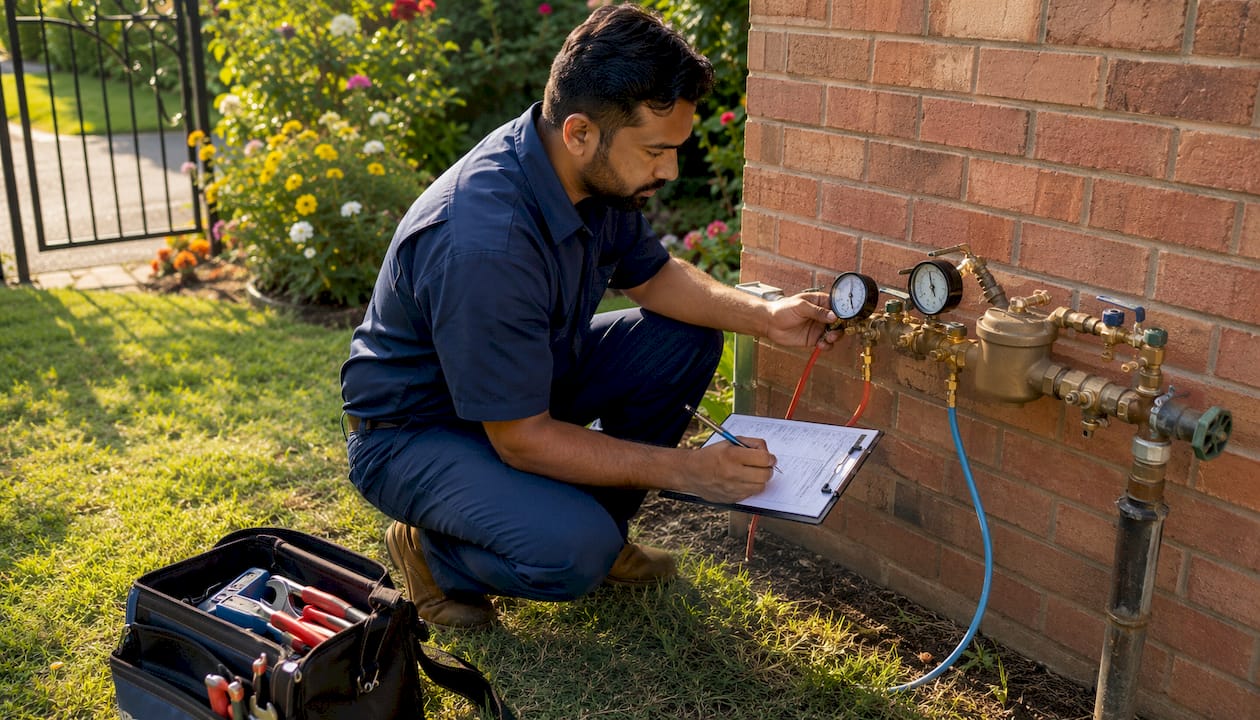
Testing a mechanical backflow preventer requires a calibrated differential pressure gauge, hose adapters sized to the test cock fittings, a bleed valve assembly, and a reference tube for water-column checks. This is not a DIY task — certified testers carry this equipment and know the exact sequence. What follows is what actually happens during a test, so you can supervise intelligently.
Required tools:
- Calibrated differential pressure gauge (5 psi or 15 psi range depending on assembly type)
- Test cock adapters (1/4-inch NPT fittings are standard on most assemblies)
- Bleed valve and hose assembly
- Reference tube for static water-column checks
- Cleaning supplies (test cocks can be fouled with mineral deposits)
Test sequence for RPZ, DCVA, and PVB
| Device | Core test actions | Pass signal |
|---|---|---|
| RPZ | Flush test cocks; attach gauge to TC1 and TC2; close downstream shutoff; record differential across check 1; test relief valve opening point | Check 1 differential ≥ 5.0 psi; relief valve opens before intermediate zone reaches inlet pressure |
| DCVA | Flush test cocks; attach gauge; close downstream shutoff; record differential across each check valve | Each check valve holds a pressure differential meeting manufacturer requirements |
| PVB | Flush test cock; attach gauge; open air inlet; record static differential | Air inlet opens at the specified pressure; check valve holds pressure as required |
Step-by-step field sequence (RPZ example):
- Flush each test cock briefly in sequence (TC1, TC2, TC3, TC4) to clear debris before attaching hoses.
- Attach the high-side gauge hose to TC2 and the low-side hose to TC3.
- Close the downstream (No. 2) shutoff valve.
- Slowly open TC2 and TC3 to pressurize the gauge.
- Record the static differential across check valve No. 1. A reading below the required differential indicates a fouled or failing first check.
- Test the relief valve by slowly closing the No. 1 shutoff and watching for relief valve discharge. The relief should open before the intermediate zone pressure rises to within about 2 psi of inlet pressure.
- Record all readings on the test report form and note whether the assembly passed or requires repair.
Pro Tip: Ask to see the tester’s current certification card before accepting any test report. An expired certification makes the report invalid for utility submission, and you may not find out until the utility rejects it months later.
Maintenance schedule and troubleshooting common failures
Backflow preventers are mechanical devices that need annual attention. A “set-and-forget” approach leaves your water supply exposed and puts you out of compliance with most utility programs.
Annual tasks
- Schedule a certified test for every RPZ, DCVA, and PVB on the property. Keep the test reports on file — utilities can require several years of documentation and may restrict service for missing records.
- Inspect all devices visually for leaks, corrosion, or physical damage.
- Confirm relief valve discharge areas are clear and draining properly.
Seasonal tasks
- Before the first hard freeze, drain and insulate outdoor assemblies or move them to a heated space if removable.
- Remove hose-bib vacuum breakers and store them indoors for winter.
- Check enclosures and vaults for water intrusion after heavy rain or snowmelt.
Common failure signs and first responses
- RPZ relief valve dripping continuously: The intermediate zone pressure has risen close to inlet pressure, meaning one check valve is fouled or not seating. Shut the downstream isolation valve, tag the device out of service, and call a certified tester. This is a diagnostic discharge, not a minor drip to ignore.
- No flow through an AVB: The air inlet poppet may be stuck open or the check valve is fouled. Remove and inspect; replace if the seat is cracked or the spring is fatigued.
- Continuous discharge from an RPZ relief port: Fouled check seats, fatigued springs, or debris are the usual culprits. Do not attempt to disassemble an RPZ yourself — internal repairs require calibrated testing before the device goes back into service.
For a broader look at routine plumbing inspections and what to watch for between professional visits, a regular inspection schedule pays for itself in avoided emergency calls.
Pro Tip: Keep a simple log: device location, installation date, tester name and contact, and test dates. When you sell the property, that file is a disclosure asset. When the utility calls, it is your proof of compliance.
What U.S. law requires: testing, reporting, and compliance
Most U.S. jurisdictions require annual testing of all testable backflow assemblies (RPZ, DCVA, PVB) by a state-licensed or locally certified tester, with passing results submitted to the local water utility. The exact rules vary by municipality, but the core obligations are consistent across programs.
What compliance typically requires:
- Annual test by a certified Backflow Prevention Assembly Tester (BPAT) registered with the local utility.
- Submission of the passing test report to the water utility within a specified window (often 30 days of the test date).
- Corrective action when a device fails: repair or replacement followed by a passing retest before the assembly is considered compliant.
- Record retention for multiple years — utilities can enforce service restriction or termination for owners who skip testing or ignore failed reports.
Local variation matters. Pittsburgh-area property owners should confirm requirements directly with their water utility or cross-connection control program. Some programs specify permitted device types, minimum installation heights, and vault construction standards that go beyond state minimums. For Pittsburgh-specific backflow testing obligations, Ag-plumbing’s local guide covers what property owners in the area face.
Compliance note: Annual testing is required in the majority of U.S. municipal cross-connection control programs, and utilities typically require submission of passing test reports as proof of compliance.
When should you hire a pro vs. do it yourself?
The line between homeowner-permissible work and professional-only work is clear, and crossing it carries real consequences: invalid test reports, potential fines, and a water supply that is not actually protected.
What homeowners can safely do:
- Install and remove screw-on hose-bib vacuum breakers.
- Verify air gap clearances visually (measure the gap, confirm it meets the 2× diameter / 1-inch minimum).
- Perform visual inspections of installed assemblies for leaks, corrosion, or physical damage.
- Keep records and schedule annual tests with a certified tester.
What requires a licensed professional:
- Field testing of RPZ, DCVA, and PVB assemblies with calibrated gauges. Non-calibrated gauges produce invalid readings, and the test report will be rejected by the utility.
- Internal repairs to check valves, relief valves, or springs inside any testable assembly.
- Commissioning a newly installed RPZ and filing the initial test report.
- Device selection and installation for any high-hazard connection (chemical injection, boiler, reclaimed water).
The value of hiring a licensed plumber for these tasks goes beyond compliance. A certified tester carries calibrated equipment, knows the local utility’s submission format, and can make minor on-site repairs during the test visit rather than scheduling a second trip.
Pro Tip: Before hiring any tester, ask for their certification number and verify it with your state licensing board or local utility registry. In many states, certification is issued by the American Backflow Prevention Association (ABPA) or a state environmental agency — and it expires annually.
Key Takeaways
Effective backflow prevention requires matching the right device to the hazard level, installing it with accessible test ports, and scheduling annual certified testing without exception.
| Point | Details |
|---|---|
| Match device to hazard | High-hazard connections require an air gap or RPZ; low-hazard connections can use a DCVA; backsiphonage-only situations allow a PVB or AVB. |
| Install with testing in mind | Every testable assembly needs accessible test cocks and isolation valves on both ends, or annual testing cannot be completed. |
| Annual certified testing | Most U.S. utilities require annual testing by a certified tester with passing results submitted to the water utility. |
| Winterize and inspect | Remove hose-bib vacuum breakers before freezing weather; drain and insulate outdoor assemblies each fall. |
| Ag-plumbing for Pittsburgh properties | Ag-plumbing provides device selection, certified backflow testing, and utility report filing for residential and commercial properties in Pittsburgh, PA. |
The part most homeowners get wrong
Most backflow failures in the field are not device failures. They are installation and maintenance failures. The wrong device for the hazard. Test cocks buried under insulation or boxed in by a deck. An RPZ that has never been tested since the irrigation contractor installed it three years ago.
The device-selection mistake is the most dangerous. Selecting a DCVA for a high-hazard connection because it was cheaper or easier to install is not a minor shortcut. A DCVA is not rated for health-hazard isolation. If the downstream system contains chemicals, reclaimed water, or boiler additives, a DCVA provides no meaningful protection against contamination. The wrong device for a hazard is a common and dangerous mistake — one that a professional site assessment catches before installation, not after a contamination event.
The second mistake is treating annual testing as optional paperwork. Mechanical devices wear. Rubber seats dry out, springs lose tension, and debris lodges in check seats. A device that passed its test two years ago may be sitting open right now. Annual testing is not bureaucratic overhead — it is the only way to know the device is actually working.
What a good local plumbing team does differently: they assess the specific hazard at each connection before recommending a device, install with the tester in mind (accessible ports, clear discharge paths, proper enclosures), and document everything so the annual test is a 20-minute visit rather than a troubleshooting call.
Ag-plumbing handles backflow prevention for Pittsburgh properties
Thirty years of local plumbing work means Ag-plumbing has seen every backflow scenario Pittsburgh properties produce: irrigation RPZs installed without proper drainage, hose bibs with no protection at all, and commercial properties with assemblies that have never been tested. The gap between a device that is installed and a device that is compliant and working is exactly where Ag-plumbing operates.
Ag-plumbing offers device selection and installation, certified backflow testing, emergency repairs, winterizing, and test report filing with local utilities. Whether you need a first-time RPZ commissioned or an existing assembly repaired and retested, the team covers residential and commercial properties across Pittsburgh and the surrounding areas. Schedule a backflow inspection or request a plumbing repair to get a certified tester on-site and your compliance documentation in order.
Useful sources
The following documents provide authoritative guidance on device selection, installation requirements, and test procedures. Check your local water utility’s cross-connection control program first — it overrides general guidance for your jurisdiction.
Sources with stepwise test procedures:
- Los Angeles County Department of Public Health — Backflow Prevention Assembly Testing Manual: Contains exact gauge hookup sequences, flush order, and pass/fail differential values for RPZ, DCVA, and PVB testing.
- Ohio EPA — Backflow Prevention & Cross-Connection Control Manual: State-level guidance covering device selection tables, installation constraints, and program administration.
Sources with device-selection tables and installation rules:
- Austin Water / AustinTexas.gov — Backflow Prevention Overview: Clear device-type descriptions, hazard matching, and approved assembly list requirements.
- American Backflow Prevention Association (ABPA) — FAQ: Plain-language definitions of each device type and why periodic testing is required.
Sources covering homeowner and food-facility requirements:
- Northern Nevada Public Health — Backflow Guidance Document: Practical installation height rules, air gap standards, and annual testing obligations.
- EPA Cross-Connection and Backflow Issue Paper: Federal-level context on cross-connection risks and program requirements.
Pro Tip: Your local water utility’s cross-connection control program is the binding authority for your property. State and national documents are useful references, but your utility’s approved device list, test frequency, and report submission deadlines are what actually govern compliance.
FAQ
What are the four main types of backflow preventers?
The four primary types are the RPZ assembly, the double check valve assembly (DCVA), the pressure vacuum breaker (PVB), and the atmospheric vacuum breaker (AVB), each suited to different hazard levels and pressure conditions. An air gap is also recognized as the most complete protection method, though it is a physical separation rather than a mechanical device.
What is the simplest and most effective backflow prevention method?
An air gap is the only fail-safe method against both backsiphonage and backpressure because it requires no moving parts and cannot mechanically fail. The minimum separation is at least twice the pipe diameter or 1 inch, whichever is greater.
Can you test a backflow preventer yourself?
Homeowners can install simple devices like hose-bib vacuum breakers and verify air gap clearances visually, but testable assemblies (RPZ, DCVA, PVB) require a certified tester with calibrated differential pressure gauges. A homeowner-conducted test produces an invalid report that most utilities will not accept.
How often does a backflow preventer need to be tested?
Most U.S. jurisdictions require annual testing of all testable assemblies by a certified tester, with passing results submitted to the local water utility. Confirm the exact schedule with your local cross-connection control program, as some utilities require more frequent testing for high-hazard connections.
What happens if a backflow preventer fails its test?
A failed device must be repaired or replaced, then retested with a passing result before compliance is restored. Utilities can restrict or terminate water service for owners who ignore failed test reports or skip annual testing altogether.
Recommended
- Backflow Prevention: What It Is and Why It Matters – AG-Plumbing
- The Role of Backflow Testing for Pittsburgh Property Owners – AG-Plumbing
- Why Install Shutoff Valves: A Homeowner’s Safety Guide – AG-Plumbing
- Step by step drain cleaning guide for PA homeowners – AG-Plumbing
