
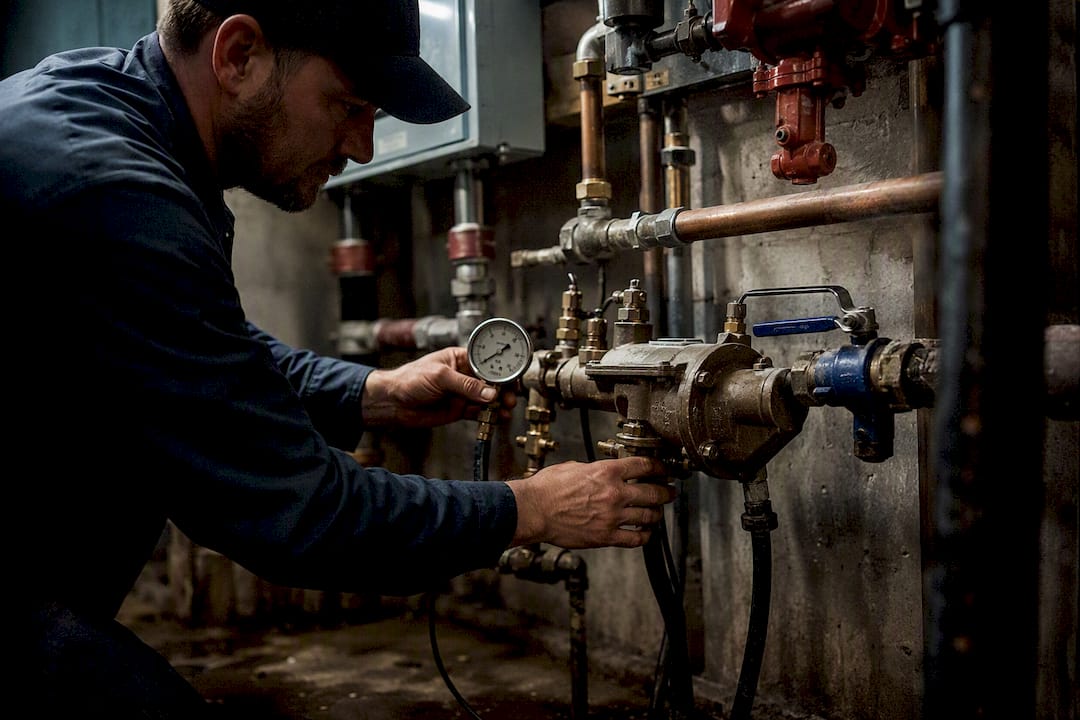
Pittsburgh property owners are legally responsible for getting their backflow prevention device tested every year and making sure the results reach the city’s water authority. That’s the whole obligation in one sentence, but it’s easy to miss until you get a shutoff notice.
Here’s what to do right now if you haven’t scheduled this year’s test:
- Confirm what type of backflow device is installed on your property and where it’s located.
- Hire an ASSE-certified tester with current calibration certificates for their gauges.
- Have the tester submit results directly through the PWSA Backflow Test Submission Portal.
- Save the confirmation email as proof the submission was accepted.
Pro Tip: Pittsburgh Water can terminate water service if approved test results aren’t on file, and that risk resets every year the moment your last test expires.
Key Takeaways
Property owners in Pittsburgh must schedule annual ASSE-certified backflow testing and confirm submission through PWSA’s portal to avoid water service termination.
| Point | Details |
|---|---|
| Owner responsibility | You’re responsible for annual testing even if PWSA never sends a reminder email. |
| Tester credentials | Confirm ASSE certification and current gauge calibration certificates before work begins. |
| Testing triggers | Devices need testing at installation, after any repair or relocation, and at least once every 12 months. |
| Enforcement risk | Missing approved test results in the PWSA portal can lead to water service termination. |
| AG Plumbing’s role | AG Plumbing handles inspection, ASSE-certified testing, repairs, and portal submission in one visit. |
Table of Contents
- Backflow Testing Pittsburgh: Who Needs a Device and Which Codes Apply
- Who Is Responsible for Scheduling the Test?
- How Does a Backflow Test Actually Work?
- What Permits and Fees Should You Expect?
- How AG Plumbing Gets You Compliant in One Visit
- How to Hire and Verify a Backflow Tester
- What Does Backflow Testing Cost in Pittsburgh?
- Who Can Legally Test Backflow Devices in Pittsburgh?
- What Usually Goes Wrong During a Backflow Test?
- A Straight Answer on What Actually Puts Owners at Risk
- Get Compliant Without Chasing Down Multiple Contractors
- Sources
- FAQ
Backflow Testing Pittsburgh: Who Needs a Device and Which Codes Apply
Not every property needs a backflow prevention device, but more of them do than most owners assume. Every commercial property connected to Pittsburgh’s water system must have one installed, tested, and reported. Residential properties usually get a pass unless they have something that creates a higher risk of contamination, like a boiler system, a fire sprinkler line, an irrigation system, or a cistern feeding back into the water line.
The rules aren’t just local custom. Pittsburgh Water requires annual testing with results filed by an ASSE-certified tester through its online portal, and that requirement sits on top of two layers of code:
- Allegheny County Health Department Plumbing Code, Article XV, which sets testing standards, device types, and required intervals across the county.
- City of Pittsburgh Chapter 319, which defines approved assembly types and accessibility rules for devices installed after the water meter wherever a cross-connection exists.
- Pennsylvania DEP regulations (Title 25, Section 109.709), which give PWSA its underlying legal authority to require backflow prevention in the first place.
If your building falls into a high-hazard category, you’re not choosing whether to comply. You’re choosing how smoothly you comply.
Who Is Responsible for Scheduling the Test?
The property owner is on the hook, full stop, whether or not PWSA sends a reminder. Owners remain responsible for compliance even if they never receive a notification email, which means waiting for a letter in the mail is a bad strategy.
Before you let anyone touch your device, confirm these three things:
- ASSE certification. The tester should hold a current ASSE credential specific to backflow assembly testing, not a general plumbing license.
- Gauge calibration certificates. PWSA requires digital copies of calibration certificates for every test gauge used, dated within the valid calibration window.
- Portal registration. The tester needs an active account on PWSA’s submission portal, since results filed outside it don’t count.
Pro Tip: Ask to see the calibration certificate’s expiration date before the test starts. A tester using an out-of-window gauge can produce a result PWSA simply won’t accept, forcing you to pay for a second visit.
How Does a Backflow Test Actually Work?
A backflow test takes most technicians well under an hour once they’re on site, but the sequence matters.
- Visual inspection. The tester checks the assembly for corrosion, leaks, and correct installation before touching a gauge.
- Gauge hookup. A calibrated differential pressure gauge connects to test ports on the device.
- Pressure readings. The tester records readings across check valves and relief valves, comparing them against ASSE test standards.
- Pass/fail determination. Results either clear the device or flag a specific component that’s failing.
Timing isn’t flexible. Testing is required at installation, immediately after any repair or relocation, and at least once every 12 months after that. A device that passed last February doesn’t get a pass on a repair made in October. That repair triggers a fresh test regardless of where you are in the annual cycle.
If a device fails, the fix depends on what’s wrong. A worn check valve or a stuck relief valve is often a straightforward repair, and the tester retests immediately after the fix. A device that needs full replacement is a bigger job. It usually needs an Allegheny County Health Department plumbing permit before the new unit goes in, followed by a fresh test and a new submission through the PWSA portal. Skipping the retest after a repair is one of the most common ways owners end up out of compliance without realizing it.
What Permits and Fees Should You Expect?
New backflow device installations and full replacements need an ACHD plumbing permit and inspection before the device gets tested and approved. Skip this step and you may end up redoing work just to get it inspected properly.
Fees vary by permit type and device size, and they change often enough that quoting a flat number here would do you a disservice. Contact PWSA directly at backflowinfo@pgh2o.com or backflow@pgh2o.com for current tariff questions, or if you’ve received a noncompliance notice and need a portal pin reissued.
The bigger cost to watch for isn’t the permit. It’s the consequence of doing nothing:
- PWSA can terminate water service to properties without approved test results on file.
- Reinstating service after a shutoff typically takes longer and costs more than the test itself would have.
- Commercial properties risk operational downtime, not just an inconvenience.
How AG Plumbing Gets You Compliant in One Visit
AG Plumbing has spent 30 years working on Pittsburgh’s plumbing systems, and backflow compliance is one of the more predictable jobs we handle because the process rarely changes: inspect, test, document, submit.
A typical visit looks like this:
- Visual inspection of your existing device and connection points.
- Testing with calibrated gauges by our ASSE certified technicians.
- An on-site repair estimate if the device fails, so you’re not guessing at cost.
- Retest after any repair, followed by submission through PWSA’s portal.
- A confirmation email you can keep on file as proof of compliance.
Owners who wait for a PWSA reminder before scheduling are already behind, since the responsibility never shifts to the agency.
If your device needs more than a quick fix, our plumbing repair services cover the installation and repair work an inspection might turn up.
How to Hire and Verify a Backflow Tester
Work through this checklist the same day you decide to schedule:
- Identify your assembly type. Check the device tag or your building’s plumbing records so the tester knows what they’re working with before arrival.
- Ask for ASSE certification up front. A legitimate tester will show you the card without hesitation.
- Ask for gauge calibration certificates. Confirm the dates are current, not expired from a prior job.
- Confirm portal registration. Ask whether they’re registered with PWSA’s submission system; an unregistered tester can’t file your results no matter how good the test itself was.
- Get the submission confirmation in writing. Don’t rely on a verbal “it’s done.”
- File the confirmation email somewhere you can find it next year, since you’ll need to repeat this whole process on roughly the same schedule.
Red flags include a tester who can’t produce a calibration date, one who wants to skip a visual inspection, or one who suggests filing “later” outside the portal. Any of those should send you looking elsewhere.
What Does Backflow Testing Cost in Pittsburgh?
Backflow testing costs in Pittsburgh depend on the device type, its size, and whether the visit includes a repair or just an inspection and test. A straightforward annual test on a residential-grade device typically costs less than a commercial detector assembly, which has more components to check and usually takes longer to complete.
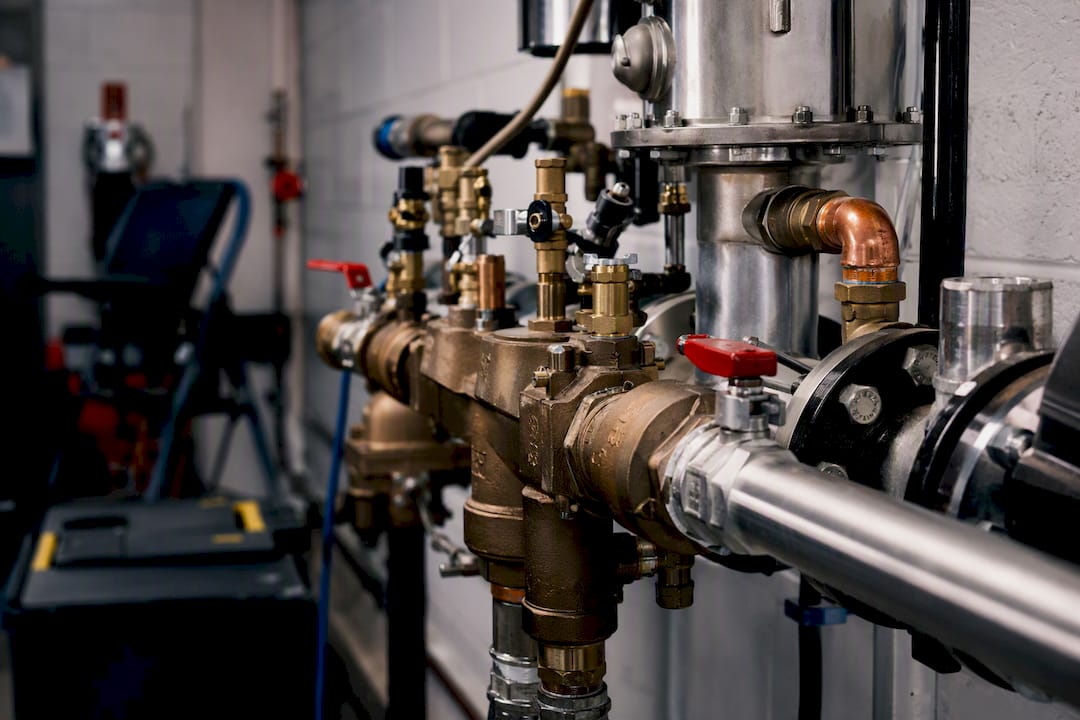
Several factors push the price up or down. Device size and complexity matter most. A simple double-check valve assembly on a small irrigation line tests faster than a large reduced-pressure zone assembly protecting a commercial boiler system. Accessibility matters too. A device tucked in a crawlspace or behind finished walls takes longer to reach than one mounted in an accessible mechanical room.
Repairs add to the base testing fee. A relief valve that needs cleaning or a worn seal that needs replacing is usually a modest add-on. A device that needs full replacement is a bigger expense, since it involves both the new assembly and the plumbing labor to install it correctly, plus the ACHD permit fee where required.
The most reliable way to budget is to get a quote specific to your property rather than assuming a number from a generic online estimate, since Pittsburgh’s older housing stock and mixed commercial building ages mean device setups vary more than in newer developments. A tester who inspects your specific assembly before quoting will give you a far more accurate number than any flat rate.
Property managers overseeing multiple buildings often find it cheaper per device to schedule several properties in one service window, since a single visit covering three or four devices spreads the trip cost across all of them.
Who Can Legally Test Backflow Devices in Pittsburgh?
Only testers holding current ASSE certification can legally test and submit results that PWSA will accept. That’s a narrower pool than “any licensed plumber,” and it’s worth understanding why before you start calling around.
An ASSE certification specific to backflow testing means the technician has trained on the exact procedure the Allegheny County Health Department’s plumbing code requires, and that they’re using equipment calibrated to the standard PWSA’s portal checks against. A general plumbing license alone doesn’t cover this. Plenty of skilled plumbers handle installations and repairs without holding the specific backflow testing credential, so it’s worth asking the question directly rather than assuming.
When you’re evaluating who to hire, look for a few concrete signals: an ASSE card they can show you on request, calibration certificates with current dates, and active registration on PWSA’s tester portal. A provider who can also handle repairs on the spot saves you a second visit if the device fails, since a repair only counts once it’s retested and resubmitted.
AG Plumbing’s technicians carry ASSE certification and handle the full loop, from inspection through repair through portal submission, which is the main reason property managers with multiple buildings tend to stick with one provider rather than shopping around every year. Our gallery of completed projects shows the range of installation and repair work our team has handled across Pittsburgh properties.
What Usually Goes Wrong During a Backflow Test?
The same handful of issues show up again and again, and most of them are cheap to fix if you catch them early.
Debris buildup inside the check valves is probably the most common culprit. Sediment or mineral scale from Pittsburgh’s older cast iron and galvanized water lines can lodge in a valve seat and prevent it from seating properly, which shows up as a failed pressure differential reading. City code requires testers to verify detector and double-check assemblies specifically for this kind of fouling, and a thorough inspection usually catches it before it becomes a bigger problem.
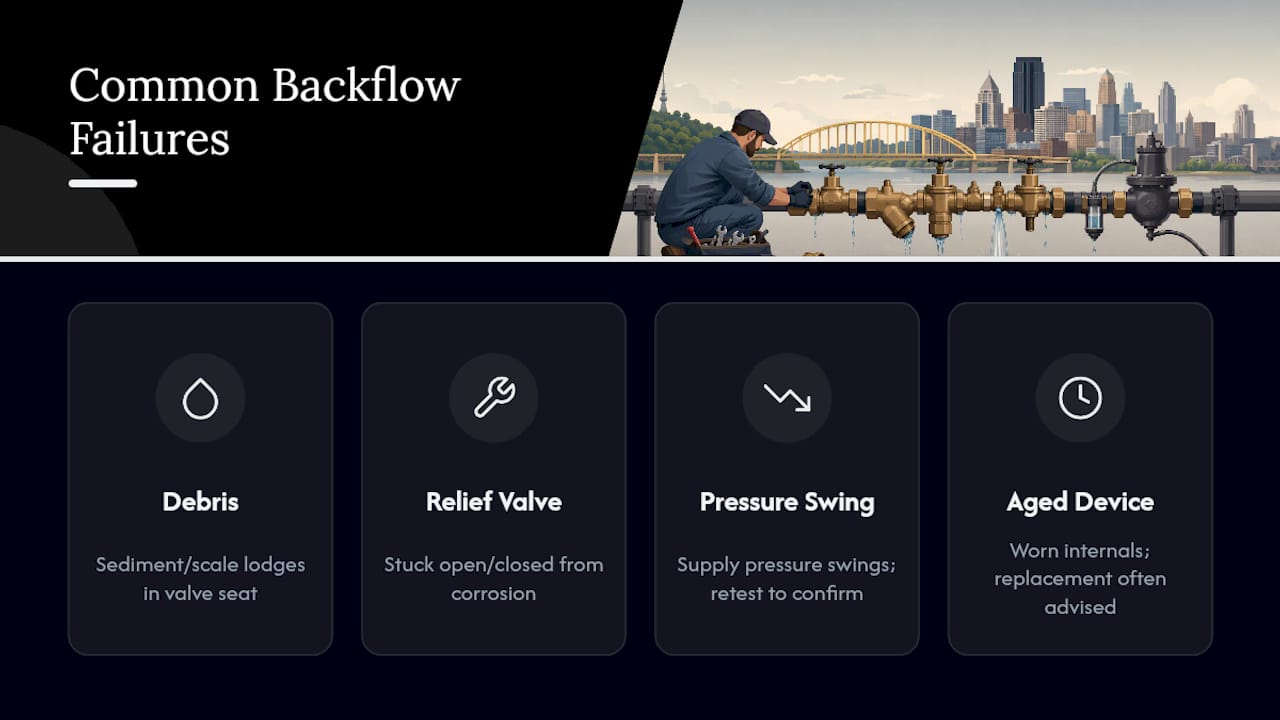
Relief valve malfunction is the second frequent issue. A relief valve that’s stuck open or closed, often from corrosion or a worn spring, throws off the entire pressure test. This one usually means a repair rather than a full replacement, and a retest right after the fix typically clears it.
Mainline pressure fluctuations can also produce a misleading reading, especially in older neighborhoods where water pressure isn’t perfectly steady. A skilled tester recognizes when a failed reading points to the device itself versus a temporary pressure swing in the supply line, and will retest before condemning a device that’s actually fine.
Less common but more expensive: a device that’s simply aged out. Internal components wear down over years of use, and at some point a repair stops making financial sense compared to replacement. If your tester recommends replacement rather than repair, that’s usually a sign the device has been in service a long time, and it’s worth asking for a straight comparison of repair cost versus replacement cost before deciding.
A Straight Answer on What Actually Puts Owners at Risk
Most owners don’t lose water service because they ignored the rules. They lose it because they assumed someone else was tracking the deadline. PWSA’s portal doesn’t chase you down, and a property manager juggling a dozen buildings can easily lose track of which device was tested in which month.
The overlooked risk isn’t the test itself. It’s the gap between “I think this got done last year” and having an actual confirmation email in a folder somewhere. I’d rather see an owner over test by a month than assume a reminder is coming that never shows up in the inbox. If you manage more than one property, put the renewal date on a calendar the same way you’d track a lease expiration, and treat it with the same seriousness. Testing on your own schedule, not the city’s reminder schedule, is the difference between routine maintenance and an emergency shutoff notice.
— Maayan
Get Compliant Without Chasing Down Multiple Contractors
Hiring a separate tester, then a separate plumber for repairs, then tracking down someone to confirm the portal submission actually went through wastes time most property owners don’t have. AG Plumbing handles the entire loop in one relationship: ASSE-certified testing, on-site repair estimates, and confirmed submission through PWSA’s portal, backed by 30 years of experience across Pittsburgh’s residential and commercial properties.
That matters most for property managers running multiple buildings, where a single missed test on one device can mean a water shutoff notice you don’t discover until a tenant calls. Our team also handles the repair side directly, so a failed test doesn’t mean waiting on a second contractor before you can retest and resubmit.
If your device is overdue or you’re not sure when it was last tested, book a visit through our plumbing repair services page and get an inspection scheduled before it becomes a compliance problem.
Sources
- Backflow Device Testing | Pittsburgh Water
- Allegheny County Health Department Plumbing Code — Article XV
FAQ
Who Is Responsible for Backflow Testing in Pittsburgh?
The property owner is legally responsible for scheduling annual testing and making sure an ASSE-certified tester submits results through PWSA’s portal, regardless of reminder emails.
How Often Does a Backflow Device Need Testing?
At least once every 12 months, plus immediately after installation, repair, or relocation of the device.
What Happens if I Skip My Backflow Test?
PWSA can terminate water service to properties without approved test results on file, and reinstating service typically takes longer than scheduling the original test would have.
Do Residential Homes Need Backflow Testing?
Only if the home has a higher-risk system like a boiler, fire sprinkler line, irrigation system, or cistern; standard residential water lines usually don’t require a device.
Can AG Plumbing Handle Both Testing and Repairs?
Yes. AG Plumbing’s ASSE-certified technicians inspect, test, repair, and resubmit results through PWSA’s portal in a single visit whenever possible.
Recommended
- The Role of Backflow Testing for Pittsburgh Property Owners – AG-Plumbing
- Step-by-Step Backflow Prevention for Homeowners – AG-Plumbing
- Why Test for Lead Pipes: A Pittsburgh Homeowner’s Guide – AG-Plumbing
- Smart Plumbing Tips Every Pittsburgh Homeowner Needs – AG-Plumbing
