
TL;DR:
- Pipe relining is a trenchless, inside-out repair that preserves landscaping and reduces disruption.
- It offers a long-lasting, cost-effective alternative to traditional excavation for Pittsburgh’s aging pipes.
- Homeowners should use camera inspections to determine if relining suits their specific plumbing issues.
Most Pittsburgh homeowners assume that fixing a broken pipe means renting a dumpster, watching a crew dig trenches through the yard, and spending weeks dealing with the mess. That assumption is understandable but outdated. Pipe relining is a modern repair method that fixes damaged pipes from the inside out, no major excavation required. If you have an older home in Pittsburgh, or you’ve been putting off pipe repairs because the cost or disruption felt too overwhelming, this guide will walk you through exactly what pipe relining is, how it works, what it costs, and when it makes sense.
Table of Contents
- What is pipe relining?
- Problems pipe relining solves in Pittsburgh homes
- Pipe relining vs. traditional pipe repair
- Choosing pipe relining: Steps, costs, and tips for homeowners
- Why pipe relining is underused and what Pittsburgh homeowners should know
- Explore modern plumbing solutions in Pittsburgh
- Frequently asked questions
Key Takeaways
| Point | Details |
|---|---|
| Minimal disruption | Pipe relining avoids excavation and preserves landscaping, saving time and hassle. |
| Cost-effective repairs | Homeowners often pay less for pipe relining compared to traditional pipe replacement projects. |
| Long-term durability | Properly done pipe relining lasts decades and protects against common Pittsburgh issues. |
| Eco-friendly solution | Relining reduces waste and energy use, making it a greener choice for pipe repairs. |
What is pipe relining?
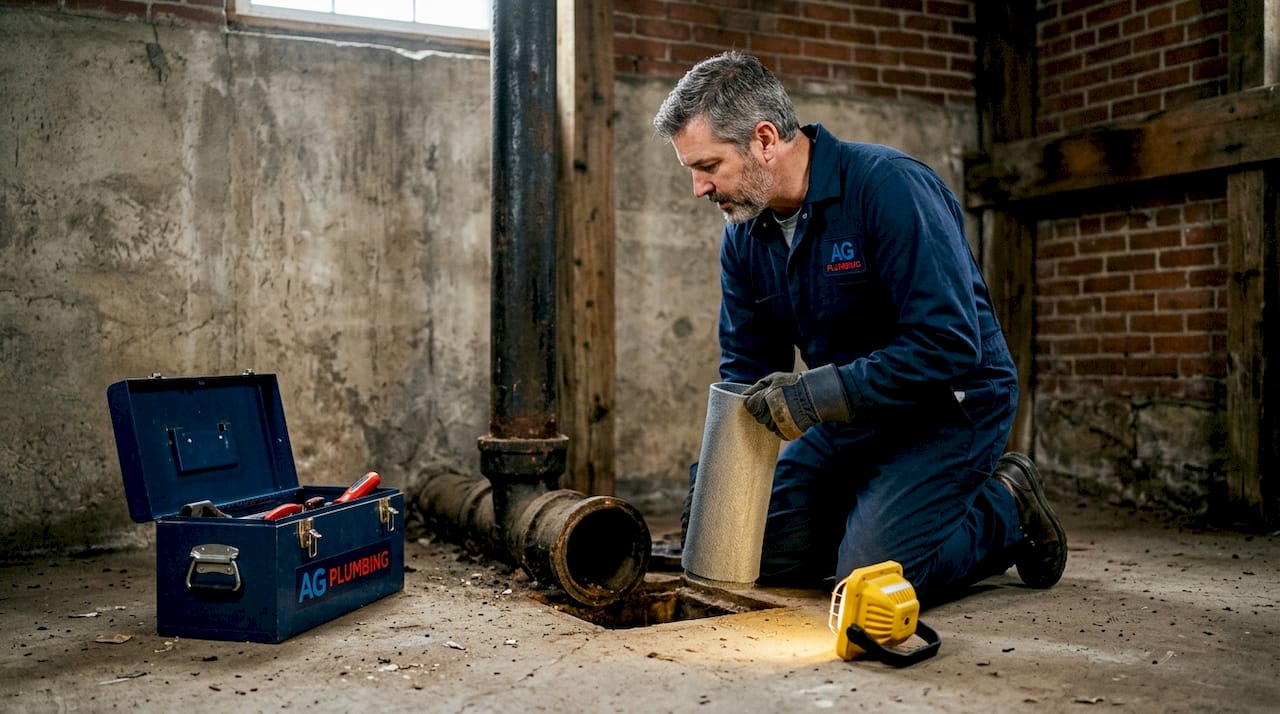
Pipe relining, sometimes called cured-in-place pipe (CIPP) lining, is a repair method where technicians insert a flexible liner coated with resin into a damaged pipe, inflate it, and then cure it in place. The result is essentially a new pipe inside the old one. It’s watertight, structurally strong, and doesn’t require tearing up your yard or walls to get there.
The process works in a few clear steps:
- Camera inspection. A technician runs a small camera through the pipe to locate the damage and assess the condition of the pipe walls.
- Cleaning. The pipe is cleaned using high-pressure water jetting to remove buildup, root fragments, and debris.
- Liner preparation. A flexible, resin-saturated liner is cut to length and prepared for insertion.
- Insertion and inflation. The liner is pushed or pulled into the pipe and then inflated using air or water pressure, pressing it firmly against the pipe walls.
- Curing. The resin hardens using hot water, steam, or UV light, depending on the system used.
- Final inspection. A camera confirms the new liner is smooth, sealed, and properly installed.
The whole process typically takes one to two days, compared to traditional excavation jobs that can run four to seven days or longer.
Here’s a quick side-by-side of what sets relining apart:
| Feature | Pipe relining | Traditional excavation |
|---|---|---|
| Digging required | None or minimal | Significant |
| Typical job duration | 1 to 2 days | 4 to 7+ days |
| Landscaping damage | Minimal | Often extensive |
| Interior disruption | Usually none | Can be significant |
| Lifespan of repair | 20 to 50 years | Varies by material |
For homeowners dealing with fixing common plumbing issues in tight spots, like pipes under a slab or beneath mature trees, relining is often the only practical option.
Key advantages of pipe relining over traditional methods:
- No need to remove concrete, tile, or landscaping
- Finished liner is often smoother than original pipe, improving flow
- Less labor means lower total cost in most situations
- Less risk of additional damage during the repair process
- Minimal impact on your daily routine
Pro Tip: Pipe relining works on bends and hard-to-reach sections of pipe that would be nearly impossible to excavate without major property damage. If your pipe runs under a patio, driveway, or garden, relining is worth asking about first.
Problems pipe relining solves in Pittsburgh homes
Pittsburgh homes present a specific set of plumbing challenges that make pipe relining especially relevant. The region’s geology, climate, and housing stock all contribute to accelerated pipe wear.
Most of the city’s older neighborhoods, think Squirrel Hill, Lawrenceville, Bloomfield, and the North Shore, contain homes built in the early 1900s through the mid-20th century. Many of these homes still have their original clay, cast iron, or Orangeburg pipes (Orangeburg was a compressed wood fiber pipe used extensively from the 1940s through the 1970s). These materials are long past their reliable lifespan.
Pittsburgh’s climate adds another layer of stress. The region experiences significant freeze/thaw cycles through winter and early spring. Water expands when it freezes, and that pressure works on any existing cracks or weak joints in your pipes year after year. After enough seasons, small cracks become real problems.
The hilly terrain that defines Pittsburgh’s neighborhoods also shifts soil in ways that stress pipe connections. Over time, joints separate, pipes misalign, and even small gaps become entry points for tree roots, which grow toward moisture and can eventually break through pipe walls entirely.
Common pipe problems that relining addresses in Pittsburgh homes:
- Root intrusion: Tree roots enter through joint gaps and grow inside pipes, causing repeated blockages
- Corroded cast iron pipes: Older iron pipes rust from the inside, reducing diameter and risking collapse
- Cracked clay pipes: Shifting soil causes clay sections to crack or separate
- Leaking joints: Worn seals between pipe sections allow water to leak into surrounding soil or your foundation
- Orangeburg pipe deterioration: This material softens and deforms over time, restricting flow
Basement drain lines, yard sewer connections, and main sewer laterals running from the house to the city sewer are the most common candidates for relining in Pittsburgh properties.
Digging up a main sewer lateral in Pittsburgh can cost $8,000 to $15,000 or more when you factor in excavation, concrete cutting, landscaping repair, and labor. Pipe relining for the same line often runs $3,000 to $6,000 with a fraction of the disruption.
Understanding your plumbing repair problems early saves money. Homeowners who notice slow drains or recurring backups should get a camera inspection before assuming full replacement is necessary. Many times, Pittsburgh plumbing repairs that seemed to require excavation turn out to be excellent candidates for relining once the pipe interior is actually viewed on camera.
Pipe relining vs. traditional pipe repair
Choosing between relining and traditional repair isn’t always straightforward. Both methods have situations where they’re the right call. The key is understanding what each option actually involves.
| Category | Pipe relining | Traditional repair |
|---|---|---|
| Upfront cost | Moderate | Can be higher with excavation |
| Long-term durability | 20 to 50 years | Depends on new pipe material |
| Property impact | Very low | Can be significant |
| Best for | Partial damage, access issues | Collapsed or severely offset pipes |
| Environmental impact | Lower (less debris, fuel) | Higher (heavy equipment, waste) |
| Resale value benefit | Yes, documented repair adds value | Yes, but landscaping cost offsets gain |
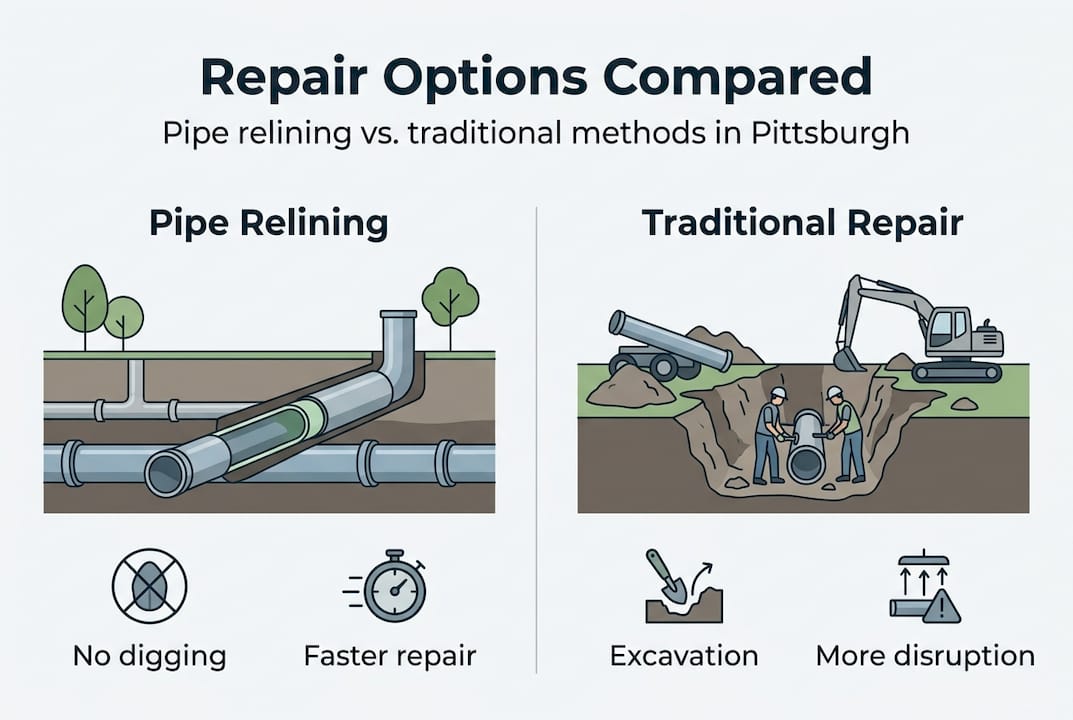
The biggest misunderstanding homeowners have is assuming that newer always means better when it comes to replacement. In many cases, a well-relined pipe outperforms a new pipe that was installed with minimal prep or in poor soil conditions, because the resin liner is corrosion-proof and creates a nearly seamless interior surface.
Trenchless repair technology, which includes pipe relining, has advanced significantly in the last decade. Modern CIPP liners are rated for decades of performance under normal residential conditions.
How to decide which method fits your situation:
- Get a camera inspection first. You can’t make a good decision without knowing exactly what’s wrong. A visual inspection shows whether the pipe is cracked, root-infested, collapsed, or simply aged.
- Check the pipe’s structural integrity. If the pipe has fully collapsed or shifted significantly out of alignment, relining may not be possible and traditional replacement is the right move.
- Consider access difficulty. Pipes under concrete slabs, mature trees, driveways, or shared walls are strong candidates for relining simply because excavation would be prohibitively expensive or destructive.
- Think about long-term plans. If you’re planning to sell the home within five years, a documented relining repair can actually be a selling point because buyers see a recently repaired sewer line as a reduced risk.
- Factor in disruption tolerance. If you run a home business or have mobility challenges, the minimal disruption of relining may be the deciding factor.
Understanding the full sewer repair process helps you ask better questions and make confident decisions when you sit down with a plumber.
Choosing pipe relining: Steps, costs, and tips for homeowners
If you’ve decided pipe relining is worth exploring, here’s what the process actually looks like from start to finish, along with realistic cost expectations for the Pittsburgh area.
Step 1: Initial inspection
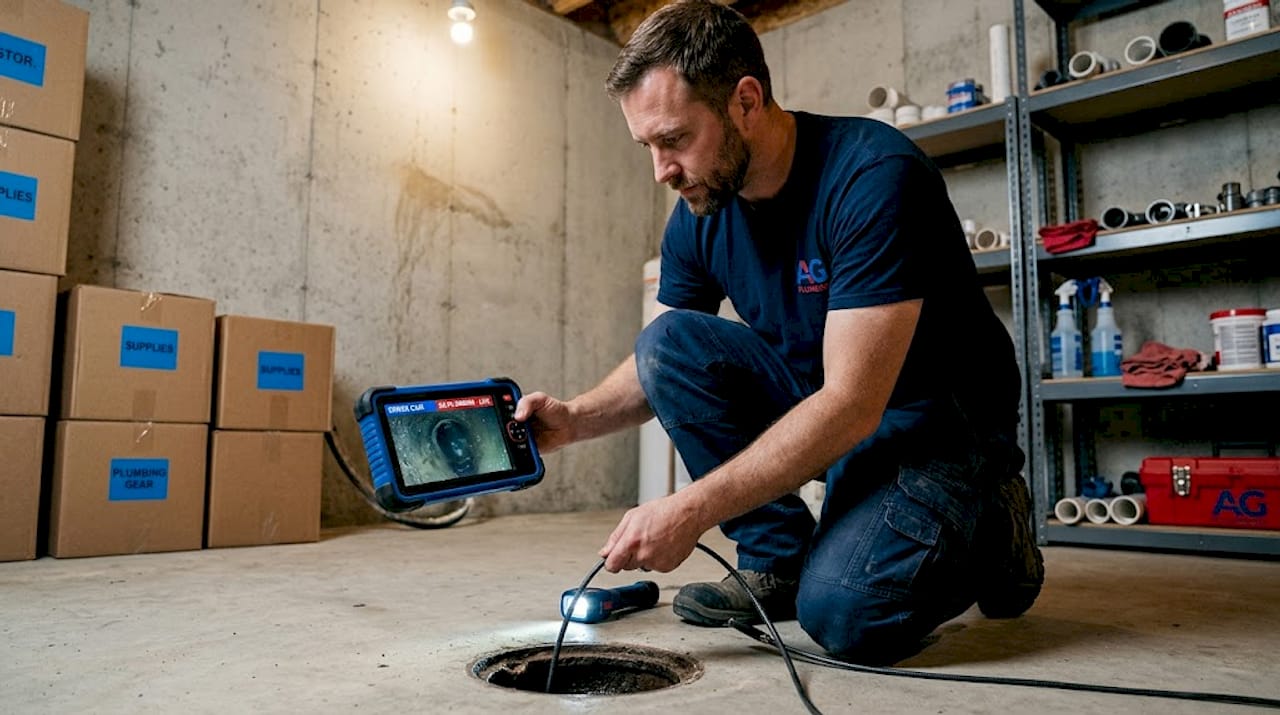
Everything starts with a camera inspection of the affected pipe. A licensed plumber inserts a small waterproof camera into the pipe through an access point, usually a cleanout, floor drain, or toilet removal. The camera feeds live video to a monitor, letting the technician identify cracks, root intrusion, offset joints, or buildup. Most inspections take 30 to 60 minutes and cost $100 to $250 in the Pittsburgh market.
Step 2: Diagnosis and recommendation
Based on the inspection footage, the plumber will explain what they found and recommend whether relining is viable. Not every pipe qualifies. Severely collapsed sections or pipes with major misalignment may need traditional replacement for part or all of the run.
Step 3: Selecting the liner
The type of resin and liner thickness depends on the pipe’s diameter, material, and the type of damage. Residential sewer lines are typically 4 to 6 inches in diameter, and liner selection is straightforward for experienced crews.
Step 4: Work execution
Once the job is scoped, cleaning and liner installation usually happen on the same day for shorter runs. Full curing and final inspection wrap up by day two in most cases. You’ll have limited or no use of certain drains during the curing phase, but normal household activity continues.
Typical cost breakdown for Pittsburgh homeowners:
- Camera inspection: $100 to $250
- Pipe cleaning (hydro jetting): $200 to $500
- Relining (per linear foot): $80 to $250, depending on pipe size and access
- Full sewer lateral relining (50 to 100 feet): $3,000 to $8,000
- Post-relining inspection: Often included by reputable contractors
Exploring your sewer repair options before committing to any repair approach gives you better negotiating ground and clearer expectations.
Tips for homeowners before and during the process:
- Ask your plumber to show you the camera footage before and after the repair
- Request documentation of the liner material and warranty terms in writing
- Ask whether the company uses UV curing, hot water curing, or ambient cure (UV tends to be faster)
- Clear the area around cleanout access points before the crew arrives
- Confirm who handles permit applications if permits are required in your municipality
Pro Tip: Request a copy of the post-relining camera footage for your records. This documentation is valuable if you ever sell the home or need to make an insurance claim related to plumbing.
Beyond the cost savings, pipe relining carries a genuine environmental benefit. Traditional excavation requires heavy diesel equipment, generates significant waste material, and often disturbs surrounding soil ecosystems. Relining uses far less fuel, produces minimal debris, and preserves the soil structure around your pipe. For Pittsburgh homeowners who care about their community and neighborhood, this is a meaningful difference.
Why pipe relining is underused and what Pittsburgh homeowners should know
Here’s something we’ve learned after 30 years of working on Pittsburgh plumbing: most homeowners don’t ask about pipe relining because they’ve never heard of it. That’s not their fault. Many plumbers don’t offer it, either because they haven’t invested in the training or because traditional excavation work is simply more familiar territory.
The uncomfortable truth is that excavation is sometimes recommended when relining would work just as well, largely because it’s what some contractors know best. We’re not saying this to alarm you, but to encourage you to ask. A good plumber will present you with both options and explain the tradeoffs honestly.
There’s also a misconception that relining is a “patch job” and therefore inferior to full replacement. In reality, modern CIPP liners are engineered to meet or exceed the performance of new pipe in most residential applications. The material is resistant to corrosion, root intrusion, and joint failure in ways that traditional clay or cast iron pipe simply isn’t.
Staying informed about energy-efficient plumbing upgrades and modern repair methods puts you in a stronger position as a homeowner. The more you know, the better the decisions you’ll make when something goes wrong.
Explore modern plumbing solutions in Pittsburgh
At AG Heating, Cooling & Plumbing, we’ve spent 30 years helping Pittsburgh homeowners navigate exactly these kinds of decisions. From the first camera inspection to final liner curing, our team walks you through every step with clear information and honest recommendations.
Whether you’re dealing with a slow drain, a suspected sewer issue, or you just want to know what’s actually inside your older pipes, we’re here to help. Explore our guide on essential plumbing services to understand what homeowners like you use most, or read our drain cleaning tips to catch problems before they grow. When you’re ready to talk repairs, our plumbing repair experts are available to schedule an inspection and give you a straight answer about your options.
Frequently asked questions
How long does pipe relining last?
Pipe relining can last 20 to 50 years depending on the liner material, pipe size, and quality of installation. Modern resin liners often outlast the original pipe material they’re repairing.
Is pipe relining safe for old pipes in Pittsburgh homes?
Yes, pipe relining is specifically designed to reinforce and repair older pipes, including clay, cast iron, and Orangeburg, without requiring full replacement. The liner bonds to the interior and adds structural strength.
Does pipe relining disrupt landscaping or home interiors?
Pipe relining is minimally invasive and typically requires only small access points rather than open trenches. In most cases, your yard, driveway, and interior finishes remain untouched.
How does the cost of pipe relining compare to conventional repairs?
Pipe relining usually costs less overall because it eliminates excavation, reduces labor hours, and avoids the landscaping and concrete restoration costs that come with traditional pipe replacement.
What signs suggest pipe relining might be needed?
Recurring drain clogs, slow drainage throughout the home, foul odors near drains, wet spots in the yard, or a sudden drop in water pressure can all indicate pipe damage that relining may be able to fix.
Recommended
- Cost-saving plumbing tips for Pittsburgh homeowners – AG-Plumbing
- Trenchless Repair: Save Your Pittsburgh Home from Disruption – AG-Plumbing
- Why repipe a home? Better water quality and safety – AG-Plumbing
- Plastic Piping for Pittsburgh Homes: Efficient Plumbing – AG-Plumbing
