

Backflow prevention is the practice of stopping contaminated water from flowing backward into a clean drinking water supply. It relies on two categories of protection: physical barriers like air gaps and mechanical devices like check valves and pressure assemblies. When water pressure in a supply line drops suddenly, the resulting pressure difference can pull non-potable water back through a cross-connection and into the pipes you drink from. Backflow prevention methods block that reversal before it reaches your tap.
Here is what that looks like in practice:
- A burst water main drops supply pressure, creating a vacuum that draws irrigation water back into the municipal system.
- A garden hose left submerged in a bucket of fertilizer solution gets siphoned backward when a nearby fire hydrant opens.
- A boiler system pressurizes above the potable supply line, pushing chemically treated water in reverse.
The EPA’s cross-connection control program places responsibility on water suppliers, property owners, and local regulators to maintain protection at every connection point between potable and non-potable systems.
Why backflow prevention matters for your health and water supply
Contaminated water flowing backward into a public supply is not a theoretical risk. A 1933 outbreak in Chicago, traced to defective plumbing that allowed drinking water to mix with sewage, resulted in 1,409 cases of amebic dysentery and 98 deaths, according to the EPA’s cross-connection control manual. Modern plumbing codes exist largely because of incidents like that one.
The contaminants that backflow carries vary widely:
- Chemicals: fertilizers, pesticides, and industrial solvents from irrigation or manufacturing connections.
- Microbes: bacteria and parasites from sewage lines, pools, or reclaimed water systems.
- Waste: gray water, boiler treatment chemicals, and fire suppression system additives.
Public water systems are shared infrastructure. A single unprotected cross-connection at one property can affect every downstream user on the same distribution line. That shared exposure is why water purveyors are legally required to implement and enforce backflow prevention programs, not just recommend them.
Residential properties carry real risk too. Irrigation systems, chemical injectors, and garden hoses left in contaminated water are among the most common residential vulnerabilities, and standard plumbing fixtures do not protect against all of them. Property owners who have boilers or in-ground sprinkler systems should treat backflow prevention as a baseline requirement, not an upgrade.

How backflow prevention devices actually work
Every backflow preventer does one thing: it keeps water moving in only one direction. The mechanics differ by device type, but the underlying principle is the same across all of them.
Backflow occurs in two ways: backpressure and backsiphonage. Backpressure happens when a downstream system builds pressure above the supply line, pushing water backward. Backsiphonage happens when supply pressure drops below atmospheric pressure, creating a vacuum that pulls water in reverse. Different devices are built to stop one or both.
Physical barriers work without moving parts. An air gap is a vertical separation between a water outlet and any receiving vessel or contamination source. The gap must be at least twice the diameter of the supply pipe and never less than one inch. Nothing mechanical can fail because there is no mechanism. The tradeoff is that air gaps interrupt continuous flow and require downstream pumping.
Mechanical devices use springs, seals, and check valves to block reverse flow while keeping the supply line intact. The internal components are subject to wear. Seals degrade, springs fatigue, and debris can hold a check valve open. A device that looks fine from the outside may be passing contaminated water. That is why mechanical backflow preventers require periodic testing with calibrated gauge equipment, not just a visual check.
Pro Tip: If you have an irrigation system or a boiler, ask your plumber specifically whether a backflow preventer is installed and when it was last tested. These are the two residential setups most likely to lack adequate protection.
Common types of backflow prevention devices
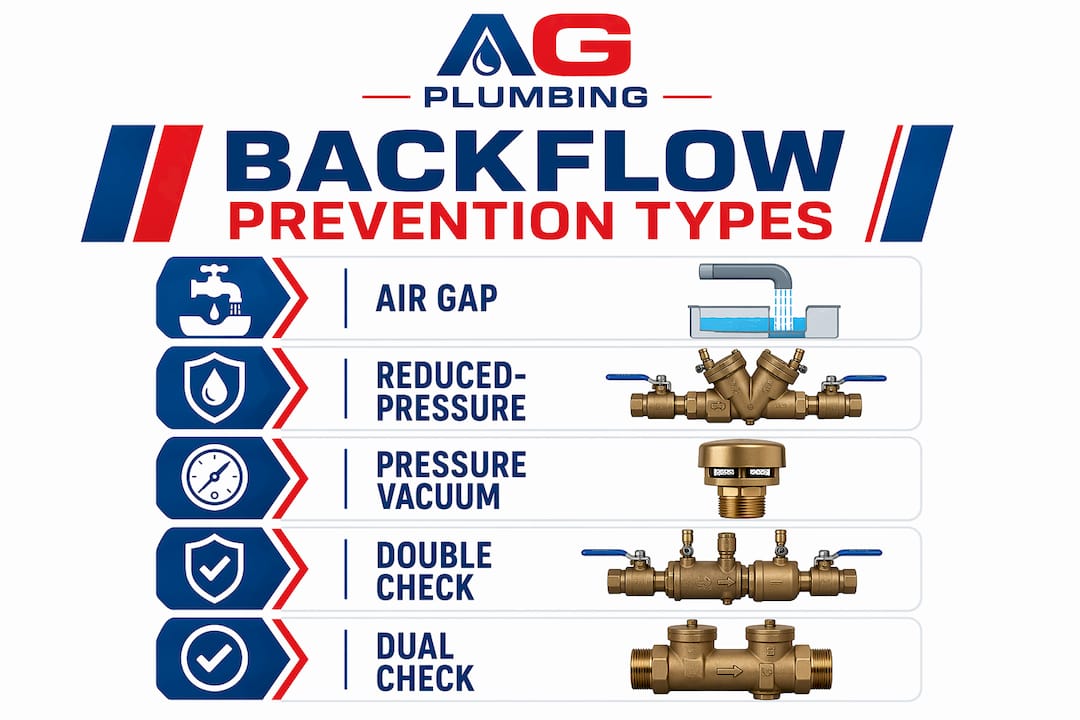
The right device depends on the hazard level at the connection point and whether the risk is backpressure, backsiphonage, or both. Here is a breakdown of the principal device types:
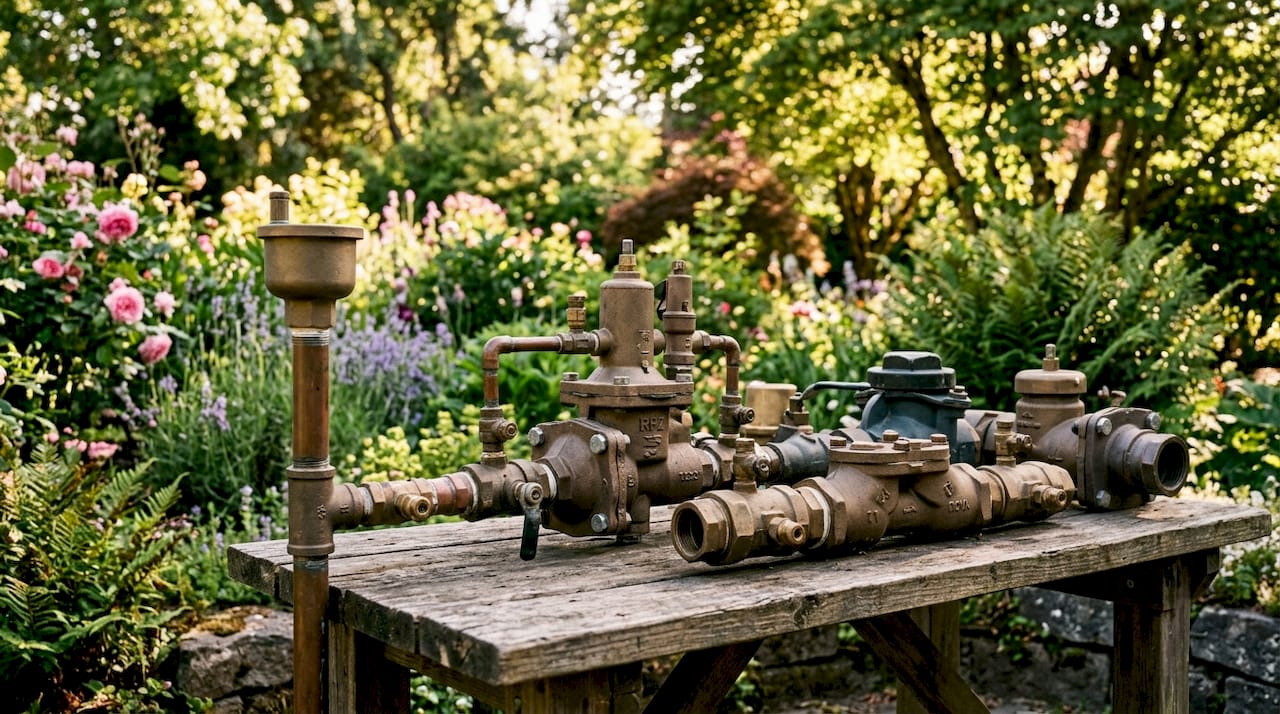
1. Air gap
The simplest and most reliable option. A physical vertical separation between the water outlet and any contamination source. Approved for all hazard levels. Requires additional pumping downstream, so it works best at end-of-line service points like storage tanks.
2. Reduced-pressure principle assembly (RPZ)
Two spring-loaded check valves with a pressure relief valve between them. The relief valve opens if the pressure differential drops, preventing backflow even if one check valve fails. Effective against both backpressure and backsiphonage. Used for high-hazard connections like chemical feed lines and domestic potable water service.
3. Pressure vacuum breaker (PVB)
A spring-loaded check valve paired with an air inlet valve on the discharge side. Protects against backsiphonage only, not backpressure. Common on irrigation systems where the device is installed above the highest sprinkler head.
4. Double check valve assembly (DC)
Two independently acting check valves in series, with shutoff valves and test cocks. Handles both backpressure and backsiphonage but is approved only for low-to-medium hazard connections. Often used on fire suppression lines and can be installed underground in a vault.
5. Residential dual check valve (rDC)
A simplified version of the double check valve, typically without shutoff valves. Less reliable than a full DC assembly. Intended only for single-family residential water service connections and low-hazard applications.
Device approval standards in the U.S. come from the American Society of Sanitary Engineers (ASSE), the American Water Works Association (AWWA), and the University of Southern California Foundation for Cross-Connection Control and Hydraulic Research (FCCCHR). Any assembly installed must appear on an approved list from one of these bodies.
Regulations, testing, and what happens if you skip it
Backflow prevention in the United States is not optional. The EPA requires water suppliers to implement cross-connection control programs, and those programs flow down to property owners through state and local codes. Requirements vary by jurisdiction, but the core obligations are consistent.
Key compliance points:
- Annual testing: Most jurisdictions require yearly testing of mechanical assemblies like RPZs and double check valve assemblies by a licensed backflow prevention assembly tester (BPAT).
- Certified testers only: Visual inspection is not sufficient. BPATs use specialized gauge equipment to verify that internal components are functioning within spec.
- Permits and installation: Many localities require a building permit and a licensed master plumber for installation. Some, like New York City, also require a Professional Engineer or Registered Architect to prepare a backflow prevention plan before work begins.
- Record keeping: Test results, repair records, and certification documents must be maintained and submitted to the local water authority.
The consequences of non-compliance are concrete. Fines can exceed $500 per violation and may be assessed daily until the property comes into compliance. Beyond fines, a water authority can terminate service entirely. Insurers may also deny claims related to contamination events if valid test records are not on file.
Installing a device and walking away is not compliance. Testing and maintenance are what keep the device legally valid and functionally reliable. Ag-plumbing’s team has handled backflow testing for Pittsburgh property owners for over 30 years, staying current with Pennsylvania’s code requirements so homeowners do not have to track every regulatory update themselves.
Get backflow protection you can count on
Ag-plumbing serves homeowners and commercial properties throughout Pittsburgh, PA with installation, testing, and repair of backflow prevention assemblies. Whether you need a first-time installation or an overdue annual test, the team brings three decades of hands-on experience to every job. For plumbing services in Pittsburgh, contact Ag-plumbing directly to schedule an assessment.
Key Takeaways
Backflow prevention protects drinking water by blocking reverse flow through physical barriers and mechanical devices, with annual testing and regulatory compliance required to keep those protections valid.
| Point | Details |
|---|---|
| Two causes of backflow | Backpressure and backsiphonage both require protection; not every device handles both. |
| Five main device types | Air gaps, RPZ assemblies, PVBs, double check valves, and residential dual check valves each suit different hazard levels. |
| Annual testing required | Most jurisdictions mandate yearly testing by a licensed BPAT using calibrated gauge equipment. |
| Fines for non-compliance | Missing or failing devices can lead to severe fines, sometimes over $500 daily, service termination, and insurance claim denials. |
| Irrigation and boilers are high risk | These residential setups are among the most common sources of backflow contamination. |
FAQ
What does backflow prevention do?
Backflow prevention stops contaminated water from reversing into a potable water supply by using physical barriers like air gaps or mechanical devices like check valves and pressure assemblies. It protects both private plumbing and the shared public water system from chemical, microbial, and waste contamination.
What happens if you don’t have a backflow preventer?
Without a backflow preventer on a cross-connected system, a pressure drop can pull non-potable water directly into your drinking supply. Beyond the health risk, missing or failing devices can result in significant daily fines, water service disconnection, and denied insurance claims.
How often does a backflow preventer need to be tested?
Annual testing is the standard for mechanical assemblies in most U.S. jurisdictions. Testing must be performed by a licensed backflow prevention assembly tester using calibrated gauge equipment, not a simple visual check.
Do homeowners need a backflow preventer?
Homeowners with irrigation systems, boilers, or connections to non-potable water sources typically need a backflow preventer and may be required by local code to install one. Check with your local water authority or a licensed plumber to confirm what your property requires.
Recommended
- The Role of Backflow Testing for Pittsburgh Property Owners – AG-Plumbing
- How Sewer Repair Can Prevent Major Plumbing Problems – AG-Plumbing
- Why Drain Cleaning Is Essential for Preventing Blockages – AG-Plumbing
- Why sewer backup occurs: causes, risks & prevention – AG-Plumbing
