
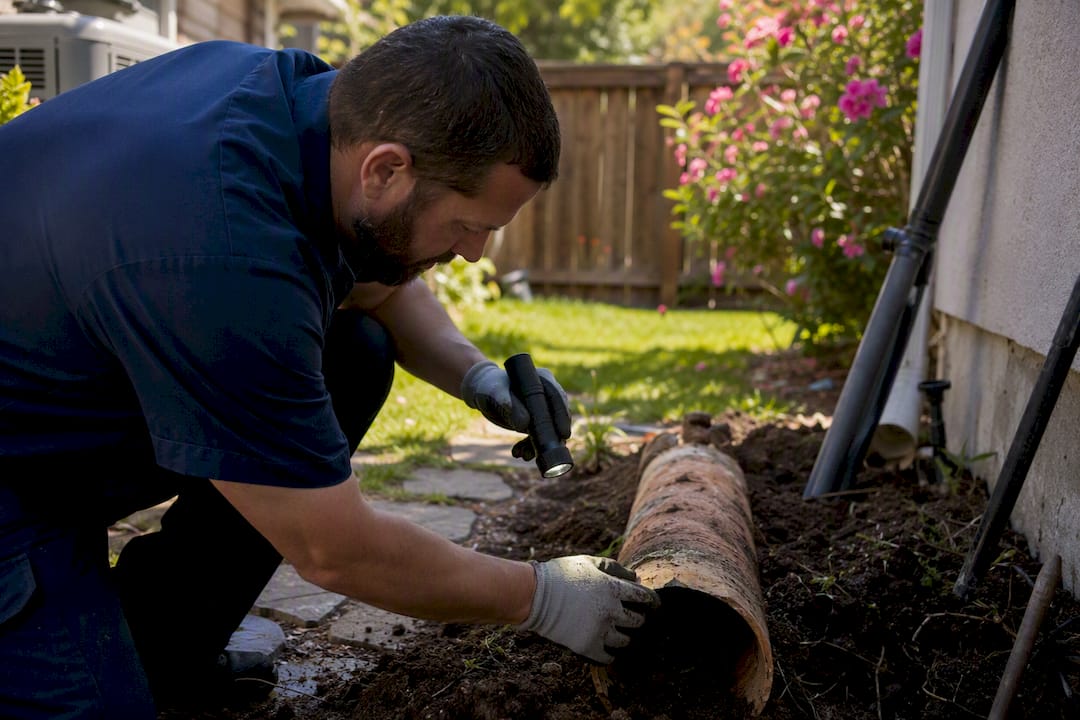
Clay sewer pipes typically last several decades in average conditions, though well-installed lines with stable soil and minimal root pressure often last much longer. Age alone doesn’t tell you what’s happening underground. Condition does. A 40-year-old line in wet, root-heavy soil can fail sooner than a 90-year-old line laid on stable ground with tight joints.
If your home was built before 1975 and you’ve never had the sewer line scoped, that’s the one thing to fix first.
- Schedule a CCTV/pipe-scope inspection before any excavation or major repair decision
- Watch for the usual failure triggers: root intrusion, joint separation, ground shifting, and heavy surface loads
- Treat symptoms (slow drains, backups, wet yard patches) as reasons to inspect now, not wait
Key Takeaways
Clay sewer pipe lifespan depends far more on soil conditions, joint quality, and installation than on age alone, and a CCTV inspection is the only way to know where your specific line stands.
| Point | Details |
|---|---|
| Typical lifespan range | Most clay sewer lines last 50 to 60 years, though well-installed lines can exceed 100 years. |
| Condition beats age | Deterioration tracks soil moisture and installation quality more than the pipe’s calendar age. |
| Watch for compounding symptoms | Slow drains, gurgling, yard wet spots, and recurring clogs together signal a line that needs scoping now. |
| Inspection precedes repair decisions | A CCTV camera inspection should always come before excavation or a replacement decision. |
| Ag-plumbing offers inspection-first service | Ag-plumbing runs CCTV diagnostics before recommending spot repair, relining, pipe bursting, or replacement in the Pittsburgh area. |
Table of Contents
- What Is Vitrified Clay Pipe and Why Older Homes Have It
- How Long Do Clay Sewer Pipes Last on Average?
- Common Failure Modes Homeowners Should Understand
- Signs a Clay Sewer Line May Be Failing
- How Do Plumbers Inspect Clay Sewer Lines?
- What Camera Findings Usually Mean for Repair Timelines
- Repair vs. Replace: Weighing Your Options
- Maintenance Steps That Extend Clay Pipe Life
- What to Ask Before Hiring a Sewer Line Plumber
- One Rule Worth Following Before Anything Breaks
- How AG Plumbing Can Help With an Aging Clay Sewer Line
- Sources
- FAQ
What Is Vitrified Clay Pipe and Why Older Homes Have It
Vitrified clay pipe, usually called VCP, is fired ceramic pipe baked at extreme heat until its surface turns glass-like and impervious to water. Installers joined individual sections with bell-and-spigot connections, one end flared to receive the next pipe’s straight end, sealed originally with mortar or oakum and later with rubber gaskets.
Builders favored clay for most of the 20th century because it resisted the chemical corrosion that ate through metal pipe, and it held up to decades of raw sewage without degrading. Vitrified clay pipe remained the standard material until plastic alternatives gained ground.
- Rigid, ceramic material resistant to chemical corrosion
- Individual sections joined at bell-and-spigot connections, a common failure point
- Common in homes built before the mid-1970s
- Less flexible than modern PVC, which tolerates ground movement differently
How Long Do Clay Sewer Pipes Last on Average?
Most plumbing references cite a working range of 50 to 60 years for clay sewer lines, but that number describes averages, not ceilings. A CCTV-based study of vitrified clay sewers in service 130 to 142 years found many sections with zero defects, concluding that deterioration tracks soil conditions and installation quality far more closely than it tracks age.
Some environmental product declarations model VCP with a 150-year reference service life under ideal installation and site conditions according to lifecycle analysis data from the National Clay Pipe Institute. That’s the ceiling. Reality for most Pittsburgh area homes lands well short of it because “ideal conditions” is doing a lot of work in that sentence.
The variables that actually decide where your pipe falls on that spectrum:
- Soil moisture and type: Expansive clay soils that swell and shrink seasonally stress joints far more than stable, well-drained ground
- Tree proximity and species: Willows, maples, and other aggressive root systems seek out joint gaps for moisture
- Traffic and surface loads: Driveways, parked vehicles, or new construction equipment over a shallow line accelerate cracking
- Joint quality: Older field-mortared joints fail earlier than factory-standardized, gasketed joints
- Maintenance history: Lines never jetted or scoped tend to develop chronic sediment buildup that hides structural problems
A properly installed, undamaged clay line can genuinely outlast the homeowner who installed it. The catch is that joint-related failures show up decades before the pipe material itself gives out.
Common Failure Modes Homeowners Should Understand
Clay pipe rarely fails all at once. It degrades in identifiable stages, and knowing which stage you’re looking at changes what repair makes sense.
- Root intrusion at joints. Roots detect moisture escaping from even a hairline gap and grow toward it, wedging the joint apart over years until a thick root mass blocks flow entirely.
- Cracks and fractures. Surface loads, frost heave, or shifting soil put stress on rigid clay in ways flexible PVC simply absorbs. Engineering comparisons of VCP and PVC show clay’s rigidity is a strength against some loads and a liability against others, since it fractures rather than flexes.
- Bellies and sedimentation. Ground settling can create a low spot, or belly, where wastewater pools instead of flowing. Sediment collects there, narrowing the channel and causing repeat clogs that cleaning alone never fully resolves.
- Joint separation and infiltration. Gaps that started as root pathways let groundwater seep in during wet weather, and in advanced cases, the surrounding soil erodes enough to cause a visible collapse or sinkhole above the line.
Signs a Clay Sewer Line May Be Failing
Most homeowners notice a pattern of small annoyances long before a full collapse. The trouble is dismissing each one as unrelated.
- Slow drains in multiple fixtures at once, especially ones on the lowest floor
- Gurgling sounds from toilets or floor drains when other fixtures run
- Sewage odor in the yard or basement that comes and goes
- Wet spots, unusually lush or green patches of grass, or a soft, sinking area in the yard along the line’s path
- Backups that get noticeably worse during or right after heavy rain, a sign of groundwater infiltrating through separated joints
- Recurring clogs that come back within weeks of professional cleaning, which usually means a structural issue rather than a simple blockage
Any one of these on its own might be nothing. Two or three together, particularly recurring clogs after cleaning, mean it’s time to look at the warning signs of a failing sewer line and get eyes on the pipe itself.
How Do Plumbers Inspect Clay Sewer Lines?
A CCTV drain camera inspection is a waterproof camera fed through the line on a flexible cable, recording footage in real time as a technician maps the pipe’s condition foot by foot.
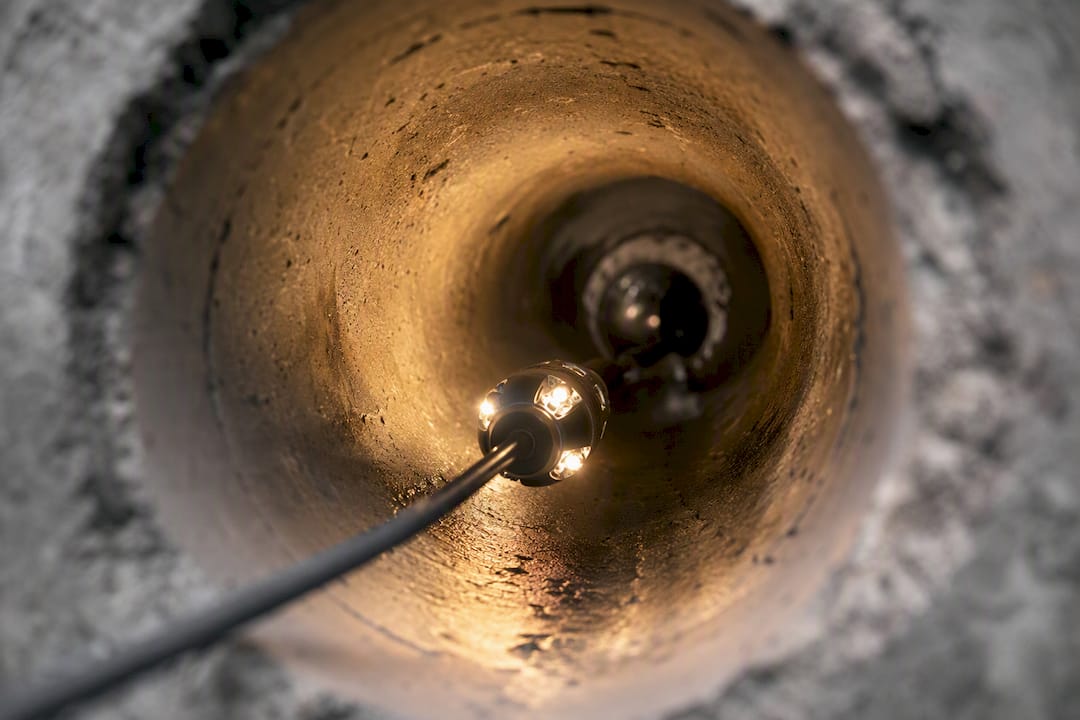
The footage reveals things no other method can show without digging: joint gaps and offsets, root masses and where they entered, cracks and their severity, bellies where the pipe has settled, and sediment or scale buildup narrowing the flow path. Inspectors typically grade defects by severity, from minor surface scaling that needs no action to structural cracks or full collapses that demand immediate repair.
Skipping this step and going straight to excavation is one of the most expensive mistakes a homeowner can make. You end up paying to dig up a section that camera footage would have shown was fine, while the actual problem sits ten feet further down the line.
- CCTV footage identifies the exact defect type and location, not just “there’s a problem somewhere”
- Grading language separates cosmetic issues from structural ones
- A camera inspection should always precede any decision to excavate or replace
Pro Tip: Ask your plumber for the recorded video file, not just a verbal summary. If you want a second opinion on a large repair, footage lets another contractor evaluate the same evidence without a repeat inspection fee.
What Camera Findings Usually Mean for Repair Timelines
After three decades of pulling cameras through Pittsburgh’s aging clay lines, a pattern holds up: isolated root hair near one joint is a maintenance issue, not a crisis. Clustered root intrusion across multiple joints, especially paired with visible offset, usually signals a line entering its final years of service without intervention.
- Isolated root hair at a single joint: usually resolves with jetting and a monitoring schedule
- Clustered roots at multiple joints with minor offset: often a strong candidate for CIPP relining
- Significant offset, bellies, or fractured sections: typically points toward pipe bursting or open trench replacement
- Lines jetted and scoped every 12 to 18 months tend to catch problems while relining is still an option, rather than after replacement becomes the only choice
A line that’s never been scoped isn’t a mystery, it’s a risk you haven’t priced yet. The camera almost always tells you which repair path makes sense before you spend a dollar on excavation.
Repair vs. Replace: Weighing Your Options
The right fix depends entirely on what the camera shows, not on gut instinct or how old the house is.
Spot or sectional repair targets one localized defect, a single cracked section or an isolated joint failure, without touching the rest of the line. It’s the fastest and cheapest option when the problem is contained.
CIPP relining pulls a resin-saturated liner through the existing pipe and cures it in place, creating a new pipe within the old one. It handles clustered root intrusion and moderate cracking well, and typically adds decades of service life with far less yard disruption than digging. Its limits show up with severe joint offsets or partial collapses, where there’s no round, continuous channel left for a liner to seat against.
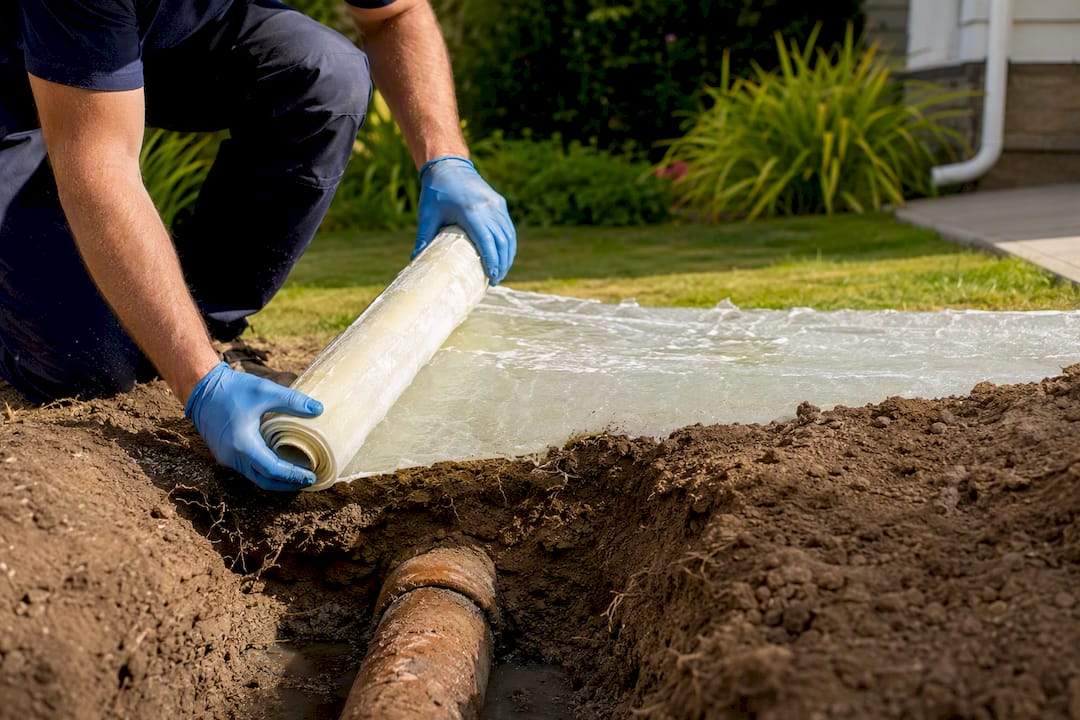
Pipe bursting and trenchless replacement break apart the old clay pipe while simultaneously pulling a new pipe through the same path, an appealing option when mature landscaping or a driveway sits over the line and full excavation would mean rebuilding a yard from scratch.
Open trench replacement remains the most reliable option when the structural damage is severe or widespread, since it replaces the entire compromised run rather than working around it.
- Spot repair: lowest cost, works only for isolated, contained damage
- CIPP relining: moderate cost, minimal digging, not viable on collapsed or heavily offset sections
- Pipe bursting: moderate to higher cost, ideal when landscaping or hardscape makes trenching impractical
- Open trench: highest disruption but the most dependable fix for severely compromised lines
Homeowners typically budget for one of these ranges rather than a single fixed number, since soil depth, pipe length, and access all swing the final price. Get a written scope from your plumber before assuming which category your repair falls into.
Maintenance Steps That Extend Clay Pipe Life
A clay line that gets attention every year or two rarely surprises you with an emergency. One that’s ignored for two decades usually does.
- Schedule a CCTV inspection every two to three years for lines over 40 years old, and hydro-jet on a similar cadence to clear root growth and sediment before they become blockages, following routine maintenance guidance for older lines.
- Keep aggressive root species like willows and silver maples well away from the sewer line’s path, and consider root-barrier installation if mature trees already sit close to it.
- Avoid parking vehicles or running heavy equipment directly over the line’s route, and protect the backfill area from new hardscaping that adds unplanned surface load.
- Keep a simple file of every inspection report and repair invoice. It saves time and money on every future service call, and it’s useful documentation if you ever sell the house.
Pro Tip: Clay pipe can handle much higher-pressure jetting than plastic pipe, up to roughly 5,000 psi versus 1,200 to 1,500 psi for PVC, per NCPI’s technical FAQ. That’s a real advantage for clearing stubborn roots, but only on a structurally sound line. Always get it scoped first.
What to Ask Before Hiring a Sewer Line Plumber
Not every plumber has deep experience with clay-specific failure patterns, and that experience matters when you’re deciding between relining and replacement.
- Ask to see a CCTV report and examples of past clay-pipe projects similar to yours
- Confirm trenchless experience specifically, along with proper licensing, insurance, and permit handling
- Request a written scope of work that lays out repair options with real pricing, not just one option
- Ask whether a post-repair camera verification is included, and get warranty terms in writing before work begins
One Rule Worth Following Before Anything Breaks
Homeowners wait for a backup because inspections feel optional until they aren’t. My honest read after covering this material: budget for a camera inspection the same way you budget for a roof check. It’s cheaper than every alternative, and it turns a guess into a plan.
— Maayan
How AG Plumbing Can Help With an Aging Clay Sewer Line
You don’t have to guess whether your line has another decade left or another season. Ag-plumbing has spent 30 years scoping, relining, and replacing sewer lines across Pittsburgh, PA, and the surrounding area, which means the diagnosis you get is grounded in what we’ve actually seen fail and what’s held up.
Our team runs full CCTV inspections before recommending any repair path, then walks you through the real options: spot repair for isolated defects, CIPP relining when the line’s structure allows it, pipe bursting when your landscaping needs protecting, or full replacement when that’s genuinely the safer long-term call. You get a written scope with pricing for each option, not a single take-it-or-leave-it quote.
If your home has clay sewer pipe and it’s never been scoped, or it’s been years since the last look, schedule a sewer inspection and repair consultation and get a clear answer on where your line actually stands.
Sources
- VCP EPD and LCA (NCPI)
- Vitrified clay pipe — Wikipedia
- Engineering sustainability comparison of VCP and PVC
FAQ
Why Did They Stop Using Clay Sewer Pipes?
Builders moved toward plastic mainly for installation advantages and funding shifts following the Clean Water Act in the 1970s, not because clay failed chemically. Vitrified clay remains highly corrosion-resistant; plastic simply installs faster and flexes with ground movement.
How Much Does It Cost to Replace a Clay Sewer Pipe?
Costs vary widely based on pipe length, depth, and access, and range from a localized spot repair on the low end to full open-trench replacement on the high end. Ag-plumbing provides a written scope with itemized options after a CCTV inspection confirms the actual damage.
What Is the Longest-Lasting Sewer Pipe Material?
Vitrified clay has documented service records exceeding 130 years in favorable soil conditions, and some lifecycle models project up to 150 years under ideal installation. Modern PVC also offers long, reliable service, with the two materials trading strengths in rigidity versus flexibility.
Can Clay Sewer Pipes Be Relined?
Yes, CIPP relining works well on clay lines with clustered root intrusion or moderate cracking, adding decades of service without full excavation. It isn’t viable on sections with severe offset or partial collapse, which typically require pipe bursting or open trench replacement instead.
Recommended
- Orangeburg Pipe: What Homeowners Need to Know – AG-Plumbing
- How Sewer Repair Can Prevent Major Plumbing Problems – AG-Plumbing
- Understanding the Sewer Repair Process From Start to Finish – AG-Plumbing
- Heating, Cooling & Plumbing Services Pittsburgh, PA
