
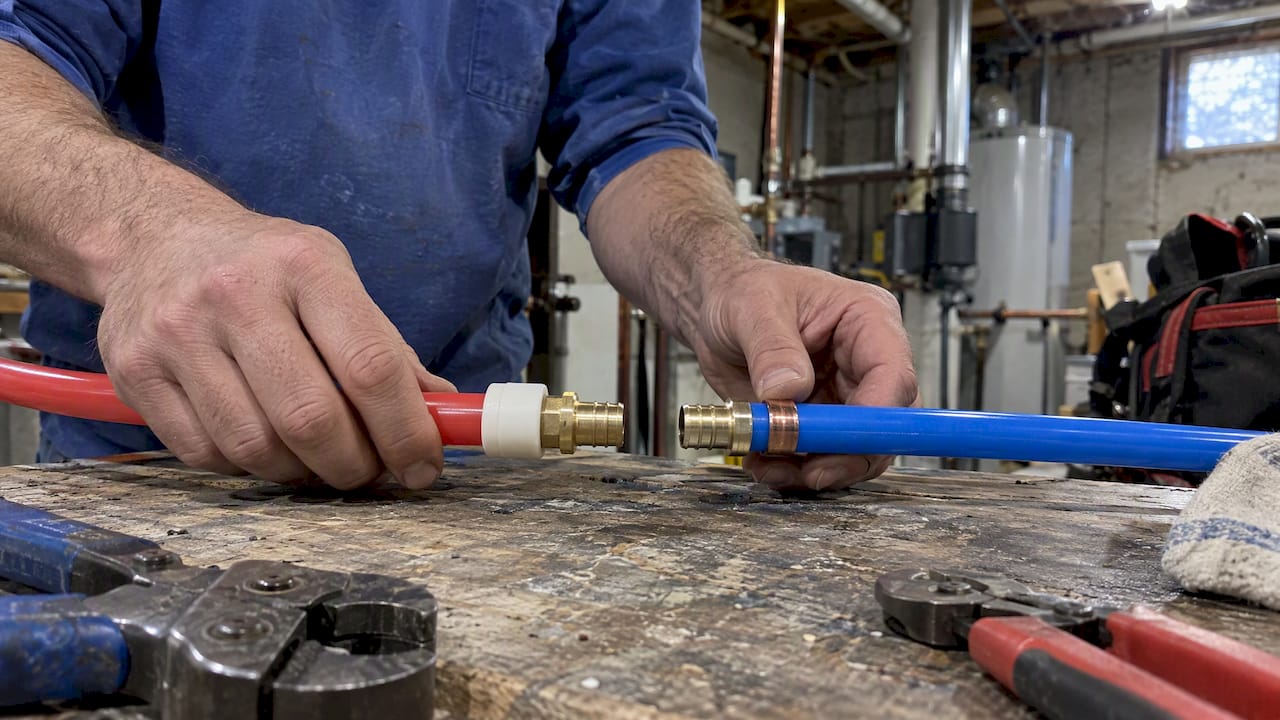
PEX-A and PEX-B are both safe, code-approved pipe for drinking water. The letters name the manufacturing method, not a quality grade. PEX-A is more flexible, shrugs off kinks and handles freeze/thaw cycles better. PEX-B is stiffer, usually costs less, and works well on simple layouts. If you are repiping an older Pittsburgh house with tight walls and cold basements, PEX-A earns its premium. If you are plumbing a straightforward run in a heated space, PEX-B is a sound, economical choice.
TL;DR
- PEX-A (Engel/peroxide method) and PEX-B (silane method) are different manufacturing processes. Both meet the same potable water standards, so neither is “the cheap, bad one.”
- PEX-A bends tighter, recovers from kinks with a heat gun and tolerates freezing better. PEX-B is stiffer and more likely to crack if water freezes inside it.
- PEX-A uses cold-expansion fittings that keep the connection close to full bore. PEX-B uses crimp or clamp rings with inserts that narrow the opening at each joint.
- PEX-B is cheaper on material and tools. PEX-A costs more up front but can save labor on complicated routing.
- The installer and the manufacturer’s fitting system matter as much as the letter. Never mix pipe and fittings that were not made for each other.
Table of Contents
- What the letters actually mean
- PEX-A vs PEX-B side by side
- Freezing: which one handles Pittsburgh winters better
- Fittings and water flow: the difference most people miss
- Kinks, bends and tight spaces
- Cost: what you will really pay
- Is PEX allowed in Pennsylvania?
- Which should you choose?
- Our perspective
- Planning a repipe? Talk to us first
- FAQ
- Sources
What the letters actually mean
PEX stands for cross-linked polyethylene. Plain polyethylene softens and fails under hot water. Cross-linking ties the polymer chains together so the pipe holds up under heat and pressure. The letters describe how that happens.
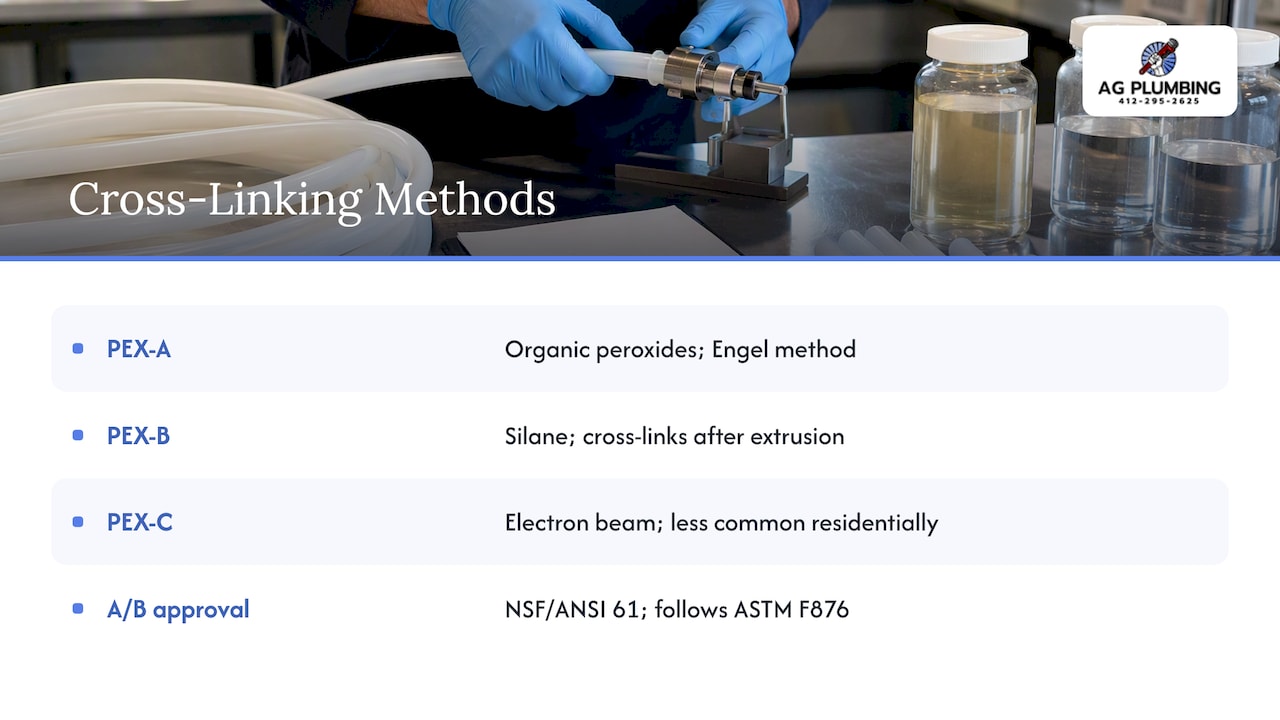
The Plastics Pipe Institute lists the common methods. PEX-A uses organic peroxides that create reactive free radicals as the pipe is extruded, which is the Engel method. PEX-B uses the silane method, where cross-linking happens after extrusion, typically in a moisture-driven step. There is also a PEX-C, made by electron beam, which is far less common in residential plumbing.
The letters are not a ranking. The same industry body notes that both PEX-A and PEX-B for potable water are certified to NSF/ANSI 61 and follow standards such as ASTM F876. If a pipe carries those marks, it is approved for drinking water. The difference is in how it behaves in your walls.
The technology also has a long history. According to Uponor’s FAQ, Dr. Thomas Engel developed the chemical cross-linking method in 1968, and PEX-A reached North America in 1984. PEX is not a new fad, and neither type is experimental.
PEX-A vs PEX-B side by side
| Factor | PEX-A | PEX-B |
|---|---|---|
| Manufacturing | Peroxide (Engel) method | Silane method |
| Cross-linking | Highest, about 80% or more | Lower, about 65-70% |
| Flexibility | Very flexible, tight bends | Stiffer, wider bend radius |
| Kink repair | Heat gun can restore the pipe | Cut out the kink and add a coupling |
| Freeze tolerance | Expands to absorb ice, best of the two | More prone to splitting |
| Typical fittings | Cold expansion (ASTM F1960) | Crimp or clamp (ASTM F1807 and similar) |
| Flow at joints | Near full bore | Insert narrows the opening |
| Material cost | Higher | Lower |
| Tool cost | Higher (expander) | Lower (crimp or clamp tool) |
| Best for | Complex remodels, manifold systems, cold areas | Simple layouts, tighter budgets |
The cross-linking percentages and freeze figures come from Uponor’s PEX-A vs PEX-B guide and the PPI. Uponor makes PEX-A, so treat its enthusiasm for PEX-A as a manufacturer’s view. The physical differences, though, are well documented across the industry.
Freezing: which one handles Pittsburgh winters better
This is the question we hear most from homeowners here, and it deserves a careful answer.
No PEX is freeze-proof. Water expands when it freezes, and a long enough cold snap can overwhelm any pipe. But PEX-A has the edge. Its higher degree of cross-linking gives it elasticity, and it can expand to accommodate ice and return to shape as the ice thaws. PEX-B is more rigid, so repeated freeze/thaw cycles are more likely to split it or crack a fitting.
That edge matters in the places Pittsburgh houses tend to have trouble: unheated basements, exterior walls, rim joists, crawl spaces and garages. It matters less for pipes running through the heated middle of the house.
A few practical points:
- Fittings freeze too. Even when the tube survives, the weak point is often a fitting. Fewer joints in cold zones means fewer chances to fail.
- Insulation beats pipe choice. Whichever type you choose, insulating pipes on cold walls and sealing air leaks does more than the letter on the tubing. See our guide to insulating water pipes and preventing freezing.
- If a pipe does burst, shut off the water first and call a plumber. Our walkthrough on repairing a burst pipe covers what to do in the first minutes.
- Outdoor lines need their own plan. Hose bibs and exterior runs are a separate problem, covered in our cold-climate outdoor plumbing tips.
Fittings and water flow: the difference most people miss
The pipe is only half the system. The real day-to-day difference between the two is how they connect.
Cold expansion (PEX-A)
With cold expansion, the installer slips a reinforcing ring over the end of the pipe, widens the pipe and ring with an expander tool, then inserts a fitting. The pipe’s shape memory pulls it back tight around the fitting. Uponor explains that cold expansion is designed for PEX-A, which has the cross-linking needed for that memory.
The result is a connection that stays close to full bore. On a house with many fixtures and a manifold, that matters. One engineering write-up argues that expansion fittings protect water pressure across long runs, while insert-style crimp fittings throttle flow a little at every joint. Each joint’s loss is small, but a system with dozens of connections adds them up.
Crimp and clamp (PEX-B, and also PEX-A)
Crimp and clamp systems slide a barbed insert into the pipe and squeeze a ring over it. According to one fitting guide, the crimp joint (ASTM F1807) is the cheapest on the truck and works on PEX-A, PEX-B and PEX-C. A go/no-go gauge is mandatory, and each pipe size needs its own die.
So crimp rings are not off limits for PEX-A. They are simply the common method for PEX-B, and the only practical one.
The one rule you cannot break
Cold expansion is for PEX-A. Uponor warns that using expansion on PEX-B or PEX-C risks micro-cracking, since those pipes lack the same elasticity, and that can mean a delayed, sudden failure. The same source notes that mixing components can void warranties.
This is why we tell homeowners to be wary of mixed-parts repairs by someone who does not do plumbing for a living. A connection can look fine on day one and fail a year later behind a wall.
Kinks, bends and tight spaces
PEX-A has shape memory. If you kink it during installation, you can often warm the kink with a heat gun and the pipe returns to its original form. PEX-B cannot do this. A kinked section has to be cut out and replaced with a coupling.
In a new build with open framing, that is a minor annoyance. In an old Pittsburgh brick row house, a balloon-framed wall or a finished ceiling, a coupling means more access holes and more joints hidden where you cannot inspect them. Building codes can also restrict connections in certain locations, such as inside slabs, a point the Uponor guide raises.
PEX-A also bends tighter, so it routes around joists and studs with fewer elbows. Fewer fittings means fewer places to leak and better flow. PEX-B needs a wider bend radius and usually more fittings to get around the same obstacles.
Cost: what you will really pay
PEX-B is cheaper on the shelf. Material for PEX-A often carries a premium of roughly 15-20%, and the expansion tool costs more than a crimp tool. Those figures come from the research behind this article, and prices move, so use them as a guide only.
For installed cost, MyHomeQuoter’s repiping guide estimated, as of late 2025, $3.25 to $5.25 per linear foot for PEX-A and $2.50 to $4.35 per linear foot for PEX-B. The same guide puts whole-house repiping at $4,500 to $15,000 depending on the home. Treat these as national ballparks. Your quote will depend on house size, access, number of fixtures and local labor rates.
Two things tilt the math:
- Labor. PEX-A can be faster to run and needs fewer fittings in complex layouts. That can offset some of the material premium.
- Access. In a house where every wall opening costs money to patch, avoiding hidden couplings is worth real dollars.
For a deeper look at pricing across pipe types, see our new plumbing installation cost guide.
Is PEX allowed in Pennsylvania?
Yes. According to the 2021 International Plumbing Code as published for Pennsylvania, PEX-A and PEX-B are both acceptable water piping materials, provided they meet referenced standards like ASTM F876. Local jurisdictions can have their own amendments and permit rules, so confirm with the municipality where your home is.
The pipe letter is not what makes an installation safe. Using fittings tested to the same standard as the pipe, following the manufacturer’s installation steps and passing inspection is what makes it last. A properly installed PEX-B system beats a sloppy PEX-A job every time.
Which should you choose?
Use this as a decision guide.
Lean toward PEX-A if:
- You are repiping an older home with finished walls and ceilings.
- Pipes will run through unheated basements, garages or exterior walls.
- You want a manifold (home-run) system with strong flow to every fixture.
- You have a large house with long runs and many fixtures.
- You value being able to fix a kink without cutting the pipe.
Lean toward PEX-B if:
- The layout is simple and the pipe runs are short.
- The pipes stay in conditioned space.
- Budget is the top priority and you accept a few more fittings.
- You want the most widely available crimp fittings and tools.
Consider neither if you want a different material entirely. Copper has its fans for good reasons, and we cover them in why copper piping suits many Pittsburgh homes. For a broader comparison, read choosing the best plumbing pipes for your Pittsburgh home. New to PEX altogether? Start with our homeowner’s guide to PEX piping.
Our perspective
After 30 years of plumbing in Pittsburgh and the surrounding area, we have learned that homeowners who ask “A or B?” are usually asking the wrong first question. The better first question is: where will the pipe run, and who will install it?
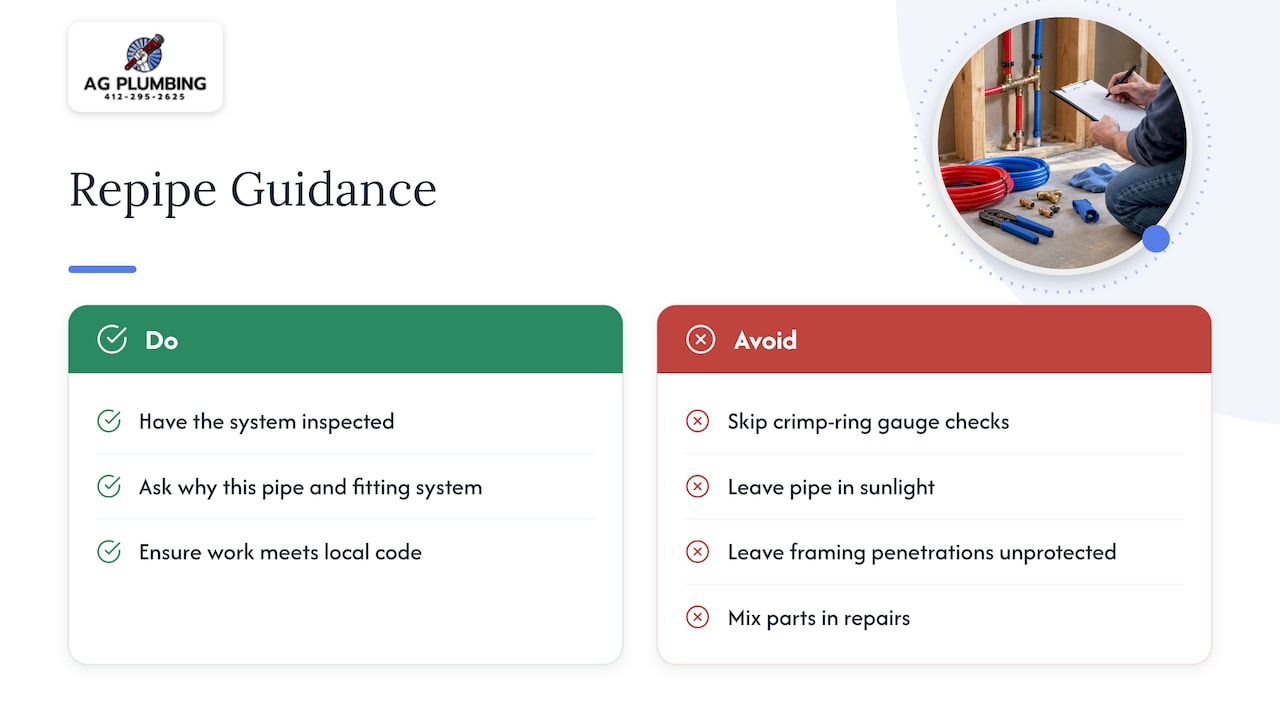
We see problems from poor installs far more often than from the pipe type. Missed gauge checks on crimp rings, pipe left in sunlight, no protection where tube passes through framing, and mixed-parts repairs cause more trouble than the letter ever does. Both types are good products when they are used as the manufacturer intended.
Still, in our area the winters are hard, many houses are older, and walls are often tight. In those conditions, flexibility, fewer hidden joints and freeze tolerance are worth paying for. That is why we usually point homeowners with complicated routing or cold spaces toward PEX-A, and say plainly when a simple job does not need it.
Our advice before any repipe: have the system looked at, ask which pipe and fitting system will be used and why, and make sure the work meets local code. A clear answer to those questions says more about a plumber than any brand name does.
— Maayan
Planning a repipe? Talk to us first
If you are weighing PEX for a repipe, a remodel or a failing section of old pipe, our team can look at your layout and explain the options in plain terms. Learn more about our plumbing repiping service, or see our plumbing repair page if you are dealing with a leak right now. We serve homes and businesses in Pittsburgh, PA and nearby areas. For a step-by-step view of what a replacement involves, read our pipe replacement guide.
FAQ
Is PEX-A the same as PEX-B?
No. They are made by different cross-linking methods and behave differently. PEX-A is more flexible and uses cold-expansion fittings, while PEX-B is stiffer and uses crimp or clamp rings. Both are approved for drinking water when they meet standards such as ASTM F876.
Is PEX-A or PEX-B better for freezing?
PEX-A. Its higher cross-linking lets it expand when water freezes and recover afterward. PEX-B is more rigid and more likely to split. Neither is freeze-proof, so insulate pipes in cold areas and keep heat on in winter.
Can you use crimp rings on PEX-A?
Yes. Crimp rings (ASTM F1807) work on PEX-A, PEX-B and PEX-C. The reverse is not true: cold-expansion fittings are made for PEX-A and should not be used on PEX-B, which can crack when expanded.
Is PEX-A worth the extra cost?
It often is for complex remodels, cold spaces and manifold systems, where fewer fittings and better flow can offset the material premium. For short, simple runs in heated space, PEX-B is a perfectly good and cheaper option. A plumber who has seen your layout can tell you which side you are on.
Is PEX allowed in Pennsylvania?
Yes. The 2021 International Plumbing Code as published for Pennsylvania allows both PEX-A and PEX-B that meet the referenced standards. Check with your local municipality for permit and inspection requirements before work begins.
Sources
- Plastics Pipe Institute: PEX Pipe and Tubing
- Uponor: PEX-a vs. PEX-b, Choosing the Right Plumbing Solution
- Uponor: FAQs
- Uponor: How to Make a Cold Expansion Connection
- EngineerSkill.blog: ProPEX vs Pex, Expansion and Crimp Systems
- PEX Fitting Types: Crimp vs Clamp vs Push vs Expansion
- MyHomeQuoter: Whole House Repiping Cost, PEX vs Copper
- UpCodes: Pennsylvania 2021 IPC, Chapter 6, Water Supply and Distribution
Recommended
- Choosing the best plumbing pipes for your Pittsburgh home
- Replace Plumbing: What Every Homeowner Needs to Know
- How to Choose Plumbing Materials for Pittsburgh Homes
- What Is PEX Piping? A Homeowner’s Guide for 2026
