
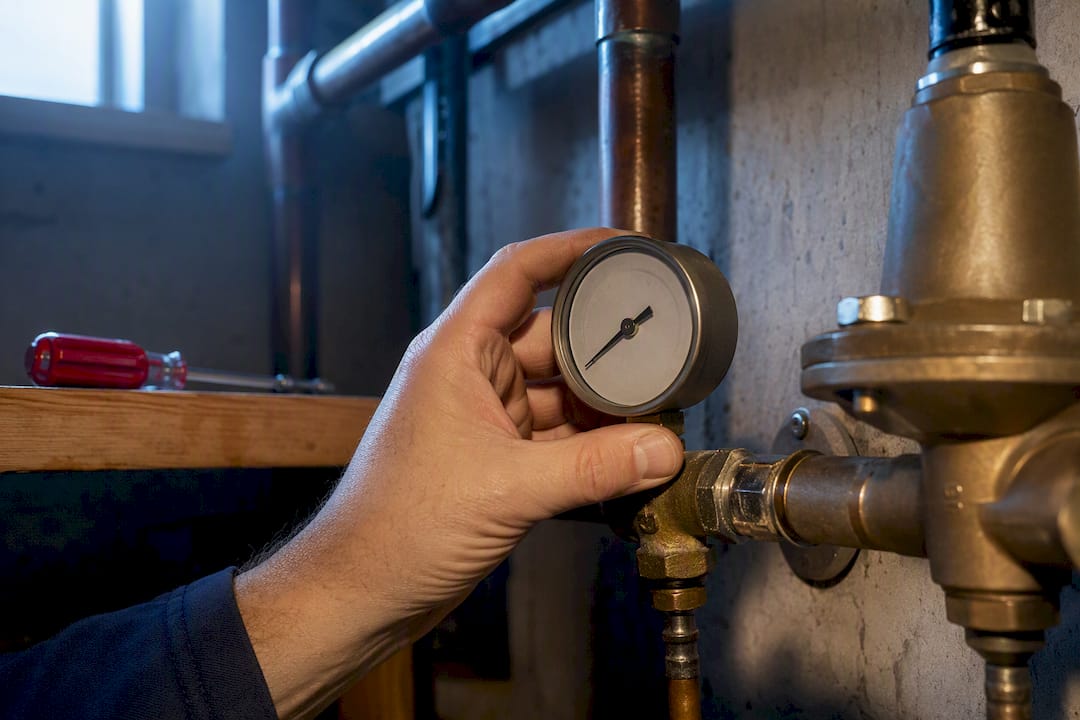
If your water pressure has changed house-wide, banging pipes have started up, or a toilet keeps running, a failing water pressure regulator is a strong suspect. The fastest way to confirm it is to attach a hose-bib pressure gauge to an outdoor spigot and check the reading. Any pressure reading significantly below or above typical residential ranges, or fluctuating irregularly, can indicate regulator issues.
TL;DR:
- A hose-bib pressure gauge can quickly confirm if the pressure is outside the safe 45 to 60 PSI range, indicating regulator issues.
- Sudden, house-wide symptoms like banging pipes or fluctuating pressure point to a failing regulator, often caused by worn springs or sediment buildup.
- Proper testing involves measuring static pressure and pressure during multiple fixtures, with readings over 80 PSI requiring urgent professional attention.
- Most regulators last 10 to 15 years, but hard water and pressure spikes can reduce lifespan and increase failure risk within 5 to 7 years.
- DIY checks like cleaning aerators and verifying the main shutoff can rule out simple causes before considering costly regulator replacement or calling a plumber.
Table of Contents
- Signs and Symptoms of Water Pressure Regulator Problems
- What Causes a Pressure Regulator to Fail?
- How Do You Test if a Regulator Is Working?
- Safe DIY Troubleshooting Steps to Try First
- Repair or Replace: What’s the Real Cost?
- When to Call a Plumber and What Happens Next
- Why Experience Matters for Regulator Repairs
- Get Your Regulator Inspected by AG-Plumbing
- A Straightforward Take on Diagnosing Regulator Trouble
- Sources
- FAQ
Signs and Symptoms of Water Pressure Regulator Problems
The first clue is scope. A single weak faucet is usually a clogged aerator or a fixture problem, not a regulator issue. A regulator failure shows up everywhere at once, in the shower, the kitchen sink, the washing machine, and the hose bib.
High pressure and low pressure look almost opposite, but both trace back to the same part. Here’s what each looks like in practice:
- High-pressure signs: loud, forceful toilet or dishwasher refills, a hard spray from every faucet, banging or vibrating pipes (a problem often called water hammer)
- Low-pressure signs: weak flow at every fixture, pressure that collapses further when a second fixture runs
- Indirect signs: water bills creeping up for no clear reason, or the same fixture failing over and over
A regulator problem often reveals itself gradually. Static pressure tends to “creep” upward over months before anyone notices a leak or a burst line, which is exactly why catching it early through symptoms matters.
What Causes a Pressure Regulator to Fail?
A pressure regulator (often called a PRV, or pressure-reducing valve) is a mechanical device with a spring and a diaphragm that wear out over time. Failure generally falls into three patterns:
- Stuck open: the valve fails to restrict flow, letting full municipal pressure through and driving readings well above the safe range
- Stuck closed: the valve restricts too much, starving every fixture in the house
- Worn spring or diaphragm: pressure fluctuates instead of holding steady, sometimes fine in the morning and erratic by evening
Hard water accelerates all three. Mineral and sediment buildup coats the internal parts, and combined with fluctuating municipal supply pressure, it wears down the diaphragm and spring faster than normal use alone would. Incorrect sizing at installation, or a regulator that was simply installed wrong, can also produce symptoms that look identical to old-age failure. Common symptoms of a failing PRV, including noisy pipes and running toilets, tend to show up well before a full failure.
How Do You Test if a Regulator Is Working?
A hose-bib pressure gauge costs about $10 to $20 at any hardware store, and it settles the question in minutes.
- Screw the gauge onto an outdoor spigot or a laundry faucet, both are close to where the main line enters the house.
- Turn the spigot fully open and read the static pressure (no other fixtures running).
- Turn on two or three fixtures elsewhere in the house and watch how far the reading drops. This checks running pressure, not just static.
- If your regulator has test ports on both sides, compare incoming municipal pressure to the reduced pressure coming out.
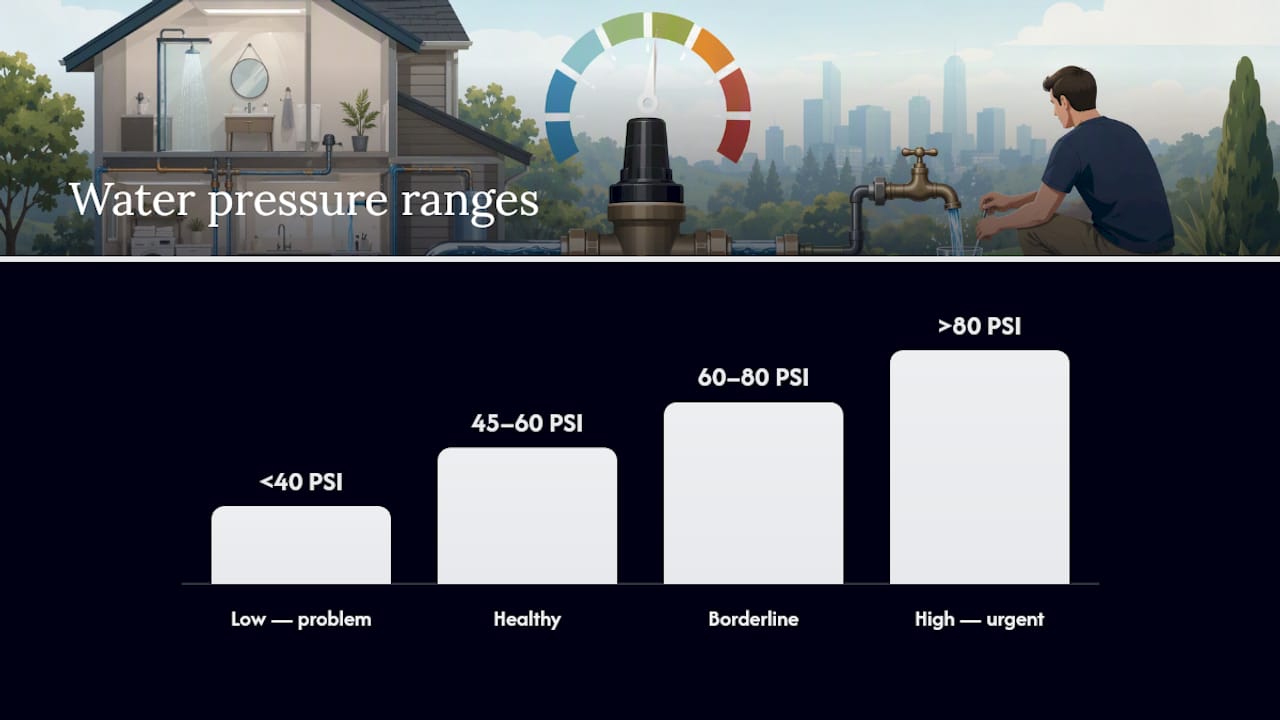
A healthy home generally holds 45 to 60 PSI, the range most fixtures and appliances are built for. Readings under 40 PSI suggest a stuck-closed regulator or a supply-side problem. Readings between 60 and 80 PSI are borderline and worth monitoring. Anything over 80 PSI needs urgent attention, since sustained high pressure stresses water heaters, supply lines, and appliance valves. Large swings between static and running pressure often mean the regulator is undersized for your home’s flow demand or the internal parts are simply worn out.
Before you blame the regulator, do two cross-checks: ask a neighbor on the same street what their pressure reads, and check whether the problem fixture just has a clogged aerator. Our guide on checking household water pressure walks through both in more detail.
Safe DIY Troubleshooting Steps to Try First
Before you call anyone, a handful of low-risk checks can narrow down the problem or even fix it.
- Clean the aerators on affected faucets. Sediment and mineral scale collect there constantly, and it’s the single most common cause of a “low pressure” complaint that has nothing to do with the regulator.
- Run several fixtures at once and note which ones lose pressure. If it’s isolated to one line, the regulator is probably fine.
- Confirm the main shutoff valve is fully open. A partially closed valve mimics regulator failure almost perfectly.
- If the regulator has an adjustment screw, loosen the lock nut first, then turn the screw in small increments, clockwise to increase pressure, counterclockwise to decrease it, checking the gauge after each turn.
- If the pressure won’t hold steady after adjustment, the diaphragm or spring is likely worn, and adjustment isn’t going to fix it long term.
Replacing the regulator itself is a different matter. It usually means cutting into the main water line, and a mistake there can flood a basement or crawl space fast. That’s the point where DIY replacement stops being worth the risk and a licensed plumber earns their fee.
Pro Tip: Before any service call, write down your PSI readings from at least two different times of day and snap a photo of the regulator itself. It saves the plumber a diagnostic step and often shortens the visit.
Repair or Replace: What’s the Real Cost?
Most residential regulators are built to last 10 to 15 years, but hard water and frequent municipal pressure spikes can cut that down to 5 to 7 years in tougher conditions.
- Repair makes sense for: a minor adjustment that holds steady, or a small leak at a fitting
- Replacement makes sense for: a failed diaphragm, heavy internal scale, or a PSI reading that keeps creeping upward despite adjustment
On cost, residential replacement typically runs $200 to $700, with a national average around $400. Access to the valve, permit requirements, and pipe size all move that number. As a rule of thumb, if a repair estimate comes in at more than half the replacement cost, replacement is the better long-term value.
When to Call a Plumber and What Happens Next
Call a licensed plumber right away if your gauge reads above 80 PSI, if you’ve got a persistent leak you can’t isolate, or if the fix clearly involves opening up the main line.
A professional visit typically includes:
- Pressure readings on both sides of the valve, not just the house side
- Inspection of the valve body, sediment buildup, and the expansion tank
- A check of appliance relief valves, since sustained high pressure stresses those too
- An estimate for repair versus replacement, plus any permit or inspection requirements in your area
Have your PSI readings, photos, and a list of which fixtures are affected ready before the appointment. It speeds up diagnosis and gives you a more accurate quote up front.
Why Experience Matters for Regulator Repairs
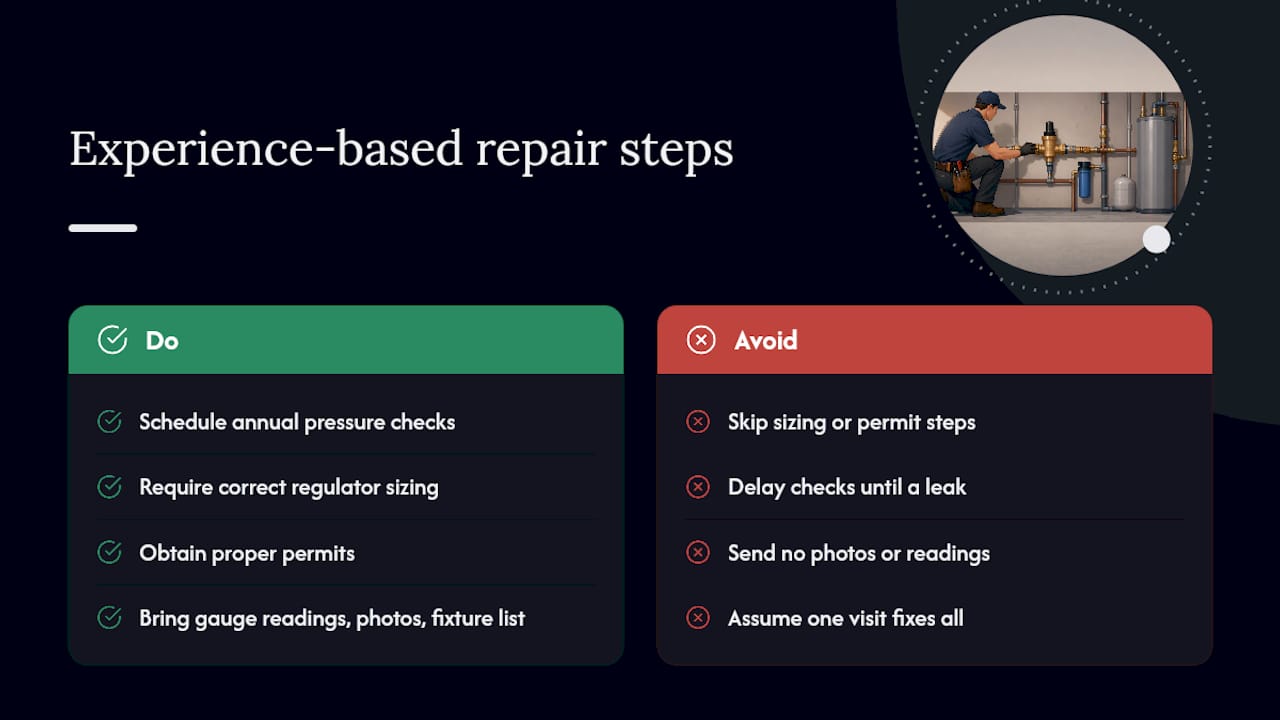
Experienced local plumbers have observed that annual pressure checks catch regulator wear long before it becomes a burst pipe or a flooded utility room. Correct sizing and proper permitting aren’t optional steps, they’re what keeps a replacement from becoming a repeat call six months later.
If you’re scheduling a visit, bring what you’ve already gathered: your gauge readings, a couple of photos of the regulator, and a short list of which fixtures act up. That prep turns a diagnostic visit into a repair visit.
Get Your Regulator Inspected by AG-Plumbing
A gauge test tells you there’s a problem. It doesn’t tell you exactly which part failed, whether your pipe sizing is right, or whether a permit is needed in your township, and that’s where a professional inspection earns its cost. AG-Plumbing handles pressure testing, adjustment, and full regulator replacement for homes and businesses throughout the Pittsburgh area, with technicians who see this exact failure pattern year-round.
A typical professional service visit can include pressure testing on both sides of the valve, inspection of the valve body and expansion tank, and a clear repair-or-replace recommendation without guesswork or upselling. If your gauge already reads outside the 45 to 60 PSI range, don’t wait for a pipe to fail. Request a quote through our plumbing repair services page and get a licensed technician out to confirm what your gauge is telling you.
A Straightforward Take on Diagnosing Regulator Trouble
Most homeowners either ignore pressure symptoms for months or assume the worst and call for a replacement they don’t need. The gauge test settles that argument for $20 and ten minutes. Test first, document what you find, then call a licensed plumber if the numbers land outside the safe range.
— Maayan
Sources
- Water Pressure Regulator Replacement Cost – Angi
- What happens when a pressure regulator valve fails? – IFAN Brass
- How to Troubleshoot Common Regulator Problems – Swagelok
- Water pressure regulator: What it is and how to check it – The Spruce
FAQ
How Do You Know When a Water Pressure Regulator Is Bad?
House-wide symptoms like banging pipes, running toilets, or pressure that swings up and down are the clearest signs. A hose-bib pressure gauge reading outside the 45 to 60 PSI range confirms it.
What Is the Average Lifespan of a Water Pressure Regulator?
Most regulators last 10 to 15 years, though hard water and frequent municipal pressure spikes can shorten that to 5 to 7 years.
What Is the Average Cost to Replace a Water Pressure Regulator?
Residential replacement typically costs between $200 and $700, averaging around $400, depending on access, permits, and pipe size.
What Is the Most Common Water Pressure Problem?
Fluctuating pressure from a worn spring or diaphragm is one of the most frequent complaints, though homeowners often mistake a clogged aerator or a partially closed shutoff valve for regulator failure.
Recommended
- Homeowners: Diagnose Low Water Pressure Upstairs in 20–30 Minutes
- How to Increase Water Pressure at Home in 2026
- Why Check Water Pressure: A Homeowner’s Guide
- Why Water Pressure Drops: A Homeowner’s Guide
