
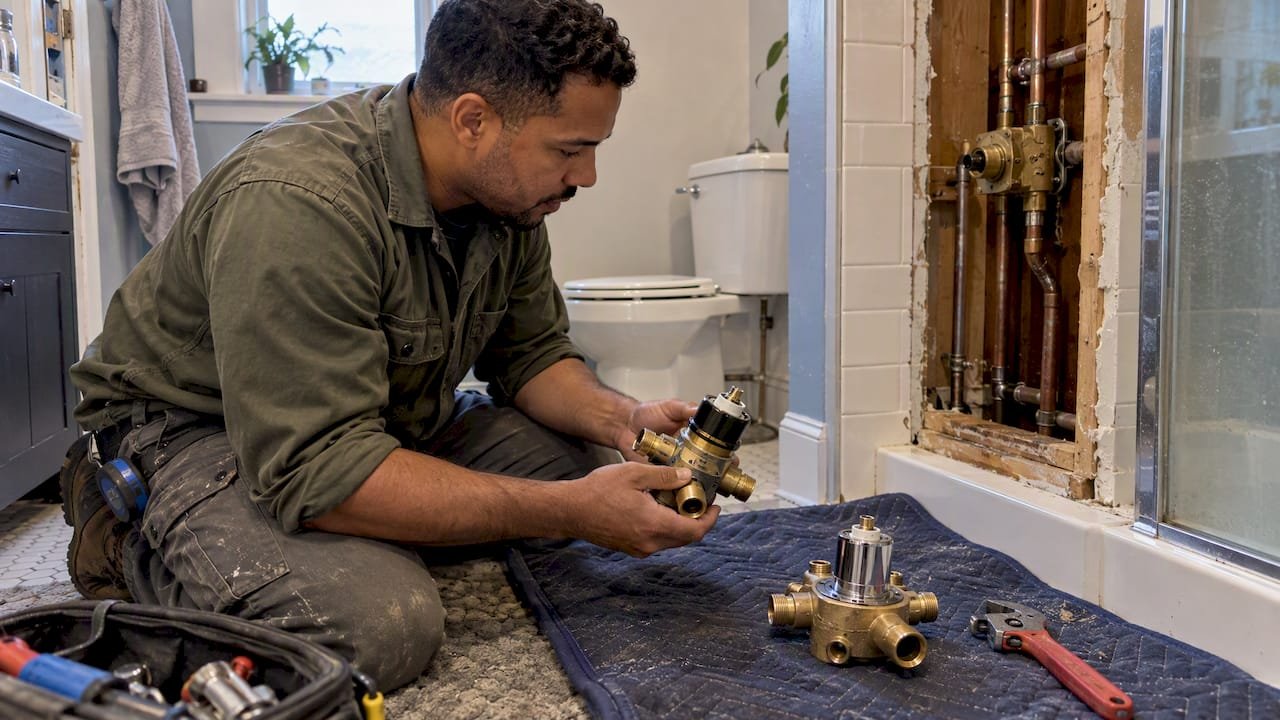
A pressure balance valve reacts to pressure changes and keeps the hot-to-cold ratio steady. A thermostatic valve measures the actual temperature of the mixed water and corrects it. If your shower swings from comfortable to scalding to cold when someone flushes a toilet, either valve type is built to prevent it. If it still happens, the valve is probably worn, clogged with scale, or set wrong, and that is a repair job, not a design flaw.
This guide explains how the two valves differ, what each one cannot do, why showers fluctuate in older Pittsburgh-area homes, and when it is time to call a plumber.
TL;DR
- Pressure balance valves respond to pressure drops on the hot or cold line. They usually have one handle and cost less to install.
- Thermostatic valves sense the real mixed-water temperature, so they hold a set temperature even when the supply temperature changes. They usually have two controls.
- Plumbing codes require one or the other (or a combination) on new or replaced shower valves, with a maximum outlet limit of 120°F.
- A shower that runs hot then cold usually points to a worn cartridge, mineral scale, a mis-set limit stop or a water heater issue.
- Not sure which you have? A plumber can identify the valve, service it, or replace it.
Table of Contents
- How a pressure balance valve works
- How a thermostatic valve works
- What the standard actually requires
- Side-by-side comparison
- Which one fits your home
- Why your shower runs hot, then cold
- Our perspective
- When to call a plumber
- Shower valve repair and replacement with AG Plumbing
- FAQ
- Sources
How a pressure balance valve works
Inside a pressure balance valve is a piston or spool that moves when the pressure on one supply line changes. Flush a toilet or start the dishwasher, and cold pressure drops. The piston shifts and reduces the hot side so the ratio stays roughly the same. According to a trade article on plumbing maintenance and the code, these valves respond to supply pressure swings but cannot compensate when the temperature of the incoming supply itself changes.
That last point matters. You set the handle where you like it, and the valve defends the ratio. It does not know what temperature the water actually is. For a deeper look at this design, see our page on why every shower needs a pressure balancing valve.
Typical traits
- One handle that controls both volume and temperature.
- Lower upfront cost and simple repair, usually a cartridge swap.
- Good protection against sudden scalding or thermal shock from pressure drops.
How a thermostatic valve works
A thermostatic valve contains a temperature-sensitive element, often wax or a bimetal component, that expands and contracts with the mixed water. It moves the hot and cold ports to hold the temperature you dialed in. Because it reads the outcome rather than the inputs, it copes with both pressure swings and changes in supply temperature.
Most thermostatic setups give you two controls: one for temperature and one for volume. That is also why people like them: you can turn the shower off and on without losing your setting. Our article on thermostatic mixing valves and home safety covers the safety side in more detail.
What the standard actually requires
Both valve types are covered by ASSE 1016. Per the summary published by Watts, a Type P (pressure balancing) valve must hold the outlet within ±3.6°F during a 50% pressure variation, while a Type T (thermostatic) valve must hold the same ±3.6°F while also accounting for pressure changes and a 25°F rise in hot water temperature.
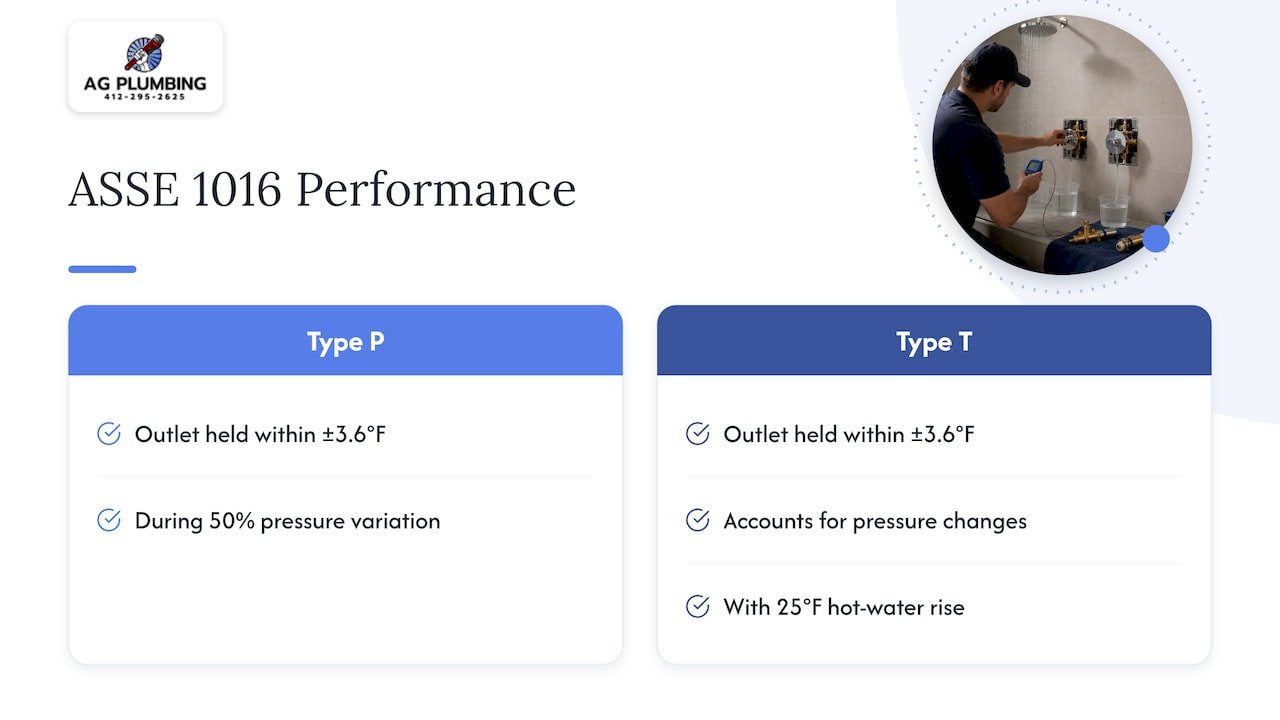
In other words, on paper the two are closer than the marketing suggests under pressure swings. The thermostatic valve earns its place when the supply temperature moves, not only the pressure.
Code and the 120°F limit
Under the 2024 International Residential Code, showers and tub-shower combinations need an individual pressure-balancing or thermostatic mixing valve with a high-limit stop, and the maximum delivered temperature is 120°F (49°C). Check with your local code office for the edition your municipality has adopted, since Pittsburgh-area municipalities can differ.
The reason is safety, not luxury. The same trade source notes that at 120°F a child takes about 1.2 minutes to get a second-degree burn, while at 140°F it takes about 0.7 seconds.
Side-by-side comparison
| Feature | Pressure balance | Thermostatic |
|---|---|---|
| What it senses | Pressure on hot and cold lines | Actual mixed water temperature |
| Controls | Usually one handle | Usually two (temperature and volume) |
| Handles pressure drops | Yes | Yes |
| Handles supply temperature changes | No | Yes |
| Temperature precision | Good | Tighter |
| Upfront cost | Lower | Higher |
| Repair | Cartridge replacement | Cartridge or thermostatic element; more sensitive to scale |
| Best for | Most standard bathrooms | Multi-head showers, households wanting a fixed setting, vulnerable users |
Which one fits your home
Choose pressure balance if you have a standard tub-shower, stable hot water and a budget to respect. It meets code and solves the classic flush-and-scald problem.
Choose thermostatic if you run several body sprays or a rain head, the hot water temperature in your house varies, or someone in the home is elderly or very young and you want the tightest control. It also suits people who like to set a temperature once and leave it.
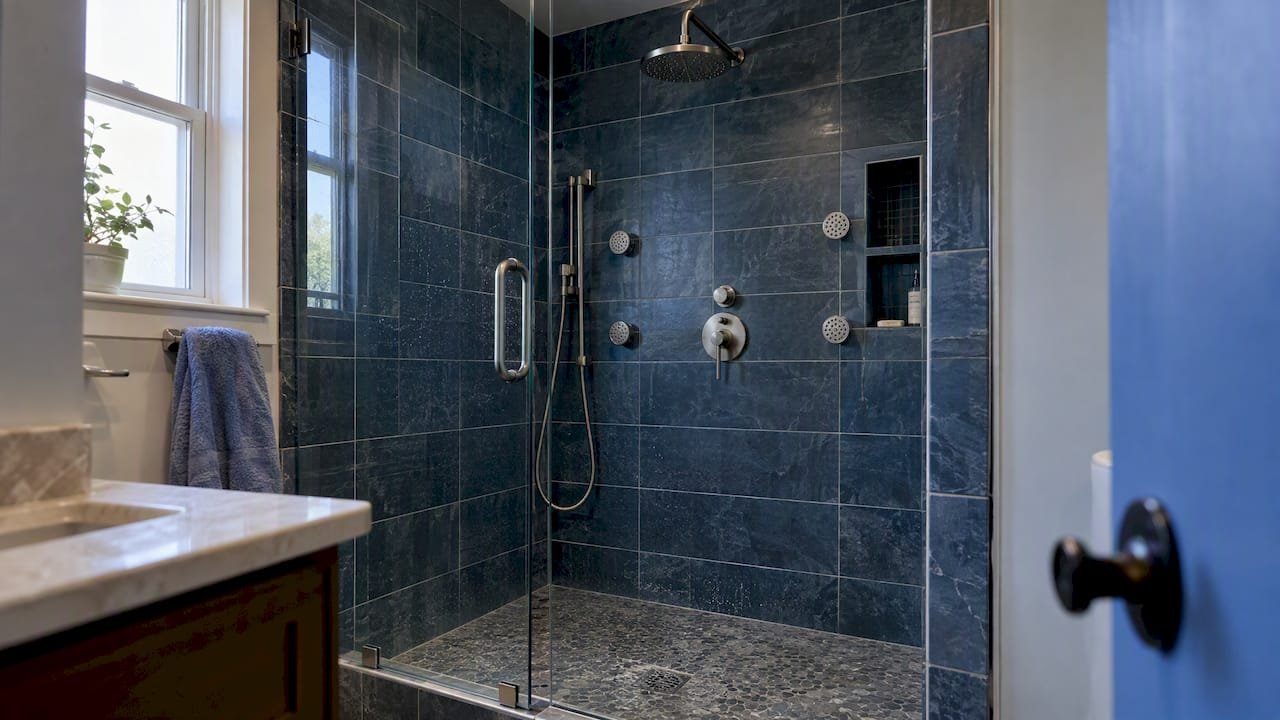
Mind the plumbing behind the wall. A new valve will not fix a failing water heater or undersized piping. A thermostatic valve with a rain head also needs enough flow, and a thermostatic valve can affect cold-side flow in systems with limited capacity. If your pressure is already low, read our guide on how to increase water pressure at home first.
Why your shower runs hot, then cold
Homeowners who search for an inconsistent shower temperature usually have one of these causes. Work from the cheapest to the most involved.
- Worn or clogged cartridge. Scale can stop a valve from doing its balancing or mixing job. The phcppros article points to scaling as a reason the control valve stops performing its function. Older cartridges in particular stick.
- Old valve with no balancing at all. Homes built before anti-scald rules became common may have a plain two-handle mixer. Every flush changes your temperature.
- Water heater trouble. Sediment, a failing thermostat or a tank that runs out produces hot-then-cold swings no valve can fix. See our notes on common water heater issues Pittsburgh homeowners face.
- Limit stop set too low or too high. The limit stop is adjusted in the field at installation. If it is set poorly, you either never get enough heat or you get too much.
- Seasonal supply changes. Cold water coming into a home is colder in a Pittsburgh winter and warmer in summer. A pressure balance valve cannot compensate for that, so the mix at the showerhead can drift between seasons even when the valve is healthy. The trade article above advises checking the limit stop seasonally.
- A leaking valve. If you also see drips from the spout when the shower is off, the cartridge or seals are failing. We cover that in leaking shower valve causes, fixes and costs.
Can you maintain it yourself?
Light upkeep is reasonable. A manufacturer’s guidance for one thermostatic valve line suggests that mineral scale is the main cause of valve problems and that soaking cartridges in a 50/50 water and vinegar mix can dissolve it, while abrasive pads and harsh chemicals can damage components and void warranties. Follow your own valve maker’s instructions.
Shut off the water before removing any cartridge. If you are not comfortable working behind the wall, or you cannot identify the valve brand, call a licensed plumber. Resetting a limit stop incorrectly is a scalding risk, so leave that adjustment to someone who can verify the outlet temperature with a thermometer.
Our perspective
We have spent 30 years working on homes and businesses in Pittsburgh and the surrounding area, and the most common mistake we see is people replacing a valve to solve a problem that lives somewhere else. A shower that swings between hot and cold is often blamed on the valve. Sometimes it is the valve. Just as often it is scale in an old cartridge, a water heater that needs attention, or a limit stop nobody has looked at since the install.
Our advice is plain. For a typical tub-shower, a quality pressure balance valve that is correctly installed and adjusted does the job and meets code. If your household has a young child, an older relative, or a multi-head shower, a thermostatic valve is worth the extra cost. Whichever you pick, have the outlet temperature tested after installation and again when seasons change. The valve is a safety device first and a comfort feature second.
— Maayan
When to call a plumber
Call a licensed plumber if:
- The temperature swings even when nobody else is using water.
- The shower runs scalding hot at any setting, which is a safety issue to address right away.
- You can’t get the shower hot enough, even though the water heater is working.
- The valve drips, handles feel gritty, or the cartridge will not come out.
- Your home still has an older valve with no balancing and you want to upgrade.
If you are unsure whether the problem is the valve, the heater or the piping, a diagnostic visit sorts it out before you spend money on parts. For a broader read on warning signs, see how to identify when plumbing repair is necessary.
Shower valve repair and replacement with AG Plumbing
AG Heating, Cooling & Plumbing handles plumbing repair for residential and commercial properties in Pittsburgh, PA and nearby communities. Our licensed and certified staff can identify what is in your wall, tell you whether a repair is enough, and explain the options before work starts. If the real problem is old supply piping behind the valve, we also handle plumbing repiping. We offer discounts for seniors, military, new customers and referrals. Contact us through our website to book a visit.
FAQ
Is a thermostatic shower worth it?
It can be, if you want a set-and-forget temperature, run multiple shower outlets, or have vulnerable people at home. It costs more up front and its parts are more sensitive to scale. For a basic bathroom with steady hot water, a pressure balance valve is usually enough.
What are the downsides of thermostatic showers?
Higher cost and more components that can stick in hard water or with debris. Some designs can also reduce flow on systems with limited capacity. Regular cartridge upkeep and a properly sized supply reduce those problems.
Why does my shower temperature fluctuate when a toilet flushes?
The flush pulls cold water and drops pressure on that line. A working pressure balance or thermostatic valve compensates, so big swings suggest an old valve with no balancing, a clogged cartridge or a failing one. A plumber can test which.
Can I switch from pressure balance to thermostatic?
Usually yes, but the valve bodies differ, so it often means opening the wall or using a compatible trim kit, and the supply flow has to suit the new valve. A plumber can check your rough-in before you buy.
Sources
- Plumbing Maintenance and the Code, phcppros
- ASSE 1016 questions and answers, Watts
- IRC 2024 anti-scald shower valve requirement, Jaspector
- Thermostatic shower valve and cold water pressure, CyShower
- Valve installation instructions and care, Crosswater spec book
Recommended
- Pressure Balancing Valves: Why Every Shower Needs One
- The Role of Thermostatic Mixing Valves in Home Safety
