
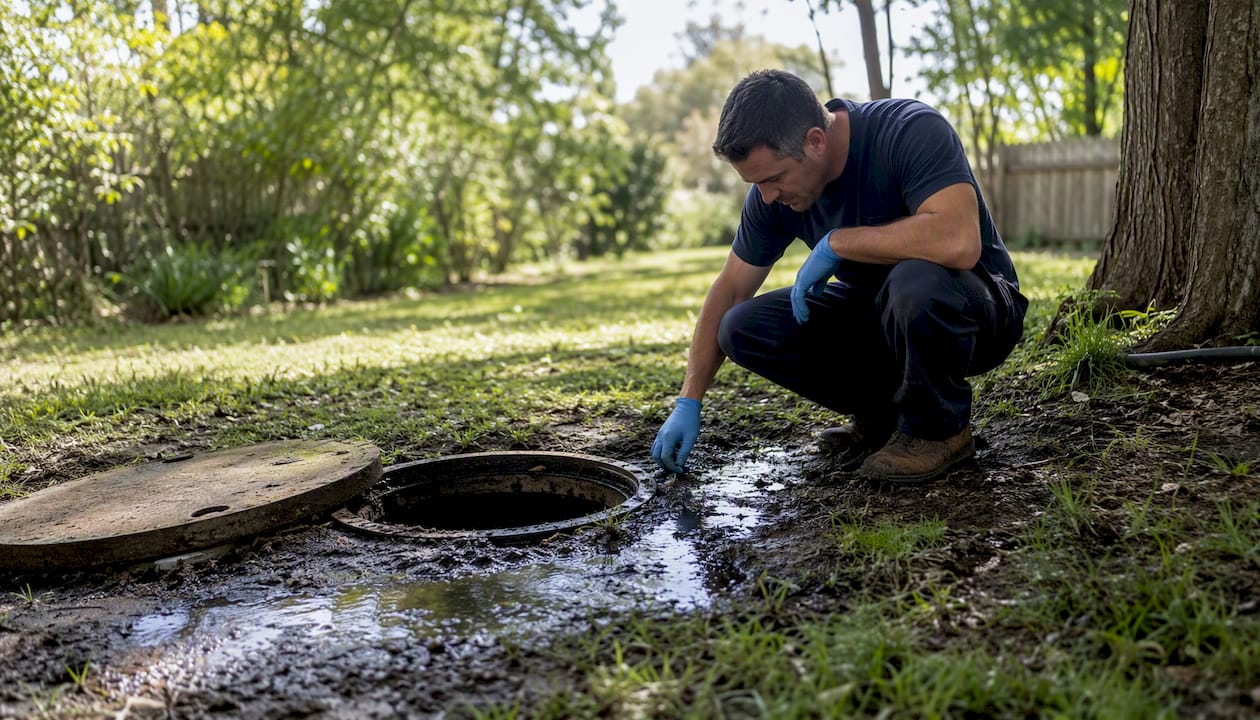
A wet yard sewage smell almost always means sewer gas or raw sewage is escaping from a breached part of your wastewater system — a cracked septic tank lid, a saturated drainfield, a broken sewer lateral, or a blocked vent stack pushing gases back to ground level. A healthy system produces no detectable outdoor odor. If you can smell it, something is wrong, and the first thing to do is keep people and pets away from the wet area while you figure out what you’re dealing with.
Before you do anything else:
- Keep children and pets out of the affected yard zone
- Open windows and doors if the odor is reaching inside the house
- Avoid open flames, gas grills, or power tools near the smell (methane can be present)
- Do not pour bleach or drain chemicals into the system — they won’t fix the cause and can damage tank biology
- Do not dig or excavate without professional guidance
The smell may be temporary — heavy rain can saturate a drainfield and push odors to the surface for a short time — but a persistent or localized odor almost always signals a system breach that needs a plumber or septic specialist.
Key Takeaways
A wet yard sewage smell almost always signals a breach in your wastewater system — and the longer it goes uninvestigated, the more expensive the repair becomes.
| Point | Details |
|---|---|
| Smell means a breach | A healthy septic or sewer system produces no detectable outdoor odor; any smell signals gas or effluent is escaping. |
| Post-rain odors: 24–48 hours is the threshold | Temporary saturation smells often resolve within a few days; persistent or localized odors indicate system failure. |
| Pump-out cost vs. drainfield replacement | A standard pump-out usually costs a few hundred dollars; ignoring the problem can escalate to drainfield repair or replacement costing several thousand dollars. |
| Pump every 3–5 years | Most residential septic tanks need pumping every few years; for example, a four-person household with a 1,000-gallon tank might require pumping closer to every three years. |
| Ag-plumbing for Pittsburgh-area inspections | Ag-plumbing provides on-site camera inspection, lateral leak detection, and repair for homeowners in Pittsburgh, PA and surrounding areas. |
Table of Contents
- What causes a sewage smell in a wet yard?
- How to systematically find where the smell is coming from
- Immediate safety steps if you smell sewage in your yard
- Safe DIY checks you can do before calling a plumber
- Clear signs you need a professional plumber or septic specialist
- How to prevent sewage odors from coming back
- How professionals locate buried leaks and why it matters
- Environmental impact and local regulations related to sewage leaks
- Long-term consequences of ignoring sewage smells in wet yards
- Why the “wait and see” approach almost always costs more
- Persistent wet yard sewage smell? Ag-plumbing can help
- Sources
- FAQ
What causes a sewage smell in a wet yard?
Outdoor septic odors are caused by gases — primarily hydrogen sulfide and methane — escaping the system somewhere they shouldn’t. The location and timing of the smell usually points directly to the cause.
The most common culprits:
- Full or overdue septic tank. When a tank hasn’t been pumped in years, solids overflow into the drainfield and gases back up through every available opening. The smell tends to be strongest near the tank itself.
- Cracked or unsealed tank lid or inspection port. Even a hairline crack lets hydrogen sulfide escape. Lids that have been buried under soil are especially prone to this — and harder to inspect. The University of Minnesota’s Onsite Sewage Treatment Program specifically warns against covering lids with soil because it complicates pumping and delays emergency access.
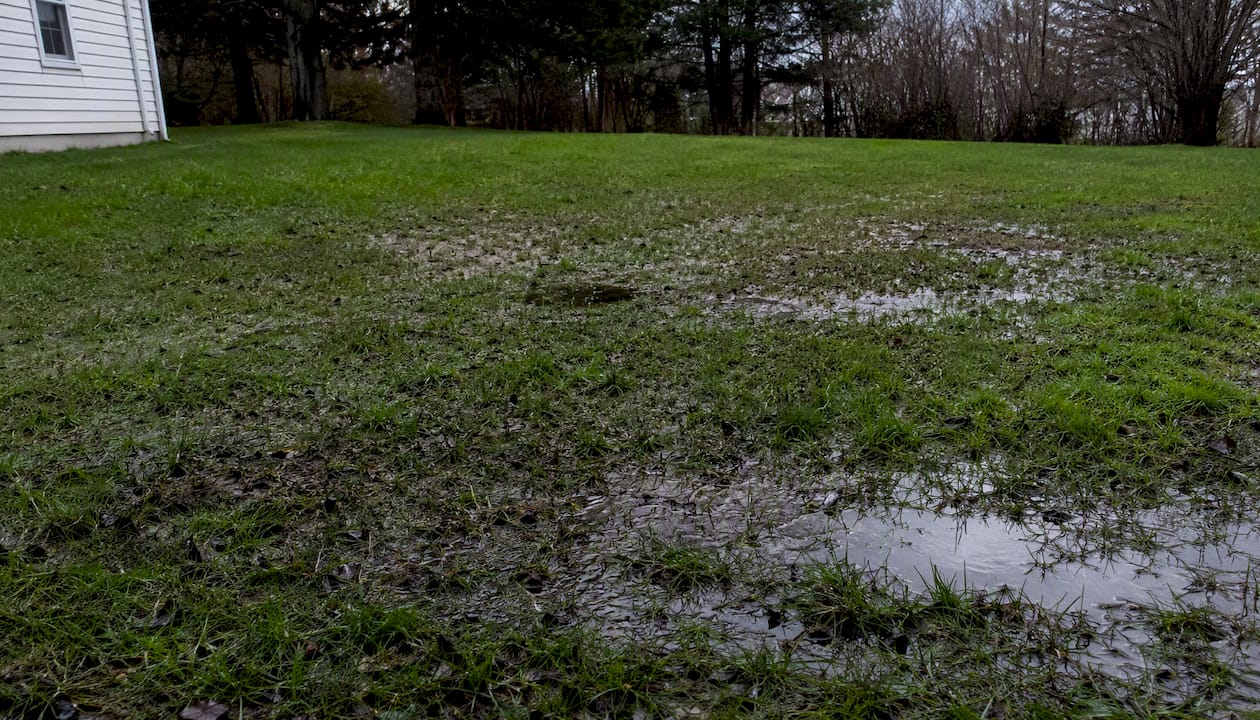
- Failing or saturated drainfield. When the soil can’t absorb effluent fast enough — especially after heavy rain — liquid sewage surfaces. You’ll notice unusually lush or spongy grass over the drainfield trenches, and the smell will be diffuse across that zone rather than pinpointed.
- Broken or root-intruded sewer lateral. The pipe running from your house to the tank or municipal main can crack, sag, or get invaded by tree roots. Odors tend to follow the pipe run and may appear as a line of wet soil across the yard.
- Blocked or down-drafted vent stack. Plumbing vents on your roof are supposed to carry sewer gases up and away. A bird’s nest, debris, or a low-pressure weather system can push those gases back down — sometimes settling in sheltered corners of the yard. Wind direction and barometric pressure genuinely affect where the smell lands, which is why the same yard can smell fine one day and terrible the next.
- Anaerobic soil after heavy rain. Saturated, oxygen-depleted soil produces geosmin and other compounds that smell musty or vaguely sewage-like. This isn’t raw sewage, but it’s worth ruling out before assuming the worst. If the smell is earthy and fades within a day of the rain stopping, anaerobic soil is a plausible explanation.
Pro Tip: Never cover septic tank lids or inspection risers with soil or heavy mulch. A thin layer of mulch can help absorb mild surface odors, but covering the lid with soil or heavier materials prevents pump truck access — causing delays and increased costs in an emergency.
How to systematically find where the smell is coming from
Pinpointing the source before calling a plumber saves diagnostic time and money. Work through this in order, and write down what you find.
Step 1: Walk the yard in a grid pattern
Do this when the smell is strongest — usually during or right after rain, or on a warm, still morning. Note the exact zones where the odor peaks: near the tank, over the drainfield, along the pipe run toward the house, or near the foundation.
Step 2: Check visible access points
- Septic tank lids and riser covers: look for cracks, gaps, or lids that sit slightly off-center
- Distribution box caps (if your system has one)
- Cleanout plugs along the lateral: a missing or loose cap is a direct escape point for sewer gas
- Wet or unusually green patches of grass: these often sit directly above a leaking pipe or surfacing effluent
Step 3: Check inside the house
Slow drains, gurgling toilets, or a sewer smell near floor drains or toilet bases all point toward a main-line problem rather than a yard-side issue. Dry P-traps — the water-filled U-bends under sinks and floor drains — dry out in about 2–4 weeks without use and let sewer gas pass freely. Pour water into any drain you haven’t used recently.
Step 4: Inspect roof vent stacks from the ground
Use binoculars. Look for bird nests, leaves, or debris blocking the vent pipe opening. Note the wind direction when the smell is present — barometric pressure and local topography can push roof-vented gases down into sheltered yard areas, making it look like a ground-level leak when the actual source is the vent stack.
What to record before calling a pro:
- Date, time, and weather conditions (rain in the past 24 hours? Temperature? Wind direction?)
- Exact location of the strongest smell
- Whether indoor drains are slow or gurgling
- When you last had the tank pumped
- Any recent landscaping, digging, or heavy vehicle traffic over the drainfield
That list cuts a diagnostic visit from two hours to thirty minutes.
Immediate safety steps if you smell sewage in your yard
Sewer gas contains hydrogen sulfide and methane. Hydrogen sulfide is detectable at extremely low concentrations — parts per billion — and causes eye and respiratory irritation at moderate levels. At high concentrations, it causes rapid loss of consciousness. Critically, olfactory fatigue sets in at dangerous levels, meaning you stop smelling it right when it becomes most hazardous. Symptoms, not smell, must guide your urgency decisions.
Practical safety steps:
- Keep everyone out of the affected yard area until the source is identified
- If odor is detectable indoors, open windows and doors and leave the building
- Turn off any pilot lights or ignition sources near the affected area
- Do not use power tools, start engines, or smoke near the smell zone
- Do not enter a septic tank or any confined space under any circumstances
When to call 911 instead of a plumber:
- Anyone in the household shows symptoms: severe headache, nausea, dizziness, or fainting
- Visible sewage is actively bubbling or pooling on the surface
- The smell is sudden, overwhelming, and spreading rapidly indoors
For anything short of those conditions, a licensed plumber or septic specialist is the right call — not emergency services.
Safe DIY checks you can do before calling a plumber
Some causes of a foul smell in the backyard are genuinely fixable without professional help. Others just look that way.
Safe steps to try:
- Refill dry traps. Pour a quart of water into every floor drain, basement drain, and infrequently used sink. If the smell reduces noticeably within an hour, a dry trap was the culprit.
- Replace a cracked inspection port cap. If you can see the cap is cracked or missing and you can safely reach it, a replacement cap from a hardware store costs a few dollars and stops gas from escaping that opening. Don’t attempt this if the lid is buried or if you’d need to dig.
- Clear visible vent cap debris. If binoculars show a bird’s nest or leaf blockage at the vent stack opening, a plumber can clear it quickly — but if you’re comfortable on a roof and the blockage is surface-level, removing it yourself is reasonable.
- Move pets and children away from wet soil patches. Until the source is confirmed, treat any wet, odorous patch as potentially contaminated.
What not to do:
- Don’t pour bleach, enzyme additives, or solvents into the system hoping to kill the smell — they don’t fix structural causes and can disrupt the bacterial balance that makes a septic tank work
- Don’t drive vehicles or heavy equipment over the drainfield — compaction crushes the absorption trenches
- Don’t bury or cover tank lids with soil or sod
- Don’t attempt to enter or open a septic tank yourself — confined-space entry without proper equipment and training is fatal
Pro Tip: Septic additives are widely marketed as odor fixes, but practitioner guidance consistently recommends physical inspection and pumping over additives as the first-line response to outdoor sewage odors. Save the money.
Clear signs you need a professional plumber or septic specialist
Some problems are simply beyond what a homeowner can safely diagnose or fix. Call a licensed plumber or septic specialist when:
- The smell persists more than 48 hours after rain stops
- The odor returns with every significant rain event
- You see sewage or effluent pooling on the surface
- Multiple drains in the house are slow or gurgling simultaneously
- The smell is detectable inside the house near floor drains or toilets
- You haven’t had the tank pumped in more than 3–5 years
What a professional inspection typically involves:
- Camera inspection of the sewer lateral to locate cracks, root intrusion, or pipe collapse
- Pressure or leak testing of the line between house and tank
- Septic tank inspection and pump-out to assess solids level and check baffles
- Drainfield evaluation using soil probes and effluent observation
- Smoke or tracer gas testing to find vent blockages or lateral breaches that cameras miss
Rough cost signals to set expectations: a standard pump-out runs roughly $300–$600 for most residential tanks. Localized lateral repairs or trenchless pipe lining vary widely depending on depth and access. Drainfield repair or full replacement can reach several thousand dollars — which is exactly why catching the problem at the pump-out or lateral-repair stage matters. A methodical order of operations (document, check traps and vents, inspect lids, pump if overdue, then escalate to camera or tracer tests) consistently saves money compared with skipping straight to excavation.
Knowing the warning signs of sewer line failure before a smell event puts you ahead of the repair curve.
How to prevent sewage odors from coming back
Most recurring yard odors are maintenance failures, not random bad luck.
Maintenance checklist:
- Pump the septic tank every 3–5 years, adjusted for household size and tank capacity. A four-person household with a 1,000-gallon tank typically needs pumping closer to every 3 years.
- Inspect tank lids and inspection port caps annually for cracks or gaps
- Keep roof vent stacks clear of debris, especially after fall leaf drop and spring nesting season
- Route surface drainage (downspouts, grading) away from the drainfield — saturated soil can’t absorb effluent
- Keep cleanout plugs capped and accessible
Behavioral habits that reduce risk:
- Don’t flush wipes (even “flushable” ones), paper towels, feminine hygiene products, or grease
- Spread laundry loads across the week during wet seasons rather than running multiple loads in one day — large water volumes can temporarily overwhelm a drainfield
- Avoid parking or compacting soil over drainfield trenches
Sustainable drainage practices — like redirecting downspouts and grading soil away from the drainfield — reduce the saturation events that trigger post-rain odors. For properties near shared water sources, preventing cross-contamination from backflow is an equally important layer of protection.
When a post-rain septic smell resolves within 1–3 days and there are no other warning signs, temporary drainfield saturation is the likely explanation. When it persists or you find soggy soil and lush grass over the leaching bed, that’s a drainfield problem — not a weather event.
How professionals locate buried leaks and why it matters
Trial-and-error digging is expensive and often misses the actual problem. Professionals use a layered set of tools that narrow the search before a shovel touches the ground.
Tools and methods:
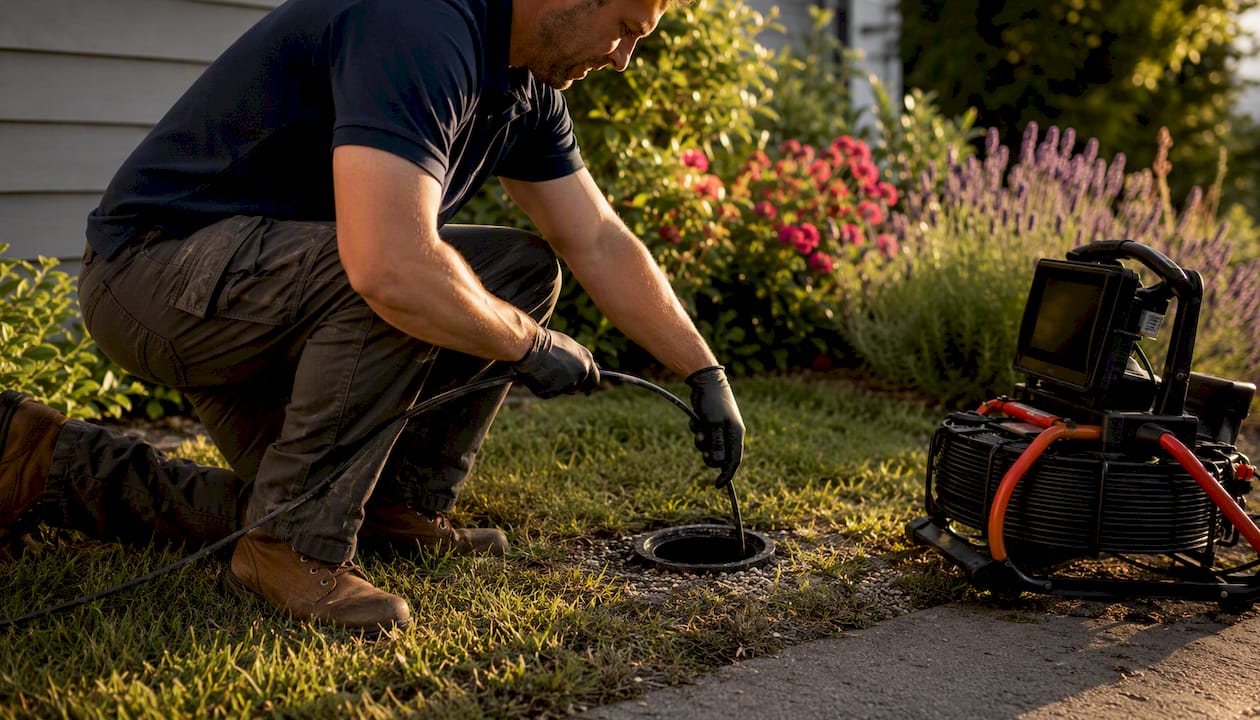
- Video camera inspection: A flexible camera is fed through a cleanout into the lateral or main line. Cracks, root intrusion, pipe sags, and joint failures show up in real time. This is usually the first diagnostic step for any sewer line issue.
- Hydro-jetting: High-pressure water clears root intrusion and grease buildup; it also reveals whether a pipe holds pressure after cleaning, which helps confirm structural integrity.
- Line locators and sonic leak detectors: Electronic locators trace the pipe’s path underground so the camera footage can be matched to a precise yard location.
- Smoke or tracer gas testing: Non-toxic smoke or an inert tracer gas is introduced into the system. It exits wherever there’s a breach — including vent blockages, cracked laterals, and failed joints that cameras can’t reach.
- Soil probes and drainfield assessment: A probe inserted into the drainfield trenches reveals whether effluent is surfacing below grade before it becomes visible above ground.
- Confined-space tank inspection: A licensed technician with proper safety equipment inspects baffles, inlet and outlet pipes, and tank walls for cracks.
Pro Tip: Same-day inspection while the odor is actively present is the most diagnostically useful timing. A technician who can observe active surfacing, run a smoke test while conditions are replicating the problem, or camera the line during a rain event will find the source faster than one working from a description two weeks later.
The full sewer repair process — from camera inspection through trenchless lining or excavation — typically moves faster when the diagnostic visit happens close to the smell event.
Environmental impact and local regulations related to sewage leaks
Surfacing sewage isn’t just a nuisance. Raw effluent contains pathogens — bacteria, viruses, and parasites — that contaminate soil and can reach groundwater, nearby wells, or surface water. The EPA classifies untreated sewage discharge as a public health and environmental violation, and most states require homeowners to report and remediate active sewage surfacing.
In Pennsylvania, the Department of Environmental Protection (DEP) regulates on-lot sewage systems under the Pennsylvania Sewage Facilities Act. A failing drainfield or cracked lateral that allows effluent to surface can trigger a notice of violation, mandatory repair timelines, and fines. Local municipalities may also have ordinances requiring inspection within a set number of days of a reported odor complaint.
Beyond the regulatory side, a sewage leak near a property line can affect neighbors’ wells and create liability. Documenting the problem — dates, photos, weather conditions — protects you if a dispute arises and gives a contractor the evidence needed to support a permit application for repairs.
Long-term consequences of ignoring sewage smells in wet yards
Letting a sewage odor go uninvestigated is one of the more expensive decisions a homeowner can make. What starts as a cracked inspection port cap or an overdue pump-out can escalate into a full drainfield replacement within a few seasons if effluent continues saturating the soil.
A failing drainfield can’t be “fixed” by pumping alone once the soil is biomat-clogged. At that point, replacement is the only option — a significantly larger expense than the earlier repair would have been. Timely sewer repair consistently prevents that escalation.
There’s also the property value dimension. A failed septic system or documented sewer lateral breach must be disclosed in most states during a home sale. Buyers and their inspectors will find it, and the negotiation hit is typically larger than the repair cost would have been. Beyond finances, persistent exposure to low-level hydrogen sulfide — even at concentrations below the acute danger threshold — can cause chronic headaches, fatigue, and respiratory irritation in household members spending time near the affected area.
Why the “wait and see” approach almost always costs more
Most homeowners who contact a plumber about a wet yard sewage smell describe the same pattern: they noticed it once after a heavy rain, assumed it would go away, and called six months later when the drains started backing up. By that point, what was likely a pump-out or a lateral repair has become a camera inspection, a hydro-jet, and sometimes excavation.
The smell is the early warning. A sewer system is designed as a closed loop vented through roof stacks — any outdoor odor means the loop is breached. The ground is not a safe filtration endpoint for raw sewage, and the longer effluent saturates the drainfield soil, the harder and more expensive the recovery becomes.
Document the first event. If it happens twice, call a plumber. That sequence is almost always cheaper than the alternative.
Persistent wet yard sewage smell? Ag-plumbing can help
Thirty years of plumbing experience in Pittsburgh, PA means the Ag-plumbing team has diagnosed every version of this problem — from a cracked inspection port cap to a collapsed lateral under a driveway. When the smell in your yard isn’t going away on its own, the fastest path to a fix is an on-site inspection while the conditions are replicating the problem.

Ag-plumbing offers camera inspection of sewer laterals, septic tank inspection and pump-out coordination, hydro-jetting, trenchless pipe lining, and full excavation and repair for Pittsburgh-area homeowners. When you call, have ready: the timing of the smell, whether it follows rain, the location on the yard, and when the tank was last pumped. That information cuts diagnostic time significantly.
Book an inspection with a licensed Ag-plumbing technician, or visit Ag-plumbing to learn more about local service coverage and repair options.
Sources
Trusted references for homeowners who want more technical detail or need documentation for contractor conversations:
- Outdoor septic odor causes and solutions | Onsite Sewage Treatment Program
- Septic Smell in Your Yard? 8 Causes and How to Fix Each One | The Septic Guide
- Septic Smell After Heavy Rain: Causes and Fixes
- Why Does My House Smell Like Sewer Gas? (And How to Fix It) | Oatey
- Sewer gas – Wikipedia
This article is general information, not a substitute for advice from a qualified doctor. Consult a qualified healthcare professional about your own circumstances before acting on anything here.
FAQ
Why does my yard smell like sewage after heavy rain?
Heavy rain saturates the drainfield, reducing its ability to absorb effluent and pushing gases to the surface. Most post-rain odors resolve within 1–3 days; if the smell persists or you see soggy soil over the leaching bed, the drainfield may be failing.
What kills sewer smell outside?
The only lasting fix is correcting the source: pumping an overdue tank, replacing a cracked lid, repairing a broken lateral, or restoring a failing drainfield. Temporary measures like refilling dry traps or clearing a blocked vent stack help when those are the cause, but bleach and chemical additives don’t address structural failures.
Can sewer smell be toxic?
Yes. Sewer gas contains hydrogen sulfide, which causes respiratory irritation at moderate concentrations and can cause loss of consciousness at high levels. Methane is also present and is flammable. If anyone in the household shows dizziness, nausea, or fainting near the affected area, treat it as an emergency.
Will a sewer smell go away on its own?
Sometimes — a post-rain odor from temporary drainfield saturation often clears within 24–48 hours. A persistent or localized smell, one that returns with every rain, or one accompanied by slow drains or visible wet patches almost never resolves without a repair.
Recommended
- Sewer Line Warning Signs Every Homeowner Should Know – AG-Plumbing
- How Sewer Repair Can Prevent Major Plumbing Problems – AG-Plumbing
- Emergency Plumbing Guide: Quick Solutions for Homeowners – AG-Plumbing
- Understanding the Sewer Repair Process From Start to Finish – AG-Plumbing
