
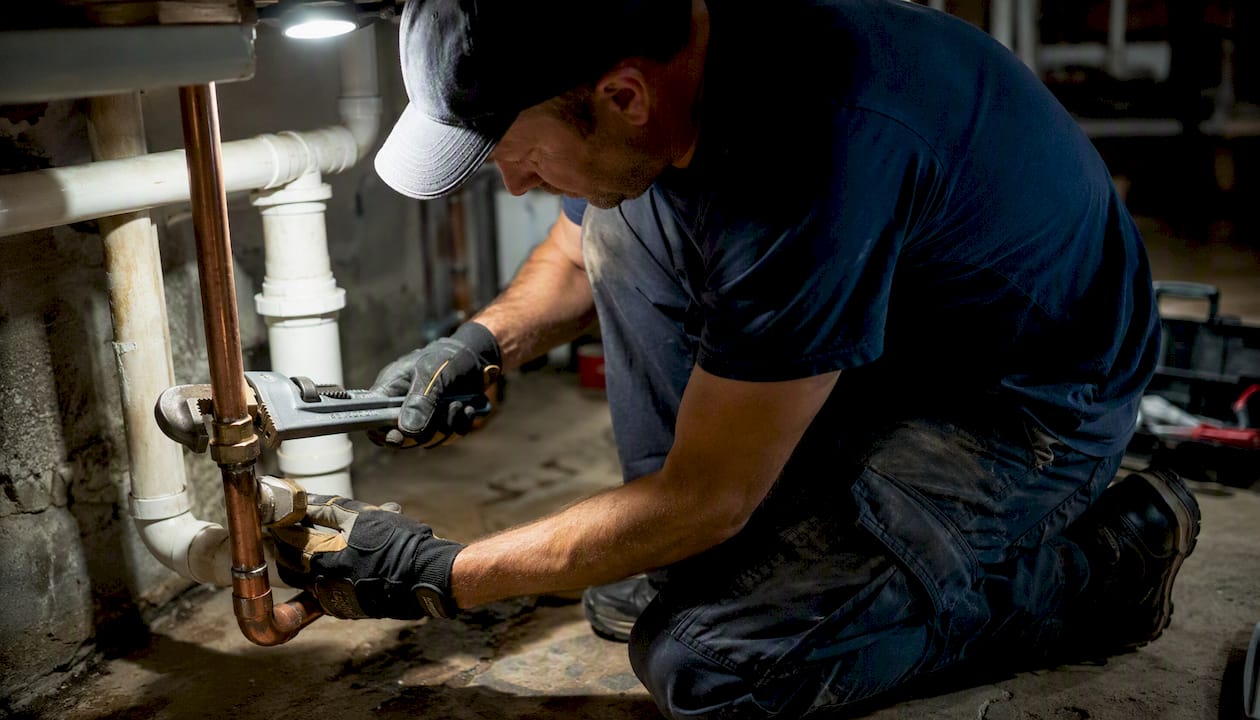
A plumber (pronounced PLUM-er) is a skilled tradesperson who installs, repairs, and maintains piping systems for potable water, drainage, and sewage in residential and commercial buildings. The Cambridge English Dictionary defines a plumber as “a person whose job is to supply, connect, or repair water pipes, baths, toilets, etc.” In the U.S., the Bureau of Labor Statistics classifies plumbers alongside pipefitters and steamfitters under construction and extraction occupations. The word itself traces back to the Latin plumbum, meaning lead — the metal Romans used to make pipes. That origin is why the trade is still called plumbing even though lead pipes largely disappeared from American homes decades ago.
Key Takeaways
A plumber is a licensed tradesperson who installs, repairs, and maintains water, drainage, and sewage systems — a role rooted in Latin plumbum (lead) that has evolved far beyond its metalworking origins.
| Point | Details |
|---|---|
| Core definition | A plumber installs, repairs, and maintains piping for potable water, drainage, and sewage in buildings. |
| Etymology | The word traces to Latin plumbum (lead); plumbers were originally lead-workers before the trade shifted to water systems. |
| Trade distinctions | Plumbers handle building water/waste systems; pipefitters and steamfitters work on industrial, high-pressure, or process piping. |
| U.S. licensing path | The typical route runs apprentice → journeyman exam → master plumber exam; requirements vary by state. |
| Public health role | Plumbers prevent contamination through backflow prevention, proper waste-line sealing, and code-compliant installations. |
Table of Contents
- What does a plumber do day to day?
- Where do plumbers work and what materials do they use?
- How does a plumber differ from a pipefitter or steamfitter?
- Why are they called plumbers? The Latin origin explained
- How does someone become a licensed plumber in the U.S.?
- Why plumbers protect more than your pipes
- How is the word “plumber” used in everyday sentences?
- What to expect when a professional plumber visits your home
- What the trade’s history tells us about its future
- Sources
- FAQ
What does a plumber do day to day?
The plumber job description covers far more than fixing a dripping faucet. According to the BLS Occupational Outlook Handbook, core duties include:
- Installing, altering, and repairing pipe systems that carry water, steam, air, or other fluids
- Repairing leaks, replacing worn fittings, and clearing clogged drains
- Installing and servicing fixtures: sinks, toilets, showers, water heaters, and dishwashers
- Reading blueprints and building plans to map pipe routes before construction begins
- Preparing cost estimates and pulling permits for new installations
- Handling sewer line repairs, septic system work, and backflow prevention devices
- Using specialized tools including drain snakes, press-fitting tools, pipe cutters, and welding torches
Some plumbers also specialize in gas line work, radiant heating systems, or medical-gas piping in hospitals. The common plumbing repair issues a homeowner encounters — burst pipes, running toilets, water heater failures — all fall squarely within a licensed plumber’s scope.
Where do plumbers work and what materials do they use?
Plumbers show up wherever pipes run, which is essentially everywhere.
Primary work environments:
- Single-family homes and apartment buildings (residential service and new construction)
- Office buildings, hospitals, schools, and retail spaces (commercial construction and maintenance)
- Industrial facilities and municipal water treatment plants
- Active construction sites, often working alongside electricians and HVAC contractors
Materials on the job today:
- Copper — still the standard for supply lines in many older homes; durable and corrosion-resistant
- PVC and CPVC — common for drain lines and some supply applications; lightweight and affordable
- PEX (cross-linked polyethylene) — flexible tubing that has largely replaced copper in new residential construction because it resists freezing better and installs faster
Lead pipe is historically significant — Romans built entire aqueduct systems with it — but it is rarely encountered in new work. When a plumber does find lead supply lines during a renovation, replacement is the standard recommendation given the well-documented health risks.
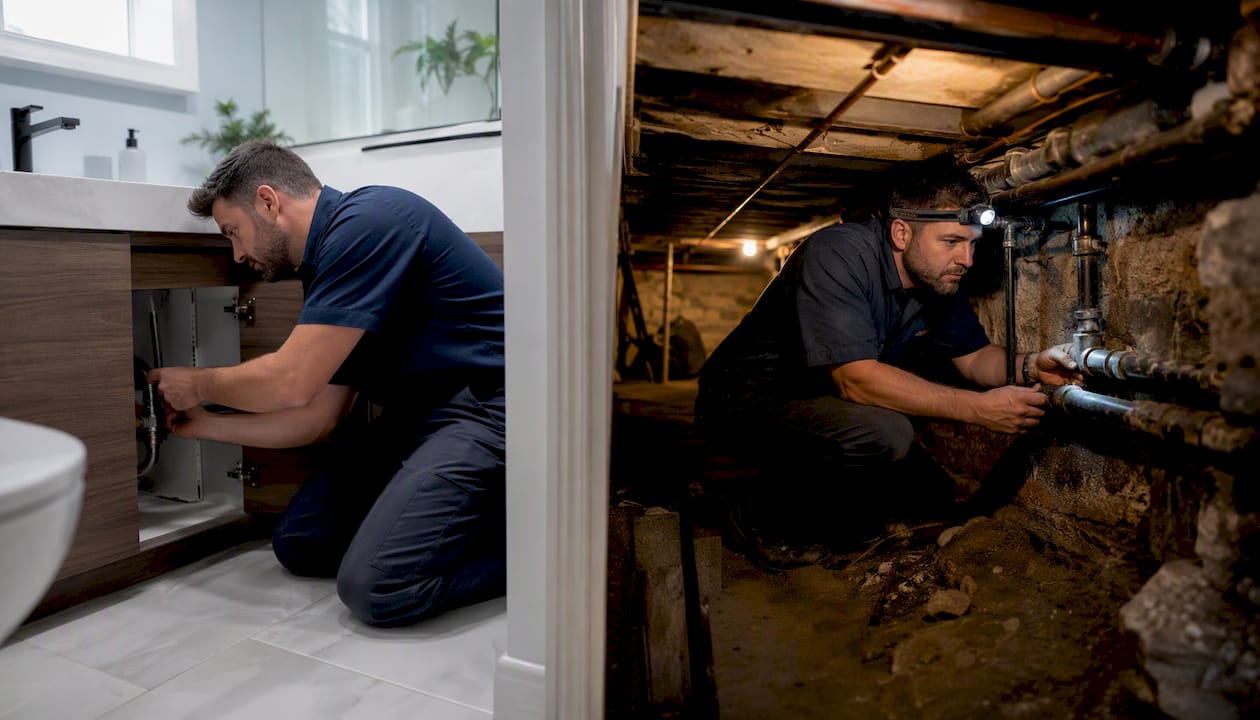
Job site conditions vary sharply. One day a plumber is working in a finished kitchen; the next, they’re in a crawlspace or digging a trench for a sewer lateral. A homeowner plumbing checklist can help you track which systems in your home may need attention before a problem surfaces.
How does a plumber differ from a pipefitter or steamfitter?
The trades overlap enough to cause real confusion, but the distinctions matter when you’re pulling a permit or hiring for a specific job.
According to the BLS, plumbers focus on potable water supply, drainage, and sewage systems inside buildings. Pipefitters and steamfitters work primarily on industrial and commercial piping that carries chemicals, gases, or high-pressure steam — think power plants, refineries, and large HVAC systems in skyscrapers.
Quick comparison:
- Plumber: residential and commercial water/waste systems, building codes, fixture installation
- Pipefitter: industrial process piping, high-pressure systems, power generation facilities
- Steamfitter: high-pressure steam and hot-water heating systems, often in large commercial or industrial settings
- Gasfitter: natural gas and propane lines (in many states, a separate license is required even for licensed plumbers)
The O*NET classification 47-2152.00 groups all three under one occupational code but lists distinct sample job titles and task sets for each.
Pro Tip: For any residential repair or new installation — a new bathroom, water heater replacement, or sewer line fix — your municipality almost certainly requires a licensed plumber, not a pipefitter. Check your local building department before hiring anyone; using the wrong trade can void a permit and create liability.
Why are they called plumbers? The Latin origin explained
The word’s history is one of the more interesting detours in the English language. As Andy Hollandbeck explains in the Saturday Evening Post, the chain runs: Latin plumbum (lead) → plumbārius (a worker in lead) → Old French plomier → Middle English plumber.
A brief timeline:
- Ancient Rome: Lead pipes, called fistulae plumbeae, carried water throughout Roman cities. The workers who made and maintained them were plumbarii.
- Medieval Europe: A plumber was a craftsman who worked lead into roofing, gutters, and decorative goods — not specifically a water-systems worker. The Middle English Dictionary records plomier and related forms with this broader lead-working sense.
- Late 19th century: Indoor plumbing spread rapidly across American cities. The trade shifted from lead-work generally to water and sewage systems specifically, and the word narrowed with it.
- Early 20th century: Etymonline documents that “plumbing” as a term for water and drainage systems became standard American English during this period.
The irony is sharp: the trade shed lead as a primary material but kept the name. Today’s plumber is far more likely to work with PEX or copper than with the metal that gave the profession its identity.
How does someone become a licensed plumber in the U.S.?
Licensing requirements vary by state and sometimes by municipality, but the typical path follows a clear progression:
- Entry-level helper or pre-apprentice — work alongside journeymen, learn basic tools and safety
- Apprenticeship (4–5 years) — usually through a union program (UA Local) or employer-sponsored apprenticeship; combines on-the-job hours with classroom instruction in codes, math, and blueprint reading
- Journeyman plumber exam — a written and sometimes practical exam administered by the state or local licensing board; passing grants a journeyman license to work independently under supervision
- Master plumber exam — requires additional years of journeyman experience; a master license allows a plumber to pull permits, run a business, and supervise others
- Continuing education — many states require periodic CE credits to renew a license, especially when codes update
Because licensing scope, required hours, and exam content differ across states, always verify current requirements with your state’s contractor licensing board. A license valid in Pennsylvania may not transfer automatically to Ohio.
Why plumbers protect more than your pipes
Plumbing work sits at the intersection of construction and public health. The BLS highlights that plumbers prevent contamination by installing backflow prevention devices, properly sealing waste lines, and eliminating cross-connections between potable and non-potable water supplies.
Safety-critical tasks that go beyond basic repairs:
- Backflow preventer installation and testing (prevents sewage or chemicals from entering the drinking supply)
- Water heater installation with proper pressure-relief valves and venting
- Sewer line repair and replacement to prevent ground contamination
- Gas line work where licensed (improper connections cause fires and carbon monoxide exposure)
Statistic callout: The BLS Occupational Outlook Handbook notes that plumbers, pipefitters, and steamfitters held a substantial number of jobs in the U.S., with employment projected to grow as aging infrastructure requires replacement and new construction continues.
Proper permitting and code compliance aren’t bureaucratic hurdles — they’re the mechanism that ensures a licensed professional has verified the work meets health and safety standards. Learn more about plumbing’s role in protecting home health and why it matters for Pittsburgh homeowners specifically.
How is the word “plumber” used in everyday sentences?
The Cambridge Dictionary provides a clean model: “a person whose job is to supply, connect, or repair water pipes, baths, toilets, etc.” Here’s how the word appears in natural usage:
- “We called a plumber after the kitchen drain backed up for the third time.”
- “The plumber installed a new water heater and had it running within two hours.”
- “Our building’s plumbing contractor handles all the commercial units in the complex.”
- “She’s studying to become a licensed plumbing technician after finishing her apprenticeship.”
- “The city inspector required a licensed plumber to sign off on the bathroom addition.”
Related terms and their nuances:
- Plumber — the standard term for a licensed tradesperson in the U.S.
- Plumbing contractor — typically a licensed master plumber or a business entity that holds a contractor’s license; used in commercial and legal contexts
- Plumbing technician — a job title sometimes used by employers for journeyman-level workers; not a standardized license category in most states
- Pipefitter — related but distinct; implies industrial or high-pressure work rather than residential water systems
In informal American English, “plumber” occasionally appears in political slang (the Nixon-era “White House Plumbers” were so named because they were tasked with stopping leaks), but the occupational meaning is overwhelmingly dominant.
What to expect when a professional plumber visits your home
A well-run service call follows a consistent workflow, whether the job is a clogged drain or a full sewer repair.
- Arrive and inspect: The plumber walks the affected area, asks about symptoms and history, and locates shutoff valves before touching anything.
- Diagnose with tools: Drain cameras, leak detection equipment, and pressure gauges identify the exact problem rather than guessing.
- Present an estimate and permit needs: For significant work, a written estimate comes before any repair begins. Permit requirements are flagged at this stage.
- Perform the repair: Work is done with minimal disruption; a professional protects floors and cabinets and cleans up afterward.
- Test and document: Water is turned back on, pressure is checked, and the repair is verified before the plumber leaves.
Ag-plumbing has served Pittsburgh, PA and the surrounding areas for 30 years. That depth of local experience means the team knows Pittsburgh’s older housing stock, common pipe materials by neighborhood, and the permit requirements of local municipalities. For residential and commercial jobs alike, Ag-plumbing’s plumbing repair services cover everything from a leaking fixture to a full sewer line replacement.
If you’re in Pittsburgh or the surrounding area and need a licensed plumber, contact Ag-plumbing for a diagnostic visit backed by three decades of local experience.
What the trade’s history tells us about its future
The word “plumber” has outlasted the material that created it. Lead is gone from modern pipe systems, but the title stuck because the function — moving clean water in and waste water out — never changed. What strikes me about the etymology is how it exposes a bias in how we think about skilled trades: people assume the job is simple because the tools look familiar. A drain snake looks less impressive than a surgical instrument, but the diagnostic process a good plumber runs before touching a pipe is genuinely methodical. They’re reading pressure, flow, and camera footage the way a technician reads data.
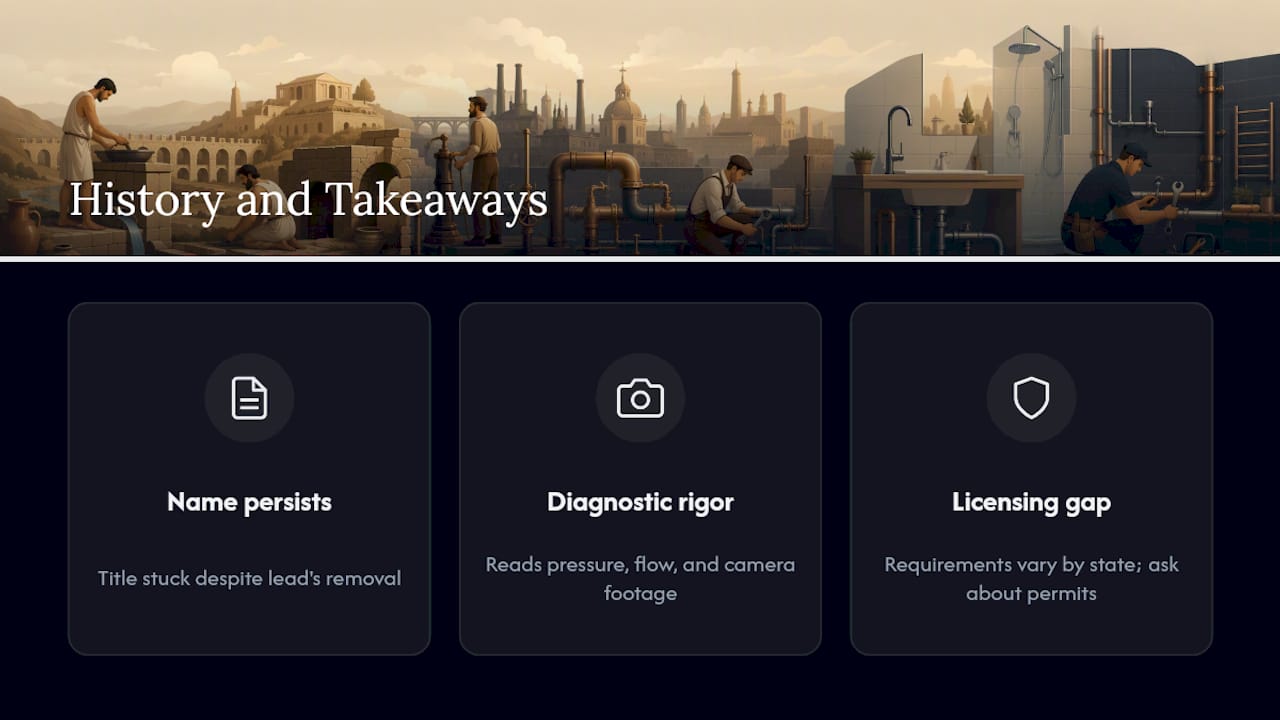
The licensing gap is the part most homeowners underestimate. Because requirements vary so sharply by state, a “licensed plumber” in one jurisdiction may have cleared a very different bar than one in another. That’s not a knock on the trade — it’s an argument for asking your contractor specifically which license they hold and whether it covers the permit your job requires. The permit isn’t paperwork for its own sake; it’s the checkpoint that puts a licensed professional’s name on the work.
Sources
- Plumbers, Pipefitters, and Steamfitters : Occupational Outlook Handbook: : U.S. Bureau of Labor Statistics
- In a Word: Plumbers’ Heavy Metal Past | The Saturday Evening Post
- 47-2152.00 – Plumbers, Pipefitters, and Steamfitters
- PLUMBER | definition in the Cambridge English Dictionary
- Plumb – Etymology, Origin & Meaning
FAQ
What does “plumber” mean in slang?
The most notable slang use comes from the Nixon administration’s “White House Plumbers,” a covert unit named for their job of stopping political leaks. Outside that historical reference, “plumber” in American English almost always refers to the licensed trade professional.
What is a synonym for plumber?
The closest synonyms are plumbing contractor (used in commercial and legal contexts) and plumbing technician (an employer job title for journeyman-level workers). Neither is a perfect substitute — “plumber” remains the standard U.S. term for the licensed tradesperson.
What does “Plummer” mean, and is it the same word?
Plummer is a surname derived from the same Old French root (plomier) as the occupational word “plumber.” As a last name it simply means a descendant of someone who worked in lead; it is not a separate occupational term in modern English.
What is the old name for a plumber?
The historical term was plumbarius in Latin and plomier in Old French, both meaning a worker in lead. In medieval English, the word appeared as plummer or plomber before settling into the modern spelling “plumber.”
Recommended
- Plumbing unions in Pittsburgh: what they are and why they matter – AG-Plumbing
- What Is Plumbing and Why It Matters for Homeowners – AG-Plumbing
- What Is Plumbing and Why It Matters for Homeowners – AG-Plumbing
- What do professional plumbers do in Pittsburgh? 2026 – AG-Plumbing
