

Google Business Profile is the strongest single replacement for Yelp across most use-cases, but no one platform covers everything Yelp does. Here is the short version before the full breakdown:
- Best for local search and discovery: Google Business Profile / Google Reviews
- Best for hyperlocal neighbor recommendations: Nextdoor
- Best for restaurants and travel: TripAdvisor or OpenTable
- Best for home-services leads: Angi (formerly Angie’s List) or HomeAdvisor
- Best for employer reputation: Glassdoor
- Best for business accreditation and complaints: Better Business Bureau (BBB)
No single platform fully replaces Yelp. Each site draws a different audience, enforces different moderation policies, and offers a different set of tools for business owners. The right answer depends on what you are trying to accomplish.
Pro Tip: If you only have time to claim one profile, make it Google Business Profile. GBP signals account for a significant portion of Local Pack ranking decisions, and most consumers check Google before anywhere else.
Key Takeaways
Google Business Profile is the single highest-priority platform for any US local service business, accounting for roughly 32% of Local Pack ranking decisions and reaching the broadest consumer audience.
| Point | Details |
|---|---|
| Start with Google Business Profile | GBP signals drive roughly 32% of Local Pack rankings; claim and complete it first. |
| Match platform to use-case | Use TripAdvisor for restaurants, Nextdoor for hyperlocal trades, Angi for contractor leads. |
| NAP consistency matters | Identical name, address, and phone across every directory protects your local SEO signals. |
| Moderation quality varies | Google and Trustpilot have active fraud detection; smaller directories like Manta have minimal oversight. |
| Ag-plumbing for Pittsburgh | Ag-plumbing offers direct local plumbing services in Pittsburgh without directory lead fees or middlemen. |
Table of Contents
- How the top Yelp.com alternatives compare at a glance
- Short profiles for every major Yelp alternative
- How to choose the right platform for your situation
- How these alternatives were selected
- Who uses each platform and how trustworthy are the reviews?
- Why a diversified review presence matters more than most local businesses realize
- Ag-plumbing: Pittsburgh’s local alternative to directory-based hiring
- Sources
- FAQ
How the top Yelp.com alternatives compare at a glance
The table below covers the platforms most commonly recommended as Yelp alternatives for business reviews. Pricing reflects publicly available tiers; always check the platform directly for current rates.
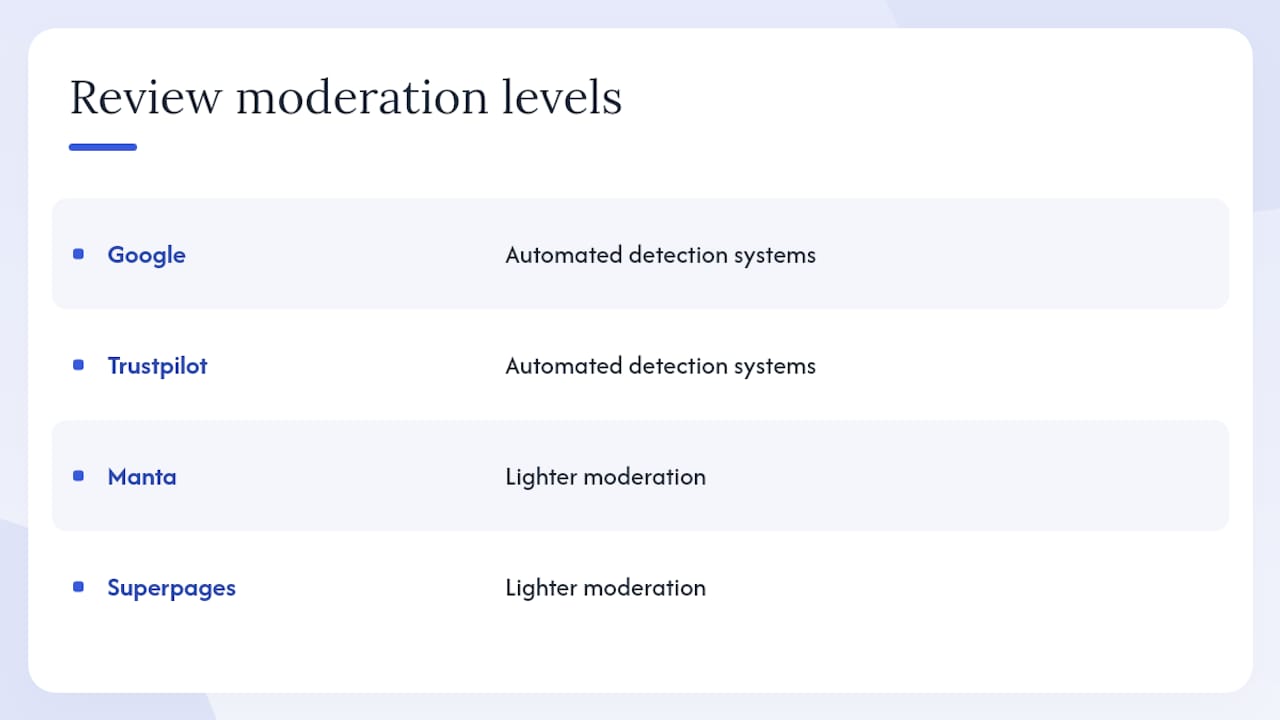
A note on review authenticity: platforms vary significantly in how they handle fake or incentivized reviews. Google and Trustpilot both have automated detection systems, while smaller directories like Manta and Superpages have lighter moderation. Consumers should treat reviews on lightly moderated platforms with more skepticism, and business owners should never solicit reviews in exchange for discounts or gifts, which violates most platforms’ terms of service.
Short profiles for every major Yelp alternative
The platforms below are grouped loosely by use-case. Each entry covers what the platform does, who it suits, and the basics of claiming or managing a business profile.
Google Business Profile / Google Reviews
The default starting point for any local business. Complete Business Profiles are more likely to appear in local searches because Google ranks local results on relevance, distance, and popularity. For service-area businesses like plumbers, you can hide your physical address and set a service area instead, which is critical for home-service providers who work from a van rather than a storefront.
Claiming a profile: Search your business name on Google Maps, click “Claim this business,” verify via postcard or phone, then fill every field including hours, services, and photos.
Free to use. Local Services Ads are a separate paid product. Mobile app available (Google Maps / Google Business Profile app). Integrates with Google Analytics and most CRM tools via API.
Facebook Page reviews
Works best when your customers already use Facebook to find local recommendations. The review tab on a Facebook Business Page lets customers leave star ratings and written feedback. Engagement is higher when you post regularly and respond to reviews publicly.
Claiming: Create or claim a Facebook Business Page, enable the Reviews tab in Page settings, and respond to every review within 48 hours to signal active management.
Free. Paid advertising is separate. Mobile app available. Integrates with many social scheduling tools including Hootsuite and Buffer.
TripAdvisor
Dominant for restaurants, hotels, and tourist attractions. If you run a restaurant, a TripAdvisor listing is close to mandatory. The platform draws a travel-intent audience, so it is less useful for plumbers or contractors but very useful for hospitality.
Claiming: Go to the TripAdvisor Management Center, search your property, and follow the verification steps. Paid Business Advantage unlocks priority placement and enhanced analytics.
Free basic listing; paid Business Advantage tier available. Strong mobile app. Limited CRM integrations.
Nextdoor
Neighbors recommending neighbors. Nextdoor’s trust signal is unusually strong because reviewers are verified local residents, not anonymous internet users. For a plumber or contractor, a handful of Nextdoor recommendations in a specific ZIP code can drive more calls than dozens of Yelp reviews.
Claiming: Visit Nextdoor’s business portal, create a free Business Page, and post in relevant neighborhoods. Paid “Local Deals” ads extend reach.
Free business page; paid neighborhood ads available. Mobile app available. Limited third-party integrations.
Angi (formerly Angie’s List) and HomeAdvisor
Both platforms sit in the same ecosystem after the Angi/HomeAdvisor merger. Angi focuses on pre-vetted contractor listings and consumer research; HomeAdvisor leans toward lead matching and quote requests. For home-service businesses, these are among the highest-intent platforms available because visitors are actively looking to hire.
Claiming: Create a free profile on Angi.com, verify your license and insurance, and opt into paid lead plans if you want matched job requests. HomeAdvisor operates similarly under the same parent company.
Free listing; paid lead fees vary by job type and market. Mobile apps available. Integrates with some CRM tools.
Better Business Bureau (BBB)
The BBB is less a review site and more a trust signal. Consumers who check the BBB are usually researching a business after a problem or before a large purchase. BBB accreditation costs money but signals commitment to complaint resolution, which matters for service businesses where disputes occasionally happen.
Claiming: Search your business at bbb.org, claim the profile, and respond to any existing complaints. Accreditation requires an application and annual fee.
Free profile; paid accreditation. No mobile app for business management. Limited integrations.
Trustpilot
Trustpilot is widely used for brand and service reviews, particularly for online-first businesses and subscription services. It is less common for local tradespeople but useful for any business that wants a public, embeddable review widget on its website.
Claiming: Register at trustpilot.com, verify your domain, and use the free plan to invite customers via email. Paid plans unlock automated review requests and advanced analytics.
Free plan available; paid plans for automation and branding. Mobile app available. API integrations with Salesforce, HubSpot, and others.
ConsumerAffairs
Complaint-heavy by design. Consumers typically land on ConsumerAffairs when researching a service brand after seeing a problem mentioned elsewhere. Paid accreditation gives businesses a response channel and a verified badge.
Free profile visible publicly; paid accreditation required for full response tools. No dedicated mobile app. Limited integrations.
Foursquare
Foursquare’s consumer app has a smaller audience than it once did, but its venue data feeds dozens of other apps and mapping tools. Claiming your Foursquare listing helps ensure your business data is accurate across the broader location-data ecosystem.
Claiming: Visit foursquare.com/business, search your venue, and claim it. Free. Mobile app available. Data feeds into Apple Maps, Uber, and other platforms.
Glassdoor
Glassdoor is for employer reputation, not consumer reviews. If you are hiring, your Glassdoor profile matters. Job candidates check it before accepting offers, and negative reviews from former employees can hurt recruiting even when your consumer reviews are strong.
Free basic profile; paid employer branding plans available. Mobile app available. Integrates with LinkedIn and some ATS platforms.
G2 and Capterra
Both platforms are for software and B2B service reviews. If you sell software or a SaaS product, Capterra and G2 are where buyers look. Neither is relevant for local service businesses like plumbers or restaurants. Free listings available on both; paid sponsored placements increase visibility.
OpenTable
For restaurants that take reservations, OpenTable combines booking with review collection. Diners who book through OpenTable are verified guests, which makes the reviews more trustworthy than open platforms. Paid subscription required.
Smaller directories: Judy’s Book, Manta, Merchant Circle, Superpages, VendOp, ServiceOrca.com
These directories offer additional listing exposure and are worth claiming for NAP (name, address, phone) consistency, which supports local SEO. None of them drive significant direct traffic on their own, but inconsistent business information across directories can hurt your Google rankings. Claim them, fill in accurate contact details, and move on. ServiceOrca.com also appears in alternative listings as a discovery resource.
Instagram and Twitter
Neither platform is a review site in the traditional sense, but both generate public customer feedback. Instagram works well for restaurants, salons, and businesses with strong visual content. Twitter (now X) is where customer service complaints go public fast. Claim your business handles on both, respond to mentions, and treat them as reputation channels rather than review platforms.
Business tip for home-service providers: Prioritize Google Business Profile, Nextdoor, and Angi before spending time on smaller directories. Those three platforms drive the highest-intent traffic for plumbers, HVAC technicians, and contractors. Tools like Birdeye and Broadly can automate review requests across multiple platforms once your core profiles are claimed.
Pro Tip: Keep your NAP (name, address, phone number) identical across every platform. Even small differences, like “St.” vs. “Street,” can fragment your local SEO signals and suppress your Google map pack ranking.
How to choose the right platform for your situation
For consumers
- Start with Google Reviews for any local business search. The volume of reviews and the integration with Google Maps makes it the most practical first stop.
- Use TripAdvisor specifically for restaurants, hotels, and travel experiences where the audience is large and review volume is high.
- Check Nextdoor for hyperlocal service recommendations, especially for tradespeople. Neighbor-verified reviews carry more weight than anonymous ones.
- Use the BBB when you want to check complaint history and resolution records before hiring a contractor or service company.
- Use Glassdoor only when evaluating an employer, not a consumer service.
For business owners
- Claim your Google Business Profile first. It is free, it directly influences your local pack ranking, and it is where most of your customers will look.
- Claim Nextdoor, Angi, and Facebook next if you are in home services or a local trade.
- Add TripAdvisor if you run a restaurant or hospitality business.
- Claim BBB if your customers tend to be older or more trust-focused buyers who research accreditation before hiring.
- Set up Trustpilot or ConsumerAffairs if you want an embeddable review widget or serve customers who research online before buying.
Red flags to watch for:
- Platforms that charge you to respond to negative reviews (pay-to-play moderation)
- Directories with no visible claiming workflow or owner verification
- Sites where review counts are suspiciously high with no variation in language or rating
- Platforms that do not disclose their fake-review detection policies
How these alternatives were selected
Platforms on this list were chosen to use four filters: US availability, primary audience fit (consumer vs. B2B vs. employer), presence of a business claiming and response workflow, and appearance in top-ranking SERP results for Yelp alternatives. Platforms that serve only non-US markets or that lack any business management tools were excluded.
Selection criteria used:
- Confirmed US availability and active user base
- Presence of a business profile claiming workflow
- Documented moderation or fake-review detection policy
- Appearance in multiple authoritative Yelp-alternative roundups
- Mobile app availability for consumer use
- Integration capabilities with common CRM or marketing tools
Pricing and features change frequently. Always verify current plans directly on each platform before committing to a paid tier. Regional differences in lead pricing (particularly on Angi and HomeAdvisor) can be significant.
Who uses each platform and how trustworthy are the reviews?
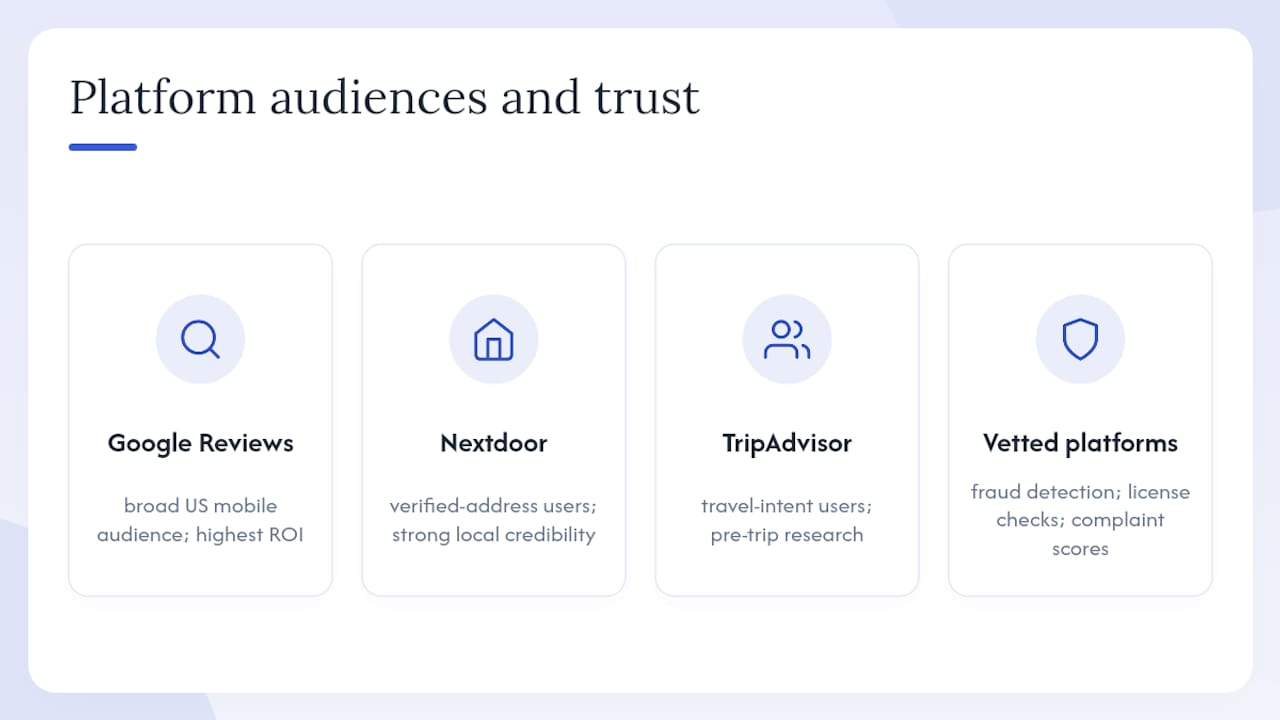
User demographics and review authenticity vary more than most people realize. Google Reviews draws the broadest US audience, skewing toward mobile users conducting local searches. TripAdvisor’s core users are travel-intent consumers, often researching before a trip rather than in the moment. Nextdoor’s verified-address requirement makes its user base genuinely local, which is why neighbor recommendations there tend to feel more credible than on open platforms.
Trustpilot uses automated fraud detection and publishes its trust and transparency reports publicly. Angi screens contractors for licensing and insurance before featuring them prominently, which adds a layer of vetting beyond raw review counts. The BBB’s model is different again: its ratings reflect complaint history and responsiveness, not star ratings from consumers, so a business with no complaints and no reviews can still carry an A+ rating.
Smaller directories like Manta, Superpages, and Merchant Circle have minimal moderation. Reviews there are sparse and often outdated. They are worth claiming for citation consistency, but a consumer researching a business should weight them far below Google, Trustpilot, or Angi.
Instagram and Twitter reviews are informal and unstructured. A viral negative post on either platform can outweigh dozens of positive reviews elsewhere, which is why monitoring brand mentions on social platforms matters even if you do not actively solicit reviews there.
Google-focused review management tools tend to deliver the highest ROI for local businesses because the majority of local-search influence lives on Google. That does not mean ignoring other platforms, but it does mean Google should get the most attention and the most consistent review-request effort.
Why a diversified review presence matters more than most local businesses realize
Most local service businesses treat reviews as a passive outcome: jobs get done, reviews trickle in, and the star rating goes up or down. That is the wrong frame. Reviews are an active acquisition channel, and the platforms where they live directly determine whether a new customer finds you or your competitor.
GBP signals account for a significant portion of Local Pack ranking decisions. Many profiles remain incomplete. That gap is an opportunity. A fully optimized Google Business Profile with recent reviews, accurate service categories, and consistent NAP will outrank a competitor with more years in business but a neglected profile.
The practical priority for a home-service business in Pittsburgh or any comparable market: get Google right first, then Nextdoor, then one or two category-specific platforms (Angi for contractors, TripAdvisor for restaurants). A well-designed website with consistent NAP and links to your review profiles reinforces all of those signals. Ag-plumbing’s own customer testimonials page is one example of how a local service business can display verified social proof without depending entirely on third-party platforms.
The businesses that win on reviews are not the ones with the most reviews. They are the ones who ask consistently, respond to every review (positive and negative), and keep their profile information accurate across every platform where they appear.
Ag-plumbing: Pittsburgh’s local alternative to directory-based hiring
The platforms compared above are useful for finding and vetting contractors. Ag-plumbing is the direct alternative for Pittsburgh homeowners who want to skip the directory search entirely and book a trusted local provider with 30 years of experience in the area.
While Angi and HomeAdvisor match you with contractors and charge lead fees that often get passed to the customer, Ag-plumbing offers plumbing repair, drain cleaning, hydro jetting, sewer repair, and more with transparent pricing and no middleman markup. The team serves Pittsburgh and the surrounding areas for residential and commercial jobs.
Schedule a service call with Ag-plumbing today and get a straight answer from a local team that has been doing this work since before most review platforms existed.
Sources
- Manage your Business Profile on Google — Google Business Profile Help
- Local SEO for Service-area Businesses – BrightLocal
- The Best Yelp Alternatives for Business Reviews
- Birdeye — Home services reputation management
- Trustpilot
Pricing, features, and platform policies change regularly. Verify current details directly on each platform before making decisions based on paid tiers or lead costs.
FAQ
What are the best free Yelp alternatives for local businesses?
Google Business Profile, Facebook Page reviews, and Nextdoor all offer free business profiles with review and response tools. Claiming all three costs nothing and covers the majority of US consumers who research local services online.
Does Yelp have a direct competitor for restaurant reviews?
TripAdvisor is the closest direct competitor for restaurant and hospitality reviews, with a large travel-intent audience and a dedicated owner management center. OpenTable serves a similar niche for restaurants that take reservations, combining booking with verified diner reviews.
Which platform should a Pittsburgh plumber prioritize first?
Google Business Profile, because GBP signals account for a significant portion of Local Pack ranking decisions and most homeowners start their contractor search on Google. Ag-plumbing, serving Pittsburgh and surrounding areas, uses its Google and local profiles alongside direct customer testimonials to build trust with new clients.
How do I spot fake reviews on any platform?
Look for reviews with no profile history, identical phrasing across multiple reviews, or a sudden spike in five-star ratings over a short period. Platforms like Google and Trustpilot use automated detection, but no system catches everything. Cross-checking a business across two or three platforms gives a more reliable picture than relying on any single site.
Recommended
- Top 8 bbb.org Alternatives 2026 – AG-Plumbing
- Facebook.com Alternatives for Pittsburgh Plumbers (2026) – AG-Plumbing
- Best MapQuest.com Alternatives for Pittsburgh Homeowners & Plumbers – AG-Plumbing
- Top 3 Ratedpeople.com Alternatives Plumbing Providers 2026 – AG-Plumbing
