
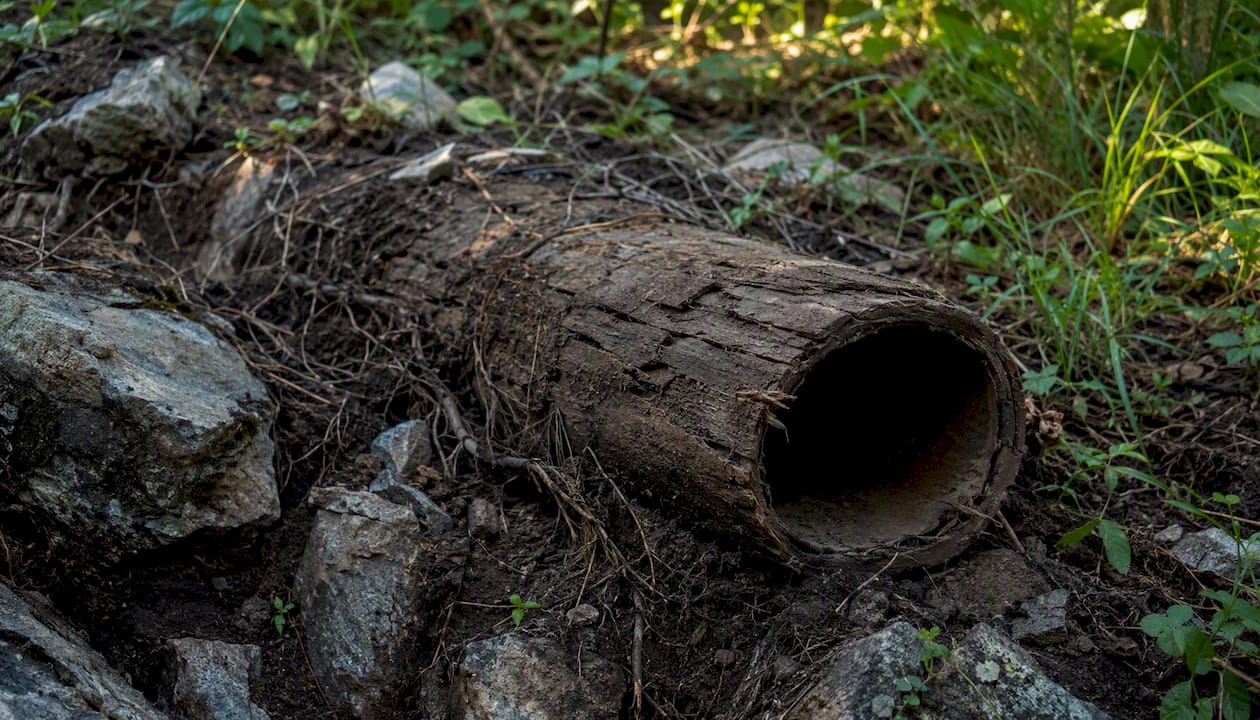
If you suspect your home has an orangeburg pipe in its sewer lateral, schedule a licensed sewer camera inspection before doing anything else. Orangeburg, the common name for bituminized fiber pipe, is a compressed wood-pulp and tar material that was installed in millions of American homes between roughly 1940 and 1970. It was never designed to last forever, and most of it is now well past its expected service life. The only reliable way to know whether it’s in your line, and how badly it has deteriorated, is a CCTV pipe inspection by a licensed plumber. Home age alone won’t tell you. Municipal records often won’t either.
Watch for these warning signs that your sewer lateral may already be failing:
- Recurring sewage backups, especially in lower-level drains
- Slow drains throughout the house, not just one fixture
- Foul odors inside the home or near the yard
- Soggy, sunken, or unusually green patches of lawn above the sewer line path
- Visible root matter when a plumber opens a cleanout
Pro Tip: If you’re experiencing any of these symptoms, don’t run a mechanical snake through the line before getting a camera inspection. Aggressive augering can collapse already-weakened bituminized fiber pipe and turn a manageable repair into a full emergency replacement.
Key Takeaways
Orangeburg pipe is a failed material that has exceeded its service life in most homes, and a licensed sewer camera inspection is the only reliable way to confirm its presence and condition before deciding on repair or replacement.
| Point | Details |
|---|---|
| Inspection first | Camera inspection is the only reliable method to confirm Orangeburg and assess its condition. |
| Lifespan already exceeded | Orangeburg can deform after 30 years; most installed pipe is now well past its 50-year ideal-conditions limit. |
| Asbestos risk is limited | Buried intact pipe poses little airborne risk; hazard opens during excavation and cutting. |
| Replacement is often the only fix | Severely ovalized or collapsed sections cannot be lined; full trench replacement is frequently the permanent solution. |
| Ag-plumbing in Pittsburgh | Ag-plumbing offers CCTV inspection, trench and trenchless replacement, and permit handling for Pittsburgh-area homeowners. |
Table of Contents
- What is Orangeburg pipe and when was it used?
- Why does Orangeburg pipe fail, and what are the symptoms?
- How can you confirm whether your sewer line is Orangeburg?
- Does Orangeburg pipe contain asbestos, and is it a health risk?
- Repair or replace: what are your real options?
- What does Orangeburg pipe replacement typically cost?
- What happens during a replacement job?
- When should you call a plumber, and what should you ask?
- Can you still buy Orangeburg pipe?
- What field experience actually shows about Orangeburg pipe
- Ag-plumbing serves Pittsburgh homeowners with Orangeburg pipe concerns
- Sources
- FAQ
What is Orangeburg pipe and when was it used?
Orangeburg pipe is made from layers of compressed wood pulp and cellulose fibers impregnated with coal-tar pitch, then pressed into a tube shape. The name comes from the Orangeburg Manufacturing Company, based in Orangeburg, New York, which produced the material at scale. The pipe was cheap, lightweight, and easy to cut, which contributed to its popularity during the post-World War II housing boom when metal pipe materials were in demand.
According to InspectApedia, Orangeburg pipe was manufactured in the United States from the late 19th century through to the early 1970s, with production ending by the early 1970s. Its peak installation years were roughly 1940 to 1970, covering the suburban expansion that built tens of millions of American homes. Pipes produced between 1946 and 1970 typically contained asbestos fibers as a reinforcing agent. After 1970, asbestos was replaced by a mineral additive before the plant shut down entirely.
A few key facts about where and how it was installed:
- Used almost exclusively for outdoor building sewer laterals, the pipe running from your home’s foundation to the municipal main
- Governed under Federal Specification SS-P-356 and Commercial Standard CS 116-54 before modern codes phased it out
- Never approved for installation under building foundations; if found under a slab, that’s a non-standard installation requiring urgent evaluation
- Replaced in new construction by PVC and ABS plastic pipe starting in the early 1970s as building codes shifted
Why does Orangeburg pipe fail, and what are the symptoms?
The material’s failure is built into its chemistry. Bituminized fiber pipe absorbs moisture over time, which causes the layers to separate, a process called delamination. As the walls weaken, soil pressure above the pipe causes it to ovalize, meaning it flattens from a round cross-section into an egg shape. That narrowing restricts flow, traps debris, and invites root intrusion. Eventually, sections collapse entirely.
PHC News reports that Orangeburg pipe may begin to deform after decades of use, with its useful lifespan generally considered limited under most conditions. Most of the pipe installed during the postwar boom has already exceeded both thresholds. Chemical exposure from soil conditions, tree roots, and even household drain cleaners accelerates the breakdown further.
Orangeburg pipe is black, tarry in appearance, and soft enough to be cut with a handsaw. That same softness is exactly why it ovalizes under soil load and why a mechanical snake can punch right through a wall that’s already delaminating.
Common homeowner symptoms include:
- Recurring sewer backups, particularly in basement floor drains or first-floor toilets
- Slow drainage across multiple fixtures simultaneously
- Sewage odors inside the home or near the yard
- Soggy or sunken lawn sections directly above the lateral path
- Root matter visible when a plumber opens a cleanout
Pro Tip: Standard mechanical snaking may temporarily clear a clog but can punch through delaminated pipe walls. If your plumber is recommending a snake without a camera inspection first, ask specifically whether Orangeburg is a possibility given your home’s age. Understanding common sewer line warning signs can help you make that call faster.
How can you confirm whether your sewer line is Orangeburg?
Home age is a useful clue, not a diagnosis. Many municipalities don’t keep detailed records of what material was used for individual sewer laterals. As the City of Ann Arbor’s guidance notes, checking whether neighboring properties have already replaced their laterals can be informative, but a camera inspection is the only reliable confirmation.
A sewer camera inspection, also called a CCTV inspection, sends a waterproof camera through the line and records video of the pipe’s interior. A trained plumber can identify Orangeburg on sight: the dark, layered texture, delaminating walls, ovalized cross-section, and joint type are all visible on camera. No other method gives you this picture without digging.
Here’s how to arrange one:
- Call a licensed plumber who offers CCTV sewer inspection services and ask specifically whether they can identify pipe material and condition.
- Locate your cleanout access point, typically a capped pipe near the foundation or in the yard. If you don’t have one, the plumber can access the line through a toilet.
- Ask for a recorded video of the full lateral run, from the house to the municipal connection. A verbal summary is not enough.
- Review the report together. Ask the plumber to identify any ovalization, delamination, root intrusion, joint separation, or collapsed sections.
- Get a written condition assessment that states the pipe material, approximate condition, and a recommendation for repair or replacement.
The City of Tempe’s building safety guidance is direct on this point: camera inspection by a licensed professional is the only reliable method, and guessing based on home age is not a substitute.
Signs an inspector will flag in the video:
- Ovalized or egg-shaped cross-section
- Visible layer separation (delamination) along the pipe walls
- Joint gaps or misalignment
- Root intrusion through wall cracks or joints
- Partial or full collapse of a section
Pro Tip: Ask for the raw video file, not just a written summary. If you’re buying a home, that footage is documentation you can use to negotiate repairs or credits before closing.
Does Orangeburg pipe contain asbestos, and is it a health risk?
Some of it does. Pipes manufactured between 1946 and 1970 used asbestos fibers as a reinforcing component. After 1970, the manufacturer switched to a mineral additive, and production stopped entirely by 1973. So whether your pipe contains asbestos depends on when it was made, which isn’t always easy to determine without lab testing.
Here’s the practical reality: buried Orangeburg pipe, even asbestos-containing pipe, poses very little airborne health risk while it remains intact underground. Asbestos becomes hazardous when fibers are released into the air, which happens through cutting, grinding, or breaking the material. A pipe sitting in the ground, even a deteriorating one, is not releasing fibers into your home’s air.
The risk window opens during excavation and removal. If your contractor is cutting out sections of old pipe, containment matters. Practical steps to take:
- Tell your contractor the pipe may contain asbestos if your home was built between 1946 and 1970. A responsible contractor will already ask.
- Request wet-cutting methods to suppress dust during removal.
- Confirm proper disposal. Asbestos-containing material requires disposal at an approved facility; your contractor should handle this, but ask explicitly.
- When in doubt, hire an asbestos abatement contractor to assess and oversee removal, especially for longer lateral runs.
Municipal guidance tends to focus on structural failure as the primary concern for homeowners with intact buried Orangeburg, not airborne asbestos exposure. The structural risk, meaning sewage backup, yard contamination, and line collapse, is the more immediate problem for most households.
Repair or replace: what are your real options?
The short answer from the City of Ann Arbor’s information sheet is that complete removal and replacement is often the only permanent solution, particularly when the pipe has already collapsed or severely ovalized. That said, the right approach depends on what the camera inspection shows.
| Method | Cost Range | Disruption | Lifespan | When It’s Viable | Common Pitfall |
|---|---|---|---|---|---|
| Mechanical snaking | Low | Minimal | Days to weeks | Active clog, no camera yet | Can collapse weakened pipe |
| Hydro-jetting | Low to moderate | Minimal | Weeks to months | Partial blockage, pre-inspection | Temporary; doesn’t fix structure |
| Spot repair (excavation) | Moderate | Localized | Long-term for repaired section | Isolated failure, rest of pipe intact | Remaining pipe still ages |
| Pipe lining (CIPP) | Moderate to high | Low | decades | Pipe structurally intact, not collapsed | Cannot line a collapsed section |
| Pipe bursting (trenchless) | Moderate to high | Low | decades | Pipe passable but failing | Requires access at both ends |
| Full trench replacement | High | Significant | decades | Severe collapse, multiple failures | Landscape and driveway restoration costs |
Trenchless methods, specifically cured-in-place pipe lining (CIPP) and pipe bursting, can save significant money on landscape restoration and are worth asking about. The catch with Orangeburg is that a collapsed or severely ovalized section may block the liner or bursting head from passing through. A camera inspection determines feasibility before any trenchless work begins. For trenchless repair options in Pittsburgh, the camera result is the deciding factor.
Pro Tip: On longer laterals, a hybrid approach sometimes makes sense: trench out the collapsed section, then line the rest. Ask your plumber whether targeted excavation combined with trenchless lining could reduce your total cost and preserve more of your yard.
What does Orangeburg pipe replacement typically cost?
Cost varies considerably based on line length, depth, access, and method. Regional labor rates matter too, and Pittsburgh-area pricing may differ from national averages. The figures below reflect general U.S. ranges for planning purposes.
| Scenario | Estimated Cost Range | Typical Timeline |
|---|---|---|
| Short lateral, trenchless | $3,000 to $6,000 | 1–2 days |
| Short lateral, full trench | $4,000 to $8,000 | 2–3 days |
| Long lateral, trenchless | $6,000 to $12,000 | 2–3 days |
| Long lateral, full trench | $8,000 to $18,000 | 3–5 days |
| Emergency replacement (active collapse) | Add a significant premium | Expedited |
Hidden costs catch many homeowners off guard. The main ones:
- Street-cut permits when the lateral runs under a public sidewalk or road
- Utility locating fees (often required before any excavation)
- Landscape and driveway restoration after trenching
- Municipal inspection fees for the new connection
- Root removal from the old trench if large trees are involved
Financing is available through some contractors and home equity products. An emergency replacement, meaning the line has already collapsed and sewage is backing up, typically adds a cost premium because it compresses the timeline and may require after-hours work. Getting at least two written estimates before an emergency hits is the best way to avoid that premium.
What happens during a replacement job?
Understanding the sequence removes most of the anxiety. Here’s what a standard dig-and-replace job looks like:
- Site preparation: The contractor marks the lateral path, calls 811 for utility locates, and sets up work-zone barriers.
- Excavation: A backhoe or hand-digging opens a trench along the lateral. Depth varies; most residential laterals run 3–6 feet deep.
- Old pipe removal: Sections of Orangeburg are cut out and removed. Asbestos-containing sections are handled per applicable disposal rules.
- New pipe installation: PVC or HDPE pipe is laid, sloped correctly toward the municipal main, and connected at both ends.
- Municipal inspection: Most jurisdictions require an inspector to approve the new connection before backfill. Your contractor should schedule this.
- Backfill and compaction: The trench is filled and compacted in lifts to prevent settling.
- Surface restoration: Sod, gravel, asphalt, or concrete is restored to pre-work condition per the contract scope.
For a detailed walkthrough of the full process, the sewer repair process guide covers each phase from permit to final inspection.
Permits you should expect:
- A plumbing or sewer permit from your municipality
- A street-opening permit if the work crosses a public right-of-way
- A final inspection sign-off before the trench is closed
Before the crew arrives, take these steps:
- Mark sprinkler heads and low-voltage landscape wiring along the lateral path
- Move vehicles out of the driveway if the lateral runs under it
- Secure pets and clear the work area of outdoor furniture
- Take photos of your yard and any hardscaping before work begins
When should you call a plumber, and what should you ask?
Call now, not later, if you’re seeing any of these:
- Raw sewage backing up into the home
- Repeated backups within days of a drain cleaning
- A visible depression or sinkhole forming in the yard above the lateral
- Persistent sewage odors inside the home that don’t clear after cleaning drains
For homeowners who aren’t in an active emergency but suspect Orangeburg based on home age or mild symptoms, scheduling a camera inspection within the next few weeks is the right move. Waiting for a full collapse is always more expensive.
When you call a plumber, ask these questions before booking:
- Are you licensed and insured for sewer lateral work in Pennsylvania?
- Do you offer CCTV sewer camera inspection, and will I receive a video recording?
- Can you perform trenchless options (pipe lining or pipe bursting) if the camera shows the pipe is passable?
- What does your written estimate include: scope, materials, labor, restoration, and permit fees?
- What warranty do you offer on the new pipe and the installation?
- Have you done similar jobs in my neighborhood or with Orangeburg pipe specifically?
- Will you handle permit applications and schedule the municipal inspection?
A written estimate should itemize labor, materials (pipe type and diameter), restoration scope, permit costs, and any contingency language for unexpected conditions like buried obstructions or deeper-than-expected pipe. Vague lump-sum estimates are a red flag.
Pro Tip: Ask for the camera inspection video before signing a replacement contract. A reputable plumber will show you the footage and walk you through what they’re seeing. If a contractor recommends full replacement without offering camera evidence, get a second opinion.
Can you still buy Orangeburg pipe?
No. Orangeburg pipe is no longer manufactured for plumbing use anywhere in the United States. The Orangeburg plant closed by the early 1970s, and no modern manufacturer produces bituminized fiber pipe as a plumbing product. You cannot buy it as a replacement material, and you would not want to.
Modern sewer lateral repairs and replacements use:
- PVC (polyvinyl chloride): The most common choice for residential laterals; rigid, smooth interior, long service life
- ABS (acrylonitrile butadiene styrene): Common in some regions; similar properties to PVC
- HDPE (high-density polyethylene): Flexible, used frequently in trenchless applications
- Cast iron: Still used in some commercial applications and under-slab installations
If a contractor removes sections of asbestos-containing Orangeburg, disposal requires an approved facility. Your contractor should handle this as part of the job scope. Ask explicitly that it’s included in the written estimate rather than billed as a separate line item after the fact.
What field experience actually shows about Orangeburg pipe
The homes Ag-plumbing sees most often with Orangeburg problems share a few consistent patterns. They’re typically built between 1945 and 1965, they have mature trees in the yard, and they’ve had repeated drain cleanings over the years that temporarily cleared symptoms without addressing the underlying pipe condition. By the time a camera goes in, the pipe is often ovalized along most of its run, with root intrusion at every joint.
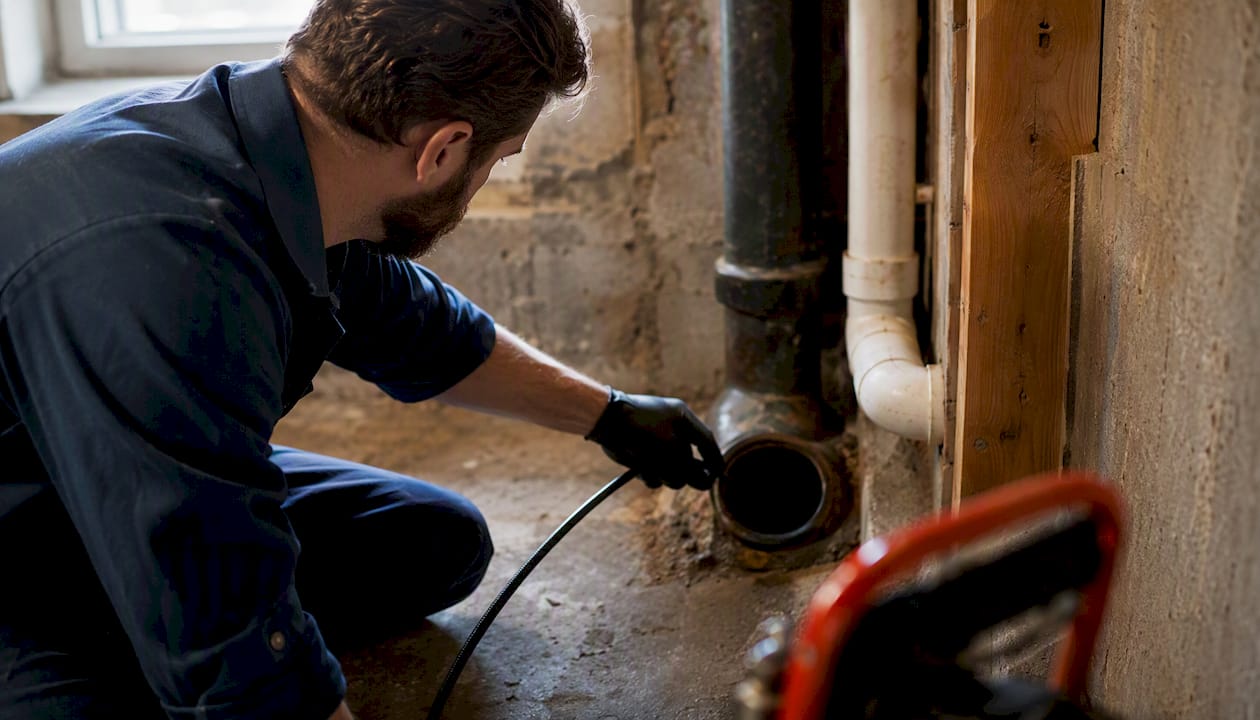
One thing that surprises homeowners: Orangeburg rarely fails all at once. It tends to fail in stages. One section collapses or gets blocked by roots, it gets snaked, the symptom clears for a few months, then it comes back. That cycle is the pipe telling you it’s done. Each round of mechanical cleaning on a delaminating line risks accelerating the next failure. The causes of pipe failure in older materials like Orangeburg follow a predictable arc once delamination starts.
The practical advice from the field: if the camera shows more than one section with significant ovalization or delamination, budget for full replacement rather than spot repairs. Spot repairs on a line that’s failing in multiple places tend to buy six to eighteen months before the next section goes. Full replacement, done once, ends the cycle.
Ag-plumbing serves Pittsburgh homeowners with Orangeburg pipe concerns
Thirty years of sewer work in Pittsburgh and the surrounding areas means Ag-plumbing has seen Orangeburg pipe in nearly every condition, from mildly ovalized to fully collapsed. The team offers CCTV sewer camera inspections that give you video documentation of your line’s actual condition, not a guess based on your home’s age. From there, Ag-plumbing handles the full scope: trench replacement, trenchless pipe bursting, permit applications, and surface restoration.
For Pittsburgh homeowners who want a straight answer about what’s in their sewer line, the starting point is a camera inspection. Ag-plumbing schedules inspections quickly, provides the video recording, and gives you a written estimate before any work begins. If replacement is needed, the sewer repair services page covers what’s included. To talk through your situation or book an inspection, visit Ag-plumbing or call the Pittsburgh office directly.
Sources
- Orangeburg Pipe History, Uses, Failures, Asbestos, Identification, Life
- Orangeburg pipe — City of Tempe building safety guidance
- Everything You Wanted to Know About Orangeburg Pipe (But Were Afraid To Ask) | PHC News
- Common Signs of Orangeburg Pipe Failure | WM Plumbing, Inc.
- CPEO-BIF Orangeburg Pipe property, Orangeburg, New York
Municipal guidance consistently identifies licensed sewer camera inspection as the primary recommended first step for any homeowner who suspects Orangeburg in their lateral.
FAQ
Should Orangeburg pipe be replaced?
In most cases, yes. Once the pipe shows significant ovalization, delamination, or repeated blockages, repair is a temporary measure. The City of Ann Arbor’s guidance states that complete replacement is often the only permanent solution.
Can you still buy Orangeburg pipe?
No. Orangeburg pipe is no longer manufactured for plumbing use. The plant closed by the early 1970s, and modern replacements use PVC, ABS, or HDPE pipe.
Is Orangeburg pipe an asbestos hazard?
Pipes made between 1946 and 1970 contained asbestos fibers, but intact buried pipe poses minimal airborne risk. The hazard arises during excavation and cutting; contractors should use wet methods and proper disposal for asbestos-containing sections.
When did Orangeburg pipe stop being used?
Orangeburg pipe was largely phased out of new construction by the early 1970s as PVC and ABS replaced it under updated building codes. Manufacturing ceased by 1973.
How do I know if my house has Orangeburg pipe?
Home age is a clue, but not a confirmation. A licensed sewer camera inspection is the only reliable way to identify the material and assess its condition, as municipal building-safety departments consistently recommend.
Recommended
- Replace Plumbing: What Every Homeowner Needs to Know – AG-Plumbing
- Step-by-step pipe replacement guide for Pittsburgh homeowners – AG-Plumbing
- Smart Plumbing Tips Every Pittsburgh Homeowner Needs – AG-Plumbing
- Choosing the best plumbing pipes for your Pittsburgh home – AG-Plumbing
