
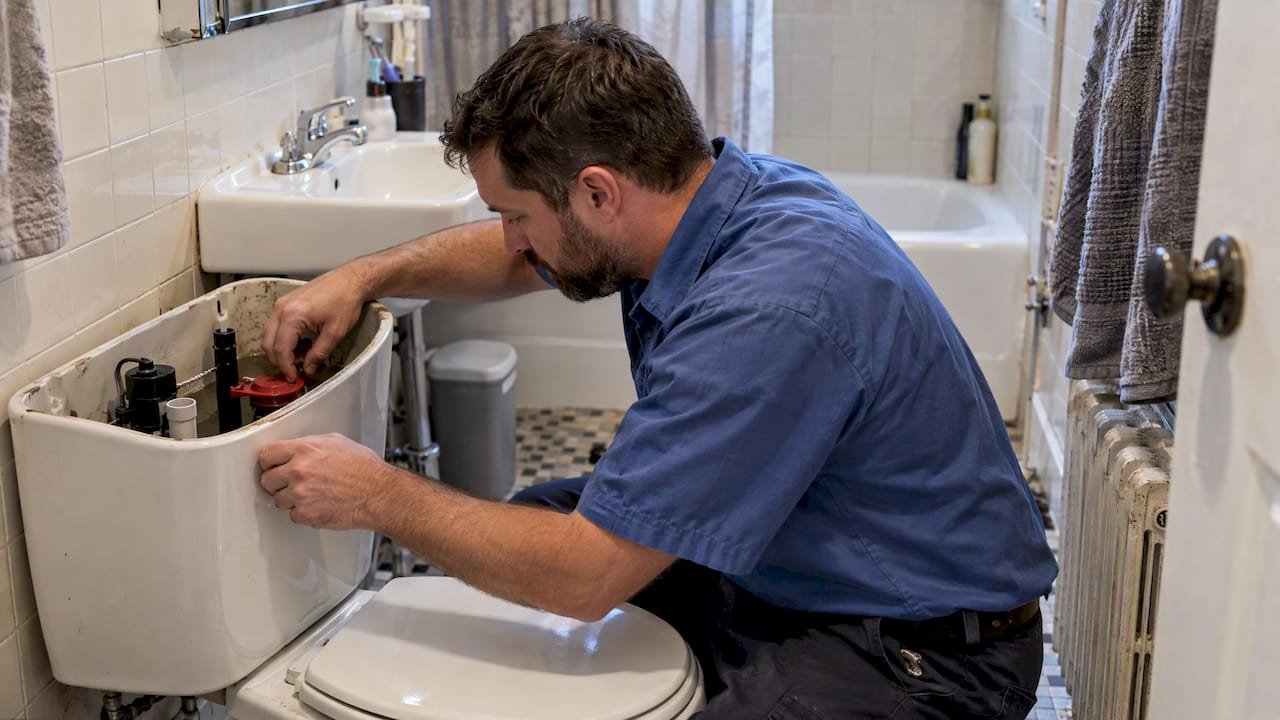
A toilet that flushes weakly is almost always a water problem, not a waste problem. Either too little water reaches the bowl, it arrives too slowly, or something is stopping the siphon from starting. Most causes sit in the tank or under the rim, and you can check them in about twenty minutes with no special tools. If the simple checks don’t solve it, the cause is usually a partial clog or a drain-line issue that needs a professional.
Below, we walk through the causes in the order we’d check them, say what each one looks like, and explain where a quick fix ends and a service call begins.
TL;DR
- Check the cheap things first: the shutoff valve behind the toilet, the tank water level, the flapper chain and the refill tube.
- If the bowl swirls unevenly or the flush starts strong and fades, suspect mineral buildup in the rim jets and siphon jet.
- Plunging and repeated flushing don’t fix a hydraulics problem. Consumer Reports advises a plunger or professional help for clogs, not flush after flush.
- If several toilets flush weakly, or sinks and tubs gurgle too, the problem is probably in the drain or sewer line, not the toilet.
- Our Pittsburgh team handles toilet repairs, drain cleaning, hydro jetting and sewer repair when a DIY fix doesn’t hold.
Table of Contents
- What a good flush actually needs
- Start with the quick checks
- Clogged rim jets and siphon jet
- Other causes worth ruling out
- A quick diagnostic table
- Our perspective
- When it’s time to call a plumber
- Help with repairs in Pittsburgh
- Keeping the flush strong
- FAQ
- Sources
What a good flush actually needs
A gravity toilet works by siphon. When you press the handle, the flapper lifts and the tank empties quickly into the bowl through the rim and a larger siphon jet at the bottom. That surge fills the trapway fast enough to start a siphon, which pulls the bowl contents down the drain. Anything that slows the surge, shrinks the water volume or narrows the passages can leave you with a flush that swirls, stalls and gives up.
Volume isn’t the whole story. Consumer Reports notes that flushing quality depends more on the direction and force of water through the jets and the bowl design than on the number of gallons alone. That matters if you own a newer toilet: a low gallons-per-flush rating is not by itself the reason it’s weak.
Start with the quick checks
Work through these in order. Each one takes a few minutes, and together they account for a large share of weak flushes.
1. The supply valve
The small valve on the wall or floor behind the toilet may be partly closed, often after someone has worked on the toilet or after a plumber has shut off the water. American Standard lists a partially closed water supply valve among the common causes of a weak or incomplete flush. Turn it counterclockwise until it stops, then flush and watch whether the tank refills faster.
2. The tank water level
Lift the tank lid and look at the water line. If the level is low, there simply isn’t enough water to power the flush. American Standard says the level should be no lower than 1/2 inch below the top of the overflow tube. Fluidmaster suggests that raising the level with the fill valve adjustment, to within about 1 inch of the overflow pipe, is a quick and often overlooked fix for sluggish flushes.
Most fill valves have an adjustment screw or a sliding clip on the side. Raise the level a little, flush, and check again. Don’t push it past the overflow tube: water spilling into the tube will run constantly and waste water.
3. The flapper chain
The chain connects the handle to the flapper. If it has too much slack, the flapper may not lift all the way, or it may drop early and cut the flush short. If it’s too tight, the flapper can’t seal and you’ll hear the tank refilling on its own. American Standard puts the right amount of slack at approximately 1/4 inch. Move the chain to a different hole in the handle arm, or on the flapper, until the slack looks about right.
While you’re there, look at the flapper itself. A warped, cracked or slimy one can fail to lift fully or fail to seal. Our guide to what a flapper valve is and how it fails shows what to look for.
4. The refill tube
The thin tube from the fill valve should be attached securely and aimed into the overflow pipe, not pushed far down inside it. Fluidmaster says a kinked, damaged or too-deep tube fails to replenish the bowl’s water level, which weakens the siphon on the next flush. If the tube is loose or bent, reposition it with its clip and check the bowl level after the tank refills.
Clogged rim jets and siphon jet
If the tank is set correctly and the flush is still weak, look at the bowl. Under the rim of most toilets is a row of small holes, and at the bottom of the bowl sits the siphon jet. Over years, calcium and lime deposits narrow these openings. Fluidmaster says minerals such as calcium and lime, along with debris, are quite common culprits in toilets that have been in use for some time.
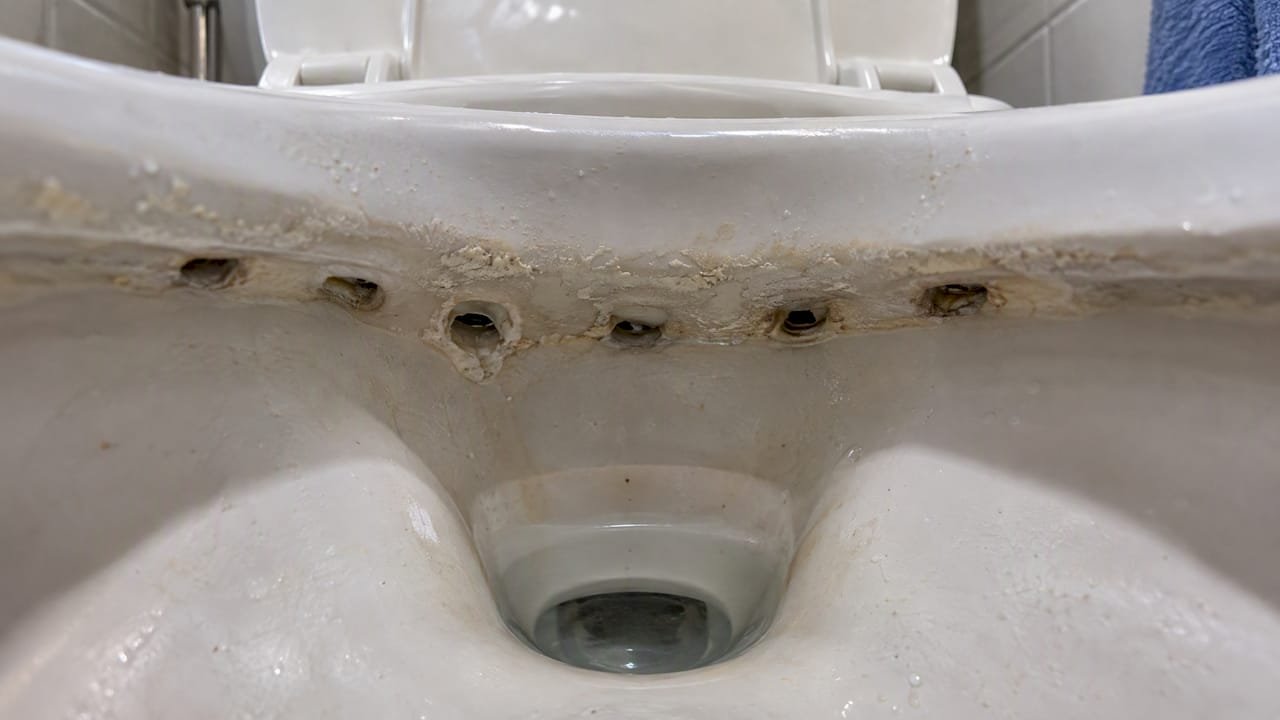
HomeFixer101 describes this as a common misdiagnosis: owners assume a persistent clog, when the real problem is hydraulics. Its guide says hard-water areas like Pittsburgh are especially prone, and that plunging won’t help because the restriction is in the rim passages.
How to tell it’s the jets
- The flush starts well, then fades.
- Water enters the bowl on one side more than the other, or some rim holes shoot water while others trickle.
- The toilet isn’t actually clogged: plunging changes nothing, and the water drains, just slowly.
- The toilet is older, and the problem came on gradually over months or years.
How to clear them
The approach in manufacturer guidance is chemical descaling plus a gentle mechanical clean:
- Check the product label first. Use a bowl cleaner made for limescale, and never mix cleaners. Mixing some household chemicals can release dangerous gases.
- Hold the flapper open (or close the shutoff and drain the tank) and pour 1 to 2 cups of the cleaner down the overflow tube so it runs through the rim passages. American Standard-style instructions, as summarized in a manufacturer care page, also call for clearing the jet and rim holes.
- Let it sit for the time the label gives.
- Use a small mirror and a flashlight to look under the rim. Scrape loose deposits from each hole with a small wire or an unfolded paper clip, being careful not to scratch the porcelain.
- Flush a few times and watch the water pattern.
If the deposits are heavy, you may need to repeat the process. If the flush is still weak after two rounds, stop. Aggressive scraping can damage the bowl, and the cause may be somewhere else.
Other causes worth ruling out
A partial clog in the trap
A toilet can drain slowly because something soft sits partway down the trapway: too much paper, a wipe, a toy. That is different from a jet problem because the bowl water level rises and falls sluggishly. A flange-style plunger, pushed in firmly with the bowl about half full, often clears it. We cover the technique in how to unclog your toilet. If it keeps happening, read why your toilet keeps clogging.
Don’t flush again and again hoping it will clear. Consumer Reports advises against repeated flushing for a clog, which can put water on your bathroom floor.
A blocked vent or a partly blocked drain
Drains need air behind the water to move freely. A blocked plumbing vent can make a toilet flush slowly and gurgle. A partly blocked branch drain or main line does the same. The telltale sign is that it isn’t just one fixture. If the toilet burbles when the washer drains, or the tub water rises when you flush, the problem is further down the line.
Those are jobs for a drain professional. Our drain cleaning service clears the line, and when buildup or grease is the problem, hydro jetting scours the pipe walls rather than punching a hole through the blockage. If roots are suspected, we run a camera first, as we explain in why we don’t jet blind.
A poorly seated or worn part
American Standard’s guidance also says that if the problem persists after checking the tank and jets, the next step is to consider replacing the wax ring or other parts, according to its troubleshooting summary. Signs of a bad seal include a toilet that rocks, water at the base, or a lingering sewer smell. This is the point where many homeowners prefer to hand the job over, since it means pulling the toilet.
An old toilet, or a poor design
Sometimes the toilet is the issue. The federal standard since 1994 has been 1.6 gallons per flush, and EPA WaterSense models use 1.28 gallons or less. But passing the minimum standard doesn’t make a toilet a strong performer. The designer of Maximum Performance (MaP) testing, John Koeller, argues certification to minimum standards ensures that a toilet works but not that it works to consumer expectations. MaP scores measure how much waste a toilet clears in a single flush, so they are worth checking before you buy a replacement.
Older toilets can be a different story. The EPA says older, inefficient models can use as much as 6 gallons per flush, and that toilets account for nearly 30 percent of indoor water use at home. A well-chosen modern replacement can cut water use without costing you flush power. For more on that trade-off, see our article on low-flow plumbing.
A quick diagnostic table
| What you notice | Most likely cause | First thing to try |
|---|---|---|
| Tank refills slowly | Partly closed supply valve | Open the valve fully |
| Water in the tank sits low | Fill valve set too low | Raise the level to the mark |
| Flush stops short | Chain slack, worn flapper | Adjust the chain, replace the flapper |
| Bowl slow to refill after flushing | Kinked or misplaced refill tube | Reseat the tube over the overflow pipe |
| Strong start, weak finish, uneven rim spray | Mineral buildup in the jets | Descale through the overflow tube |
| Slow drain, water level rises | Partial clog in the trap | Flange plunger |
| Several fixtures slow or gurgling | Drain or vent problem | Call a plumber |
Our perspective
When we’re called out for a weak flush, the toilet is only part of the story. We see the same pattern across Pittsburgh homes: someone has already tried a plunger, a chemical drain product and a few extra flushes, and the toilet still isn’t right because the real problem was never in the trap.
Our rule is to start with the water. We confirm the supply, the tank level and the flapper, then look at the rim and jets, and only then move to the drain. If the toilet is the only fixture misbehaving, it’s usually a repair. If other drains are slow, we look at the line, and that’s where our drain cleaning, hydro jetting and camera work come in.
We also tell homeowners when a toilet isn’t worth saving. If a bowl has been descaled, the parts are fresh and it still flushes poorly, that’s a design limitation, and replacing it is a better use of money than another repair. We’d rather say that than sell a fix that won’t last.
— Maayan
When it’s time to call a plumber
Call for help when any of these apply:
- More than one toilet flushes weakly, or sinks, tubs and floor drains are also slow.
- You hear gurgling, or water backs up into a tub or shower when you flush.
- You’ve fixed the tank settings and cleaned the jets, and the flush is still poor.
- The toilet rocks, leaks at the base, or smells of sewage.
- Your home is older and has had repeated clogs. Aging pipes can be the cause, which is why we sometimes recommend looking at updated plumbing or a sewer line inspection and repair.
Our team has 30 years of experience serving Pittsburgh and the surrounding area, and we handle toilet and fixture repairs for homes and businesses. You can see what’s included under plumbing repair, or contact us through our site to book a visit. We offer discounts for seniors, military, new customers and referrals.
Help with repairs in Pittsburgh
If cost is the obstacle, check what your utility offers. Pittsburgh Water’s Line Repair and Water Conservation Program provides income-eligible customers with in-home plumbing repairs, aimed at reducing water loss from leaking pipes and inefficient fixtures. Eligibility rules and availability can change, so confirm the details with Pittsburgh Water before you plan around it.
Keeping the flush strong
- Look into the tank twice a year. Check the water line, chain slack, and the condition of the flapper.
- Descale the rim and jets every so often if your water leaves white or orange crust on fixtures.
- Keep wipes, even “flushable” ones, out of the toilet. They collect in the trap and the line.
- Don’t drop in-tank bleach tablets. They can degrade rubber parts such as the flapper.
- Have recurring clogs investigated early. Our checklist for stopping recurring drain clogs is a good place to start, and our cost-saving plumbing tips cover other low-cost maintenance for Pittsburgh homes.
FAQ
Why is my toilet flush not powerful enough?
The usual causes are a low tank water level, a partly closed supply valve, too much chain slack or clogged rim and siphon jets. Check them in that order. If none of them is the problem, the trap or drain line may be partly blocked.
Can I make my toilet flush stronger?
Often, yes. Raising the tank water level toward the fill line, adjusting the flapper chain and descaling the jets can restore the original power. What you can’t do is make a poorly designed bowl perform like a top-rated one. If it’s still weak after repairs, a replacement with a strong single-flush MaP score is the better answer.
Does a low-flow toilet always flush weakly?
No. Consumer Reports says a toilet’s jets and bowl design matter more than water volume alone. A modern 1.28-gallon toilet can outperform an old high-volume one. A weak flush in a newer toilet usually points to a setting, a part or a clog.
Is it a clog or a mineral problem?
A clog slows the drain, and the bowl water rises or falls sluggishly. A jet problem weakens the surge of water coming in, and the bowl drains normally but the flush is feeble and uneven. If a plunger changes nothing, suspect the jets.
When should I worry about more than the toilet?
When other fixtures are slow or gurgling, or water backs up elsewhere in the house. That points to a drain or sewer line problem, and it needs a plumber with the right equipment, not more toilet fixes.
Sources
- American Standard: How do I fix a toilet with a poor flush?
- American Standard: troubleshooting a toilet that is not flushing properly
- Fluidmaster: How to fix a weak or incomplete toilet flush
- HomeFixer101: Complete guide to toilet repair
- Consumer Reports: Busting myths about water-efficient toilets
- Maximum Performance (MaP) testing report
- US EPA: Residential toilets
- Pittsburgh Water: rate request press release, June 2025
Recommended
- How to Fix a Running Toilet: a DIY Guide
- How to Unclog Your Toilet: Simple DIY Solutions That Work
- What Is a Flapper Valve? A Homeowner’s Guide
- Common Plumbing Repair Issues and How to Fix Them
