
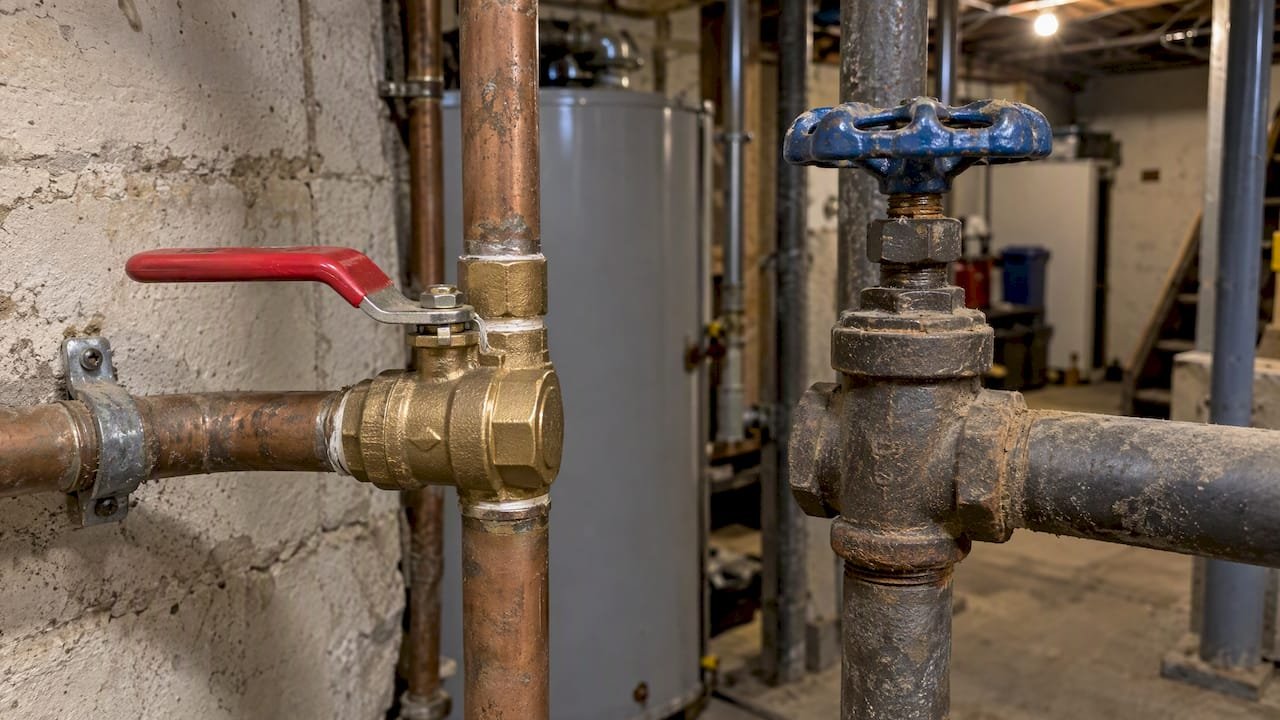
For most home shutoff jobs, a full-port ball valve is the better choice. It closes with a quarter turn, shows at a glance whether it is open or shut, and is less likely to seize after years untouched. A gate valve is still a sound isolation valve, especially on larger lines and at the street, but it is slower and tends to get stiff. Neither one is meant to control flow. Both are made to be fully open or fully closed.
Below, we explain how each valve works, where each one wins, how to tell which one you have, and when a replacement is worth a plumber’s visit.
TL;DR
- A ball valve uses a rotating sphere with a hole through it. A gate valve lifts and lowers a wedge or disk with a wheel handle.
- Ball valves are quick and give a tight shutoff. Gate valves are slow, which is gentler on piping, but they are more prone to sticking with age.
- Do not use either one to throttle flow. A partly open gate valve wears out its wedge and seat, and a standard ball valve can damage its seats.
- For a home main shutoff, a full-port ball valve is usually the best replacement. After any valve work, reopen the water slowly.
- A valve that will not turn, drips at the stem or will not fully stop the water needs a licensed plumber, not more force.
Table of Contents
- How the two valves work
- Ball vs gate valve at a glance
- Where a ball valve wins
- Where a gate valve still makes sense
- The disadvantages nobody mentions on the box
- Do not use either one to regulate flow
- How to tell which valve you have
- Which valve for which spot in your home
- What it costs, and why price should not decide
- Replacing a main valve: what the job involves
- After the work: reopen the water slowly
- Our perspective
- Valve stuck, leaking or in the wrong place? Call us
- FAQ
- Sources
How the two valves work
Both valves belong to the family of on-off service valves. University of Florida irrigation guidance describes them as valves that slide or turn a flow element across the opening. When fully open, they give an unrestricted passage and very little pressure loss.
Gate valve. Turning the round wheel handle raises or lowers a wedge-shaped gate across the pipe. It takes many turns to travel from open to closed, which is why the valve feels slow. The Pennsylvania DEP notes that this slow action helps prevent fluid hammer, and that there is very little pressure loss through the valve when it is fully open.
Ball valve. A lever turns a sphere with a bore through it by 90 degrees. Lined up with the pipe, water flows. Turned sideways, the solid part of the ball blocks it. The same DEP page describes ball valves as quarter-turn valves with low pressure drop. The speed is the whole appeal, and it is also the main caution.
Ball vs gate valve at a glance
| Factor | Ball valve | Gate valve |
|---|---|---|
| Handle | Lever | Round wheel |
| Operation | Quarter turn | Several full turns |
| Speed in an emergency | Very fast | Slow |
| Open/closed indication | Lever position shows it | Hard to tell from the wheel |
| Pressure loss when fully open | Low (full-port types) | Very low |
| Surge risk | Higher if closed or opened abruptly | Lower, because it moves slowly |
| Long-term reliability | Tends to stay free to turn | Can stick or fail after long periods without use |
| Throttling | Not recommended | Not recommended |
| Typical home use | Main shutoff, fixture stops, hose bibs | Older main valves, curb valves, larger lines |
The table is a guide, not a ruling. Valve quality, materials and the condition of the pipe matter as much as the style.
Where a ball valve wins
Speed when it counts. If a pipe bursts at 2 a.m., a lever that closes in a quarter turn beats a wheel that needs several rotations, especially with wet hands in a dark basement.
You can see its position. A lever parallel to the pipe generally means open. Perpendicular means closed. On a wheel handle, you cannot tell how far the gate has travelled.
Compact and tight. The University of Michigan’s valve encyclopedia lists compact size, quick operation, high flow capacity and tight shutoff among the strengths of ball valves.
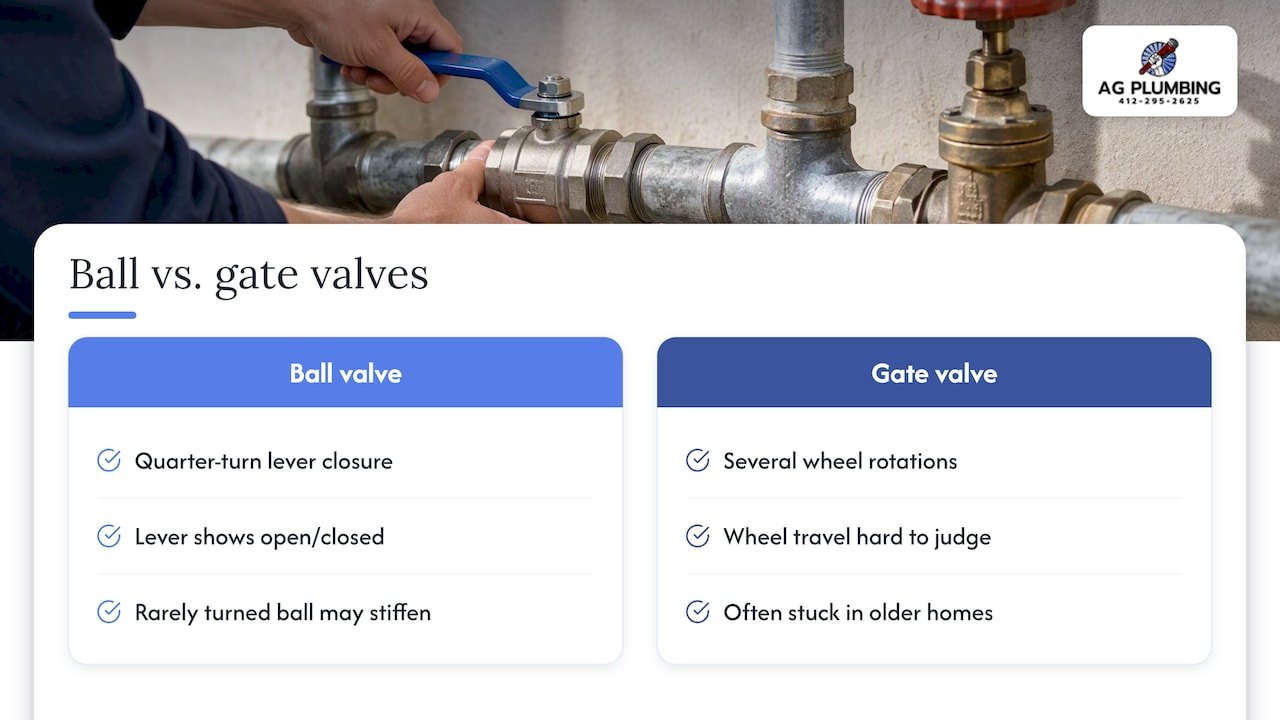
Fewer seizing problems. A ball that is turned rarely can still stiffen, but gate valves are the ones we find stuck most often in older homes. That is an observation from the field, not a rule, and you should test your own valve once a year either way.
Where a gate valve still makes sense
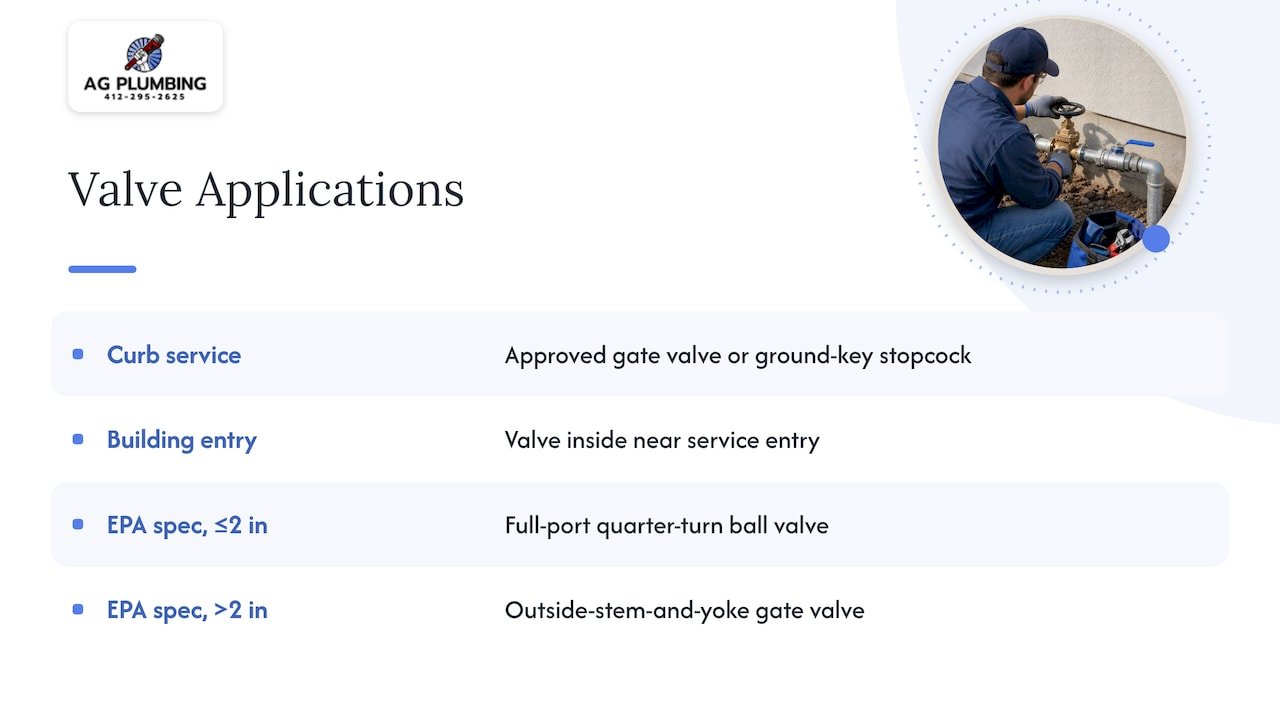
Large lines and municipal service. The Allegheny County plumbing code says an approved gate valve or ground key stopcock must be installed near the curb on each water service from the street main. A building valve must also be provided inside the building near the point where the service enters. Gate valves are not obsolete: they remain a normal part of water systems.
Gentler on the piping. Because a gate valve closes slowly, it is less likely to slam the pipes. That is a real advantage on systems that already knock.
Larger commercial assemblies. A 2025 EPA project specification for backflow preventers called for full-port quarter-turn ball valves on units 2 inches and smaller, and outside-stem-and-yoke gate valves on units larger than 2 inches. That is one project’s spec, not a universal rule, but it shows how size and assembly design can change the answer. If your commercial property has a backflow assembly, our backflow testing team checks the shutoff valves on it as part of the work.
The disadvantages nobody mentions on the box
Ball valve drawbacks
The University of Michigan source lists limited throttling ability, surge from rapid opening, trapped fluid in the ball cavity, and temperature limits tied to plastic seats. In a house, the one you will meet is surge. Snap a ball valve shut or open and the moving water has nowhere to go, which can produce a bang. Our guide to what water hammer is and how to fix it covers that in detail.
Gate valve drawbacks
They are bulky, slow and easy to forget. The bigger issue is age. A gate valve left open for decades can build up mineral deposits, and the stem packing can leak when you finally turn it. Partly closing one is worse: leaving a gate valve partly open can erode the wedge and the lower seating surface, according to IAPMO code guidance. A valve that once closed fully may never do so again.
Do not use either one to regulate flow
This is the mistake we see most. People crack a valve halfway to lower pressure or slow a fixture, and the valve slowly destroys itself. IAPMO guidance says fullway gate and ball valves are for fully open or fully closed isolation. The University of Florida guidance says much the same: neither should be used to regulate flow unless it is specifically designed for that.
If a plumber finds a valve being used to throttle, the right fix may not be swapping ball for gate or gate for ball. A globe valve or a purpose-built control valve may be the correct part. If your real problem is pressure that is too high or too low, start with why checking water pressure matters and our guide on how to increase water pressure at home rather than a half-closed valve.
How to tell which valve you have
Look at the handle.
- Round wheel: the City of Hamilton, Ohio explains that round wheel handles are gate valves, which close clockwise and may take two or more full turns.
- Lever handle: that is a ball valve, which stops flow with a quarter turn.
- Check the lever angle: parallel to the pipe is generally open and perpendicular is closed.
- Confirm with a fixture. Open a faucet downstream after closing the valve. If water keeps running, the valve has failed, whatever the handle says. A water district’s shutoff guide also points out that the master shutoff is typically in the garage or outside the home, and separate supply stops serve individual fixtures.
Most Pittsburgh homes have the main valve in the basement, close to where the water line comes through the front foundation wall. Find yours before you need it, and put a tag on it.
Which valve for which spot in your home
| Location | Our usual recommendation |
|---|---|
| Main shutoff inside the house | Full-port ball valve |
| Under sinks, toilets, and at appliances | Quarter-turn stop valve |
| Water heater supply | Full-port ball valve |
| Outdoor hose bib | Ball-type shutoff inside, for winter drain-down |
| Curb stop at the street | Gate valve or ground key stopcock, as the county code describes; usually the water authority’s equipment, so do not operate it yourself unless permitted |
| Larger commercial lines | Depends on size and assembly; confirm with a plumber |
For more on why every fixture should have its own stop, see our homeowner’s safety guide to shutoff valves.
What it costs, and why price should not decide
Search results often say gate valves are cheaper to buy, and that ball valves cost less over time because they need less maintenance. Both statements are plausible, but the part is a small fraction of the job. Labor, shutting down the water, soldering or press fittings, and any permit make up most of the bill, and water damage from a failed old valve dwarfs all of it. We do not publish prices for valve replacement because it depends on pipe size, access and whether the street-side water must be shut off. We give an upfront quote after seeing the job.
Replacing a main valve: what the job involves
A proper replacement is about the whole assembly, not just ball versus gate. The valve body material, pressure and temperature rating, size, and its suitability for drinking water all matter. ASME B16.34 covers ratings, dimensions, materials, testing and marking for the valves it applies to, and a plumber should use listed, marked products.
Compliance is local. Pennsylvania uses a statewide Uniform Construction Code, as the Commonwealth’s site describes, but Allegheny County has its own plumbing code and your water authority has its own requirements. A licensed plumber verifies permits, materials and access before starting.
If your main valve is the only thing between you and a flooded basement and it will not turn, replacing it is a repair worth doing on a calm day. Our plumbing repair team can do it. If the old valve is a symptom of aging pipes, it may be the right moment to talk about repiping. Buyers of older homes should also read our old house plumbing checks.
After the work: reopen the water slowly
The speed that makes a ball valve good in an emergency can cause surge when you reopen it. The DEP source says slow operation reduces fluid hammer. After any valve work:
- Open a hose bib or a high fixture so air can escape.
- Open the main valve slowly, not with a snap.
- Let air and sputtering clear from each fixture.
- Check the new joints and stem for drips.
- Test a fixture downstream the next time you close the valve, to confirm it holds.
For a broader look at saving water at home once your plumbing is in order, this guide to water efficiency in homes is written for the UK, so check local rules before applying any specifics.
Our perspective
We have spent 30 years working on plumbing in Pittsburgh and the surrounding areas, and the valve question comes up on almost every older house. Our view is simple. The best valve is the one you can close in ten seconds, in the dark, without a wrench. For most homeowners that means a full-port ball valve on the main, plus working stops at fixtures. But we do not replace good gate valves just to replace them. If a gate valve turns freely, closes fully and does not leak, exercise it twice a year and leave it. If it is stiff, weeping or will not stop the water, do not wait for the day you need it.
We would also rather tell you what a valve cannot do. Neither type fixes pressure problems, and neither should be left half open. Clear communication and a transparent process matter more to us than an upsell.
— Maayan
Valve stuck, leaking or in the wrong place? Call us
AG Heating, Cooling & Plumbing serves homeowners, property managers and businesses in Pittsburgh, PA and the surrounding areas. We are licensed and certified and BBB accredited, and we offer discounts for seniors, military, new customers and referrals. Book a plumbing repair visit and we will check your main shutoff, tell you plainly whether it needs replacing, and quote the work before we start. You can also reach us through our main site.
FAQ
Is a ball valve better than a gate valve?
For a home shutoff, usually yes. It closes faster, shows its position and tends to stay free to turn. A gate valve is still appropriate on larger lines and at the curb, where the Allegheny County code calls for one or a ground key stopcock.
Are gate valves obsolete?
No. They are common in municipal and large-diameter work and are gentler on pipes because they close slowly. Their weakness is age: they can stick or fail to seal after years without use, so test them regularly.
What are the disadvantages of a ball valve?
They are poor at throttling, can cause surge if operated abruptly, and can trap fluid in the ball cavity. Seats made of plastic have temperature limits, according to the University of Michigan source. In a house, the practical rule is to open and close it smoothly and never leave it half open.
Can I use a gate or ball valve to reduce water flow?
No. Both are isolation valves. Partly open, a gate valve erodes its wedge and seat, and a standard ball valve can damage its seats. If you want less flow or lower pressure, ask a plumber about a pressure-reducing valve or a valve designed for control.
How do I know if my main valve is open or closed?
On a lever, parallel to the pipe means open and perpendicular means closed. A wheel gives no such clue, so close it, then open a faucet downstream to confirm the water stops.
Sources
- University of Florida IFAS: Valves in Irrigation Systems
- Pennsylvania DEP: Valve Basics and Selection Tips
- IAPMO code guidance on valves
- University of Michigan: Valves, Visual Encyclopedia of Chemical Engineering Equipment
- Allegheny County Code, Section 860-178
- EPA: AIS availability waiver request for potable water backflow preventers
- ASME B16.34 valves standard preview
- City of Hamilton, OH: Operating water shut-off valves
- Western Municipal Water District: How to turn off your water
- Commonwealth of Pennsylvania
Recommended
- Pressure Balancing Valves: Why Every Shower Needs One
- Why Install Shutoff Valves: A Homeowner’s Safety Guide
- The Role of Isolation Valves in Safe Fluid Systems
- What Is a Flapper Valve? A Homeowner’s Guide
