
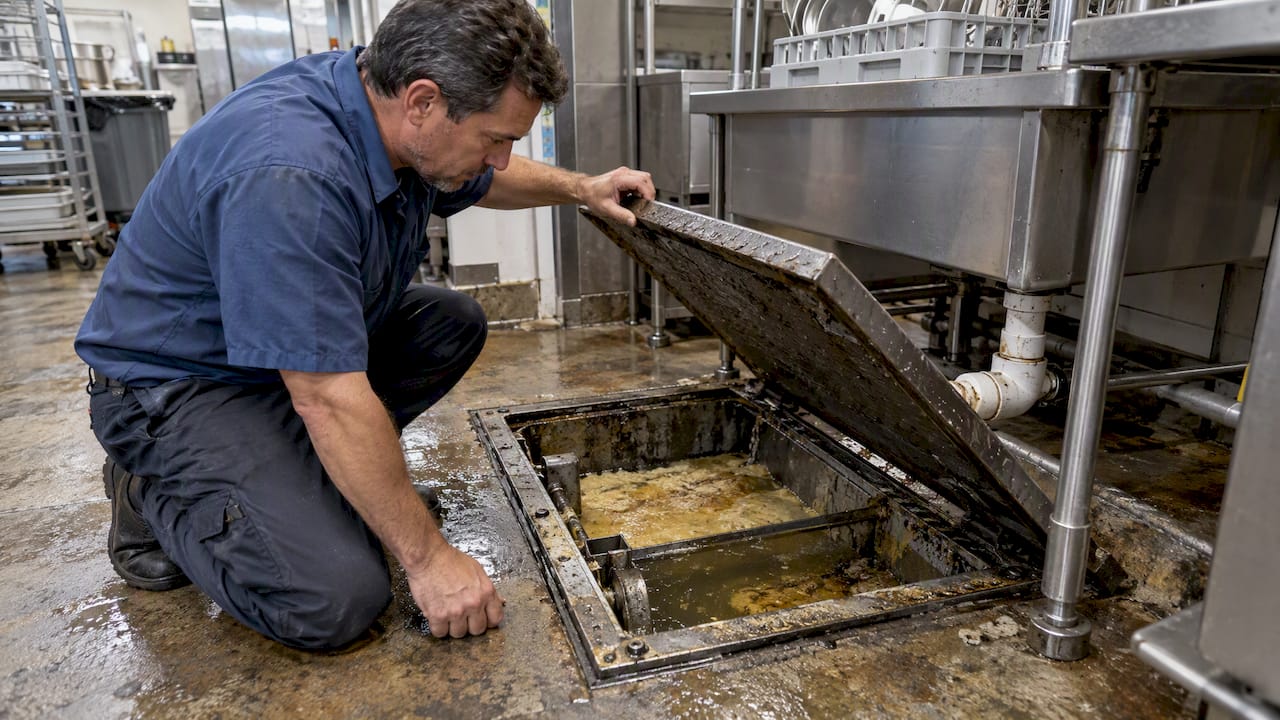
Shut off water to affected fixtures, contain the spill with absorbent pads, and call a permitted grease hauler or licensed plumber immediately. The single rule that prevents most repeat overflows: clean the trap once it reaches 25% of its operating depth in fats, oils, grease, and solids, or at least every 90 days, whichever comes first. Pair that schedule with daily dry-wiping and drain strainers, and most overflows never happen.
TL;DR:
- Never flush hot water, solvents, caustics, or enzyme treatments during an overflow; they can move grease downstream, where it hardens and blocks inaccessible pipes.
- Call a professional immediately if sewage backs up, grease appears at downstream fixtures, or contamination threatens food preparation; these signs indicate more than routine skimming.
- Inspect grease and solids depth weekly, record measurements and corrective actions, and retain service receipts; some jurisdictions require those records for up to five years.
- If grease returns downstream soon after service, request high pressure pipe cleaning or a camera inspection; pump outs alone can leave adhered buildup in pipes.
- A trap beside a commercial dishwasher may stay too warm to separate grease, so recurring failures can require relocation or flow controls.
Table of Contents
- Step-by-step actions to take the minute you discover an overflow
- Common causes of grease trap overflow and how to diagnose them
- Routine program: daily, weekly, and quarterly practices that keep traps from overflowing
- When to call a grease hauler or plumber, and what to expect
- On-site inspection checklist and the records inspectors ask for
- Field-tested tips from experienced plumbers
- Treating FOG control as business continuity, not a chore
- How our plumbing team handles emergency and preventive grease trap needs
- FAQ
- Sources
Step-by-step actions to take the minute you discover an overflow
The first ten minutes decide how much damage, downtime, and regulatory exposure you end up with. Move through these steps in order rather than trying to do everything at once.
- Shut off or isolate the water supply to the affected fixtures, including any dishwasher or disposal feeding the trap.
- Stop running the dishwasher and garbage disposal immediately since both push hot water and solids into an already full system.
- Contain visible spills with absorbent pads and block floor drains near food prep areas to keep contamination away from food contact surfaces.
- Place saturated pads and recovered waste in sealed containers rather than rinsing them down a nearby drain.
- Call your permitted grease hauler or a licensed plumber, and have your trap size and last service date on hand so the technician can mobilize with the right equipment.
- Notify your local pretreatment authority or publicly owned treatment works when your permit requires it, and keep the pump-out receipt on file afterward.
Avoid flushing hot water, solvents, or enzyme treatments down the drain during an active overflow. These temporarily liquefy grease, which then travels downstream and resolidifies in a pipe you cannot easily reach, turning a contained trap problem into a sewer line problem.
Pro Tip: Keep a laminated card near the trap listing its size, install date, and your hauler’s phone number so any staff member can act without searching for information during an emergency.
If a backup has already reached a sink or floor drain in your kitchen, our guide on fixing grease clogs in a kitchen sink covers the troubleshooting steps worth trying before a technician arrives.
Common causes of grease trap overflow and how to diagnose them
An overflow is a symptom. Finding the actual cause keeps it from coming back within weeks of the last cleaning.
- FOG and solids buildup: fats, oils, grease, and food solids accumulate faster than the cleaning schedule removes them, eventually occupying more than a quarter of the trap’s depth.
- Undersized trap or short hydraulic retention time: a trap that is too small for kitchen volume does not give wastewater enough time to cool and separate before it exits.
- High-temperature discharges: dishwasher water entering at high heat keeps grease liquid instead of letting it float and separate, so FOG passes through even when the trap looks far from full.
- Downstream blockages: solids that channel past the baffles settle in the line beyond the trap, backing pressure up into the unit itself.
- Improper maintenance methods: hot water, caustics, and emulsifying agents used during cleaning temporarily mobilize grease, pushing it further into the line instead of removing it.
Placement plays a role too. A trap installed close to a high-heat source such as a commercial dishwasher can run warm enough that grease never fully separates, which means a unit can fail even on a strict cleaning schedule if it was sited wrong to begin with. For more on how traps are supposed to function in a working kitchen, see the role of grease traps in commercial kitchens.
Routine program: daily, weekly, and quarterly practices that keep traps from overflowing
A working prevention program has three layers: daily habits, a measured cleaning schedule, and smart equipment choices.
Daily and weekly practices that reduce the load reaching the trap:
- Dry-wipe pans and pots before washing to keep heavy grease out of the wastewater stream entirely.
- Install strainers and screens on all drains feeding the trap to catch solids before they enter.
- Store used cooking oil separately for recycling instead of pouring it down any drain.
- Train staff to scrape plates into waste bins, not sinks, before dishwashing.
EPA guidance links these Best Management Practices directly to results: dry-wiping, strainers, and consistent scheduled maintenance correlate with reduced pump-out frequency and fewer sewer blockages, and municipal pretreatment programs increasingly tie permit compliance to documented schedules.
On equipment, automatic grease recovery units (AGRUs) separate and remove grease more frequently than a manual trap, which can reduce how often you need a full pump-out. They still require their own manufacturer-mandated daily or weekly maintenance, and skipping that schedule defeats the purpose of the unit.
Service scheduling should follow the 25% operating-depth threshold with a 90-day ceiling regardless of how full the trap appears. Traps should also sit away from high-heat discharge points and include flow-control devices that preserve hydraulic retention time, since a trap that drains too fast never gives grease the chance to separate. Consistent BMPs and documented schedules can also reduce municipal surcharges tied to high-strength waste, since many pretreatment programs base fees partly on compliance history. Our restaurant grease trap maintenance checklist walks through building this schedule into a recurring log.
When to call a grease hauler or plumber, and what to expect
Some situations call for in-house cleaning. Others need a professional on-site within hours.
- Active overflow or sewage backing up into the facility requires an immediate call, not a wait-and-see approach.
- Grease visible in downstream fixtures or floor drains signals the trap is no longer separating effectively and needs more than a routine skim.
- Any health-code violation risk, such as grease near food prep surfaces, should trigger a same-day service call.
A professional visit typically includes a full pump-out, hydro-jetting to clear adhered grease from pipe walls, a camera inspection to check for downstream damage, and interceptor repair when baffles or fittings have failed. Have your trap size, last service date, and any visible symptoms ready before the technician arrives so they can bring the right equipment. Request a pump-out receipt and inspection photos afterward since both serve as documentation for your maintenance log and any regulatory request. If a gurgling drain showed up before the overflow, mention it, since it often points to a developing downstream blockage.
On-site inspection checklist and the records inspectors ask for
A short weekly check catches problems before they become emergencies, and a simple log satisfies most documentation requests.
- Measure grease and solids depth against the 25% threshold using a dipstick or sight glass.
- Check effluent clarity at the sample point if your system has one.
- Record who checked the trap, the date, the measured depth, and any corrective action taken.
- File every pump-out receipt; some jurisdictions require retention for up to five years.
| Check item | Frequency | What to record |
|---|---|---|
| Grease and solids depth | Weekly | Measured depth versus 25% threshold |
| Pump-out service | At 25% depth or every 90 days | Hauler name, date, volume removed |
| Visual downstream check | Weekly | Presence of grease at floor drains or fixtures |
| Maintenance log review | Monthly | Staff initials, corrective actions logged |
Field-tested tips from experienced plumbers
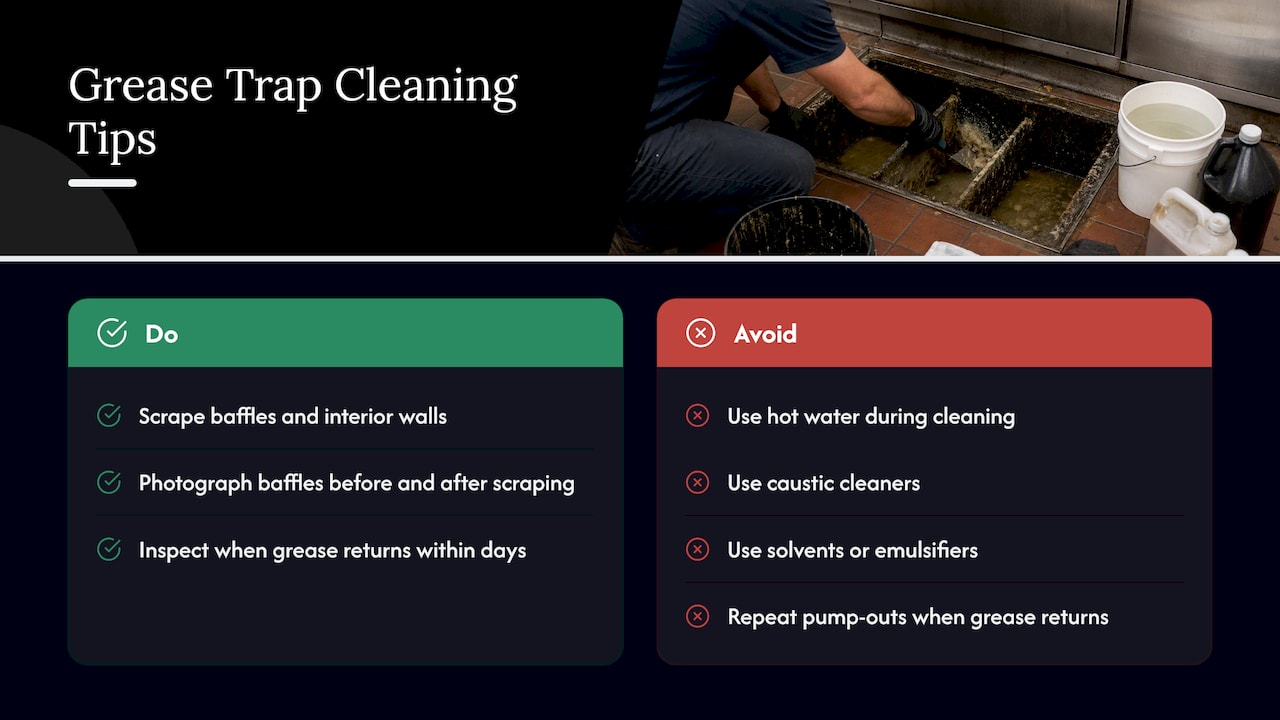
Pump-outs alone do not solve an overflow problem. Cleaning should include manual scraping of baffles and interior walls since adhered grease left behind continues building toward the next overflow even right after a service visit.
Avoid hot water, caustic cleaners, solvents, or emulsifiers during any cleaning step. They loosen grease just long enough for it to travel downstream before resolidifying in a harder-to-reach section of pipe. When routine cleaning no longer keeps pace, or when grease keeps reappearing downstream within days of service, it is time to move to hydro-jetting or a camera inspection rather than repeating the same pump-out.
Pro Tip: Ask your service provider to photograph the baffles before and after scraping. It gives you a visual record of buildup speed and helps justify adjusting your cleaning frequency.
Treating FOG control as business continuity, not a chore
A grease trap overflow is rarely a surprise. It is the predictable result of a skipped cleaning or a BMP nobody enforced. Preventive maintenance is cheaper than every alternative, and it is the only approach that keeps an overflow from becoming a recurring line item.
— Maayan
How our plumbing team handles emergency and preventive grease trap needs
When a trap overflows, we respond with drain cleaning and hydro-jetting to clear adhered grease from both the trap and the line beyond it, not just the symptom at the surface.
- We assess trap size, discharge temperature, and placement to find potential causes behind repeat overflows.
- We handle scheduled pump-outs and hydro-jetting to support maintaining an appropriate cleaning schedule.
- We also offer sewer repair and plumbing repair when an overflow has already damaged downstream lines.
Have your trap size, last service date, and any visible symptoms ready when you call. It helps us arrive with the right equipment the first time. Reach out through our plumbing services page to schedule an inspection or get a response for an active overflow.
FAQ
Are grease traps supposed to have water in them?
Yes, a grease trap should always hold water as its baseline level. Wastewater sitting in the trap is what allows grease to float and solids to settle, so an empty trap signals a design flaw or a maintenance failure rather than a good sign.
What causes a drain pipe to overflow?
A drain pipe overflows when grease, solids, or both block flow faster than the pipe can drain, often because adhered grease narrowed the pipe over time. Scraping baffles and walls during cleaning removes buildup that a pump-out alone leaves behind.
What are the signs that my grease trap is leaking?
Watch for grease odors near the trap, slow-draining sinks, and visible grease deposits at downstream fixtures or floor drains. Any of these point to a trap nearing capacity or already allowing FOG to pass through untreated.
What happens if a grease trap is not properly maintained?
Skipped cleanings let fats, oils, grease, and solids build past the 25% operating-depth threshold, which leads to overflows, sewer line blockages, and potential pretreatment violations. Consistent BMPs and a documented cleaning schedule are what keep these issues from recurring.
Sources
Municipal maintenance guides and EPA pretreatment materials provide the cleaning thresholds and BMP standards referenced throughout this guide. For broader kitchen organization practices that support dry-wiping and waste separation habits, see Cozee Bay’s guide to organizing commercial kitchens efficiently.
- Gravity Grease Interceptor – GGI Maintenance (Spokane County)
- Reducing Impacts of Unseen Food Waste: FOG abatement program guidance (EPA)
- How grease traps work (Stanford University guidance)
