
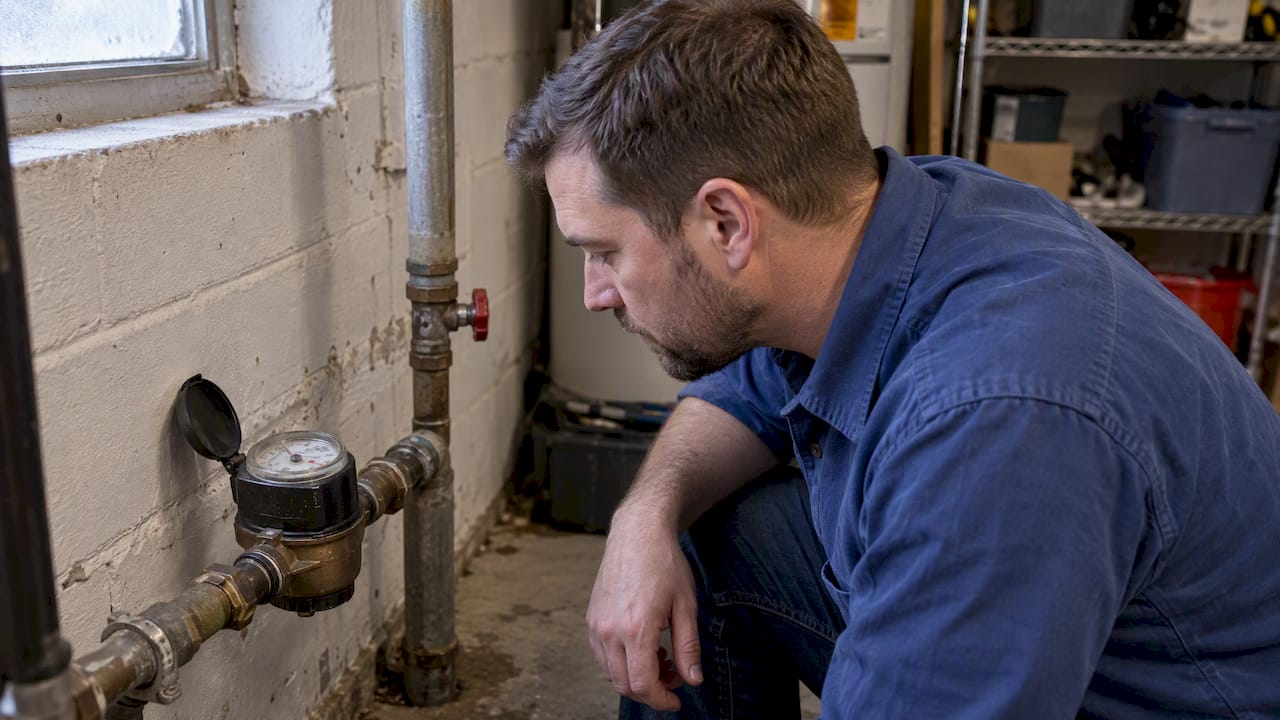
Non-invasive leak detection uses acoustic listening, tracer gas, thermal imaging, and flow monitoring to find hidden water leaks without tearing open walls, floors, or the yard. Most hidden household leaks, including slab leaks, supply lines behind walls, and underground service lines near a structure, can be located this way. If your water bill jumped or you hear running water with everything off, start with a quick meter check, then schedule a professional detection visit if the problem doesn’t resolve.
TL;DR:
- Before booking a visit, shut off all water and check the meter again after two hours; movement indicates a leak somewhere in the system.
- Acoustic testing suits pressurized supply lines, while tracer gas helps locate leaks in isolated pipes or HVAC lines when background noise masks sound.
- Thermal imaging can reveal damp areas behind drywall or flooring, but deep soil and thick insulation may hide temperature changes; cameras confirm a narrowed search.
- Pair a whole home flow monitor with moisture sensors near appliances to reduce missed leaks, especially in vacation homes left unoccupied for stretches.
- Call a professional if the meter keeps moving, bills stay high, or mold or ceiling stains appear; request photos and marked repair locations.
Table of Contents
- 1. Main non-invasive methods and when each one fits
- 2. Why acoustic detection comes first and what technicians listen for
- 3. Other non-invasive techniques worth knowing about
- 4. How to choose the right approach and what a professional visit involves
- 5. How we run a non-invasive detection job in the field
- 6. Regulatory standards and certifications for leak detection devices
- 7. Find the leak before you open anything up
- 8. Schedule a detection visit with AG Heating, Cooling & Plumbing
- FAQ
- Sources
1. Main non-invasive methods and when each one fits
Each method answers a different question, and picking the right one depends on where you suspect the leak and what’s around it.
- Acoustic listening picks up the hiss or rush of pressurized water through pipe walls, floors, and ground, and works best on pressurized supply lines rather than gravity drains.
- Tracer gas (usually a hydrogen blend) gets pushed through an isolated section of pipe and surfaces through even a pinhole crack, making it useful for pressurized systems and HVAC or refrigeration lines where acoustic signals are weak, according to Inficon’s description of hydrogen tracer-gas testing.
- Thermal or infrared imaging spots temperature differences caused by wet insulation or damp framing, though it can miss leaks buried deep in soil or behind thick materials.
- Moisture sensors sit at floor level near appliances or in crawl spaces and trigger an alert the moment water touches them.
- Flow monitoring tracks water use at the meter or at a single fixture and flags continuous, low-level flow that signals a leak even when no one’s running water.
- Camera inspection confirms a suspected trouble spot once another method has narrowed the search area, rather than searching blind.
In practice, technicians often combine methods. Flow monitoring might confirm a leak exists somewhere in the system, then acoustic testing pinpoints the exact spot before anyone touches a wall or floor. Our guide to leak detection methods walks through how these techniques compare for different home layouts.
2. Why acoustic detection comes first and what technicians listen for
Acoustic detection is often the first tool out of the bag because it works through finished surfaces without any setup beyond a sensor and a quiet moment. A leak under pressure produces a sound signature with a specific frequency range and amplitude that differs from normal plumbing noise or background vibration. Technicians place sensors at two or more points along a suspected line and compare the timing of the sound’s arrival at each one, a technique called cross-correlation, to calculate exactly where the leak sits between them.
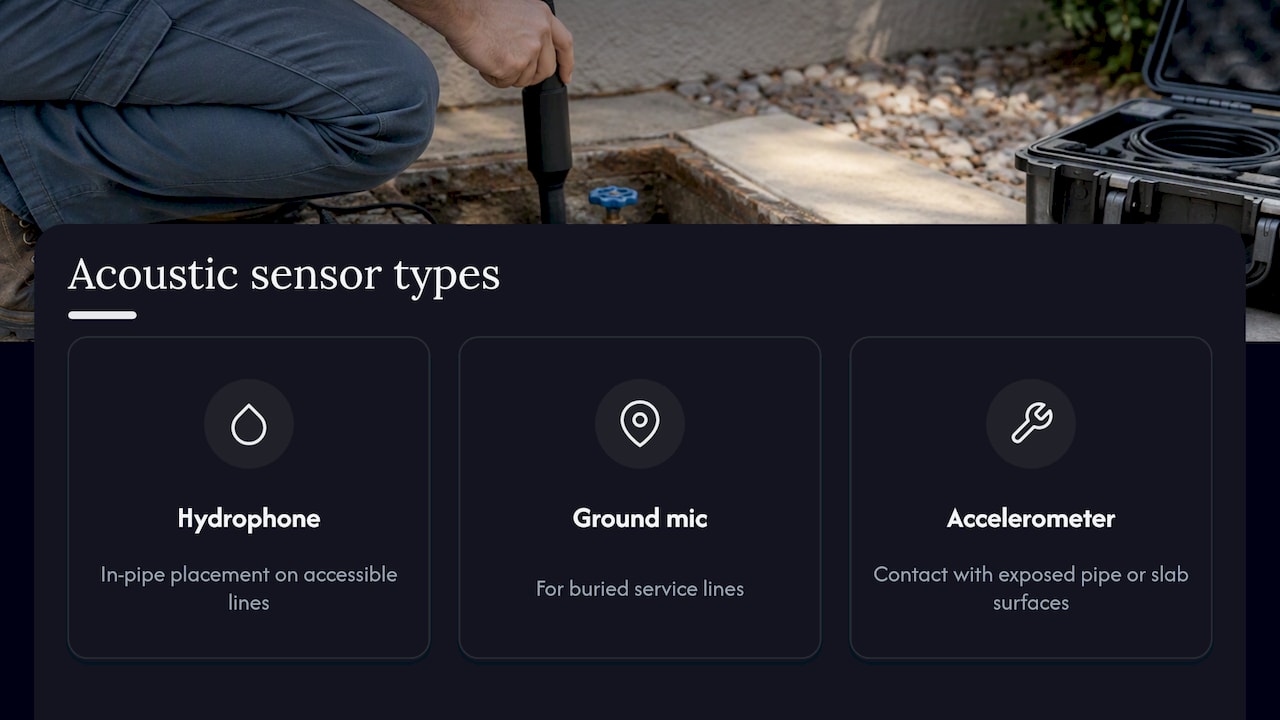
Three sensor types cover most situations: hydrophones for in-pipe placement on accessible lines, ground microphones for buried service lines, and accelerometers for direct contact with exposed pipe or slab surfaces. Research on hydroacoustic detection has found that peak frequency and maximum amplitude are among the strongest features for telling a true leak signal apart from background noise in automated classification models, based on field study results on AIoT hydrophone monitoring.
Pro Tip: Ask whether the acoustic survey includes marked surface points and photos. That documentation is what keeps a repair crew from opening more drywall or flooring than necessary.
Lab testbeds using MEMS hydrophone sensors and tuned signal processing have localized leaks to within about 1.5 meters under controlled conditions, according to research on MEMS hydrophone IoT systems, which helps explain why a well-run acoustic survey can narrow a repair to a small, specific area.
3. Other non-invasive techniques worth knowing about
Beyond acoustic listening, a few other tools cover situations where sound alone doesn’t give a clear answer.
- Tracer gas works well on isolated, pressurized systems like HVAC/R lines or sections of plumbing that can be shut off and pressurized independently, and it’s a dependable backup when ambient noise drowns out acoustic signals.
- Thermal imaging is most useful for spotting a wet patch behind drywall or under flooring, though it has blind spots in deep soil or behind thick insulation where temperature differences don’t reach the surface.
- Moisture sensors are homeowner-installable and cost little to place near water heaters, washing machines, or under sinks, giving an early alert before a slow leak becomes a bigger repair.
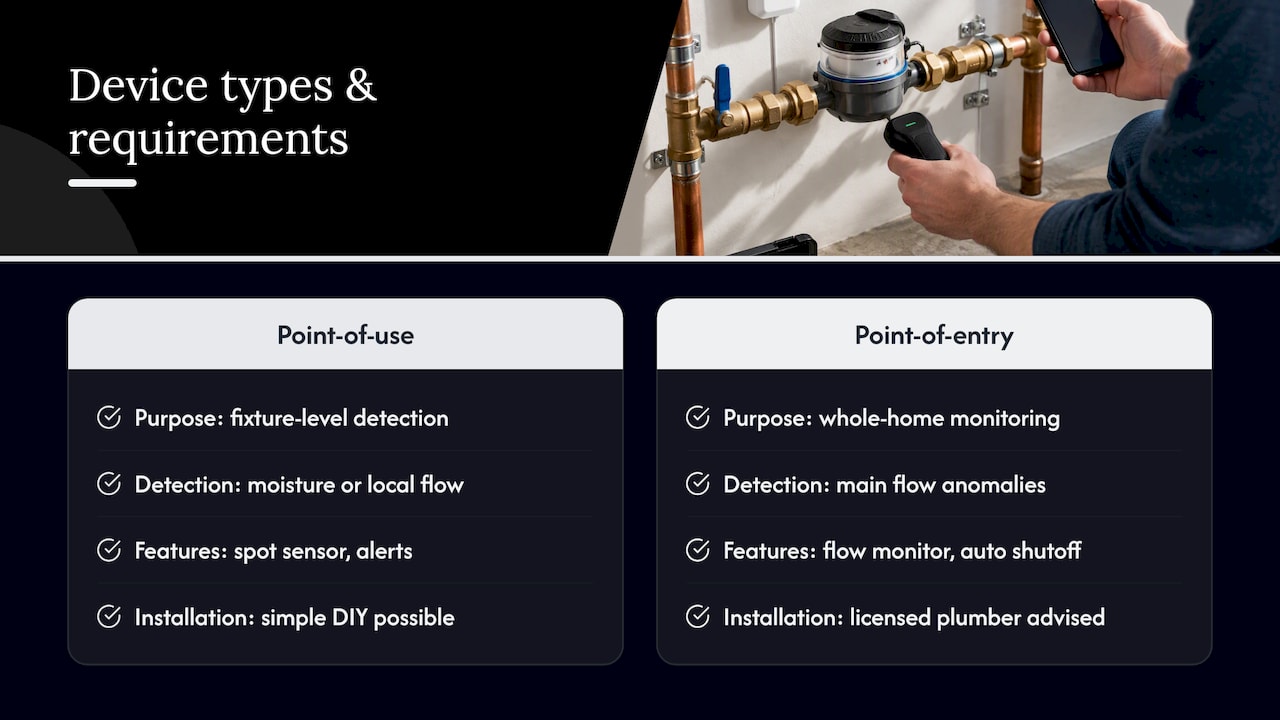
- Flow monitoring comes in two forms: point-of-entry devices that watch total household flow, and point-of-use devices on a single fixture, and both catch the kind of small, continuous leak that a visual check would miss.
- Camera inspection typically comes last, confirming the exact condition of a pipe once another method has already identified the general area.
4. How to choose the right approach and what a professional visit involves
Start with checks you can run yourself before scheduling anything.
- Read your water meter, wait two hours with no water use, and read it again. Any movement points to a leak somewhere in the system.
- Run a toilet dye test by adding food coloring to the tank and checking the bowl after ten minutes without flushing.
- Look for stains, warped flooring, or a musty odor near walls, ceilings, or the foundation.
These simple checks, outlined in the EPA’s detect-and-chase leak checklist, catch many common leaks, including toilet flappers and faucet drips, without any special equipment. If the meter keeps moving after you rule out fixtures, or you notice a persistently high bill, visible mold, or ceiling stains, it’s time to call a professional for targeted testing.
When you do, ask what method they’ll use, why, and what documentation you’ll get afterward, including photos, moisture readings, and marked locations for any repair. Detection visit costs vary by method, access, and region, and most jobs wrap up in a single visit once the leak location is confirmed. For a broader homeowner checklist before that call, see our ten quick leak detection checks.
5. How we run a non-invasive detection job in the field
Our approach starts with intake questions about the bill history and any visible signs, followed by a meter check to confirm a leak exists. From there, we run targeted acoustic or tracer gas testing depending on the pipe type and location, then confirm the find with a camera or moisture meter before marking and photographing the repair point. Our team has refined this sequence to limit how much of a floor, wall, or yard needs to be opened.
Homeowners should expect technicians to need access to the suspected area, a water shutoff if testing requires it, and typically a few hours on site depending on the property. Our Pittsburgh leak detection guide covers examples of how this plays out on real jobs.
6. Regulatory standards and certifications for leak detection devices
Non-invasive leak detection devices sold for home use fall under general product safety and plumbing code frameworks rather than a single dedicated certification. The EPA’s guide to leak detection and flow monitoring products recommends choosing point-of-use sensors for fixture-level detection and point-of-entry devices for whole-home monitoring, and it outlines installation and shut-off features worth checking before buying.
Flow monitoring and shutoff devices intended for permanent plumbing connections typically need to meet plumbing code requirements enforced at the local level, and installation by a licensed plumber helps make sure a device’s shutoff function won’t create backflow or pressure problems elsewhere in the system. For whole-home monitors with automatic shutoff, confirm the device is compatible with your plumbing material and pressure rating before installation. Homes that installed external flow monitors reduced indoor water use in some studies, and in-line monitoring with shutoff has uncovered previously undetected leaks in a number of installations, per the EPA’s product guidance. Hybrid setups that pair point-of-entry flow monitoring with point-of-use moisture sensors cut down on false negatives and are worth considering for vacation homes or any property that sits unoccupied for stretches of time.
If you’re weighing moisture-sensing options for a basement specifically, Expressions Remodeling’s piece on basement potential touches on moisture concerns worth addressing before finishing a space.
7. Find the leak before you open anything up
In my view, the biggest mistake homeowners make is skipping straight to demolition because a leak feels urgent. Non-invasive detection almost always comes first; locating the exact spot is what keeps a repair small instead of turning into a full remodel. Ask for documentation at every step: it protects you if an insurance claim comes up later.
— Maayan
8. Schedule a detection visit with AG Heating, Cooling & Plumbing
We run non-invasive leak detection as the first step before any repair, then follow through with plumbing repair, sewer repair, or hydro jetting when a clogged or damaged line is the culprit.
Every visit includes a documented detection report with photos, moisture readings, and a repair estimate before any work begins. Call or visit Ag-plumbing to schedule an inspection.
FAQ
How to find a water leak that isn’t visible?
Start with a meter test: shut off all water, note the meter reading, wait two hours, then check again for movement. If the meter moves, a professional can use acoustic listening or tracer gas to pinpoint the exact location without opening walls or flooring, as outlined in the EPA’s leak-chasing checklist.
What is the average cost for water leak detection?
Cost depends on the method used, how accessible the suspected area is, and your region, so there’s no single figure that applies everywhere. Ask for a quote up front and request documentation, including photos and marked locations, as part of the service.
What is the best device to detect water leaks?
For whole-home monitoring, a point-of-entry flow device catches small continuous leaks, while point-of-use moisture sensors work well near individual appliances, according to the EPA’s product guidance. Pairing both types reduces the chance of missing a leak.
What are the three types of leak detection?
Leak detection generally falls into acoustic methods (listening for the sound of pressurized water), tracer methods (introducing gas or dye to reveal where water escapes), and monitoring methods (tracking flow or moisture over time to flag unusual activity). Professionals often combine more than one type depending on the suspected leak location.
When should I call a plumber instead of checking it myself?
Call a professional if your water bill stays high after ruling out fixtures, if you see mold, warped flooring, or ceiling stains, or if the leak seems to be underground or behind a wall. A licensed plumber can run targeted acoustic or tracer gas testing and confirm findings with a camera before any repair begins.
Sources
- Detect and chase down leaks checklist (EPA)
- AIoT-driven leak detection in real water networks using hydrophones (Springer Nature)
- AIN-based MEMS hydrophone sensors for IoT water leakage detection system (Water MDPI)
Recommended
- Leak Detection Tips for Homeowners: 10 Quick Checks
- Top Leak Detection Methods for Homeowners and Pros
- Homeowners: Start With the Meter to Pinpoint High Water Bills Fast
- Signs of a Leak Behind Wall: How to Confirm and Fix It
