
TL;DR:
- Water heating accounts for nearly 20% of household energy use and can cost Pittsburgh families over $500 annually, especially if the unit is over a decade old. Upgrading to modern options like heat pump or tankless water heaters can significantly reduce energy bills, with rebates and tax credits shortening payback periods to just a few years. Waiting for the current heater to fail often results in higher costs and less efficient performance; early replacement ensures savings and comfort.
Water heating quietly drains your wallet every single month. In fact, water heating accounts for nearly 20% of your home’s total energy use, costing most Pittsburgh families $400 to $600 every year. If your tank is more than a decade old and humming away in the basement, it’s likely costing you far more than that. This guide breaks down why upgrading makes financial sense right now, what your best options are, what real savings look like in Pittsburgh, and how to take advantage of rebates and tax credits that can cut your payback period to just a few years.
Table of Contents
- Why traditional water heaters fall short
- How modern water heaters boost savings and comfort
- Real costs, savings, and incentives for Pittsburgh homeowners
- Should you upgrade? Factors every Pittsburgh homeowner should weigh
- The uncomfortable truth: Why waiting to upgrade costs you more
- Ready to upgrade? Expert help for your Pittsburgh water heater
- Frequently asked questions
Key Takeaways
| Point | Details |
|---|---|
| Major cost savings | Upgrading can save Pittsburgh families $400-600 or more each year on energy bills. |
| Local rebates and credits | Homeowners can claim up to $2,000 in federal tax credits and $300 local rebates for efficient upgrades. |
| Best fit for Pittsburgh | Heat pump water heaters offer the highest efficiency and are ideal for local basements. |
| Long-term comfort | New heaters provide more hot water, longer lifespans, and fewer repair hassles. |
Why traditional water heaters fall short
Most homeowners only think about their water heater when it stops working. That’s understandable, but it’s also expensive thinking. The truth is, your tank water heater could be slowly bleeding money from your household budget every single day, and you’d never know it.
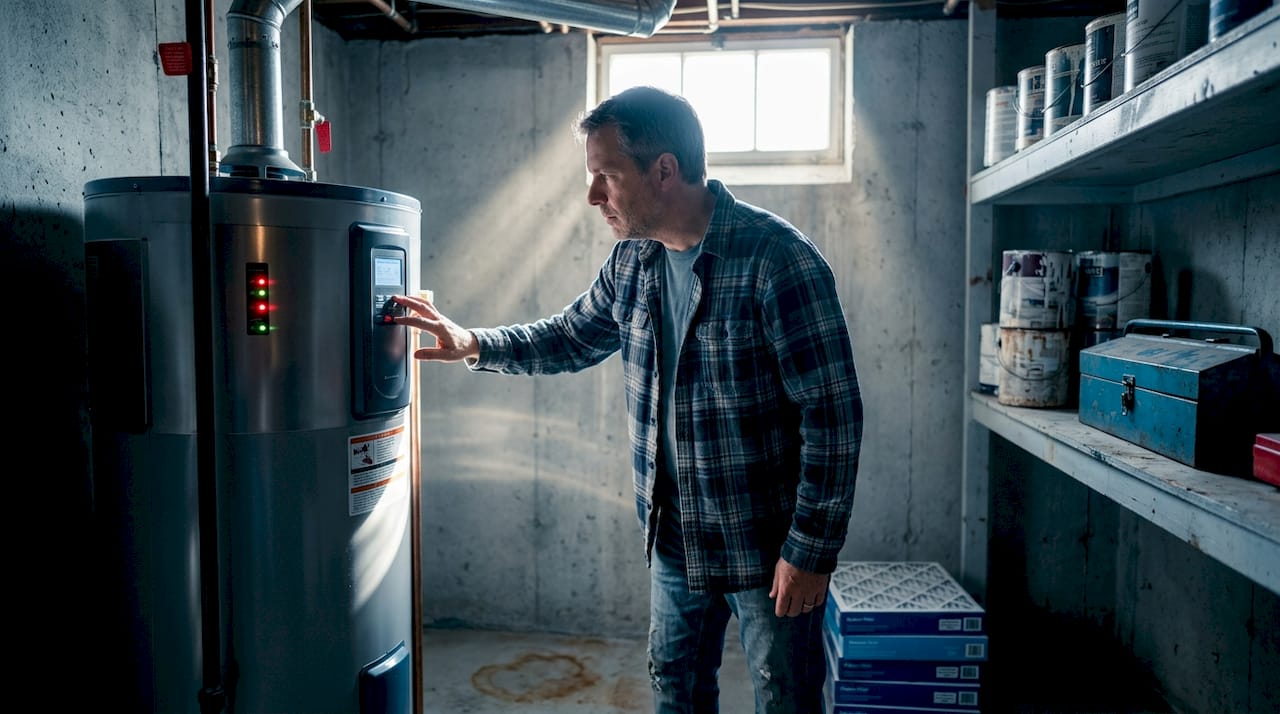
Here’s the core problem: traditional storage tank water heaters keep a large volume of water hot around the clock. Whether you’re at work, asleep, or on vacation, the heater cycles on repeatedly to maintain temperature. This is called standby heat loss, and it represents energy you pay for but never actually use. On a cold Pittsburgh winter night, when your basement drops below 50°F, that loss gets even worse.
“An aging water heater doesn’t just run less efficiently — it runs more to compensate, quietly driving up your utility bills while you sleep.”
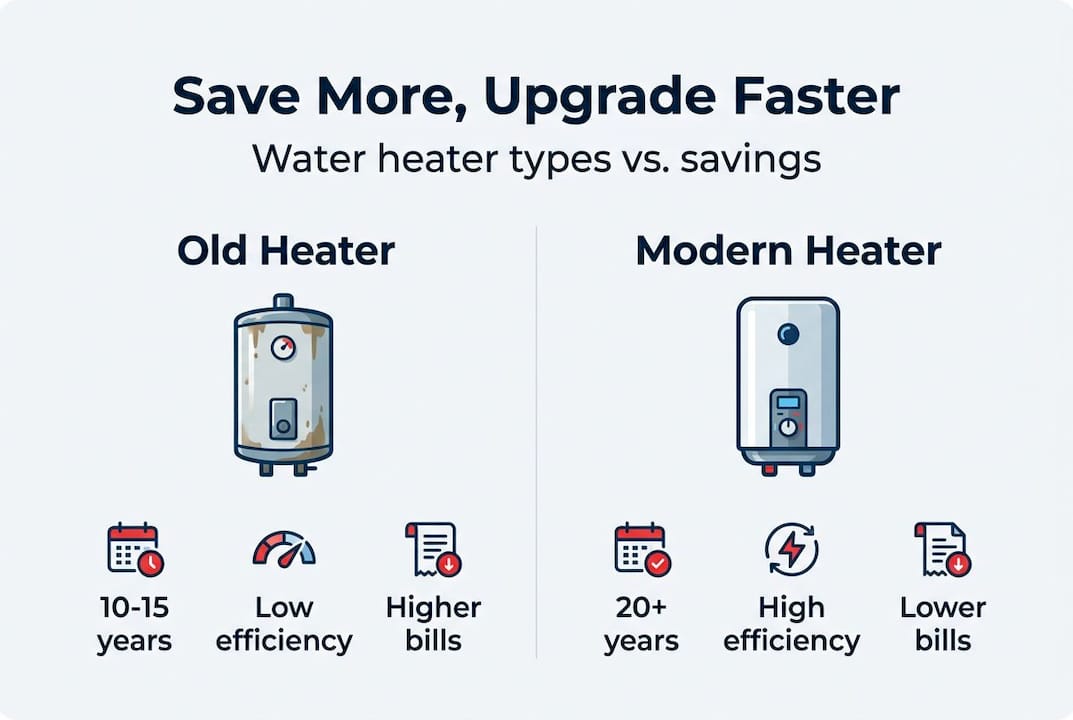
Most tank heaters also have a limited lifespan. The average unit lasts between 10 and 15 years, and efficiency drops noticeably in the final years of operation. If your heater is pushing past 10 years, it’s likely working harder than it should to deliver the same results. Given that water heating represents nearly 20% of your home energy costs, even a 15% drop in efficiency translates to real money lost each month.
Pittsburgh’s energy landscape adds another layer. Local electricity rates through providers like Duquesne Light make running an inefficient tank heater particularly costly compared to modern alternatives. Reviewing plumbing efficiency tips can help you spot other areas where your home may be losing money, but the water heater is almost always the biggest opportunity.
Common signs your current unit is underperforming:
- Rising utility bills with no clear explanation
- Inconsistent water temperature, especially during peak morning hours
- Visible rust or sediment in hot water or around the tank base
- Frequent cycling or the heater running more than usual
- Age over 10 years, even if it still technically functions
How modern water heaters boost savings and comfort
Now that you know the downsides of old tanks, let’s look at the upgraded alternatives and what makes them so much smarter.
There are three main types worth considering for Pittsburgh homes: heat pump water heaters (HPWH), tankless water heaters, and high-efficiency tank models. Each has a distinct approach to heating water, and each comes with different upfront costs and long-term savings.
Heat pump water heaters work by moving heat from the surrounding air into the water, rather than generating heat directly. This is the same principle behind your refrigerator, just running in reverse. Because they’re moving heat instead of creating it, they use dramatically less electricity. HPWHs are 3 to 4 times more efficient than standard electric tanks, saving a family of four up to $550 to $600 per year, with a Uniform Energy Factor (UEF) rating between 3.5 and 4.0. That rating means for every unit of electricity used, you get 3.5 to 4 units of heat output. No other technology comes close at this price point.
Tankless water heaters heat water only when you turn on the tap, using a powerful burner or heating element to warm water as it flows through the unit. There’s no storage tank and no standby loss. According to the U.S. Department of Energy, tankless heaters save 24 to 34% in energy for homes using less than 41 gallons per day, and 8 to 14% for higher-use households. They also last significantly longer, with a typical lifespan of 20 or more years versus 10 to 15 for tank models.
High-efficiency tank models are an improvement over standard tanks, often featuring better insulation and improved burner technology. They’re a solid option if budget is tight or if your home isn’t suited for a heat pump unit. That said, they don’t match the long-term savings of an HPWH.
| Water heater type | Upfront cost | Annual savings vs. standard | Avg. lifespan | UEF rating |
|---|---|---|---|---|
| Standard electric tank | $400-$700 | Baseline | 10-15 years | 0.90-0.95 |
| High-efficiency tank | $700-$1,100 | $50-$100 | 10-15 years | 0.95-1.00 |
| Heat pump (HPWH) | $1,100-$1,800 | $400-$600 | 12-15 years | 3.5-4.0 |
| Tankless (gas) | $1,000-$2,000 | $100-$200 | 20+ years | 0.82-0.98 |
Pro Tip: If your Pittsburgh home has a basement with at least 1,000 cubic feet of air space and temperatures that stay above 40°F most of the year, you’re in an ideal setup for a heat pump water heater. Check out our PA water heater efficiency guide for a room-by-room breakdown of installation considerations.
Understanding these options in context matters. Our Pittsburgh water heater guide walks through the specific installation requirements for each model type and what Pittsburgh homeowners encounter most often during upgrades.
Real costs, savings, and incentives for Pittsburgh homeowners
Understanding the technology is great, but what about actual numbers and what you can pocket each year?
Let’s get specific. The biggest barrier most homeowners face is the upfront cost of a heat pump water heater compared to a basic replacement tank. But once you factor in available rebates and credits, that gap shrinks fast.
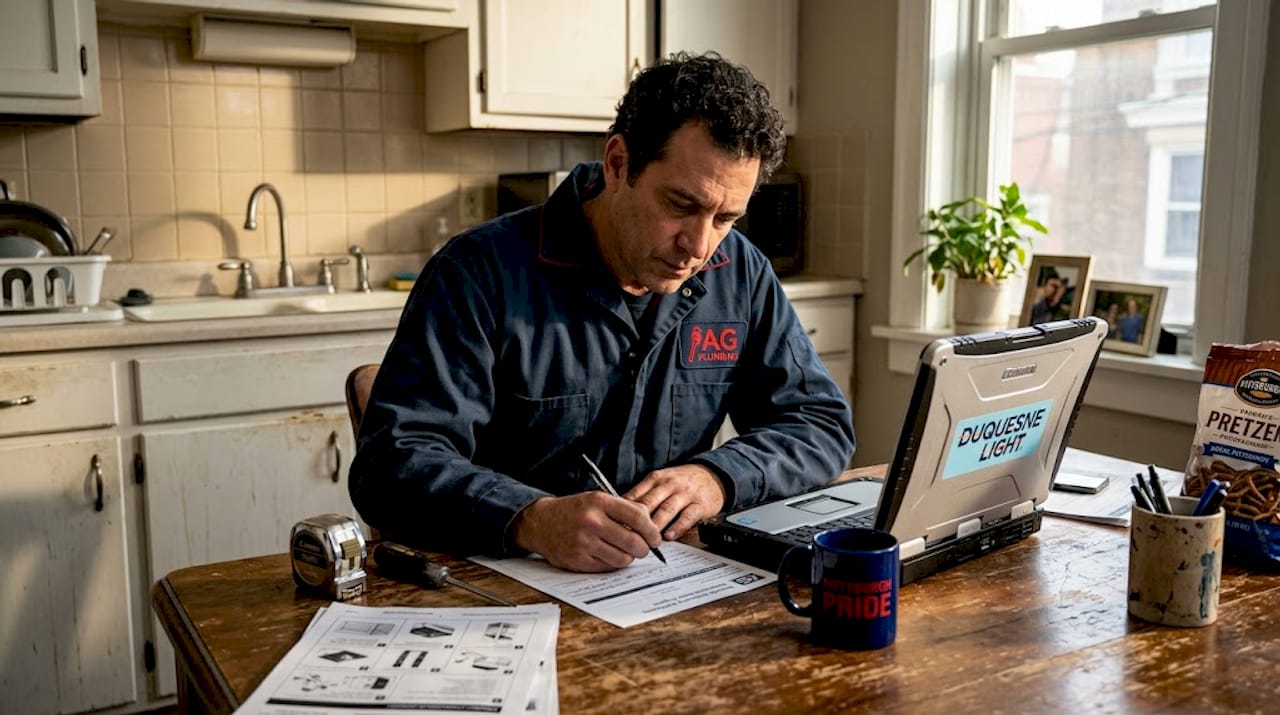
Duquesne Light offers a $300 rebate for qualifying heat pump water heater installations, and the federal Inflation Reduction Act (IRA) provides a tax credit of up to $2,000 for HPWH purchases. Together, that’s up to $2,300 back in your pocket on a unit that already pays for itself through energy savings.
Here’s a real-world payback example for a Pittsburgh homeowner switching from a 12-year-old standard electric tank to a new HPWH:
| Item | Amount |
|---|---|
| HPWH purchase and installation | $1,600 |
| Duquesne Light rebate | -$300 |
| Federal IRA tax credit | -$500 (30% of equipment cost) |
| Net out-of-pocket cost | $800 |
| Annual energy savings | $520 |
| Payback period | ~1.5 years |
That’s a real return on investment. Once that unit pays for itself, every year after is pure savings. And as incentives reduce payback periods to just 2 to 4 years, even higher-cost installations make strong financial sense for most Pittsburgh households.
How to claim your rebate and tax credit:
- Purchase a qualifying HPWH with a UEF of 2.0 or higher (most modern models qualify easily)
- Keep your purchase receipt and installation documentation from your licensed plumber
- Submit your Duquesne Light rebate through their online portal within 90 days of installation
- File IRS Form 5695 with your annual tax return to claim the federal residential energy credit
- Check for additional Pennsylvania utility rebates through your specific provider if you’re outside Duquesne Light’s service area
Exploring cost-saving plumbing tips can also reveal other rebate opportunities you might be missing alongside your water heater upgrade.
Should you upgrade? Factors every Pittsburgh homeowner should weigh
With all the options and incentives in play, here’s how to decide what’s right for your home.
Not every upgrade is a simple swap. The right choice depends on your home’s layout, your family’s daily water usage, and where your new unit will live. Getting this decision right from the start avoids costly adjustments down the road.
Key factors to consider before choosing a unit:
- Household size and daily usage: A family of four with two bathrooms uses significantly more hot water than a single person in a condo. HPWHs shine in high-use households where savings multiply.
- Available installation space: HPWHs need adequate air volume around them to work efficiently, typically at least 1,000 cubic feet. Tight closets or small utility rooms may not qualify without modifications.
- Fuel source and infrastructure: Switching from gas to electric (or vice versa) may require additional electrical panel upgrades or gas line modifications. Factor this cost into your comparison.
- Pittsburgh’s climate specifics: Our winters are cold but our basements tend to stay above freezing. That consistent basement temperature is actually ideal for HPWH operation, since the unit draws warmth from the surrounding air.
- Your current heater’s age: If your tank is under 7 years old and functioning well, waiting a few more years may still make sense. If it’s over 10, upgrading now beats waiting for a failure that forces a rushed, often more expensive, replacement.
There’s a common myth worth addressing: many homeowners assume tankless is always the superior choice. In Pittsburgh, that’s not necessarily true. Tankless units perform best in homes with consistent, moderate water demand. For larger families or homes with older plumbing that creates uneven pressure, experts favor HPWHs for Pittsburgh basements and climate due to their superior efficiency and compatibility with local conditions.
Pro Tip: Before purchasing any unit, have a licensed plumber assess your space, your household’s peak demand, and your current electrical panel capacity. This 30-minute conversation often saves Pittsburgh homeowners hundreds of dollars by avoiding an undersized unit or an unexpected wiring upgrade. Our team at AG Heating, Cooling & Plumbing handles exactly these assessments. Reviewing smart plumbing tips before your consultation can help you come prepared with the right questions.
The uncomfortable truth: Why waiting to upgrade costs you more
After 30 years in the plumbing business across Pittsburgh and the surrounding areas, we’ve seen the same scenario play out hundreds of times. A homeowner has a 13-year-old water heater that technically still works. Bills are creeping up, showers occasionally go lukewarm, but nothing has “broken” yet. So they wait.
Then one January morning, the tank leaks. Now they’re dealing with water damage, emergency service calls, and a forced same-day purchase with zero time to compare models, apply for rebates, or plan for installation requirements. The rushed decision almost always costs more and delivers less efficiency than a planned upgrade would have.
Here’s what those homeowners missed: that aging heater was already costing them extra every single month in wasted standby energy. The must-know facts for water heaters in Pittsburgh point clearly to one conclusion: the longer you run an inefficient unit past its prime, the more you pay for comfort you’re not fully receiving.
We also want to push back on the idea that upgrading is only about chasing the latest technology. It isn’t. It’s about stopping a slow, invisible drain on your household budget and replacing it with reliable, comfortable hot water at a fraction of the operating cost. Pittsburgh basements, with their stable cool temperatures year-round, are genuinely one of the best environments in the country for heat pump water heater performance. Waiting means leaving that advantage unused.
The best time to upgrade is not when your heater fails. It’s before it does, when you have the luxury of time, comparison shopping, and access to every rebate and credit available.
Ready to upgrade? Expert help for your Pittsburgh water heater
If this article has made one thing clear, it’s that upgrading your water heater is one of the smartest investments a Pittsburgh homeowner can make right now.
At AG Heating, Cooling & Plumbing, we’ve helped Pittsburgh homeowners navigate water heater upgrades for 30 years. We know which models perform best in local conditions, how to maximize your rebate eligibility, and how to size and install your unit correctly the first time. Our guide to efficient water heater upgrades is a great starting point, and our team is ready to walk you through the full process from assessment to installation. Whether you need professional plumbing repair or a full system upgrade, we make the process straightforward and stress-free. Explore the complete Pittsburgh water heater guide or call us to schedule your home assessment today.
Frequently asked questions
How much can I save if I upgrade my water heater?
Upgrading to a heat pump water heater can save a family of four about $550 to $600 per year on energy bills, and even more if your current unit is older and running inefficiently.
Are there rebates available in Pittsburgh for new water heaters?
Yes. Duquesne Light offers a $300 rebate for qualifying heat pump water heater installations, and federal IRA tax credits can provide up to $2,000 in additional savings.
Which water heater type is best for Pittsburgh homes?
Experts recommend HPWHs for Pittsburgh homes, particularly those with basement installations, because of their superior efficiency and compatibility with the local climate.
How long will a new water heater last?
Tankless models last 20 or more years, while traditional tank models typically last 10 to 15 years before efficiency drops significantly.
Is it worth upgrading if my current water heater still works?
Absolutely. Older water heaters waste energy and cost more to run each year, meaning you’re paying a penalty every month you delay the upgrade.
Recommended
- Water Heaters: What Every Pittsburgh Homeowner Must Know – AG-Plumbing
- How plumbing improves energy efficiency and cuts costs – AG-Plumbing
- Cost-saving plumbing tips for Pittsburgh homeowners – AG-Plumbing
- Service water heaters: efficiency guide for PA homes – AG-Plumbing
