

TL;DR:
- Proper pipe sizing in Pittsburgh homes is essential to maintain water pressure, prevent noise, and ensure system longevity. It involves matching flow demand with pressure, controlling velocity, and complying with local codes, often using fixture-unit calculations and consideration of pipe material and layout. Common mistakes include oversizing, undersizing, ignoring velocity limits, and neglecting local standards, which can cause pressure drops, noise, or costly rework.
Most Pittsburgh homeowners think plumbing is straightforward: pick a pipe, connect it, done. But the real story is more nuanced, and getting pipe sizing wrong sets off a chain reaction that affects water pressure, energy bills, pipe lifespan, and even the noise levels inside your walls. Pipe sizing is not about grabbing the biggest diameter on the shelf and calling it a day. It involves matching flow demand to available pressure, controlling water velocity, and meeting local code requirements from Pittsburgh Water. This guide breaks down exactly how it works, why it matters, and what mistakes to avoid.
Table of Contents
- Pipe sizing 101: What it actually means
- How plumbers size pipes: Methods and standards
- The impact of pipe sizing on water supply, heating, and drainage
- Common pipe sizing mistakes: What happens in Pittsburgh homes
- What most Pittsburgh guides miss about pipe sizing
- Need expert help with pipe sizing in your Pittsburgh home?
- Frequently asked questions
Key Takeaways
| Point | Details |
|---|---|
| Proper sizing prevents issues | Correct pipe sizing ensures strong water pressure, reduces noise, and avoids costly repairs for Pittsburgh homes. |
| Local standards matter | Pittsburgh homes must meet utility requirements for pipe sizing, materials, and installation. |
| Professional methods are specific | Plumbers use proven demand, velocity, and loss calculations for reliable pipe sizing—never guess or just ‘go bigger.’ |
| Mistakes cost more later | Incorrect sizing leads to clogs, leaks, and expensive redos—so initial accuracy pays off. |
Pipe sizing 101: What it actually means
The phrase “pipe sizing” sounds simple, but it covers a lot of ground. It is not just about the diameter of a pipe. It is about making sure every pipe in your home carries the right amount of water at the right speed without causing damage, noise, or waste.
Pipe sizing in residential plumbing is mainly about matching expected simultaneous fixture demand to available water pressure while keeping velocities and friction losses within safe operating limits to avoid noise, erosion, and poor performance. That definition packs a lot in. Let’s unpack it.
Velocity limits are a real constraint. When water moves too fast through a pipe, it creates turbulence, vibration, and accelerated wear on fittings and joints. The accepted safe velocity limits are:
- Cold water supply: up to 8 feet per second
- Hot water supply: up to 5 feet per second
- Anything above these limits risks erosion and pipe noise over time
What goes wrong with poor sizing? Here is where homeowners feel it most:
- Undersized pipes cause pressure drops, especially when two or more fixtures run at once (shower plus dishwasher, for example)
- Oversized pipes waste material, increase installation cost, and slow down hot water delivery
- Incorrect velocity causes that annoying banging or whining sound known as water hammer
- Unbalanced systems force some fixtures to underperform while others run fine
Plumbers sizing your pipes weigh several factors at once: the number of fixtures in your home, which ones are likely to run at the same time, the total developed length of the piping run (the actual travel distance, not just straight-line distance), the pipe material, and the available water pressure at your meter.
When choosing plumbing pipes for a Pittsburgh home, the pipe material itself changes the friction equation. Copper, PEX, and CPVC all have different friction characteristics, which means the same diameter in two different materials can produce different flow results.
“The right pipe size is the one that meets demand without racing past safe velocity limits. Going bigger is not automatically safer.”
Pro Tip: Slightly oversizing one segment is often manageable, but a pattern of oversizing throughout the home adds unnecessary cost and can actually slow hot water delivery, meaning you wait longer at the tap for warm water to arrive.
The best way to think about selecting plumbing materials and pipe sizing together is to treat them as two sides of the same decision. You cannot finalize one without knowing the other.
How plumbers size pipes: Methods and standards
Understanding the stakes is one thing. Seeing how professionals actually work through the sizing process is another. There is a structured methodology behind every pipe diameter choice a licensed plumber makes.
The most established approach is the fixture-unit method, often called the WSFU method (Water Supply Fixture Units). Originally developed by Roy B. Hunter in the mid-20th century, it assigns a load value to each plumbing fixture based on how much water it demands and how often it is likely to be used simultaneously. A toilet might carry one WSFU, a bathtub carries four, a washing machine connection carries three. You total those units, look up the corresponding flow demand, and then size the pipe to handle that flow at acceptable velocity and pressure loss over the pipe’s developed length.
Modern simulation tools use fixture-unit-based demand calculations and then size pipes based on developed length and available pressure rather than estimating a diameter from instinct. This keeps sizing consistent and defensible under code review.
Here is a simplified version of how a plumber works through a typical Pittsburgh home:
- Inventory all fixtures in the home, including hose bibs, appliances, and any future planned additions
- Assign WSFU values to each fixture using the applicable code table
- Total the WSFUs for each branch line and the main supply line
- Map the developed length of each pipe run from the meter to the farthest fixture
- Check available pressure at the meter (Pittsburgh Water can supply this) and account for any elevation changes in your home
- Select pipe diameter that delivers the required flow without exceeding velocity limits or acceptable friction loss
- Verify compliance with Pittsburgh codes and Pittsburgh Water standard details before finalizing
The following table gives a general reference for how fixture demand scales with pipe size:
| Pipe diameter | Approximate WSFU capacity | Typical application |
|---|---|---|
| 1/2 inch | Up to 4 WSFU | Single fixture branch line |
| 3/4 inch | Up to 25 WSFU | Multiple fixture branch |
| 1 inch | Up to 60 WSFU | Main supply for small home |
| 1.25 inch | Up to 102 WSFU | Main supply for larger home |
| 1.5 inch | Up to 180 WSFU | Large home or high-demand layout |
These numbers shift based on pipe material and developed length, which is why plumbers do not just pull a size from a chart without running the full calculation.
A well-designed plumbing fixture installation depends on this upstream sizing work being done correctly. If the pipe feeding a new bathroom addition is undersized, no amount of quality fixture installation will fix the resulting pressure problems.
The impact of pipe sizing on water supply, heating, and drainage
Correct sizing is not a single-system concern. It touches your water supply, your heating system if you have hydronic heat, and your drain, waste, and vent system. Each system has its own set of sizing priorities, and they do not always overlap neatly.
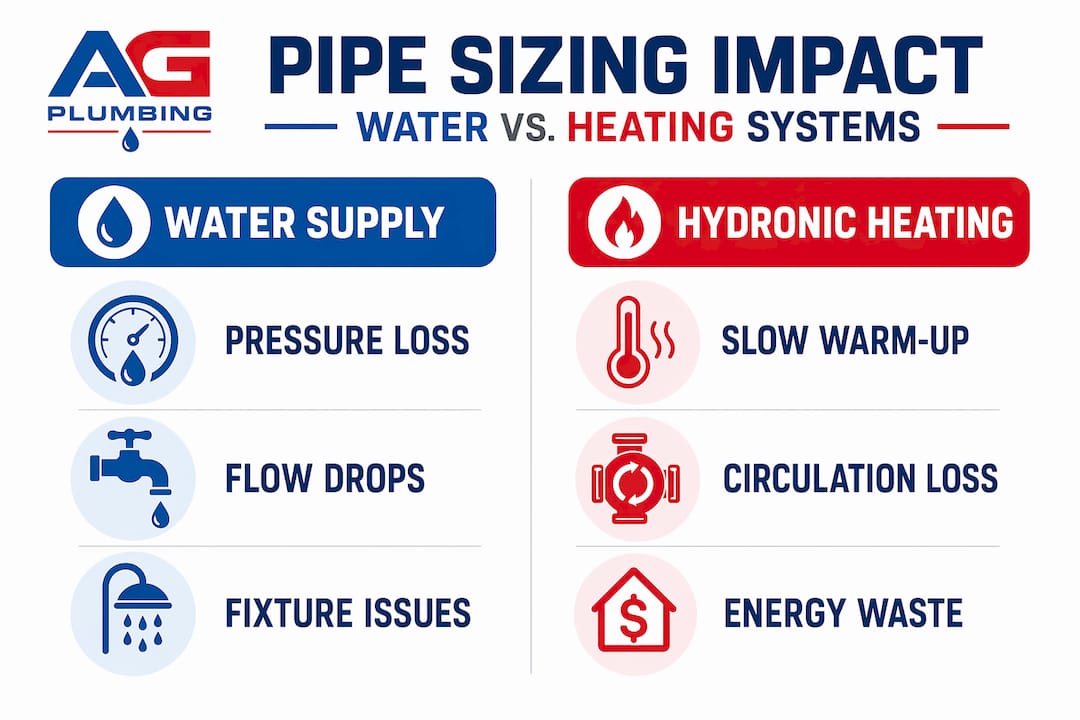
Water supply systems are the most visible. Undersized supply pipes create pressure drops that you feel immediately whenever two fixtures run at the same time. Oversized supply pipes, on the other hand, mean longer wait times for hot water and higher installation costs without any real performance benefit.
Hydronic heating systems face a different challenge. In hydronic piping, pipe sizing is a tradeoff among required flow, allowable friction loss (pressure drop and head), and resulting pump energy and noise. Friction-loss limits often govern the diameter selection. A pipe that is too small forces the pump to work harder, shortening its lifespan and raising your energy costs. A pipe that is too large can slow the water down enough to reduce heating efficiency and create uneven temperatures across radiators or baseboard heaters.
Drainage systems work on entirely different physics. There is no pressure pushing water through; gravity does the work. Correct drain sizing is tied to design loading methods based on drainage fixture units (DFU) and how fully the pipe flows, and how direction changes and venting affect trap siphonage and the flow carrying solids. An oversized drain can actually cause problems: water moves so slowly that solids do not get carried along, leading to buildup and clogs. An undersized drain backs up under heavy use.
The following table compares the primary sizing priorities across all three systems:
| System | Main sizing concern | Problem if undersized | Problem if oversized |
|---|---|---|---|
| Water supply | Pressure and velocity | Pressure drop, noise, erosion | Material waste, slow hot water |
| Hydronic heating | Friction loss and pump load | High pump energy, noise | Uneven heat distribution |
| Drain/waste/vent | Gravity flow and solid carrying | Backups, poor trap performance | Sludge buildup, clogs |
Thinking about plastic piping efficiency in terms of all three systems at once is worth your attention. PEX, for example, performs differently in supply versus radiant heating applications, and that performance difference affects which diameter you choose.
Pro Tip: The sizing constraint often shifts as you move from one segment of the pipe run to the next. The main supply line faces one set of limits; the branch to a single bathroom faces another. Sizing each segment correctly for its specific load is what separates a well-performing system from one that causes headaches in year three.
Common pipe sizing mistakes: What happens in Pittsburgh homes
Theory is useful. Real-world mistakes are more instructive.
Pittsburgh homeowners face a few specific challenges that make pipe sizing errors more likely. First, many homes in the Pittsburgh area were built decades ago with supply lines sized for older, less-efficient fixtures. Modern showers, dishwashers, and washing machines have different demand profiles, and a pipe sized in 1965 may not be right for a 2026 remodel.

Second, Pittsburgh Water has its own requirements. For Pittsburgh-area homeowners connecting to the public water and sewer system, utilities may require that new installations conform to their standard details and procedures, which can affect pipe sizing choices, materials, and layout at tap-in points. Ignoring these standards does not just mean a failed inspection; it can mean tearing out new work and starting over at your expense.
Here are the most common pipe sizing mistakes we see in Pittsburgh homes:
- Oversizing throughout the system because “bigger feels safer,” adding unnecessary cost and slowing hot water delivery
- Undersizing branch lines to save money on materials, then wondering why the master bath loses pressure when someone runs the kitchen faucet
- Ignoring velocity limits because the pipe physically fits the space, not realizing that high-velocity water erodes fittings and creates noise over time
- Failing to account for elevation changes in Pittsburgh’s hilly terrain, which affect available pressure at the fixture
- Skipping local code requirements from Pittsburgh Water, leading to expensive corrections after an inspection
- Not planning for future fixtures when sizing the main supply, making additions far more costly later
Research on residential water systems indicates that inadequate supply line sizing can cause major flow loss during peak use periods, which in Pittsburgh homes often means mornings when multiple family members are preparing for the day at the same time.
If you notice low water flow at one or more fixtures, banging pipes, or slow drain performance, your first step is a professional assessment. A licensed plumber can trace whether the issue is sizing, material degradation, or something else entirely. A good Pittsburgh pipe replacement guide will tell you what to expect from that process, including costs and timelines. Reviewing pipe repair examples from actual local projects also gives you a clearer picture of what problems look like before and after a fix.
What most Pittsburgh guides miss about pipe sizing
After 30 years of working on Pittsburgh homes, we have seen a clear pattern. Most homeowners who research pipe sizing end up with chart-based answers: “use 3/4-inch for the main, 1/2-inch for branches.” That guidance is not wrong. It is just incomplete.
Every home has its own layout, elevation profile, fixture mix, and pressure characteristics. A chart built on average assumptions will be close for an average home. But Pittsburgh is a city of hills, older housing stock, and unique pressure zones depending on your neighborhood. The chart does not know that your 1920s home in Squirrel Hill has long horizontal runs through the basement before the pipe ever rises to the second floor. A blanket recommendation does not account for that.
This is exactly why simulation-based tools are gaining ground. Organizations are developing data-driven approaches to estimate real peak demand patterns and optimize pipe sizing and pressure losses more accurately than the traditional fixture-unit method alone. We expect these tools to become standard in complex residential projects within the next several years.
That said, code minimums exist for a reason, and there are times when exceeding them makes sense. If you are adding a bathroom in a finished basement with a long supply run, sizing up from the code minimum on that branch line is often the right call even if the calculation does not strictly require it. The cost difference is small. The performance difference over 20 years is significant.
We also hear from homeowners who tried to save money by having a non-licensed contractor handle pipe work, only to discover later that the sizing decisions were made by guesswork. The correction costs far outweigh what they saved upfront. The impact of plumbing on home comfort is not abstract. It is the morning shower, the kitchen faucet, the heating system that runs quietly and efficiently. Getting sizing right the first time is the smartest investment you can make in your home’s long-term performance.
Need expert help with pipe sizing in your Pittsburgh home?
Accurate pipe sizing is technical work that combines code knowledge, local utility requirements, and real-world experience with Pittsburgh homes. Getting it right the first time saves you money, prevents future problems, and keeps your home running smoothly for decades.
AG Heating, Cooling & Plumbing has been doing exactly this work for 30 years across Pittsburgh and the surrounding areas. Our team can assess your existing piping, identify sizing problems, and recommend targeted upgrades that meet Pittsburgh Water standards and current code requirements. Whether you need diagnostics, repairs, or a full replacement, our plumbing repair services cover every stage of the project. Explore our essential plumbing services to understand the full scope of what we offer, or start with our detailed pipe replacement guide if you already know you need new piping. We are ready to help you get it right.
Frequently asked questions
How does pipe sizing affect water pressure in Pittsburgh homes?
Incorrect pipe sizing causes noticeable pressure drops, especially when multiple fixtures run at once, because undersized pipes cannot deliver enough flow to meet simultaneous demand. A professional assessment can pinpoint whether sizing or another issue is the cause.
Can I just choose a bigger pipe to be safe?
Oversizing pipes wastes material and can hurt heat-up and circulation efficiency in hydronic systems, meaning bigger is not always better. Proper sizing balances flow demand, velocity limits, and pressure constraints together.
What codes or standards should I follow for pipe sizing in Pittsburgh?
New installations must conform to Pittsburgh Water’s standard details and procedures, and approval is required before work begins. Your licensed plumber should also reference the IRC and any local amendments.
How do plumbers calculate the correct pipe size?
Most pros use fixture-unit-based calculations (WSFU method) and then size pipes based on developed length and available pressure, accounting for velocity limits and friction loss throughout. Modern projects may also use simulation tools for more complex layouts.
How do I know if my pipes are the wrong size?
Warning signs include consistently low water flow at fixtures, banging or whining sounds in the walls, and frequent clogs in the drain system. If you notice any of these, contact a licensed Pittsburgh plumber for a proper diagnosis.
Recommended
- Choosing the best plumbing pipes for your Pittsburgh home – AG-Plumbing
- How to Choose Plumbing Materials for Pittsburgh Homes – AG-Plumbing
- Step-by-step pipe replacement guide for Pittsburgh homeowners – AG-Plumbing
- Pipe relining: Smart, cost-saving fix for Pittsburgh pipes – AG-Plumbing
