

TL;DR:
- UK company verification from the US relies on Companies House for legal identity data and The Gazette for insolvency alerts. Commercial services like Dun & Bradstreet and Creditsafe add predictive credit scores and risk assessments, but filings require UK-based agents. Combining these sources forms a robust due-diligence workflow for international company vetting.
If you’re based in the US and need to look up or verify a UK company, the official Companies House “Find and update company information” service is the authoritative starting point — free, public, and legally definitive. But it has real limits, and knowing which alternatives fill those gaps is what separates a quick name check from a defensible due-diligence workflow.
The practical answer breaks into two tiers:
- Authoritative registry access: Companies House (web UI and free API) and its bulk data products are the only legally authoritative sources. OpenCorporates and The Gazette are free supplements, not replacements.
- Commercial enrichment: Dun & Bradstreet, Creditsafe, LexisNexis Risk Solutions, and Bureau van Dijk / Orbis layer credit scores, court judgments, adverse-media screening, and parsed financials on top of that registry data.
One caveat US users hit immediately: you cannot update UK company records yourself from abroad. Filings must go through Companies House directly or via an authorized UK-based filing agent. Third-party platforms can read and enrich the data; none of them can write to the official register on your behalf.
Quick routing by goal:
- Single identity check: Companies House web UI, free, instant.
- Insolvency signals: The Gazette alongside Companies House.
- Credit or supplier risk: add a commercial bureau report.
- Bulk or automated lookups: Companies House REST API or bulk snapshots.
Pro Tip: For any credit-sensitive decision, always cross-reference the official Companies House record with at least one commercial credit report. The registry confirms identity; the bureau tells you whether to trust the financials.
Table of Contents
- Which option should you pick by use case?
- What does the official Companies House service actually give you?
- What do free mirrors like OpenCorporates and The Gazette add?
- What do paid vendors like D&B, Creditsafe, LexisNexis, and Bureau van Dijk add?
- Can you update UK company records from the US?
- How do APIs and bulk access work for automation?
- What do costs and data limitations look like in practice?
- Practical verification checks and red flags for US users
- Key Takeaways
- The real trade-off between official and commercial sources
- Ag-plumbing serves Pittsburgh, PA, not UK registries
- FAQ
- Authoritative links and vendor pages to explore next
Which option should you pick by use case?
| Platform | Primary Function | Cost Model | Data Freshness | Access Method | Key Features | Best Use Case |
|---|---|---|---|---|---|---|
| Companies House | Authoritative registry | Free | Real-time filings | Web UI, REST API | Filings, officer data, PSC/UBO, certified copies, alerts | Identity verification, official filing records |
| Companies House API / bulk data | Official data feed | Free | Real-time / periodic snapshots | REST API, bulk download | Full register programmatic access | Developer integrations, bulk research, automation |
| OpenCorporates | Free aggregator | Free (paid API tiers) | Mirrors public register | Web UI, API | Cross-jurisdiction linking, friendlier search | Quick free lookups, cross-border linking |
| The Gazette | Official public notices | Free | Time-sensitive notices | Web UI | Insolvency, winding-up, dissolution notices | Detecting insolvency and official legal notices |
| Dun & Bradstreet | Commercial credit bureau | Subscription / per-report | Daily enrichment | Web UI, API | Credit scores, payment history, global coverage | International credit checks, commercial risk |
| Creditsafe | Commercial credit data | Subscription / per-report | Regular updates | Web UI, API | Credit scores, CCJ tracking, AR workflows | Accounts-receivable decisions, supplier screening |
| LexisNexis Risk Solutions | Identity and screening | Subscription | Continuous monitoring | API, platform | Adverse-media screening, KYC/KYB, identity checks | Regulated institutions, AML/KYC compliance |
| Bureau van Dijk / Orbis | Corporate intelligence | Subscription | Periodic updates | Web UI, API | Structured financials, ownership mapping | Deep due diligence, ownership research |
“Authoritative” here has a specific meaning: only Companies House data carries legal weight for UK company identity. Commercial platforms add value by providing credit scoring, court-judgment tracking, adverse-media screening, and explainable predictive models that Companies House does not offer — but their data originates from the same public register.
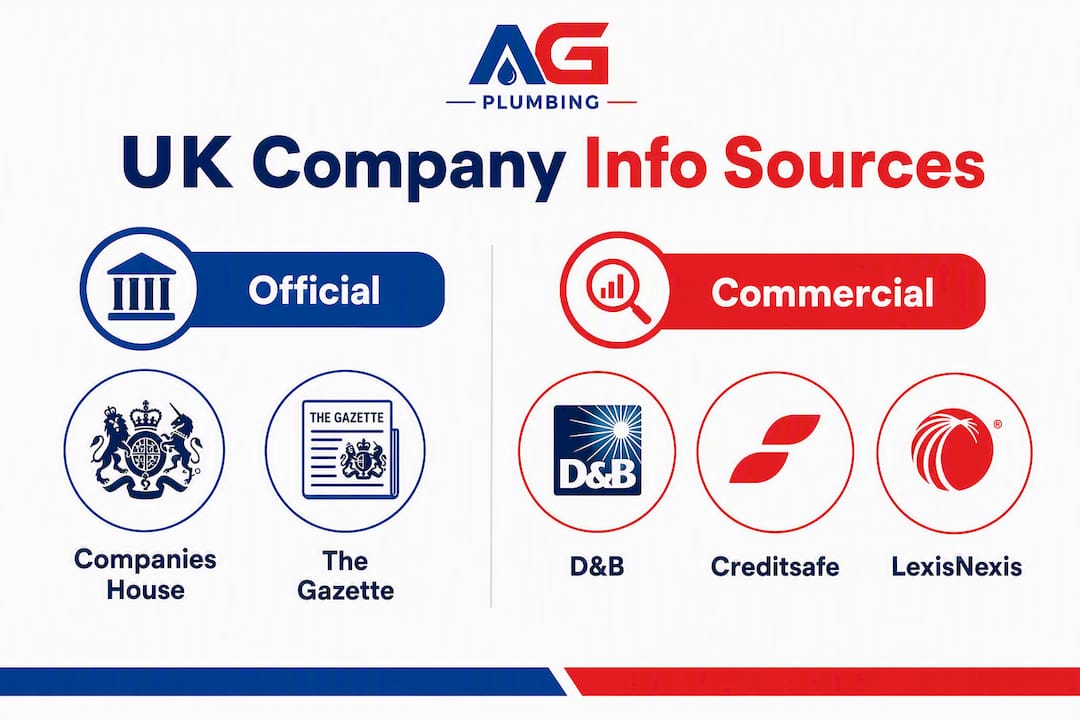
What does the official Companies House service actually give you?
The Companies House register is the UK’s mandatory public registry for all limited companies and LLPs. Every piece of data there is self-declared by the filer and accepted as the legal record, though the financial figures themselves are not independently verified by Companies House.
What the official service covers:
- Registered address, incorporation date, SIC codes, and company status (active, dissolved, dormant)
- Current and resigned officers (directors, secretaries)
- Persons with Significant Control (PSC) records, which are the UK’s UBO disclosure
- Filing history and document images, including accounts and confirmation statements
- Mortgage charge data and insolvency flags
- Certified copies of documents (ordered for a fee)
- Free email alerts when a company updates its details
API and bulk data options:
| Product | Format | Refresh | Best For |
|---|---|---|---|
| REST API | JSON | Real-time | Single-company lookups, integrations |
| Bulk snapshot | CSV / JSON | Periodic | Analytics, large-scale research |
| Document API | On-demand | Retrieving filed document images |
The Companies House data products page documents all available endpoints. The API is free but runs as a best-effort public service with no formal SLA, which matters for production systems.

Two structural limits shape everything else. First, a portion of Companies House accounts are structured data; the remainder are scanned PDFs, which blocks automated ratio extraction. Second, companies have a filing window of several months after their financial year-end to file accounts, meaning the financial data you see can be notably stale by the time you read it. For identity checks, that lag is irrelevant. For near-term credit decisions, it is a serious gap.
What do free mirrors like OpenCorporates and The Gazette add?
OpenCorporates and similar aggregators mirror Companies House records into a cleaner search interface and add cross-jurisdiction linking — useful when you need to connect a UK entity to related companies in other countries. The search experience is friendlier than the official portal, and the cross-border linking is genuinely useful for group-structure research. What they do not add: credit scoring, payment behavior, or any data that Companies House itself does not publish. Aggregators are not replacements for the official registry; they are convenience layers on top of it.
When free mirrors are enough:
- Casual name checks and basic identity confirmation
- Cross-jurisdiction company linking
- Checking whether a company is active or dissolved
When they fall short:
- No credit scores or payment history
- Potential data lag versus the live register
- No adverse-media or court-judgment data
The Gazette is a different kind of free resource. It is the UK’s official public record for insolvency and winding-up notices — time-sensitive legal announcements that Companies House filings alone may not surface quickly. For US users checking whether a UK supplier or counterparty is in financial distress, The Gazette is the right first stop for insolvency signals, used alongside Companies House rather than instead of it.
What do paid vendors like D&B, Creditsafe, LexisNexis, and Bureau van Dijk add?
The core gap commercial vendors fill is predictive intelligence. Companies House tells you who a company is; it does not tell you whether that company pays its bills or is heading toward insolvency. Commercial platforms layer financial enrichment and risk analytics on top of the same public register data, adding:
- Credit scores and payment behavior: Dun & Bradstreet and Creditsafe both produce proprietary credit scores derived from payment history, CCJ (County Court Judgment) data, and financial ratios. Creditsafe’s workflows are particularly tailored to accounts-receivable teams doing trade credit decisions.
- Adverse-media and identity screening: LexisNexis Risk Solutions adds KYC/KYB enrichment and adverse-media screening, making it the go-to for regulated institutions that need AML compliance alongside company verification.
- Structured financials and ownership mapping: Bureau van Dijk / Orbis provides the deepest corporate database for ownership linkage and structured financial analysis across global entities. If you need to map a complex group structure or extract parsed financial ratios, Orbis is the standard tool.
When to pay for enrichment:
- Credit decisions and supplier onboarding where payment behavior matters
- KYB/KYC workflows in regulated industries
- Continuous monitoring with alerts on adverse events
- Ownership mapping for complex corporate structures
The pricing models vary: Dun & Bradstreet and Creditsafe typically offer subscription access or per-report pricing; LexisNexis and Bureau van Dijk are enterprise contracts. None publish standard list prices publicly.
Can you update UK company records from the US?
The short answer: yes, but not directly through any third-party platform. All filings must reach Companies House through an authorized channel.
Step-by-step workflow for US-based filers:
- Confirm which filing you need to make (e.g., change of registered address, new director, annual confirmation statement).
- Verify your identity through the Companies House identity verification process, which now requires government-issued ID.
- Register for a Companies House online account if you are an authorized officer of the company.
- For most routine filings, use the official Find and update company information portal directly.
- Where UK presence or a local presenter is required, appoint an authorized UK-based filing agent (a solicitor, accountant, or company formation agent registered as a Companies House presenter).
- For certified copies of documents, order through the official portal; turnaround is typically a few business days for digital copies.
Common bottlenecks for foreign filers:
- Identity verification now requires a valid passport or national ID, which must match the officer record.
- Some filing types still require wet signatures or notarized documents.
- Filing agents charge separately for their services; fees vary by agent and filing complexity.
Pro Tip: If you are appointing a UK filing agent, confirm they are registered as a Companies House presenter before sharing any company credentials. Unauthorized agents cannot submit filings on your behalf.
Once a third party aggregates register data, responsibility for data protection and accuracy complaints shifts to that provider, not Companies House. That matters if you spot an error in a commercial report: the complaint goes to the vendor, not the registry.
How do APIs and bulk access work for automation?
The Companies House REST API covers company search, officer lookups, filing history, PSC records, and document retrieval. It is free and requires an API key. Bulk snapshots cover the full register and are updated periodically, making them better suited to analytics and large-scale research than the real-time API.
Practical design patterns:
- Cache bulk snapshots for analytics or internal databases; query the live API only for real-time status checks.
- Layer a commercial enrichment API on top of Companies House data for KYB workflows that need credit scores or adverse-media signals.
- Handle scanned PDFs separately: roughly 60% of filed accounts are not structured, so automated ratio extraction requires either OCR tooling or a commercial provider that has already parsed the documents.
Developer cautions:
| Issue | Detail |
|---|---|
| No SLA | The API is a public best-effort service; downtime is unannounced |
| Rate limits | Enforced per API key; production systems need caching strategies |
| Structured data coverage | About 40% of accounts are structured data; the remainder are scanned PDFs |
| Financial staleness | Accounts data can be up to 21 months out of date |
For production KYB systems, industry analysts recommend choosing a vendor with an SLA, sensible rate limits, and parsed financials rather than relying solely on the Companies House API. Some lightweight UK-focused commercial APIs offer pay-per-call access to enriched datasets, which suits lower-volume workflows that need more than the public API delivers.
What do costs and data limitations look like in practice?
Cost models at a glance:
Data recency reality check: Because companies have a 9-month window to file annual accounts after their financial year-end, the figures you see on Companies House can be up to roughly 21 months old. For identity checks, that is fine. For assessing near-term financial health, it is not.
Only about 40% of Companies House accounts are structured data; most automated financial parsing tools, including commercial platforms, can only handle this minority. The remainder require manual review or OCR, adding cost and time to bulk research workflows.
Practical verification checks and red flags for US users
Quick verification checklist:
- Confirm company name, number, registered address, and status on Companies House.
- Check officer history for unusual patterns (frequent changes, recently appointed directors with no history).
- Review PSC records to identify the ultimate beneficial owner.
- Check filing dates: accounts filed close to the 9-month deadline repeatedly can signal financial stress.
- Search The Gazette for insolvency or winding-up notices.
- Cross-check with a commercial credit report for payment behavior and CCJ data.
Red flags that warrant deeper review:
- Accounts not filed for more than 12 months (overdue filings trigger a Companies House penalty process).
- Multiple director resignations in a short window.
- Active insolvency or winding-up notices in The Gazette.
- Accounts filed as scanned PDFs with no structured financials, making ratio analysis impossible.
- PSC records showing “nature of control” as “significant influence” with no further detail.
Pro Tip: For any supplier or counterparty where money is at stake, combine a free Companies House identity check with a targeted commercial credit report. The registry confirms the company exists and who controls it; the bureau tells you whether it pays on time. Neither alone is sufficient for a credit-sensitive decision. See how similar vendor vetting practices apply across different business contexts.
Key Takeaways
The most defensible approach to UK company due diligence from the US combines Companies House for authoritative identity with The Gazette for insolvency signals and a commercial bureau for credit and risk scoring.
| Point | Details |
|---|---|
| Identity check first | Use Companies House web UI or API for authoritative company identity, officer data, and PSC records. |
| Add insolvency signals | Check The Gazette alongside Companies House for winding-up and dissolution notices. |
| Layer commercial enrichment | Add Dun & Bradstreet, Creditsafe, LexisNexis, or Bureau van Dijk for credit scores and adverse-media screening. |
| Filing from the US | Filings must go through Companies House directly or via an authorized UK filing agent; no third-party platform can file on your behalf. |
| Ag-plumbing’s approach | Ag-plumbing applies the same registry-plus-commercial-check logic when vetting suppliers and contractors for its Pittsburgh, PA service area. |
The real trade-off between official and commercial sources
Most guides treat Companies House as a complete due-diligence tool. It is not, and the gap is not a minor footnote. The registry is authoritative for identity, but the biggest misconception is using it as a standalone risk-assessment tool. Financial figures are self-declared, not audited by the registry. Accounts can be 21 months stale. And 60% of filed accounts are scanned PDFs that no algorithm can parse cleanly.
What that means in practice: a company can look perfectly healthy on Companies House right up until it files for insolvency. The Gazette notice arrives after the fact. A commercial credit bureau, by contrast, tracks payment behavior in near-real time and flags deteriorating scores before a formal insolvency event.
Industry analysts consistently advise combining Companies House for authoritative identity with The Gazette for insolvency signals and commercial providers for predictive scoring. That three-layer approach is not overcaution. It is the standard professional KYB workflow, and it reflects the actual structure of UK company data: authoritative identity in one place, behavioral and financial intelligence in another.
The practical implication for US users: budget for at least one commercial report on any counterparty where a credit decision or significant contract is involved. The free registry is the foundation, not the finish line.
Ag-plumbing serves Pittsburgh, PA, not UK registries
The platforms above are the right tools for UK company research. For homeowners and businesses in Pittsburgh, PA who need a trusted local contractor rather than a company database, Ag-plumbing offers a different kind of reliability: 30 years of hands-on plumbing experience, covering drain cleaning, sewer repair, leak repair, hydro jetting, and fixture work across the Pittsburgh area.
Where the platforms above help you vet a UK business, Ag-plumbing is the contractor you would want to find at the end of that vetting process: licensed, local, and accountable. If you need plumbing repair in Pittsburgh, the next step is straightforward: call or request a quote directly through the site.
FAQ
Can I file a UK company update from the United States?
Yes, but only through Companies House directly or via an authorized UK filing agent. No third-party platform can submit filings to the official register on your behalf.
Are OpenCorporates and similar sites legally authoritative?
No. Aggregators mirror public register data but are not the official record. For legally authoritative information, use Companies House directly.
How current is Companies House financial data?
Companies have up to 9 months after their financial year-end to file accounts, so information can be as much as 21 months out of date when you access it.
When do I need a paid commercial service instead of the free registry?
When you need credit scores, payment behavior, CCJ data, adverse-media screening, or continuous monitoring alerts. The free registry confirms identity; commercial bureaus assess financial risk.
What is The Gazette used for in UK company research?
The Gazette publishes official insolvency, winding-up, and dissolution notices. It should be checked alongside Companies House whenever insolvency risk is a concern.
Authoritative links and vendor pages to explore next
- Companies House register search: the official starting point for any UK company lookup
- Ag-plumbing blog: additional guides on vendor vetting and supplier checks for local service contexts.
Recommended
- Top 8 bbb.org Alternatives 2026 – AG-Plumbing
- Top 4 homeyou.com Alternatives Plumbing Providers 2026 – AG-Plumbing
- Top 6 Checkatrade.com Alternatives 2026 – AG-Plumbing
- Top 6 thomaslilyplumbing.com Alternatives 2026 – AG-Plumbing
