
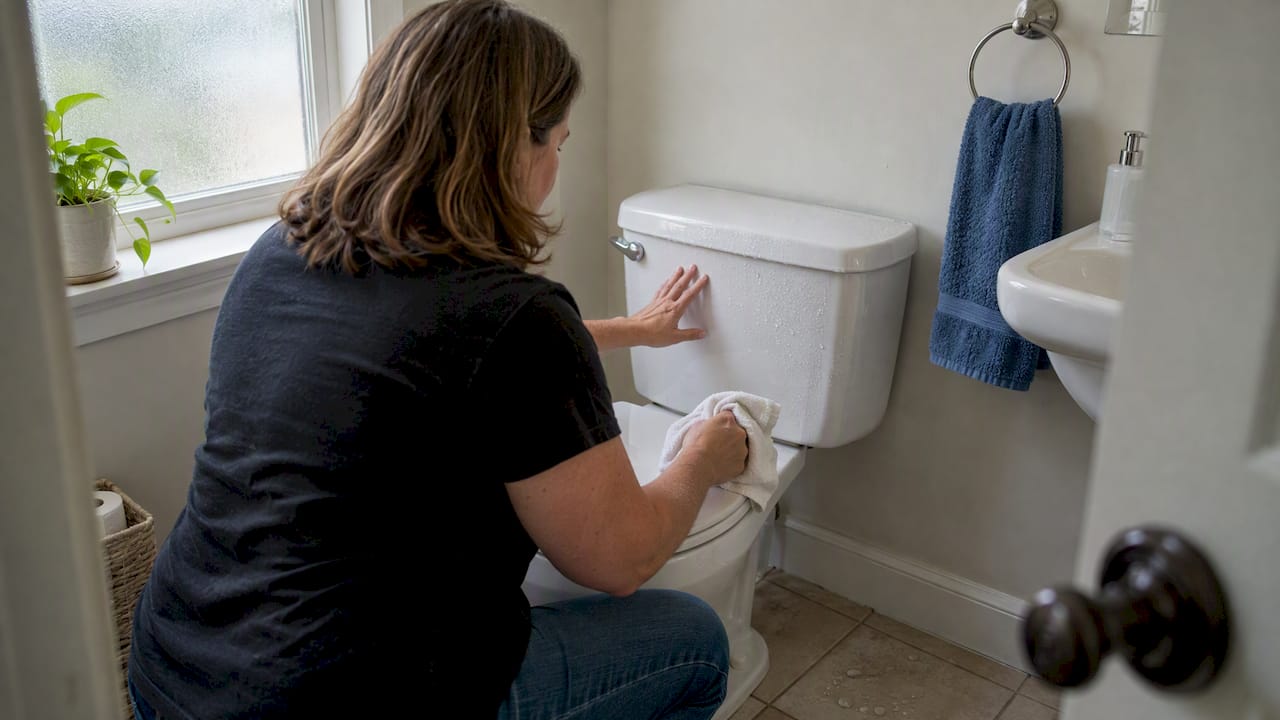
A sweating toilet tank is almost always condensation, not a leak: warm, humid air meets the cold porcelain and water beads up on the outside. Verify the toilet isn’t running, run a fan or dehumidifier, and for a lasting fix consider an anti-sweat valve or tank insulation. Call a plumber if the toilet runs continuously or if the fix requires tapping into a hot-water line.
TL;DR:
- Using a dehumidifier or a properly rated exhaust fan can often reduce condensation on toilet tanks within a few days.
- Installing an anti-sweat valve to blend hot water into the cold supply line effectively prevents moisture buildup when humidity is high.
- Insulating cold supply pipes and tank liners can help, but they are less effective without humidity control measures in place first.
- Routine checks should include verifying the water level, inspecting for leaks, and monitoring room humidity to prevent ongoing or hidden water issues.
- Professional plumbing installation is recommended for anti-sweat valves and complex repairs, especially when tapping into hot water lines or repairing subfloor damage.
Table of Contents
- Why toilet tanks sweat: dew point, tank temperature, and common triggers
- Diagnose: how to tell condensation from a leak
- Fast, low-cost fixes you can try today
- Anti-sweat valve: how it works and what installation involves
- Insulating the tank: liners, foam panels, and compatibility limits
- Control bathroom humidity for long-term prevention
- Maintenance checklist and red flags that mean call a professional
- Why trust this guidance: author and AG Heating, Cooling & Plumbing credentials
- Publisher perspective: where DIY stops making sense
- How AG Heating, Cooling & Plumbing can help
- FAQ
- Sources
Why toilet tanks sweat: dew point, tank temperature, and common triggers
Condensation happens when a surface cools below the dew point of the air around it, the temperature at which air can no longer hold its moisture as vapor. A porcelain toilet tank filled with cold supply water often sits well below that threshold, especially in summer when incoming groundwater runs cold and room air is thick with humidity. Tank surfaces in the 50 to 60 degree Fahrenheit range are the most common trigger for this, according to moisture problems in the house, which is exactly the range typical supply water reaches in warmer months.
A few household conditions make it worse:
- A running toilet that constantly refills with cold water keeps the tank chilled.
- Poor bathroom ventilation lets humid air linger after showers.
- Frequent showers or baths push indoor humidity above the point where condensation forms.
Controlling indoor moisture through ventilation and dehumidification reduces condensation risk across a home’s surfaces, not just the toilet tank.
Diagnose: how to tell condensation from a leak
Before you fix anything, confirm what you’re dealing with. Water pooling only after a hot shower is almost always condensation; water that’s there constantly, even in a dry bathroom, points to a leak.
- Check timing: wipe the tank dry, then watch it over the next hour without running water elsewhere.
- Drop food coloring into the tank and wait 15 minutes; color in the bowl means the flapper is leaking.
- Listen and feel for a toilet that keeps refilling on its own, a sign the fill valve isn’t shutting off.
- Check the tank’s water level against the fill line marked inside.
- Use a cheap hygrometer to check relative humidity; condensation becomes likely once indoor RH climbs above roughly 50 to 60 percent.
Fast, low-cost fixes you can try today
Start with the cheapest options before buying parts or calling anyone. Most sweating tanks respond to a change in airflow or humidity within a day or two.
- Run the bathroom exhaust fan during every shower and for 20 to 30 minutes afterward to clear humid air before it settles on cold surfaces.
- Add a small dehumidifier in the bathroom, positioned a few feet from the tank, and aim for relative humidity under 50%.
- Lower the tank’s water level slightly at the fill valve as a temporary stopgap, which reduces the volume of cold water in contact with the tank walls.
- Insulate any exposed cold supply pipe running into the tank with foam pipe sleeves, the same approach covered in how to insulate water pipes and prevent freezing.
Pro Tip: Check your fan’s rating against the bathroom’s square footage; an undersized fan runs constantly without ever pulling enough moisture out of the air.
If other fixtures sweat too, the humidity problem likely extends beyond the toilet; see pipe sweating explained for related causes and fixes.
Anti-sweat valve: how it works and what installation involves
An anti-sweat valve, also called a mixing valve, blends a small amount of hot water into the cold line feeding the tank so the water inside stays above the dew point. It’s the most dependable fix when humidity control alone isn’t enough.
- Fixed valves mix a set ratio year-round; adjustable models let you dial in more hot water during humid months and shut the mixing off in winter to save energy, a feature This Old House notes on adjustable units.
- The valve must be installed in a vertical orientation so its internal check mechanism works correctly; installed sideways, it can let hot water cross into the cold line, according to This Old House’s guide to stopping condensation.
- Tapping into a hot-water line and sweating copper fittings is plumbing work most homeowners should not attempt without experience, since a bad joint or wrong orientation risks scalding water at a cold tap.
- After installation, test cold-water fixtures nearby to confirm no hot water is crossing over, then insulate the valve body to hold its temperature steady.
Pro Tip: If you’re unsure which direction is “up” on the valve body, stop and call a plumber rather than guess; a reversed install is a safety issue, not just an inconvenience.
For more on how these valves work and where they’re used for safety, see the role of thermostatic mixing valves in home safety.
Insulating the tank: liners, foam panels, and compatibility limits
Interior tank liners and foam panels create a barrier between cold tank water and the warm, humid air outside, which can stop condensation on many older tanks. The catch is compatibility: newer low-flow toilets often have tighter internal clearances, and a liner can interfere with the float or flapper mechanism, according to InspectApedia’s condensation reference.
- Drain and dry the tank completely before fitting any liner or panel.
- Cut and fit foam pieces so they never touch the float, flapper, or fill valve arm.
- Seal panel edges so water can’t seep behind them and sit unnoticed.
- Skip insulation if you haven’t ruled out a running toilet first, since insulation can mask a leak while damage continues underneath.
Insulation alone rarely solves sweating in very humid climates or on toilets that run frequently; pair it with the humidity fixes above.
Control bathroom humidity for long-term prevention
Stopping the tank from sweating for good usually comes down to keeping the room itself dry rather than treating the tank in isolation.
- Size the exhaust fan to the room and consider a humidity-sensing model that switches on automatically, a method the EPA’s moisture control guidance flags as more consistent than manual fan use.
- Use a portable dehumidifier for a single bathroom; consider a whole-house dehumidifier if multiple rooms stay damp, an option covered in this HVAC dehumidification guide.
- Stagger back-to-back showers where possible so humid air has time to clear.
- Avoid drying wet towels or clothes in the bathroom, and squeegee shower walls after use.
Keeping relative humidity under 50% prevents most mold growth and stops condensation from forming on cold surfaces in the first place.
Maintenance checklist and red flags that mean call a professional
A short routine catches problems before they turn into repairs. Every few months, check the fill valve, tank bolts, and base seals, and rerun the food-coloring test. Each season, test the fan, check insulation or liners, glance at a hygrometer, and look at the floor around the base for staining or softness.
- Call a plumber if the toilet keeps running no matter how you adjust the fill valve.
- Call a plumber if the subfloor near the toilet feels soft or discolored.
- Call a plumber if you see mold forming despite good ventilation.
- Call a plumber if dripping continues after you’ve addressed humidity and airflow.
Left unchecked, that dripping can rot subflooring and feed mold growth, the kind of damage moisture problems in the house warns builds quietly under flooring and baseboards.
Why trust this guidance: author and AG Heating, Cooling & Plumbing credentials
This guide is written by Maayan, a contributor to AG Heating, Cooling & Plumbing, drawing on practical plumbing knowledge rather than guesswork. AG Heating, Cooling & Plumbing has 30 years of industry experience serving Pittsburgh and the surrounding area. For related DIY steps, see our guides on fixing a running toilet and installing a new toilet, and for diagnosing hidden leaks before you insulate anything, check leak detection methods for homeowners and pros.
Publisher perspective: where DIY stops making sense
Running a fan, adding a dehumidifier, fitting a tank liner, or nudging the fill valve down are all reasonable weekend projects. Installing an anti-sweat valve is different: it means tapping a hot-water line, getting the orientation right, and confirming there’s no cross-connection, work that rewards experience over trial and error. Suspected subfloor damage falls in the same category. Inspections, valve installs, and repairs can be handled by professional plumbers, who often provide a written estimate before any work starts.
— Maayan
How AG Heating, Cooling & Plumbing can help
A sweating tank that won’t quit despite fans and dehumidifiers usually needs a plumbing fix, not another gadget. Professional plumbing services can inspect the toilet, confirm whether it’s condensation or a hidden leak, and install an anti-sweat valve correctly with proper orientation and a tested cold-water line.

- On-site inspection to rule out a running toilet or leak before any valve work begins.
- Licensed techs install anti-sweat valves with proper hot-water tapping and orientation.
- A written estimate before work starts, so there are no surprises on the invoice.
| Service | What it addresses |
|---|---|
| Plumbing Repair | Fixing running toilets, faulty fill valves, and fittings tied to sweating |
| Plumbing Repiping | Addressing cold supply lines that keep tank water chilled |
| Backflow Testing | Checking system safety when hot and cold lines are modified |
Request an inspection through AG Heating, Cooling & Plumbing and get a clear plan for stopping the sweating for good.
FAQ
Is it normal to have condensation on your toilet tank?
Yes, it’s common in humid weather or after hot showers, when warm air meets the cold tank surface. It becomes a problem worth fixing once it drips regularly, since standing water can damage flooring over time.
How to tell if water is leaking from a toilet tank?
Drop food coloring into the tank water and check the bowl after about 15 minutes; color in the bowl means the flapper is leaking. A toilet that refills on its own without being flushed is also a sign of a leaking or faulty fill valve.
What is the lifespan of a toilet tank?
Porcelain toilet tanks typically last decades with basic care, though internal parts like the flapper and fill valve wear out much sooner and need periodic replacement. Watch for persistent running or sweating as signs that internal components, not the tank itself, need attention.
What are some good toilet tank covers to prevent sweating?
Interior foam liners and rigid foam panels are the common options, and they work by keeping the tank’s inner surface above the surrounding dew point. Check compatibility first, since liners can interfere with the float or flapper on some low-flow toilets.
Sources
- How To Fix a Sweating Toilet Tank — This Old House
- Condensation or Sweating Plumbing Pipes & Water Tanks — InspectApedia
- Moisture Control Guidance for Building Design, Construction and Maintenance — EPA
Recommended
- Toilet Installation Guide for Homeowners: 2026 Edition
- How to Fix a Running Toilet: a DIY Guide
- Diagnose Gurgling Toilet Causes in 10 Minutes, Homeowners
- Common Plumbing Repair Issues and How to Fix Them
