
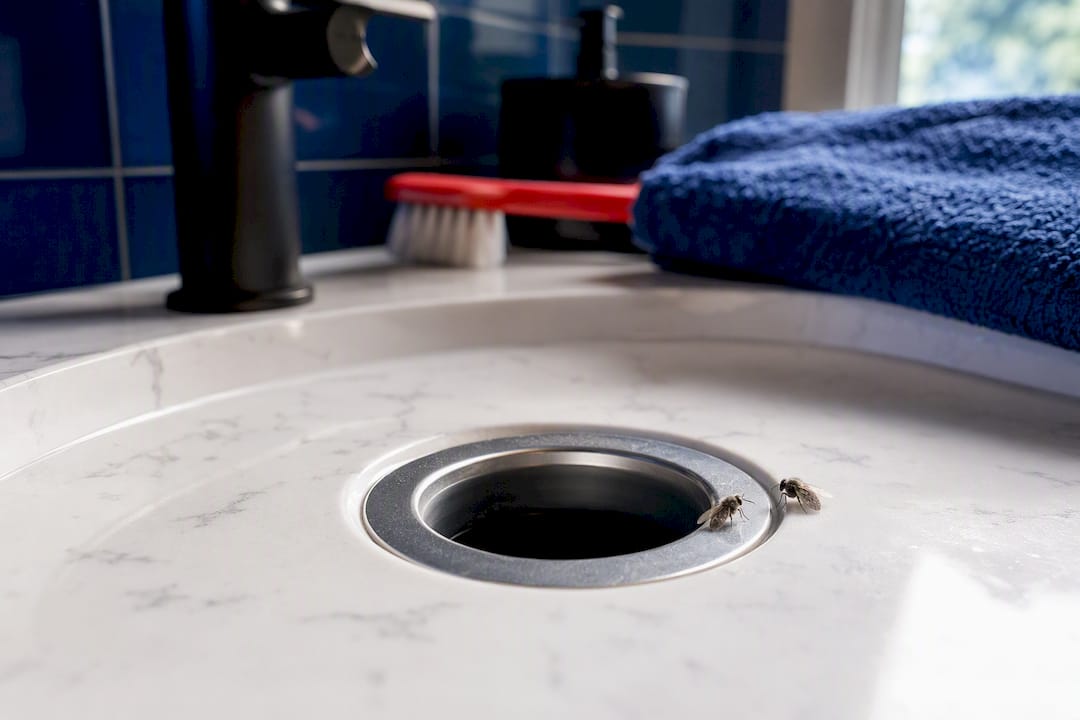
Drain flies in your bathroom mean one thing: a slimy organic film has built up somewhere in your plumbing, and adult flies are breeding in it. Killing what you see won’t fix it. The only durable solution is removing that biofilm and then monitoring the drain for about three weeks to catch the next generation before it hatches. If the flies keep coming back after that, or you’re seeing them near more than one drain, it’s time to get a plumber in to look deeper.
TL;DR:
- Removing biofilm through scrubbing, enzymatic treatment, and weekly maintenance is necessary because chemical or heat methods only offer short-term relief.
- Finding the breeding source often requires testing all bathroom drains with traps or tape to identify where larvae are developing, especially if flies appear at multiple drains.
- Persistent drain fly problems beyond three weeks despite cleaning suggest a deeper buildup or leak that requires professional camera inspection and hydro-jetting to fully resolve.
- Regular bathroom drain maintenance, including running water, cleaning traps, and fixing leaks, helps prevent future infestations, especially in rarely used or shared drains.
- Professional services using drain cameras and hydro-jetting can locate hidden leaks or deep biofilm buildup beyond manual reach, ending recurring infestations once and for all.
Table of Contents
- What Are Drain Flies (And How Do You Know That’s What You Have)?
- Where Do Drain Flies Breed, and How Do You Find the Source?
- Why Bleach, Boiling Water, and Sprays Don’t Actually Work
- How to Get Rid of Drain Flies for Good: A 3-Week Plan
- When to Call a Plumber for Drain Flies
- Preventing Drain Flies From Coming Back
- How AG Plumbing Handles the Infestations DIY Can’t Solve
- Get Professional Help for Bathroom Fly Infestations
- Sources
- FAQ
What Are Drain Flies (And How Do You Know That’s What You Have)?
Drain flies, also called moth flies, belong to the family Psychodidae. They’re tiny, usually 1.5 to 5 millimeters long, with fuzzy, tan or gray wings that give them a moth-like look under a bathroom light. They’re weak fliers. Instead of buzzing around like a fruit fly, they tend to rest flat against the wall or tile near a drain and only flutter short distances when disturbed.
Their life cycle moves fast, which is exactly why they seem to multiply overnight:
- Egg to larva: Eggs are laid directly in the organic slime lining a drain, hatching within 48 hours.
- Larva stage: Larvae feed on hair, soap scum, and bacteria in the film for roughly 1 to 2 weeks.
- Pupa to adult: Adults emerge shortly after and live only about a week, but they breed again immediately.
That’s different from fruit flies, which target rotting produce, or fungus gnats, which breed in overwatered houseplant soil. If you’re seeing them specifically around a sink, tub, or floor drain and nowhere else in the kitchen, drain biofilm is almost always the source.
Where Do Drain Flies Breed, and How Do You Find the Source?
Bathroom drains are the usual suspects, but not the only ones. Any spot where water sits and organic debris collects can turn into a breeding ground.
Common breeding sites include:
- Shower and tub drains, where hair and soap scum accumulate along the pipe walls.
- Sink P-traps, especially in sinks used infrequently.
- Overflow channels in sinks and tubs, which trap slime and rarely get cleaned.
- The base of the toilet tank and the area around wax rings.
- Condensate pans near HVAC equipment if your bathroom shares a wall or closet with one.
- Floor drains, which dry out between uses and let biofilm cake up undisturbed.
To confirm exactly which drain is breeding flies, refer to signs of drain fly infestation: how to spot and act and coat the inside of a clear cup or jar with cooking oil or petroleum jelly and set it upside down over the drain overnight. Any adult that emerges gets stuck trying to fly out. A strip of clear tape laid sticky-side down over the drain opening works almost as well and is easier to check at a glance.
Pro Tip: Run this test on every drain in the bathroom at once, even the ones you haven’t seen flies near. Adults are weak fliers, so if you’re only catching them at one spot, that’s your breeding site. Catching them at several means the problem has already spread.
Slow drainage, a persistent musty smell, or flies returning within days of a cleaning are signs the biofilm goes deeper than you can reach with a brush.
Why Bleach, Boiling Water, and Sprays Don’t Actually Work
Biofilm is a living microbial layer, not just dirt. It clings to pipe walls with a protective matrix that shields it from short bursts of heat or chemicals, which is why a quick pour of boiling water only ever gives temporary relief.
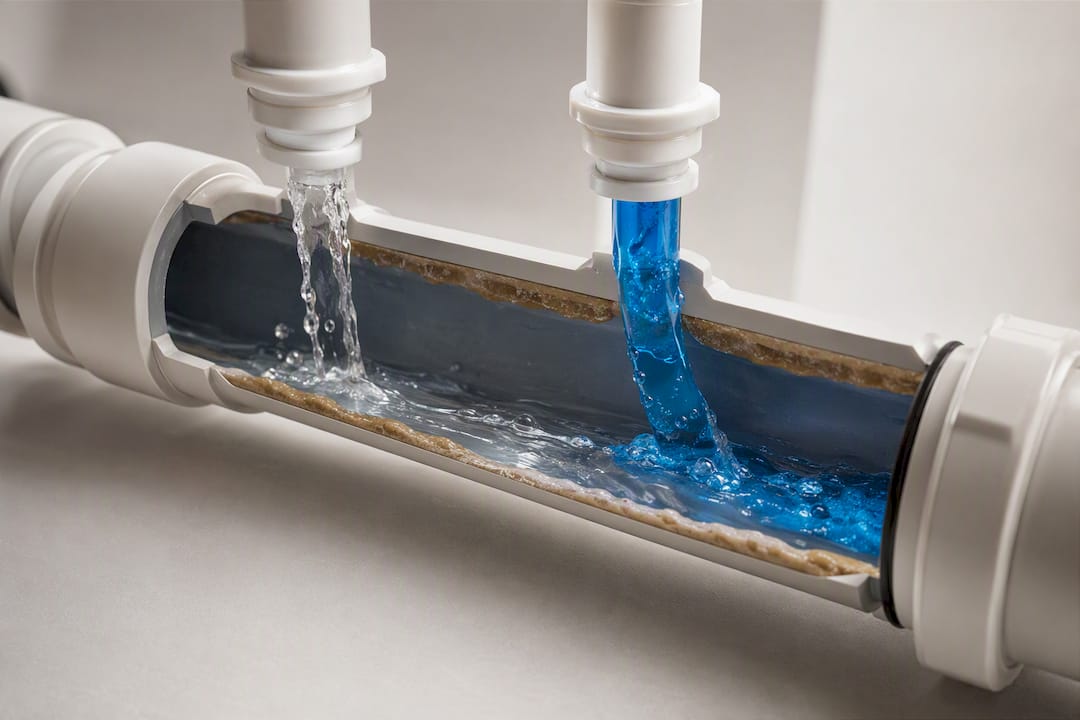
Bleach has the same problem. It doesn’t penetrate deep enough into the film to kill the larvae living inside it, and drain fly larvae are aquatic, so they can survive submerged for stretches that outlast a typical bleach pour. Worse, mixing bleach with other drain cleaners already in the pipe, especially anything ammonia-based, can produce toxic chlorine gas in an enclosed bathroom.
Spraying visible adults with insecticide has the same flaw as boiling water: it kills what you can see and leaves the breeding site fully intact.
- Bleach and vinegar don’t remove the protective biofilm layer.
- Boiling water gives only short-term knockdown, not elimination.
- Mixing cleaners in a drain can release hazardous fumes.
- Killing adults without removing their food source guarantees a new batch within days.
Research on drain biofilm shows these microbial layers carry significant resistance to standard antimicrobial exposure, which is exactly why extension entomologists frame this as a cleaning problem, not a pest-spray problem.
How to Get Rid of Drain Flies for Good: A 3-Week Plan
This is the part that actually works, and it takes patience more than any special skill. Extension guidance is consistent on the timeline: plan on at least three weeks of consistent attention, because that’s roughly how long it takes to catch every larva already in the pipe as it matures and emerges.
What you’ll need: a stiff drain brush or bottle brush, a plumber’s snake, a bucket, an adjustable wrench, an enzymatic or foaming drain treatment, oil or petroleum jelly for trap cups, and a few sticky fly traps.
- Remove the drain cover and physically scrub the exposed pipe walls with the stiff brush. This is the single most important step. You’re not trying to flush the slime, you’re trying to scrape it off.
- Pull the P-trap if you can reach it. Most bathroom sink P-traps unscrew by hand or with a wrench. Empty it into a bucket, scrub the inside, and rinse before reattaching.
- Run a plumber’s snake through any drain that’s slow or clogged, since trapped hair and debris behind a clog is often where the thickest biofilm builds.
- Apply an enzymatic or foaming drain treatment after the mechanical scrub. Extension research recommends this combination because foaming formulas cling to pipe walls and reach the film that a liquid pour just runs past. Follow the product label and reapply weekly.
- Set your cup or tape trap on every treated drain and check it every 2 to 3 days.
- Repeat the scrub and enzyme treatment weekly for at least three weeks, even if you stop seeing adults after week one. The larvae already in the pipe when you started need time to finish their cycle and emerge, and that’s your real test of whether the source is gone.
- Keep a quick log. A note on your phone with the date and trap count tells you fast whether you’re winning or whether the same drain keeps producing flies.
Sticky traps placed near (not in) the drain will pick off any adults still emerging between cleanings, and they double as a free monitoring tool. If you see adults resting on the wall and want quick knockdown, a non-residual spray aimed only at visible insects is fine. Never pour insecticide down the drain itself and never combine it with any other cleaner already in the pipe.
When to Call a Plumber for Drain Flies
Three weeks of honest effort is the fair test. If flies are still emerging after that, or if you’re seeing them at multiple drains, slow drainage, or a lingering sewer smell, the biofilm has likely built up somewhere you can’t physically reach with a brush or a snake.
- Flies persist despite three full weeks of scrubbing and enzyme treatment.
- More than one drain or room shows activity.
- Drainage stays slow no matter how much you clean.
- You notice a sewer odor or any sign of a hidden leak.
This is where drain camera inspection earns its keep. A camera can locate biofilm buildup deep in a pipe run, a slab leak, or a cracked joint that’s been feeding moisture and organic matter into your wall or floor for months. Hydro-jetting follows the same logic as the manual scrub you already did, just at full pipe scale: high-pressure water shears the biofilm off the entire interior wall of the pipe instead of just the first foot or two you could reach by hand. One thorough professional visit at this stage usually costs less, in time and frustration, than another month of repeat DIY attempts that never touch the actual source.
Preventing Drain Flies From Coming Back
Once a drain is clean, keeping it that way takes a few minutes a week, not a deep clean every time.
- Run water in guest bathrooms or rarely used drains at least weekly so the trap doesn’t dry out and organic film doesn’t cake up.
- Clear hair and soap scum from shower and tub drains after every few uses.
- Use an enzymatic drain cleaner once a month as maintenance, not just as a cure.
- Fix small leaks around the toilet base or under the sink promptly, since standing moisture is what lets biofilm establish in the first place.
- Improve bathroom ventilation to cut down on the humidity that helps biofilm thrive.
- Check condensate pans and floor drains, which dry out and get ignored more than any other drain in the house.
Rental turnovers and any bathroom with a history of repeated infestations are good candidates for a periodic professional cleaning or camera check rather than waiting for flies to show up again.
How AG Plumbing Handles the Infestations DIY Can’t Solve
After 30 years serving homes around Pittsburgh, our crews at Ag-plumbing have seen how often a “simple” drain fly problem turns out to be a biofilm buildup sitting behind a slow leak nobody noticed. We rely on drain cameras to find exactly where slime has collected past the reach of any brush, and hydro-jetting to clear it completely. More than once, a routine camera run for recurring flies has turned up a slab leak that explains months of frustration. Homeowners who bring in a pro at that point usually see the problem end for good, not just for a week.
— Maayan
Get Professional Help for Bathroom Fly Infestations
If you’ve scrubbed, snaked, and waited three weeks and the flies are still showing up, it’s time for tools that reach further than a bottle brush. Ag-plumbing offers full drain cleaning service built around exactly this problem: camera inspection to find where biofilm or a hidden leak is feeding the infestation, hydro-jetting to strip the pipe clean along its entire length, and leak repair when the camera finds the real culprit behind the slime.

A service visit starts with the same detective work you did at home, just with equipment that sees inside the pipe. Our technician runs the camera, shows you exactly what’s there, and jets the line clean in the same visit whenever possible. No guessing which drain is the problem and no repeat trips for the same fly infestation. If you’re in the Pittsburgh area and the flies won’t quit, request a service visit and get the drain checked properly the first time.
Sources
- Drain flies (moth flies) — Ohio State University Extension
- Drain flies in the home: Identification & management — Alabama Cooperative Extension System
- Drain flies: What to know — WebMD
FAQ
Why Am I Getting Drain Flies in My Bathroom?
Drain flies show up because organic biofilm, made of hair, soap scum, and bacteria, has built up somewhere in your plumbing and adults are breeding in it. The fix is removing that film, not just the flies you can see.
How Do I Permanently Get Rid of Drain Flies in My Bathroom?
Scrub the exposed pipe and P-trap by hand, apply an enzymatic or foaming drain treatment, and repeat weekly for at least three weeks to catch larvae already in the pipe as they mature. If flies persist past that window, a plumber’s camera inspection and hydro-jetting usually finish the job.
Do Drain Flies Indicate a Plumbing Issue?
Sometimes. A single dirty drain can breed flies without any underlying damage, but flies at multiple drains, slow drainage, or a lingering odor often point to a leak or deeper buildup that needs professional attention.
Will Pouring Bleach Down a Drain Kill Drain Flies?
No. Bleach doesn’t penetrate the protective biofilm layer where larvae live, so it only offers a short-term knockdown of adults at best. It can also react dangerously if mixed with other drain chemicals already in the pipe.
Are Drain Flies a Health Risk?
Drain flies don’t bite, but large infestations can act as mechanical carriers of bacteria and may trigger respiratory irritation in sensitive people. They’re mainly a sanitation nuisance rather than a direct disease threat.
Recommended
- Drain Clog Prevention Tips for Pittsburgh Homeowners
- Top Bathroom Plumbing Ideas for Pittsburgh Homeowners
- Why Regular Drain Cleaning Protects Pittsburgh Homes
- Types of Drain Cleaning Methods for Pittsburgh Homes
