
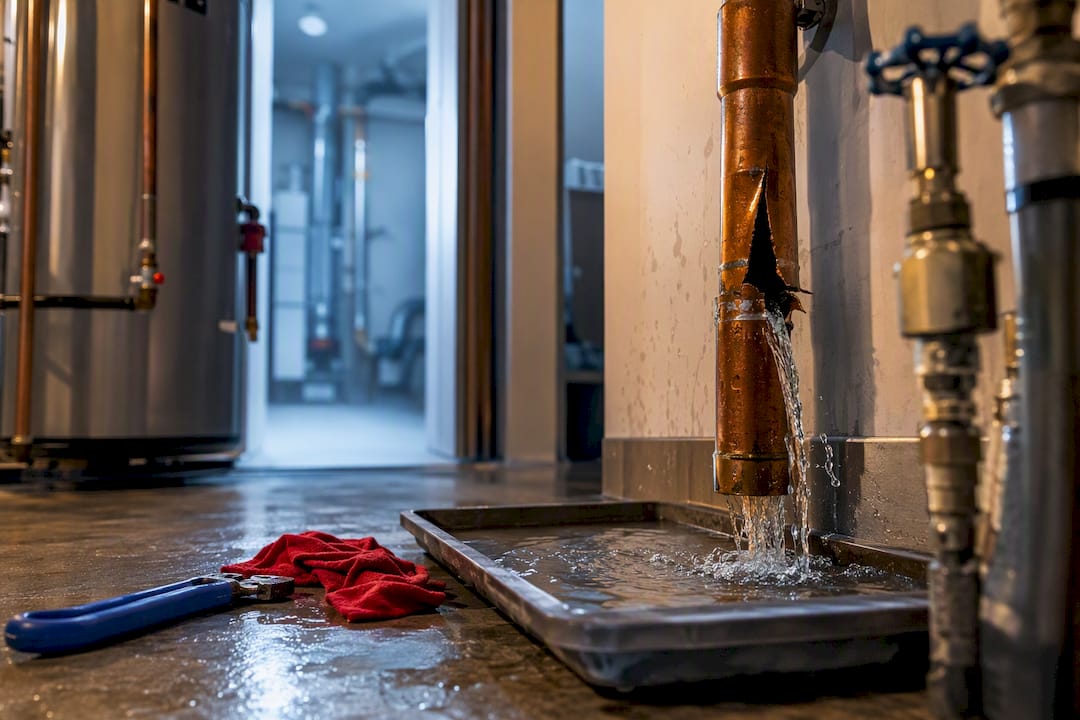
Standard homeowners insurance usually pays to repair the water damage a burst pipe causes to your home and belongings, but it typically will not pay to fix the pipe itself. Coverage hinges on whether the break was sudden and accidental, not the result of neglect. If a pipe froze because you skipped heat all winter or left a vacant home unwinterized, the insurer can deny the claim.
TL;DR:
- Homeowners insurance covers water damage from burst pipes if the break occurs suddenly and accidentally, but does not pay for the pipe repair itself.
- Damage to the dwelling, personal belongings, and extra living expenses are covered within policy limits and minus deductibles, but gradual leaks and corrosion are excluded.
- Fire, vacancy, and negligence increase the likelihood of claim denial, requiring homeowners to document preventative measures like thermostat settings and pipe insulation.
- Additional endorsements like water backup, service line, and flood insurance are necessary to cover backups, external flooding, or underground pipe damage.
- Immediate actions after a pipe burst include shutting off water and power, photographing damage, contacting the insurer, and obtaining professional estimates to support a swift claim.
Table of Contents
- Burst Pipe Insurance: What Homeowners Coverage Actually Pays For
- What Your Policy Won’t Pay For After a Pipe Bursts
- Frozen Pipes, Vacant Homes, and How Insurers Judge Negligence
- Deductibles, Endorsements, and Coverage Gaps Worth Closing
- What to Do in the First 72 Hours After a Pipe Bursts
- Why a Plumber’s Estimate Matters More Than Homeowners Realize
- A Pittsburgh Plumber’s Take on Insurance and Burst Pipes
- Get Emergency Help and Claim-Ready Documentation From Ag-Plumbing
- Sources
- FAQ
Burst Pipe Insurance: What Homeowners Coverage Actually Pays For
Once an insurer accepts that a burst was sudden and accidental, several parts of your policy kick in at once. Each one covers a different kind of loss, and knowing the difference matters when you are staring at a soaked hallway wondering what you can actually recover.
- Dwelling coverage pays to repair structural damage: drywall, flooring, ceilings, cabinetry, anything the water discharge ruined.
- Personal property coverage reimburses ruined belongings, though the payout depends on whether your policy pays replacement cost value (what a new item costs) or actual cash value (replacement cost minus depreciation).
- Loss of use, also called Additional Living Expense (ALE) coverage, pays for a hotel or short-term rental if the damage makes your home unlivable while repairs happen.
- Policy limits and deductibles set your real out-of-pocket number. A $2,000 deductible on a $15,000 claim means the insurer cuts a check for $13,000, not the full repair bill.
Travelers notes that this pattern (covering resulting damage and ALE, not the pipe itself) is the industry standard, not an exception written into a handful of policies.
What Your Policy Won’t Pay For After a Pipe Bursts
The pipe repair itself is the biggest gap homeowners misunderstand. Insurers treat that cost as maintenance, the same category as a worn-out roof or an aging water heater, and maintenance sits outside what a homeowners policy is built to cover.
- Repairing or replacing the burst section of pipe, even though the water damage around it is covered.
- Gradual leaks, slow drips behind a wall, corrosion, or rust that built up over months or years.
- Damage traced to deferred maintenance the insurer can document during inspection.
- Exterior flooding or sewer and drain backups, which fall under separate coverage entirely.
The NAIC’s own guidance draws a hard line here: coverage applies only when the discharge is sudden and accidental, and that standard is exactly what separates a paid claim from a denied one. The Zebra confirms sewer backup and flood damage require their own endorsements or policies, since standard homeowners insurance excludes both by default. A home warranty, separate from your insurance, sometimes covers the mechanical repair cost the insurer won’t touch.
Frozen Pipes, Vacant Homes, and How Insurers Judge Negligence
Freeze claims get more scrutiny than almost any other burst-pipe scenario, because insurers can usually tell the difference between “unlucky” and “unmaintained.” The NAIC’s guidance centers on a reasonableness standard: did you take the steps a prudent homeowner would take to prevent freezing?
- Keep the thermostat at a minimum consistent temperature, generally 55°F or higher, even when you travel.
- Insulate exposed pipes in attics, crawl spaces, and exterior walls before winter hits to prevent freezing and reduce damage risks, as explained in this guide to winterizing your doors.
- Drain water lines completely if you’re leaving a property vacant for an extended stretch.
- Know your policy’s vacancy clause. Many insurers require notification if a home sits empty beyond a set number of days.
Insurers investigating a freeze claim will ask about thermostat logs, smart-home data, neighbor accounts, and whether you had someone checking the property. NAIC guidance makes clear that simply claiming “the heat was on” without evidence rarely satisfies an adjuster.
Pro Tip: Photograph your thermostat setting before a winter trip and text the photo to yourself. It’s a timestamped record that costs nothing and can save a claim. Our winterizing guide for Pittsburgh homeowners covers the exact steps insurers expect to see.
Deductibles, Endorsements, and Coverage Gaps Worth Closing
Before you file anything, run the math. A claim just above your deductible often isn’t worth filing once you factor in the risk of a premium increase down the road, according to MoneyGeek’s analysis of frozen-pipe claims. Several optional endorsements close the gaps standard policies leave open.
- Water backup coverage pays for sewer or drain backups, an event standard policies exclude, though limits often cap out lower than dwelling coverage.
- Service line coverage protects the underground supply line between the street and your house, a section many homeowners assume is covered and isn’t.
- Flood insurance through the NFIP is a separate policy entirely; if water enters from outside (a rising creek, storm surge, groundwater), it’s a flood, not a covered peril under homeowners insurance.
- Review your declarations page annually. The Zebra points out that service-line ownership boundaries are easy to misunderstand until a claim is already denied.
What to Do in the First 72 Hours After a Pipe Bursts
The actions you take in the first three days shape both how fast the water damage gets fixed and how strong your claim looks to an adjuster. Move through these in order.
- Shut off the water and power at the main valve; cut electricity to affected areas if water is near outlets or panels.
- Stop the source if it’s safe to do so, then start removing standing water immediately.
- Photograph and video everything before you touch or move anything, with timestamps visible.
- Call your insurer to open a claim and ask what documentation the adjuster needs.
- Get a plumber’s estimate and a drying/mitigation quote; keep every receipt, including hotel costs if you’re displaced.
| Action | Timeframe | Why it matters |
|---|---|---|
| Shut off water/power | Immediately | Prevents further damage and injury |
| Photograph damage | Before cleanup begins | Creates the evidence adjusters rely on |
| Contact insurer | Promptly | Starts the claims clock, confirms coverage |
| Plumber estimate | Within several days | Separates covered damage from excluded repair |
Allstate’s guidance on burst pipes lists documentation and professional estimates as the two factors that most speed up claims processing. Our emergency plumbing guide walks through the mitigation steps in more detail.
Why a Plumber’s Estimate Matters More Than Homeowners Realize
A burst pipe rarely announces the full extent of its damage on day one. Water travels behind drywall and under subfloors long before mold or structural rot becomes visible, which is why insurers lean so heavily on professional inspection reports before finalizing a claim.
- A moisture map and drying report from a licensed plumber gives adjusters hard evidence separating the sudden loss from any pre-existing wear.
- Insurers pay for the water damage; they still won’t fund the pipe fix itself, so budget for that separately.
- If you see water pooling near an electrical panel, hear hissing inside a wall, or can’t locate the shutoff valve fast enough, that’s an emergency call, not a DIY moment.
Our step-by-step burst pipe repair guide for Pittsburgh homes breaks down what that inspection actually involves.
A Pittsburgh Plumber’s Take on Insurance and Burst Pipes
Ag-plumbing has spent 30 years pulling wet insulation out of Pittsburgh basements after winter freezes, and one pattern never changes: the homeowners who document damage fast get paid fast. We build moisture reports and repair estimates specifically written for adjusters, and we coordinate directly with insurers when a claim needs a professional voice behind it.
— Maayan
Get Emergency Help and Claim-Ready Documentation From Ag-Plumbing
A burst pipe doesn’t wait for business hours, and neither should your plumber. Ag-plumbing sends licensed techs to shut off the source, start mitigation, and document damage the way your insurance adjuster expects to see it, with photos, moisture readings, and a written estimate that separates covered water damage from the pipe repair itself.
We’ve handled burst-pipe emergencies across Pittsburgh and the surrounding area for three decades, and we know what a claims rep looks for in a plumber’s report. Beyond the emergency call, we also handle the pipe replacement work insurance won’t cover, along with the winterizing services that prevent the next freeze from happening at all. If a pipe has already burst, or you want your home checked before the next cold front hits, visit our plumbing repair page to schedule a visit or call for emergency dispatch.
This article is general information, not a substitute for advice from a qualified financial advisor. Consult a qualified financial professional about your own circumstances before acting on anything here.
Sources
- Will My Homeowners Insurance Policy Cover Water Damage From a Burst Pipe? — NAIC
- Does Homeowners Insurance Cover Burst Pipes? — Travelers
- Sewer backup coverage — The Zebra
- What to do if a pipe bursts in your home — Allstate
FAQ
What two events are not covered under homeowners insurance?
Gradual leaks caused by wear, corrosion, or lack of maintenance, and flood or sewer backup damage from outside the home, are both standard exclusions unless you add specific endorsements.
Will homeowners insurance pay for a leaking pipe?
It pays for the resulting water damage if the leak was sudden and accidental, but it generally does not pay to repair or replace the leaking pipe itself, per Travelers’ claims guidance.
Does homeowners insurance cover a burst pipe in the foundation?
Yes, if the break was sudden, coverage typically extends to foundation-area water damage, though the pipe repair cost still falls on the homeowner and a plumber’s estimate is usually required to document the loss.
Who pays for a burst water pipe?
The homeowner pays for the plumbing repair itself; the insurer pays for the resulting damage to the structure and belongings, assuming the burst meets the sudden-and-accidental standard NAIC guidance describes.
Recommended
- How to repair a burst pipe: quick fixes for Pittsburgh
- Same Day Plumbing in Pittsburgh: Cut Damage Costs 30%
- Why Water Leaks Matter: A Homeowner’s Guide
- Emergency Plumbing Guide: Quick Solutions for Homeowners
