
TL;DR:
- Pittsburgh homes have separate sanitary and stormwater drainage systems, each with distinct functions.
- Proper venting and trap seals are crucial to prevent sewer gases and backups in sanitary systems.
- Regular maintenance and inspections help detect issues early, avoiding costly repairs and health hazards.
Pittsburgh homeowners often treat their plumbing as one big system, but your home actually runs two completely separate drainage networks. Sanitary drainage carries wastewater from toilets, sinks, and showers to the public sewer, while stormwater drainage handles rain and runoff. Confusing the two, or simply ignoring either one, can lead to sewer gas in your home, basement backups, and repair bills that can easily climb into the thousands. This guide walks you through what sanitary drainage is, how it works, where your responsibilities begin and end, and when it makes sense to consider upgrades.
Table of Contents
- Sanitary drainage basics: What it is and how it works
- Sanitary drainage vs. storm drainage: What every homeowner should know
- Homeowner responsibilities: Maintaining your sanitary drainage system
- Signs, symptoms, and upgrades: When to act on sanitary drainage issues
- Hard-won lessons: What Pittsburgh homeowners miss about sanitary drainage
- Reliable plumbing solutions for Pittsburgh homes
- Frequently asked questions
Key Takeaways
| Point | Details |
|---|---|
| Sanitary vs. storm drainage | Sanitary drainage handles wastewater from your home, while storm drainage manages rain runoff, preventing system mix-ups. |
| Homeowner responsibility | You are accountable for maintaining the sanitary lateral from your home to the main connection, including regular inspections. |
| Preventative maintenance | Spot common warning signs early and perform routine drain cleaning to reduce emergency repairs and health risks. |
| Upgrade wisely | Address venting and cross-connections when upgrading to ensure safe, reliable drainage and compliance with local rules. |
Sanitary drainage basics: What it is and how it works
Sanitary drainage is your home’s built-in wastewater removal system. Every time you flush a toilet, run a sink, or take a shower, that water needs somewhere to go. The sanitary drainage system moves that wastewater away from fixtures and connects it to the municipal sewer for proper treatment. Without this system working correctly, your home would face health hazards and serious structural damage.
The technical framework behind this is called the Drain-Waste-Vent (DWV) system. Each word in that name matters. “Drain” refers to the sloped pipes that let gravity carry wastewater down and away. “Waste” describes the solid and liquid material those pipes move. “Vent” is the part most homeowners never think about, yet it is often where problems start. Vent pipes run up through your walls and out the roof, maintaining air pressure in the drain lines.
Why does pressure matter? Because without balanced pressure, water in your P-traps gets siphoned out. A P-trap is the curved section of pipe under your sink or behind your toilet. It holds a small amount of water at all times, and that water is the barrier between your living space and the sewer gases below. Lose that water seal, and sewer gases like methane and hydrogen sulfide flow right into your home.
According to plumbing education resources, most homeowner drainage issues trace back to improper venting or trap seal loss. That single fact is worth keeping in mind every time you notice something unusual in your bathroom or kitchen.
Key components of a healthy DWV system:
- Fixture drains connected to branch drain lines
- Branch lines sloped at the correct angle (typically 1/4 inch per foot)
- Main stack connecting everything vertically
- Vent pipes extending to the roof to equalize pressure
- P-traps under every fixture to block sewer gas
| DWV component | Function | Failure sign |
|---|---|---|
| Drain pipe | Moves wastewater by gravity | Slow drainage |
| Vent pipe | Maintains air pressure | Gurgling sounds |
| P-trap | Blocks sewer gas | Sewer odors indoors |
| Main stack | Central connection point | Multiple fixture backups |
Pro Tip: If you hear a gurgling sound from your sink or toilet after flushing, that is your first signal of a venting problem. Read up on plumbing venting essentials to understand what that sound really means before it turns into a bigger issue.
Sanitary drainage vs. storm drainage: What every homeowner should know
Now that the system is defined, it is crucial to see how sanitary drainage differs from stormwater drainage, because mixing them up is one of the most expensive mistakes a Pittsburgh homeowner can make.
Both systems exist in your home and neighborhood, but they serve completely different purposes and go to completely different places. Sanitary drainage carries wastewater that needs treatment before it can be safely returned to the environment. Storm drainage collects rain and snowmelt and routes it to streams, rivers, or retention basins, typically without any treatment.
“Wastewater flows to a sanitary sewer pipe, while stormwater flows from a storm drain to a storm drainage pipe.” This distinction is not just technical. It has legal and financial consequences for homeowners who unknowingly connect the two.
Sanitary vs. storm drainage at a glance:
| Feature | Sanitary drainage | Storm drainage |
|---|---|---|
| What it carries | Wastewater from fixtures | Rain and snow runoff |
| Where it goes | Sewage treatment plant | Streams, rivers, retention |
| Treatment required | Yes | Usually no |
| Health risk if misused | High | Moderate to high |
| Homeowner responsibility | Full lateral ownership | Property drainage only |
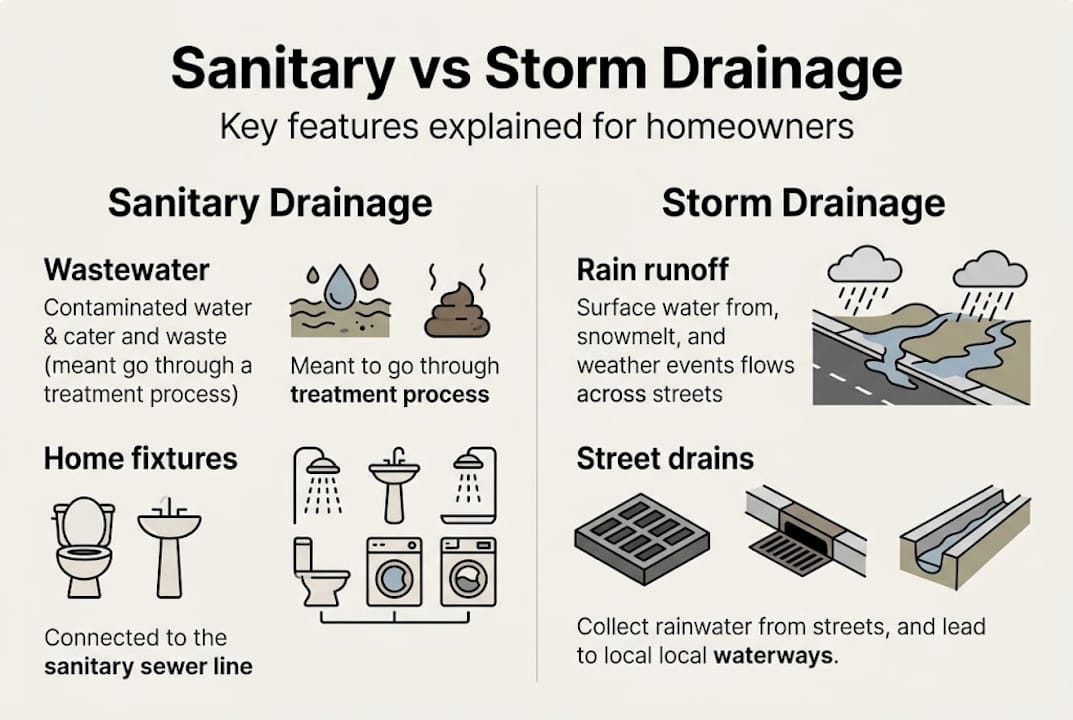
The dangerous mistake is called a cross-connection, when storm drainage gets accidentally routed into the sanitary system or vice versa. During heavy Pittsburgh rain, a cross-connected home can flood the sanitary sewer with stormwater, overloading the system and pushing sewage back into basements. It is a genuine crisis, and it happens more often than most people realize.
Common causes of cross-connections:
- Old homes with combined sewer systems that were never updated
- Improper sump pump discharge routed into the sanitary line
- Downspouts or yard drains connected to the wrong pipe
- DIY plumbing work done without permits or inspections
Municipalities often conduct dye testing or flow testing to catch illegal cross-connections. If caught, homeowners face mandatory repairs at their own expense. The smarter move is to know which system is which before you touch anything.
Homeowner responsibilities: Maintaining your sanitary drainage system
Knowing how the systems differ, let us focus on what Pittsburgh homeowners need to maintain themselves. The boundary of your responsibility starts at your home and runs to the main sewer connection at the street. That entire stretch, called the service lateral, belongs to you. The city maintains the main sewer line, but if your lateral cracks, clogs, or collapses, the repair cost falls on you.
According to local resources, homeowners own the private service lateral and are responsible for inspecting and maintaining it. That is not small print. A full lateral replacement in Pittsburgh can run from $3,000 to $15,000 or more depending on length, depth, and material.
Warning signs your lateral or internal drainage needs attention:
- Multiple fixtures draining slowly at the same time
- Sewage odors in the basement or near floor drains
- Wet spots or unusually lush patches of grass over the lateral’s path
- Water backing up into the basement after heavy rain
- Gurgling or bubbling sounds in drains not being used
The good news is that routine maintenance can head off most of these problems. Use this plumbing maintenance checklist to build an annual inspection habit. Many common plumbing repair issues that homeowners pay to fix could have been avoided with earlier attention.
Annual sanitary drainage maintenance in 3 steps:
- Inspect your accessible cleanouts and floor drains for buildup, odors, or slow flow. Look at the vent stacks on your roof if you can do so safely.
- Clean your traps and drain lines. Drain cleaning at least once a year prevents grease, soap scum, and debris from building up into full blockages.
- Test your P-traps by running water into infrequently used drains (guest bathrooms, basement sinks). Traps that dry out lose their gas barrier. Running water refills them.
Pro Tip: Ask your local utility if they offer a service line protection program. Pittsburgh Water offers options that can offset the cost of lateral repairs, which is worth a few minutes of your time to explore.
Signs, symptoms, and upgrades: When to act on sanitary drainage issues
Once you know your responsibilities, let us look at the warning signs and consider upgrades to preserve a safe and reliable sanitary drainage system long-term.
“Symptoms like toilet or sink gurgling, slow drains, or basement backups often point to sanitary drainage path or venting issues.”
These symptoms rarely appear out of nowhere. By the time your toilet gurgles or your basement drain backs up, the problem has usually been building for months. Acting early is almost always cheaper. A step-by-step drain cleaning guide can help you tackle minor clogs before they require professional intervention.
Top 5 warning signs and what to do:
- Gurgling from toilet or sink: Check venting first; call a plumber if it persists after 48 hours
- Slow drains in multiple rooms: Likely a main line clog; avoid chemical drain cleaners and snake the line instead with a DIY drain snaking approach
- Sewer odors in basement: Pour water into floor drains to restore trap seals; investigate further if odors continue
- Basement backup after heavy rain: Suspect a cross-connection; do not run fixtures until inspected
- Wet patches over lateral path in yard: Get a camera inspection of your lateral immediately
For Pittsburgh homeowners considering upgrades, three improvements deliver the most value. First, modern fixture installation (low-flow toilets and updated P-traps) improves flow and reduces blockage risk. Second, improved or added vent pipes correct chronic venting problems without major demolition. Third, lateral pipe relining is a trenchless technology that rehabilitates your service lateral from the inside without digging up your yard.
As noted in local inspection research, cross-connections between storm and sanitary systems can trigger cascading backups during heavy rain and are illegal in Pennsylvania. If you are buying a home or planning a major renovation, a sewer scope inspection before signing anything can save you from inheriting a very expensive problem. Check out these cost-saving plumbing tips to understand how proactive choices keep repair costs low over the long run.
Hard-won lessons: What Pittsburgh homeowners miss about sanitary drainage
After 30 years of working on Pittsburgh plumbing systems, one pattern shows up repeatedly. Homeowners chase the symptom and ignore the cause. A basement backup gets snaked, a slow drain gets a bottle of chemical cleaner, and the job is considered done. But the real question is never asked: why did it happen?
Conventional wisdom says keep the drains clear. That is good advice as far as it goes. But venting failures and trap seal loss cause just as many problems as physical blockages, and they are almost never caught during basic maintenance. Sewer gas exposure is a health hazard, not just an odor complaint. Carbon monoxide and methane can accumulate in poorly ventilated spaces, and preventing blockages through consistent drain care is only half the equation.
The other half is cross-connection awareness, especially in older Pittsburgh homes built before separate storm and sanitary systems became standard. Our team recommends camera inspections of the lateral every 5 to 7 years, not just when something breaks. Discovering a hairline crack or root intrusion early costs a fraction of an emergency repair. Prevention is always cheaper, and in the case of sanitary drainage, it is safer too.
Reliable plumbing solutions for Pittsburgh homes
Routine inspections and professional cleaning keep your sanitary drainage system out of emergency territory, and that means fewer surprises and lower costs over time. Pittsburgh homeowners who invest in prevention rarely face the kind of catastrophic backups that turn into week-long repair projects.
At AG Heating, Cooling & Plumbing, our team has 30 years of experience diagnosing and resolving exactly the issues covered in this guide. From sewer repair services that address lateral damage to targeted drain cleaning service that restores proper flow, we handle every part of your sanitary drainage system with care. If you are ready to move from understanding your plumbing to protecting it, our Pittsburgh plumbing pros are ready to help.
Frequently asked questions
How does sanitary drainage differ from storm drainage?
Sanitary drainage carries wastewater from home fixtures to the sewer for treatment, while storm drainage handles runoff separately without treatment. Mixing the two creates illegal cross-connections and serious backup risks.
What parts of sanitary drainage does a Pittsburgh homeowner own?
You are responsible for the private service lateral from your home to the main sewer connection. According to Pittsburgh Water’s guidance, maintenance and repair costs for that portion fall entirely on the homeowner.
What are common signs of sanitary drainage problems?
Gurgling toilets, slow-draining fixtures, basement backups, and persistent sewer odors are the most reliable early indicators. These symptoms point to drainage issues in your main line, lateral, or venting.
Why is venting important in sanitary drainage systems?
Vent pipes maintain the air pressure needed to keep P-trap seals intact. Without proper venting for pressure balance, sewer gases including methane can enter your home through dried-out traps.
Can cross-connections between storm and sanitary systems cause problems?
Yes. During heavy rain, a cross-connected system sends stormwater flooding into the sanitary line, causing backups and illegal discharges. Local municipalities may require testing to catch cross-connections and mandate homeowner repairs at full cost.
Recommended
- What is a plumbing trap? Homeowner’s guide to clean drains – AG-Plumbing
- How to snake a drain: DIY guide for Pittsburgh homeowners – AG-Plumbing
- Clear Sewer Line Blockages: 2026 Homeowner’s Guide – AG-Plumbing
- Why Drain Cleaning Is Essential for Preventing Blockages – AG-Plumbing
