
TL;DR:
- Upgrading your plumbing in Pittsburgh can reduce water bills, prevent damage, and increase your home’s resale value.
- Prioritize safety and active risks like lead pipes and aging water heaters, while efficiency upgrades improve long-term savings.
Choosing the right plumbing upgrades is harder than it looks. You’re weighing water bills, safety concerns, contractor costs, and a dozen product options, all while trying to figure out which changes actually pay off and which ones are just nice to have. The advantages of updated plumbing go well beyond a new showerhead. Done right, upgrading your plumbing system can lower your utility bills, protect your family from lead exposure, prevent thousands of dollars in water damage, and measurably increase your home’s resale value. This guide gives you a clear, practical framework to make those decisions with confidence.
Table of Contents
- What to look for when considering plumbing upgrades
- Water-efficient fixtures: toilets, faucets, and showerheads
- Replacing old pipes and preventing water damage
- Energy savings with advanced water heating technology
- Smart leak detection and flow monitoring systems
- Comparison of key plumbing upgrade options for Pittsburgh homes
- What 30 years of Pittsburgh plumbing work actually teaches you
- Ready to upgrade your Pittsburgh home’s plumbing?
- Frequently asked questions
Key Takeaways
| Point | Details |
|---|---|
| Water-efficient fixtures | Installing EPA WaterSense labeled toilets and faucets can reduce indoor water use by at least 20%, saving thousands of gallons annually. |
| Pipe upgrades improve safety | Replacing old pipes, especially lead lines, enhances water quality and prevents costly leaks and mold damage. |
| Energy-saving water heaters | ENERGY STAR heat pump water heaters save hundreds yearly by using heat transfer technology in Pittsburgh’s climate. |
| Smart leak detection | Modern leak detection devices help avoid water waste and property damage by alerting homeowners to leaks early. |
| Local programs help homeowners | Pittsburgh Water’s lead line replacement program offers many homeowners no-cost pipe replacements, reducing health risks. |
What to look for when considering plumbing upgrades
Before you start pulling permits or calling contractors, you need a clear set of criteria to evaluate your options. Not every upgrade makes equal financial or practical sense for every home, and Pittsburgh has some specific factors that change the math in your favor.
Here’s what to assess before committing to any upgrade:
- Water and energy efficiency: How much does the old fixture or system waste compared to modern alternatives? This drives your monthly cost savings.
- Safety and health: Older Pittsburgh homes often have lead service lines or corroded galvanized pipes that leach contaminants into drinking water. This isn’t optional, it’s a health issue.
- Return on investment: Some upgrades pay for themselves within two to three years. Others take longer but add significant resale value.
- Local programs: Pittsburgh Water has active funding programs for lead line replacements that can reduce or eliminate your out-of-pocket costs. Knowing what’s available changes your priorities.
- Certification standards: Look for fixtures bearing the EPA’s WaterSense label or ENERGY STAR certification. These aren’t marketing claims, they’re independently tested performance thresholds.
When you factor in plumbing upgrades that save money specifically tailored to Pittsburgh homes, the decision tree gets much clearer. And if your home is older, reviewing a water line replacement guide before scheduling any work can save you from replacing only half the problem.
With this evaluation framework in mind, let’s explore the specific plumbing upgrade options offering these advantages.
Water-efficient fixtures: toilets, faucets, and showerheads
Toilets account for roughly 30% of indoor household water use. That’s the single biggest opportunity in your home before you even think about anything else. Older toilets use 3.5 to 7 gallons per flush, while WaterSense-labeled toilets use 1.28 gallons per flush or less, saving thousands of gallons annually per household.
That’s not a small difference. A family of four can save anywhere from 13,000 to 20,000 gallons per year just by replacing an old toilet, with no reduction in flush performance. Modern pressure-assist and gravity-flush designs have solved the weak-flush stigma that plagued early low-flow models.
Faucets and showerheads offer similar gains. WaterSense faucets and showerheads reduce water use by 20 to 30%, saving an average family about 700 gallons per year on faucets alone. Multiply that across every fixture in your home and the annual savings become significant, both on your water bill and on the energy cost of heating that water.
Key fixture upgrade benefits:
- Toilets: 1.28 gpf or less versus 3.5 to 7 gpf on older models
- Faucets: 1.5 gallons per minute versus the standard 2.2 gpm
- Showerheads: 2.0 gpm or less without sacrificing pressure
- Annual water savings per household: often 10,000 to 20,000 gallons or more
Pro Tip: When shopping for fixtures, look for the WaterSense label specifically, not just “low-flow” marketing language. WaterSense products are independently tested to confirm both efficiency and performance, so you’re not trading pressure for savings.
Understanding the low-flow plumbing benefits in full helps you prioritize which rooms to tackle first, and which upgrades deliver the fastest payback on investment.
Now that you know what to prioritize, let’s look deeper at what’s going on behind your walls.
Replacing old pipes and preventing water damage
Fixtures are the visible part of your plumbing. Pipes are the part that can quietly cause the most damage. In Pittsburgh’s older housing stock, lead service lines and corroded galvanized steel pipes are still common. Lead pipes don’t just raise contamination risks, they narrow over time as mineral deposits build up, which reduces water pressure and increases the likelihood of a sudden failure.
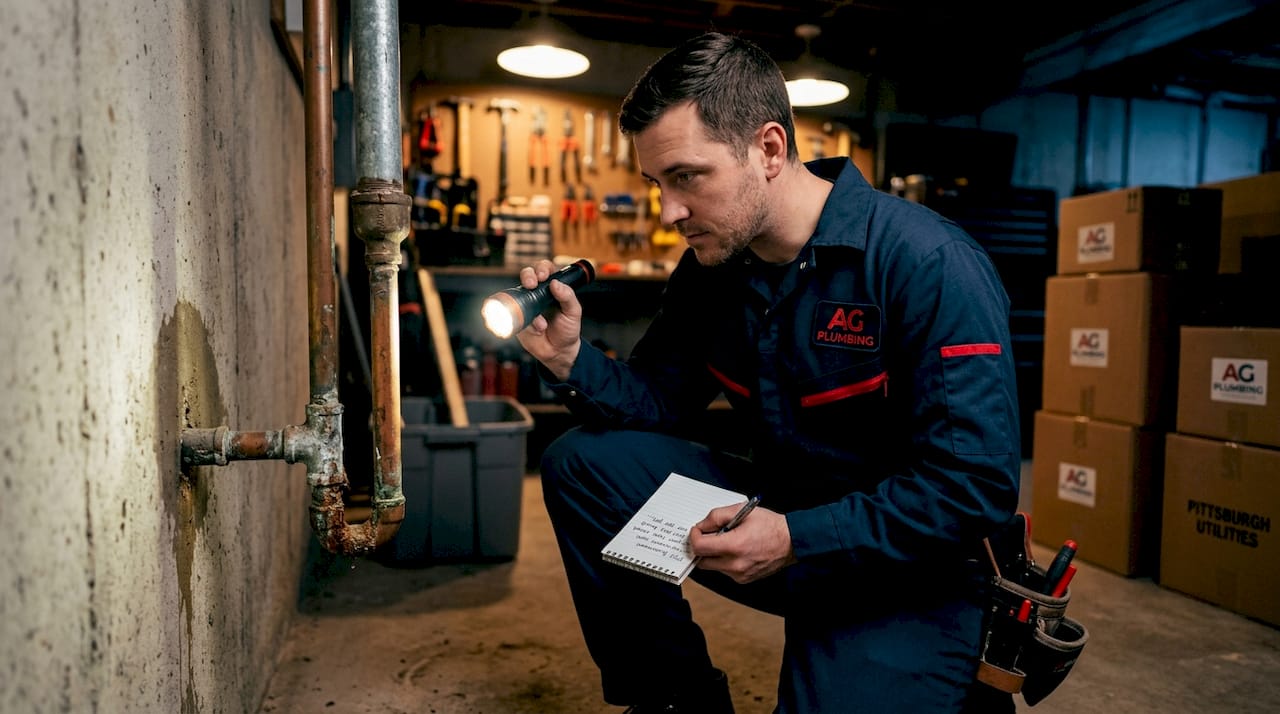
Upgrading to modern materials like PEX or copper reduces water waste by 30 to 50%, lowers energy bills, and cuts the leak risks that cause mold, rot, and structural damage. PEX is particularly practical for Pittsburgh homes because it flexes under freezing conditions rather than splitting, which is a real advantage in a city that sees harsh winter temperature swings.
On the lead pipe front, Pittsburgh homeowners have a resource that most cities don’t. Pittsburgh Water is replacing over 700 lead service lines using nearly $78 million in PENNVEST funding, bringing lead levels to a historic low. For eligible homeowners, this means the public portion of your lead service line may be replaced at no cost to you.
Why pipe replacement matters:
- Eliminates lead contamination risk from corroded service lines
- Prevents costly mold, rot, and structural damage from slow leaks
- Improves water pressure throughout the home
- PEX piping resists freeze cracking, ideal for Pittsburgh winters
- Coordination with city programs can reduce your total replacement cost significantly
Pro Tip: If Pittsburgh Water is scheduled to replace the public side of your lead line, time your private-side replacement for the same project window. Doing both at once saves excavation costs and minimizes yard disruption.
The main water line replacement guide in Pittsburgh walks through exactly how to coordinate with city programs and what to expect during the process.
Energy savings with advanced water heating technology
Water heating typically accounts for 14 to 18% of a home’s total energy bill. Traditional electric resistance water heaters are essentially giant toasters, converting electricity directly to heat at roughly 100% efficiency. That sounds good until you compare it to heat pump water heaters, which don’t generate heat at all. They move it from the surrounding air into the water, the same way a refrigerator moves heat out of its interior.
Heat pump water heaters are 3 to 4 times more efficient than standard electric resistance models, and they’re specifically recommended for Pittsburgh’s variable climate when paired with proper pipe insulation. The result is genuine, measurable savings on your monthly bill.
ENERGY STAR certified heat pump water heaters save $550 annually on electric bills for a four-person household and $5,610 over their lifetime. That’s not a theoretical projection, it’s the average across households that have made the switch.
Heat pump water heater advantages for Pittsburgh homes:
- 3 to 4 times more efficient than traditional electric resistance heaters
- Average annual savings of $550 per household
- Lifetime savings exceeding $5,600 per unit
- Works well in basements and utility rooms, which are common in Pittsburgh homes
- Qualifies for federal tax credits under current clean energy incentive programs
The water heater efficiency guide breaks down which models perform best in Pennsylvania’s climate and how to size the right unit for your household.
Smart leak detection and flow monitoring systems
Here’s a statistic that should change how you think about plumbing maintenance: household leaks waste thousands of gallons annually, and most homeowners have no idea they exist until they see a stain on the ceiling or a spike on the water bill. A slow drip behind a wall is invisible. A pinhole leak in a basement pipe can cause mold damage for months before anyone notices.
Modern leak detection devices solve this with two approaches. Moisture sensors placed near water-using appliances, under sinks, and around water heaters trigger an alert the moment they detect wet conditions. Whole-home flow monitors analyze your water usage patterns and flag abnormal flow, like water running at 3 a.m. when no one is using it.
The best systems do both and add one more feature: automatic water shutoff. When a significant leak is detected, the device closes your main water supply valve automatically. In a Pittsburgh winter, when a burst pipe can release hundreds of gallons before you even wake up, that automatic shutoff is the difference between a small repair and a catastrophic renovation.
Smart leak detection benefits:
- Early alerts prevent minor leaks from becoming major water damage
- Automatic shutoff stops flooding before it worsens
- Flow monitoring catches slow leaks invisible to the naked eye
- Especially valuable during Pittsburgh’s freeze-thaw cycles
- Many systems integrate with smartphones for remote monitoring
Pro Tip: Install moisture sensors in the top three risk zones first: under the water heater, under the kitchen sink, and near the washing machine connection. These are where the most preventable water damage starts in Pittsburgh homes.
Pairing smart detection with other plumbing upgrades that save money creates a layered protection strategy, one that reduces both waste and the risk of expensive emergency repairs.
Comparison of key plumbing upgrade options for Pittsburgh homes
Various plumbing upgrades address different problems with different timelines and investment levels. Here’s how the main categories stack up side by side.
| Upgrade type | Primary benefit | Estimated cost range | Payback period | Pittsburgh-specific advantage |
|---|---|---|---|---|
| WaterSense fixtures | Water savings (20-30%) | $50–$500 per fixture | 1–3 years | Lower PWSA water bills |
| Pipe replacement (PEX/copper) | Leak prevention, water quality | $2,000–$15,000+ | 5–10 years | Freeze resistance, city lead program funding |
| Heat pump water heater | Energy savings ($550/yr avg) | $1,000–$3,000 installed | 3–5 years | Federal tax credits available |
| Leak detection system | Damage prevention | $200–$1,500 | Immediate risk reduction | Critical for freeze-thaw cycles |
Before deciding where to start, consider these prioritization factors:
- If your home was built before 1986, lead pipe testing and replacement should be your first call, not your last.
- If your water heater is more than 10 years old, replacement now avoids an emergency replacement later at the worst possible moment.
- Fixtures offer the fastest payback and the lowest barrier to entry, making them a smart first step even while you plan larger projects.
- Leak detection is low-cost insurance that pays for itself the first time it prevents damage.
Reviewing how to maximize remodeling investment with plumbing upgrades can help you sequence these projects in the order that delivers the best return for your specific home’s age and condition.
What 30 years of Pittsburgh plumbing work actually teaches you
Most articles about plumbing upgrades frame the decision as purely financial. Run the numbers, calculate the payback, decide. That framing misses something important.
In three decades of working in Pittsburgh homes, the pattern we see most consistently isn’t homeowners who upgraded too early. It’s homeowners who delayed because the math didn’t feel urgent enough, and then spent four times the money recovering from a burst pipe, a mold remediation, or an emergency water heater replacement on a January weekend.
The real advantage of updated plumbing isn’t just the efficiency gains or the monthly savings, though those are real. It’s the shift from reactive to proactive. A home with modern pipes, efficient fixtures, and a leak detection system stops being a source of unexpected financial hits. You stop worrying about what’s happening behind the walls.
Pittsburgh homes in particular carry a legacy of aging infrastructure. The city’s housing stock skews older than the national average, which means the gap between what’s currently installed and what’s currently available is wider here than in newer metro areas. That gap represents real money being wasted every month and real risk sitting behind your drywall.
Our honest advice: don’t prioritize upgrades purely by which one has the fastest payback period on a spreadsheet. Prioritize the ones that address active risk first. Lead pipes, aging water heaters past their 10-year mark, and homes with no leak detection in the basement are genuinely urgent. The fixture swaps and efficiency upgrades are excellent and worth doing, but they’re not emergencies. The others sometimes are.
Ready to upgrade your Pittsburgh home’s plumbing?
The benefits of modern plumbing are clear, but knowing where to start in your specific home is a different question. Every Pittsburgh house has a different combination of pipe materials, fixture ages, water heater condition, and risk factors.
At AG Heating, Cooling & Plumbing, we’ve spent 30 years working in Pittsburgh homes exactly like yours. We know the local infrastructure, the city programs worth tapping, and the upgrades that deliver real results versus the ones that sound good on paper. Whether you’re ready to replace a water heater, investigate your service line, or put together a full plumbing renovation plan, our team gives you straight answers and quality work backed by three decades of local experience. Contact AG Heating, Cooling & Plumbing to schedule your assessment today.
Frequently asked questions
What are the main water-saving benefits of updated plumbing fixtures?
Updated fixtures with WaterSense labels use at least 20% less water than older models while maintaining strong performance, with WaterSense toilets using 1.28 gallons per flush or less and saving thousands of gallons annually. The savings add up faster than most homeowners expect once you account for every fixture in the home.
How can Pittsburgh homeowners get lead pipes replaced at no cost?
Pittsburgh Water’s PENNVEST program is funding lead service line replacements across the city, often covering both the public and private sides at no direct cost to eligible homeowners. Contact Pittsburgh Water directly to check your address and get on the replacement schedule.
Are heat pump water heaters suitable for Pittsburgh’s climate?
Yes. Heat pump water heaters are 3 to 4 times more efficient than standard electric models and perform well in Pittsburgh’s climate, especially when installed in a conditioned basement space. The average household saves over $550 per year after switching.
What benefits do leak detection systems offer for Pittsburgh homes?
Leak detection devices identify leaks early and the best systems automatically shut off your water supply to stop flooding before it spreads. In Pittsburgh’s freeze-thaw environment, where burst pipes are a real seasonal risk, this kind of early warning is one of the most practical investments you can make.
Recommended
- Top bathroom plumbing ideas for Pittsburgh homeowners – AG-Plumbing
- Plumbing upgrades that save Pittsburgh homes money – AG-Plumbing
- Maximize bathroom comfort: role of plumbing in Pittsburgh 2026 – AG-Plumbing
- How plumbing improves energy efficiency and cuts costs – AG-Plumbing
