
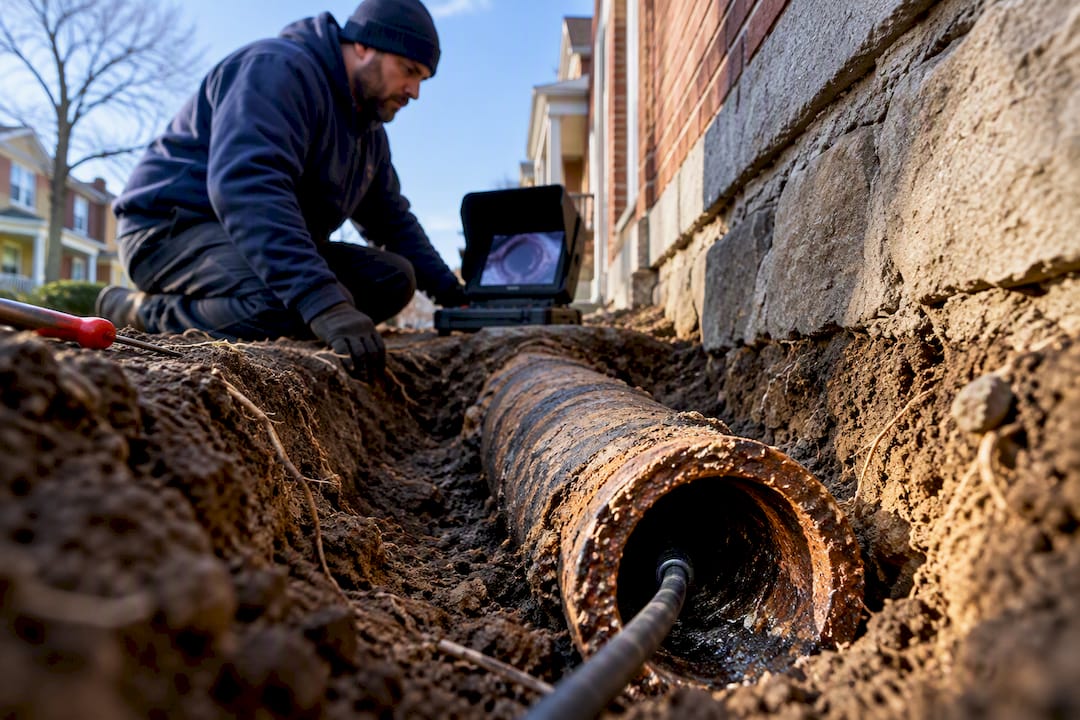
Cast iron drain pipes typically last several decades, often between about 50 and 100 years, with many homes seeing real trouble in the typical operating window once corrosion and scale buildup catch up with the metal. Actual condition hinges on your soil, local water chemistry, and whatever repairs were done before you owned the house. If your system is past 60 years or you’ve had repeat clogs, schedule a sewer camera inspection now rather than wait for a backup to force the decision.
TL;DR:
- Older cast iron pipes installed before the 1970s and with lead or oakum joints typically fail sooner, especially after 60 years, and should be inspected if issues arise.
- High soil moisture and acidity combined with certain water chemistry accelerate external and internal corrosion, reducing pipe lifespan regardless of initial installation quality.
- Symptoms like multiple slow drains, sewage odors, and yard wetness usually indicate serious deterioration necessitating a camera inspection to confirm the condition.
- Camera inspections provide detailed insights into corrosion, tuberculation, cracks, and collapses, guiding whether cleaning, lining, or full replacement is appropriate.
- PVC piping generally offers better resistance to corrosion and costs less, but cast iron remains preferred for sound dampening if noise reduction is a priority.
Table of Contents
- Cast Iron Drain Lifespan: Why the Numbers Vary So Much
- What Actually Shortens or Extends Cast Iron Drain Durability
- Warning Signs Your Cast Iron Drains Are Failing
- Getting an Accurate Read: Sewer Camera Inspections
- Repair Options: Cleaning, Lining, or Full Replacement
- Maintenance That Actually Extends Service Life
- What Inspection, Lining, and Replacement Actually Cost
- Cast Iron vs. PVC: Which Wins for Replacement?
- A Plumber’s Honest Take on Cast Iron Drains
- A Straightforward Next Step From Ag-plumbing
- Sources
- FAQ
Cast Iron Drain Lifespan: Why the Numbers Vary So Much
The typical cast iron drain pipe lifespan runs 50 to 100 years, though most plumbers see real problems surface between 60 and 80 years. That’s a wide window, and the spread comes down to how the pipe was installed and what’s been running through it for decades.
Installation era matters more than people think. Older hub-and-spigot joints sealed with lead and oakum behave differently over time than modern rubber-coupled connections, and homes built before the 1970s still commonly run on original cast iron sewer lines. Once corrosion starts on an aging line, it tends to accelerate rather than plateau. A pipe that seemed fine at year 55 can fail hard by year 65. Some systems coast well past a century with minimal issues; others need attention by year 40. The difference usually isn’t luck.
What Actually Shortens or Extends Cast Iron Drain Durability
Soil conditions outside the pipe and water chemistry inside it do most of the damage over a lifetime. Acidic or consistently wet soil accelerates external corrosion, while dry, stable ground slows it down. Inside the pipe, calcium levels and alkalinity determine how corrosion actually progresses.
A technical corrosion study on cast iron piping found that higher calcium levels combined with alkalinity can form protective carbonate deposits that actually slow corrosion in some water conditions. That’s counterintuitive. Not every mineral deposit is bad news for your pipes.
Here’s what shapes remaining service life the most:
- Soil moisture and acidity around the buried sections
- Water chemistry, including calcium, alkalinity, and chlorine exposure
- Sewer gas (hydrogen sulfide) reacting with the pipe’s interior and causing pitting
- Joint type and the quality of the original installation
- Any prior spot repairs, which can mask a bigger structural issue nearby
Tuberculation is the term for the iron-oxide mounds that build up inside these pipes, and it deserves its own callout: it’s one of the clearest fingerprints of long-term corrosion, but it’s not automatically a death sentence for the line. Tuberculation reduces flow and can often be cleaned out, though its presence signals that corrosion has been active for a while.
Warning Signs Your Cast Iron Drains Are Failing
Some symptoms mean “call someone this week.” Others mean “keep an eye on it.” Here’s how to tell the difference:
- Multiple slow drains at once. One sluggish sink is a local clog. Several slow drains across the house points to a main line problem.
- Gurgling sounds or sewage odors. Both suggest a partial blockage or a vent issue tied to the main line, not a single fixture.
- Wet or sunken patches in the yard. This usually means a buried section has already cracked or collapsed.
- Rust-colored water or clogs that return fast after snaking. Repeated fixes that don’t hold are a strong sign the underlying pipe is deteriorating, not just dirty.
Single-fixture slowness is a Tuesday afternoon problem. Whole-house symptoms are a schedule-an-inspection problem.
Getting an Accurate Read: Sewer Camera Inspections
A sewer camera inspection is the single most reliable way to see what’s actually happening inside the line, and it turns guesswork into a real plan. Cameras reliably show:
- Root intrusion at joints and cracks
- Tuberculation buildup and how much it’s narrowing the pipe
- Offset or separated joints
- Cracks, fractures, and full collapse
- The exact distance to each defect, which tells the plumber where to dig or line
Cameras have limits, too. They can’t see corrosion happening on the outside of the pipe, and a hard collapse can stop the camera from reaching sections farther down the line.
Pro Tip: Ask your plumber to record the camera footage and mark the distance to every defect found. That footage becomes your reference point if you get a second opinion or compare quotes for lining versus replacement.
Inspection is worth the cost if you’re buying a house with an older system, you’ve had recurring backups, or you’ve paid for a “quick fix” more than once on the same line.
Repair Options: Cleaning, Lining, or Full Replacement
The right fix depends entirely on what the camera actually finds, not on which option sounds the most thorough.
- Hydro-jetting and cleaning. Best when the problem is mostly buildup and grease rather than structural damage. It clears tuberculation and restores flow without touching the pipe itself.
- Spot repair. Makes sense when damage is limited to one short section, like a single cracked joint, and the rest of the line checks out fine.
- CIPP lining. A cured-in-place liner creates a new pipe inside the old one without major digging. It works well when the host pipe is still structurally continuous, and it can add decades of service life. It’s not an option once a section has collapsed or shifted badly out of alignment.
- Full excavation and repipe. The most disruptive and expensive route, but it’s the only real answer once a line has collapsed or corroded past the point lining can help.
The decision rule is simple: if the camera shows an intact but scaled or root-choked pipe, cleaning or lining usually solves it. If it shows collapse, severe offset, or corrosion that’s eaten through sections of pipe wall, replacement is the honest answer.
Maintenance That Actually Extends Service Life
You can’t stop cast iron from aging, but you can slow it down considerably with a few consistent habits.
- Schedule professional drain cleaning or hydro-jetting on a routine cadence rather than waiting for a clog.
- Keep grease, wipes, and anything fibrous out of the drains. Use strainers on kitchen and bathroom drains.
- Log what happens after each service call. If the same symptom returns within months, that’s data, not bad luck.
- Consider a periodic camera check every several years once the system passes the 50 year mark, even without obvious symptoms.
Pro Tip: Keep a simple log of every drain issue, including the date and which fixture was affected. A pattern that repeats at the same fixture, or across the whole house, tells your plumber more in five minutes than a one time snapshot ever could.
What Inspection, Lining, and Replacement Actually Cost
A sewer camera inspection is the cheapest step by far and usually wraps up within an hour or two, giving you a clear answer the same day. From there, costs climb in a predictable order: cleaning and hydro-jetting cost the least, CIPP lining sits in the middle, and full excavation and repipe costs the most.
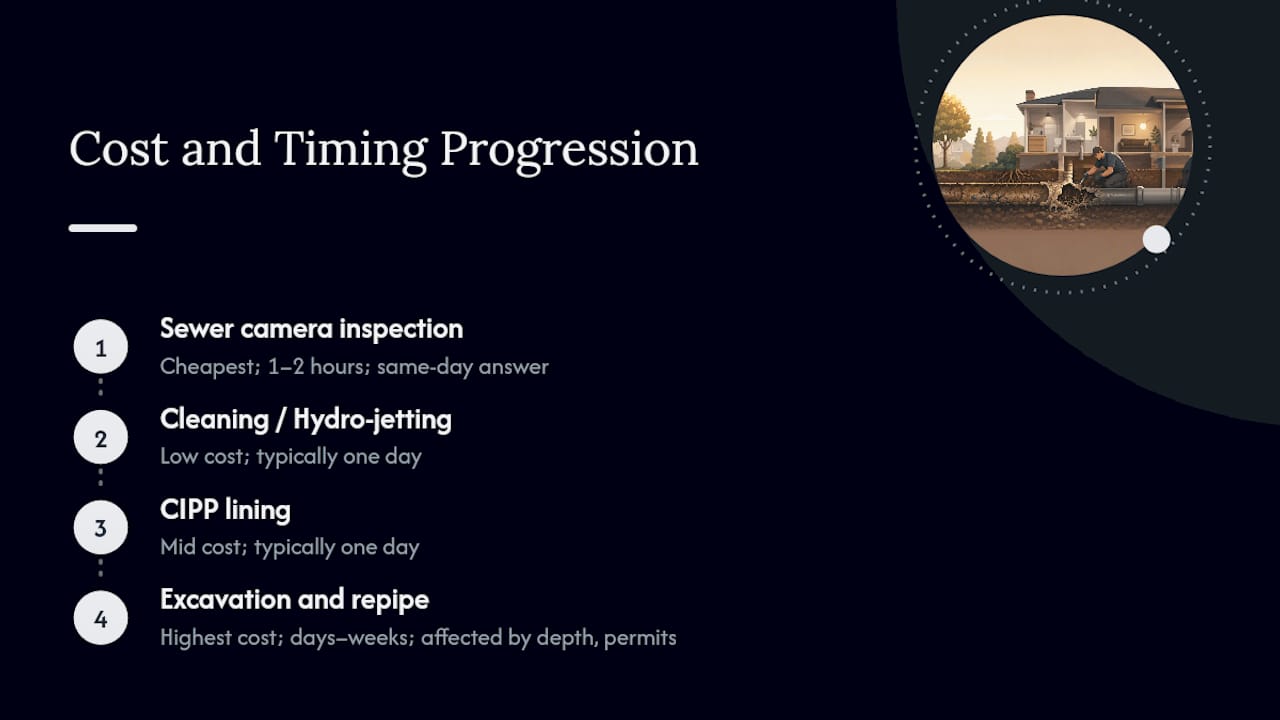
Timing follows the same pattern. Cleaning and lining are typically done in a single day. Full excavation and repiping can take several days to a couple of weeks, especially when landscaping, driveways, or permit requirements add complications. Pipe depth and how far the damaged section runs both affect the final bill and the schedule.
Cast Iron vs. PVC: Which Wins for Replacement?
Cast iron has one real advantage that gets overlooked: it’s quiet. The dense metal dampens the sound of water moving through walls and ceilings, which matters more than people expect once you’ve lived with a noisier system.
PVC wins on nearly everything else. It resists corrosion, weighs far less, and costs less per foot than new cast iron. If you’re replacing a failed section anyway, PVC is the practical standard today. The trade-off is simple: pick cast iron only if sound dampening genuinely matters to you, and pick PVC for everything else.
A Plumber’s Honest Take on Cast Iron Drains
The biggest misperception homeowners have is thinking a snake that clears a clog means the pipe is fine. It rarely does. Ask any plumber pulling camera footage on a 70-year-old line for the real story.
Before agreeing to any costly fix, ask for the camera video, ask exactly where each defect sits, and ask whether lining is even possible given the pipe’s current condition. Documentation first, decisions second.
— Maayan
A Straightforward Next Step From Ag-plumbing
Some plumbing companies provide a documented answer instead of a guess. While many quote a fix off a phone call, a reliable approach is to run a sewer camera inspection first, show exactly what’s happening inside the line, and then recommend hydro-jetting, CIPP lining, spot repair, or a full repipe based on what the footage actually shows, not what’s easiest to sell.
With 30 years serving homeowners around Pittsburgh, our team has walked plenty of aging cast iron systems through this exact decision. If your drains are slow, gurgling, or you’ve paid for the same fix twice, start with a sewer repair evaluation or ask about hydro jetting if buildup looks like the main culprit. Ready to get a real answer instead of another guess? Reach out through Ag-plumbing’s services page to schedule an inspection and get a straight recommendation.
Sources
A few sources back the numbers and guidance in this article, if you want to dig deeper:
- Cast Iron Drain Pipe Guide | Hale Home Services
- Cast Iron Sewer Warning Signs: When to Schedule a Camera Inspection | Total Leak Detection
- Cast Iron Sewer Pipes and Replacement Options | Joe the Plumber
- Technical study on cast-iron corrosion and tuberculation
- Tuberculation definition and practical notes | Trenchlesspedia
FAQ
When Did Plumbers Stop Using Cast Iron Pipes?
Cast iron was the standard for drain lines through roughly the 1970s, after which PVC gradually took over as the preferred material for new construction. Homes built before that era commonly still have their original cast iron sewer lines in place today.
How Much Does It Cost to Replace a Cast Iron Drain?
Costs vary widely depending on pipe depth, length of the damaged section, and whether lining or full excavation is needed, with cleaning costing the least and full repipe costing the most. Ag-plumbing doesn’t publish set pricing online, so the most accurate number comes from a sewer repair estimate based on your specific line.
What Are the Downsides of Cast Iron Plumbing?
Cast iron corrodes internally from sewer gases and externally from soil conditions, and once corrosion sets in it tends to accelerate rather than level off. It’s also heavier and harder to work with than PVC, which makes repairs on old cast iron systems more labor intensive.
How Do I Know if My Cast Iron Pipes Are Bad?
Watch for multiple slow drains at once, gurgling sounds, sewage odors, wet spots in the yard, or clogs that return quickly after snaking. A sewer camera inspection gives you a definitive answer by showing exactly where the damage sits and how severe it is.
Recommended
- Homeowners: Quick Checklist to Stop Recurring Drain Clogs
- Plumbing Maintenance Checklist: Prevent Costly Home Repairs
- Why regular drain cleaning protects Pittsburgh homes
- Sanitary drainage explained: A homeowner’s guide to reliability
