
TL;DR:
- Trenchless repair fixes underground pipes with minimal surface disruption and faster completion times.
- There are two main methods: CIPP lining for minor damage and pipe bursting for severe failures.
- Proper inspection and experience are key to choosing the right approach and ensuring long-term durability.
Most homeowners assume a broken sewer line means weeks of torn-up yards, cracked driveways, and a landscaping bill that rivals the plumbing repair itself. That assumption is outdated. Modern trenchless technology lets us fix underground pipes through one or two small access points, leaving your lawn and driveway almost exactly as we found them. In this guide, we’ll walk you through exactly how trenchless repair works, the two main methods available, when it’s the right call for Pittsburgh homes, and how to make a smart decision before spending a dollar.
Table of Contents
- What is trenchless repair and how does it work?
- Major types of trenchless repair: CIPP lining vs. pipe bursting
- Where trenchless works—and where it doesn’t
- Advantages and real-world impacts for Pittsburgh homeowners
- Our take: What most guides miss about trenchless repair for Pittsburgh homes
- Next steps: Get expert help for a stress-free trenchless repair
- Frequently asked questions
Key Takeaways
| Point | Details |
|---|---|
| Minimal yard impact | Trenchless repair fixes pipes using only small access points, so your yard stays intact. |
| Fast and efficient | Most trenchless jobs are completed in one to two days, saving homeowners time and stress. |
| Not for every pipe | A camera inspection is key—severely damaged or sagging pipes may still need traditional replacement. |
| Long-term value | Trenchless methods have a lifespan of 50 years or more, reducing future repair needs. |
What is trenchless repair and how does it work?
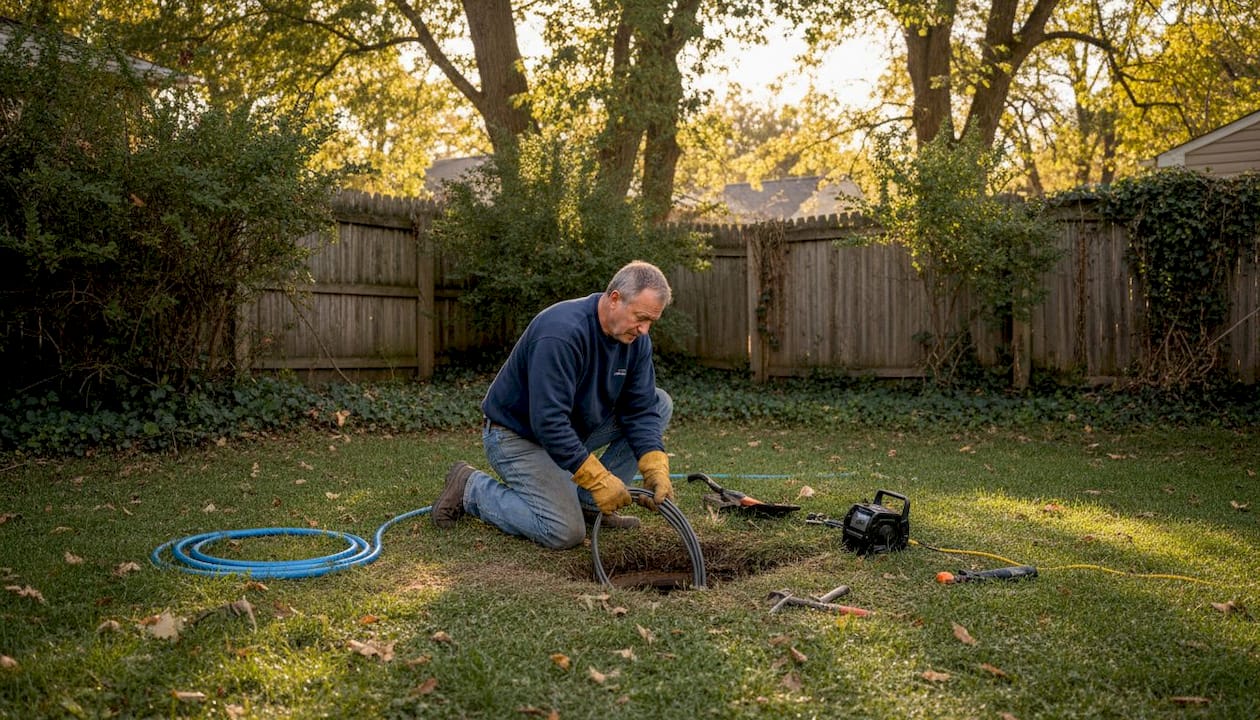
If you’ve never heard the term before, here’s the short version: trenchless repair is a no-dig method to repair or replace underground pipes using minimal access points instead of full excavation. Instead of digging a long trench across your entire yard, a technician creates one or two small entry points, then uses specialized equipment to fix or replace the pipe below ground.
Traditional repair is almost the opposite. A crew would dig up a trench the full length of the damaged pipe, sometimes running 20, 30, or even 50 feet through your yard, under your driveway, or across a sidewalk. After the repair, everything gets backfilled and compacted, but you’re still left with a yard that looks like a construction site for weeks.
Trenchless methods avoid all of that. Here’s what the basic process looks like:
- A camera inspection identifies the exact location and type of damage
- Small access pits are dug at the start and end of the damaged section
- Equipment is fed through those access points to repair or replace the pipe
- The repair is completed, access pits are filled, and cleanup is minimal
For Pittsburgh homeowners, this matters a lot. Many local homes sit on older clay or terracotta sewer lines, and our sewer repair services are frequently requested in neighborhoods where digging would mean destroying mature landscaping or historic hardscaping.
The real advantage isn’t just avoiding a mess. It’s the speed. Most trenchless repairs wrap up in one to two days. A traditional excavation job on the same pipe could take a week or more, factoring in digging, repair, backfill, and surface restoration.
Trenchless repair is commonly used for:
- Sewer lines running from your home to the city main
- Drain pipes buried under concrete slabs or foundations
- Lateral lines that run under driveways or sidewalks
For older Pittsburgh homes, these are exactly the pipes that tend to fail first. Understanding how the process works puts you in a much stronger position when a plumber shows up and starts explaining your options.
Major types of trenchless repair: CIPP lining vs. pipe bursting
There are two primary trenchless methods, and they work very differently. Knowing which one fits your situation can help you ask better questions and avoid being talked into the wrong repair.
CIPP (Cured-in-Place Pipe) lining works by inserting a resin-saturated liner into the existing pipe, then inflating and curing it using UV, steam, or water to form a brand-new pipe inside the old one. Think of it like slipping a new sleeve inside a damaged tube. The old pipe stays in place and becomes the outer shell, while the new liner carries all the flow. The tradeoff is a slight reduction in pipe diameter, typically 6 to 12 percent, but the new lining is actually stronger than most original materials.
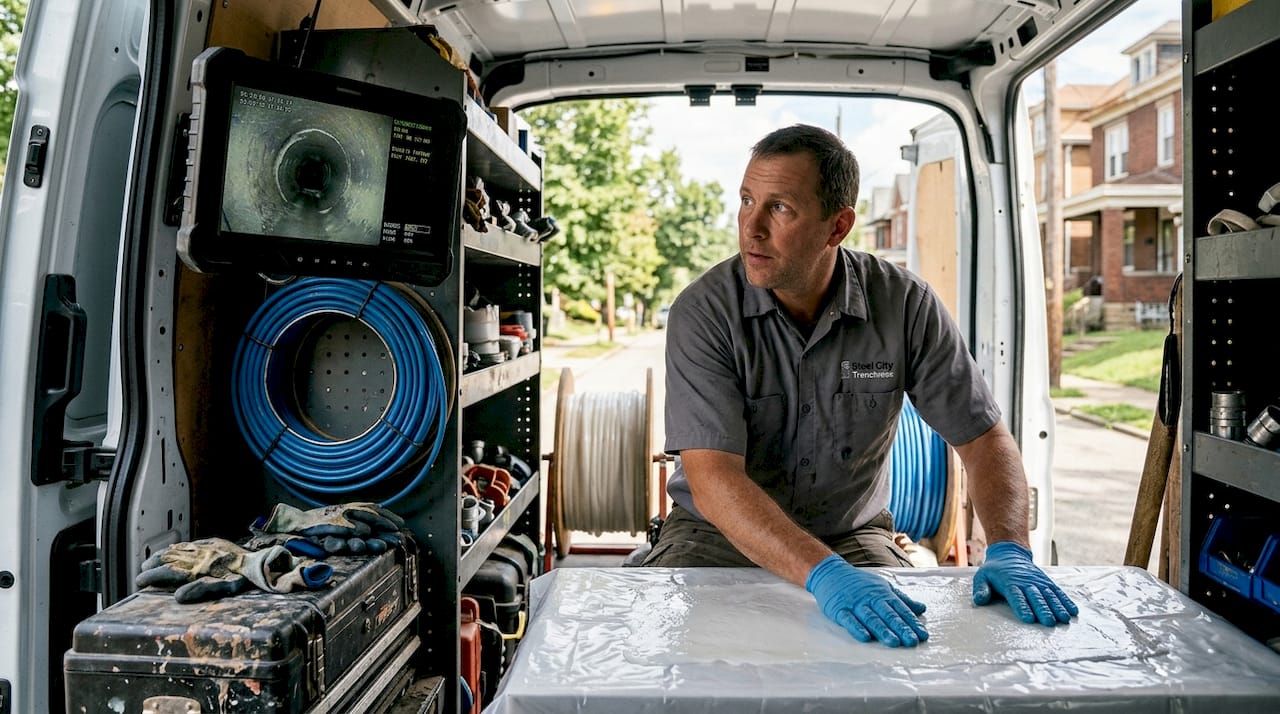
Pipe bursting takes a different approach. A bursting head is pulled through the old pipe, fracturing it outward while simultaneously pulling new HDPE pipe through the same path. This is a true replacement, not a repair. It also allows you to upsize the pipe if needed, which can be a major advantage for older homes with undersized sewer lines.
Here’s a quick comparison to help you see the difference at a glance:
| Feature | CIPP Lining | Pipe Bursting |
|---|---|---|
| Method | Liner inside existing pipe | Breaks old pipe, pulls new one through |
| Diameter change | Reduces 6 to 12% | Same or larger |
| Best for | Mostly intact pipes with cracks or root intrusion | Severely damaged or broken pipes |
| Lifespan | 50+ years | 50 to 100+ years |
| Disruption | Minimal | Minimal |
| Standards | ASTM F1216 | ASTM F1962 |
Both methods meet CIPP and pipe bursting standards that ensure long-term durability. Choosing between them comes down to the condition of your existing pipe.
Here’s a simple way to think about it:
- Get a camera inspection first. Always.
- If the pipe walls are mostly intact, CIPP lining is usually the better fit.
- If the pipe has serious breaks, multiple failures, or you want to upsize, pipe bursting is the stronger choice.
Pro Tip: Ask your plumber to show you the camera footage before recommending a method. If they can’t explain why one method fits your specific pipe condition, that’s a red flag. Our sewer line repair guide walks through how to read those inspection results.
Where trenchless works—and where it doesn’t
Trenchless repair is excellent, but it isn’t magic. Knowing its limits saves you from an unpleasant surprise mid-project.
Trenchless methods perform best in these situations:
- Sewer lines running under yards, driveways, or sidewalks where digging would cause serious damage
- Pipes with root intrusion, cracks, joint separation, or corrosion but still structurally present
- Clay and terracotta pipes, which are extremely common in Pittsburgh and respond well to UV-CIPP lining
- Situations where speed matters, such as an active sewer backup affecting a family home
But trenchless has real limitations. CIPP cannot fix fully collapsed pipes with more than 25 percent wall loss, serious sags (called bellies), or severe offsets where pipe sections have shifted significantly out of alignment. Pipe bursting also requires enough space around the old pipe for the bursting head to fracture the walls outward. In dense urban lots or areas with utilities running close together, that space may not exist.
Pittsburgh’s older neighborhoods add their own layer of complexity. Tree roots from mature oaks and maples can cause repeated intrusions. Some historic districts have restrictions on surface work that actually favor trenchless, while others have shared lateral lines that complicate any repair approach.
Pro Tip: Before any trenchless quote, insist on a full video camera inspection. This isn’t just a formality. It’s the only way to confirm whether the pipe walls can support a liner or whether the surrounding soil allows for bursting. Skipping this step is how homeowners end up paying twice.
For a broader look at what tends to go wrong with Pittsburgh pipes, our guide on common Pittsburgh plumbing problems covers the most frequent issues we see across the region. The Pennsylvania DEP trenchless guidance also outlines when trenchless is the preferred approach from an environmental standpoint.
Advantages and real-world impacts for Pittsburgh homeowners
Let’s move past the technology and talk about what trenchless repair actually means for your home, your schedule, and your wallet.
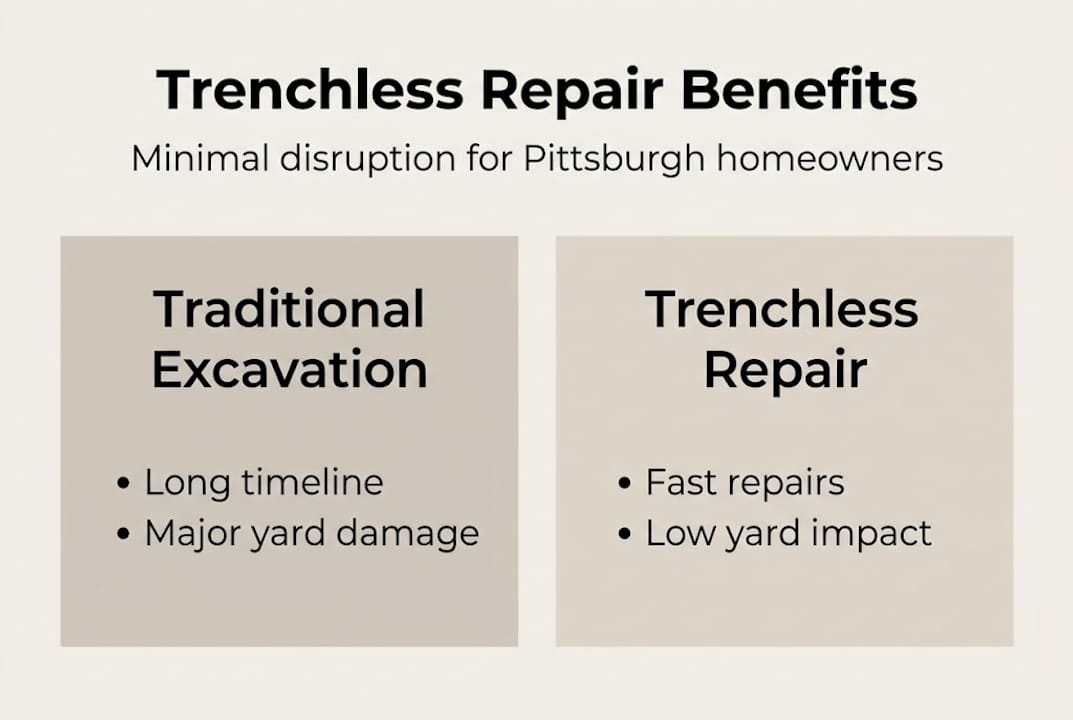
The most obvious benefit is disruption. Traditional excavation can leave your yard unusable for weeks. Trenchless repairs are completed in 1 to 2 days with minimal surface impact. That matters enormously if you have kids, pets, or a yard you’ve spent years maintaining.
Here’s how the two approaches compare in practical terms:
| Factor | Traditional Excavation | Trenchless Repair |
|---|---|---|
| Timeline | 5 to 10+ days | 1 to 2 days |
| Yard damage | Extensive | Minimal |
| Restoration needed | Yes, significant | Rarely needed |
| Eco impact | High waste, soil disruption | Low waste, minimal disruption |
| Long-term lifespan | Depends on material | 50 to 100+ years |
The environmental angle is worth noting. Trenchless generates far less construction waste and avoids the soil erosion that comes with open trenching. PA DEP guidance actively supports trenchless as a preferred method for minimizing environmental impact, and Pittsburgh’s clay and terracotta pipe stock makes UV-CIPP an especially clean solution.
On cost, trenchless sometimes carries a higher upfront price than basic excavation. But that comparison is misleading. When you factor in driveway replacement, landscaping restoration, and the time your property is out of commission, trenchless almost always wins on total project cost.
Key real-world benefits for Pittsburgh homeowners:
- No need to replant gardens, reseed lawns, or repave driveways
- Faster return to normal life with minimal household disruption
- Repaired pipes that outlast most original materials by decades
- Lower long-term maintenance costs with smooth, seamless liners that resist root intrusion
Our plumbing services for homeowners page covers the full range of what we offer, and our before-and-after repairs gallery shows real results from Pittsburgh jobs.
Our take: What most guides miss about trenchless repair for Pittsburgh homes
Most articles about trenchless repair treat it like a universal upgrade, as if every pipe in every neighborhood is a perfect candidate. After 30 years of working in Pittsburgh, we can tell you that’s not the full picture.
Older Pittsburgh neighborhoods present real challenges that generic guides skip entirely. Shared lateral lines in dense row-home blocks, massive tree root systems from century-old trees, and landmark district restrictions can all affect which method is viable and how the job gets done. Technology alone doesn’t solve those problems. Experience does.
We’ve seen homeowners choose trenchless based on a low quote, only to discover mid-job that the pipe condition required full replacement anyway. The inspection step isn’t optional. It’s the foundation of a smart repair decision.
Here’s the uncomfortable truth: the cheapest trenchless quote is rarely the best value. A proper diagnosis, the right method for your specific pipe and soil, and a contractor who knows Pittsburgh’s quirks will save you far more than a discounted estimate. Our overview of types of plumbing services can help you understand the full scope of what a quality repair involves.
Custom solutions beat generic ones every time. That’s what actually protects your home.
Next steps: Get expert help for a stress-free trenchless repair
If your sewer line is showing signs of trouble, the worst move is waiting. A small crack or root intrusion can escalate fast, and the longer you wait, the fewer trenchless options remain available.
At AG Heating, Cooling & Plumbing, we’ve been diagnosing and repairing Pittsburgh pipes for 30 years. We start every trenchless evaluation with a full camera inspection so you get an honest assessment, not a guess. Whether CIPP lining or pipe bursting is the right fit, we’ll show you exactly why before any work begins. Explore our plumbing repair services or read through our detailed repair guide to understand what the process looks like from start to finish.
Frequently asked questions
How long does trenchless pipe repair take?
Most trenchless repairs are completed in 1 to 2 days, which is significantly faster than traditional excavation methods that can take a week or more.
Is trenchless repair suitable for all types of pipes?
Trenchless works well for pipes with moderate damage, but fully collapsed pipes with more than 25 percent wall loss, severe sags, or major offsets are not good candidates and may require traditional excavation.
Will trenchless methods damage my yard or driveway?
Trenchless repair uses minimal access points rather than full excavation, so your yard and driveway are left nearly untouched compared to traditional digging methods.
How long will a trenchless repair last?
Both CIPP lining and pipe bursting are built to last, with lifespans of 50 years or longer under normal conditions, giving Pittsburgh homeowners genuine long-term peace of mind.
Recommended
- Sewer line repair guide for Pittsburgh homeowners – AG-Plumbing
- Same Day Plumbing in Pittsburgh: Cut Damage Costs 30% – AG-Plumbing
- Reliable Sewer Repair Services in Pittsburgh, PA
- How to repair a burst pipe: quick fixes for Pittsburgh – AG-Plumbing
