
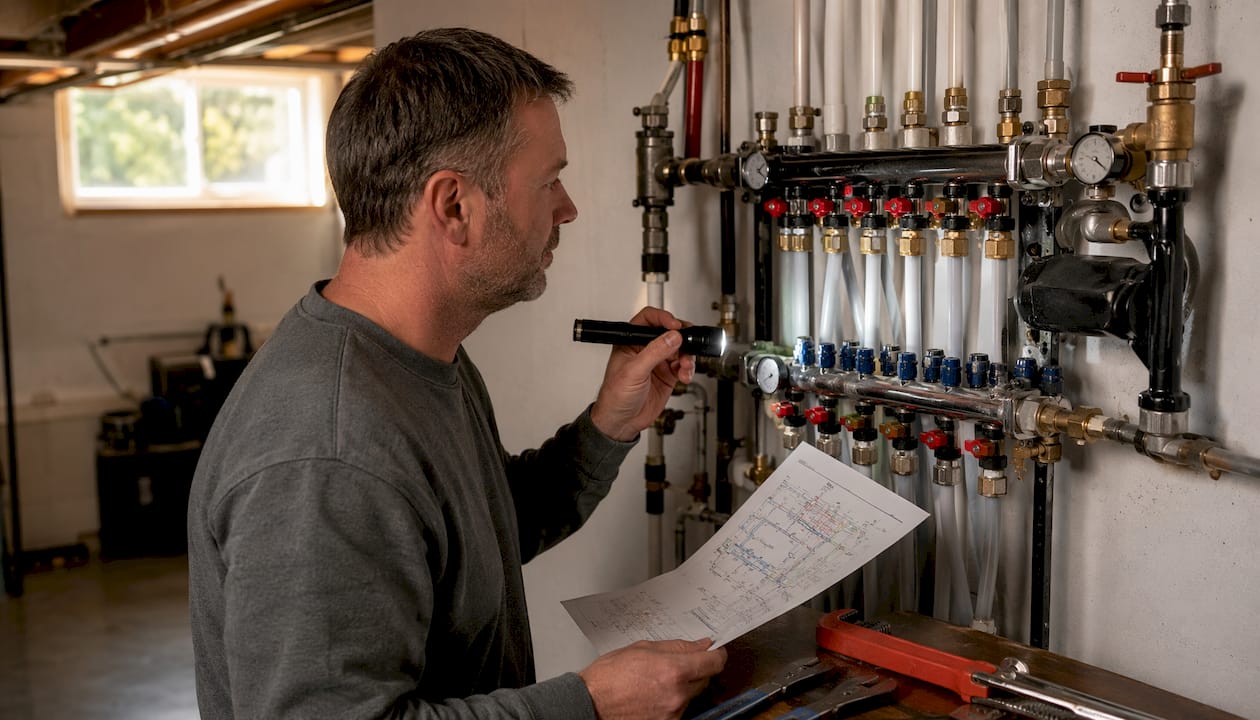
TL;DR:
- A plumbing manifold system centralizes water distribution by routing dedicated lines from a main hub to each fixture. It offers faster hot water delivery, easier fixture isolation, and reduces hidden leaks compared to traditional trunk-and-branch plumbing. However, it is most practical for new construction or major remodels due to higher upfront costs and installation complexity.
A manifold system in plumbing is a central distribution hub that receives water from the main supply and routes individual dedicated lines directly to each fixture in your home. Think of it as a breaker box for water: one central point, one shutoff per fixture, no hidden fittings buried inside walls or under floors. The biggest practical payoff for homeowners is centralized control — you can shut off the kitchen sink without touching anything else — combined with fewer concealed joints, which are the most common source of hidden leaks in traditional plumbing.
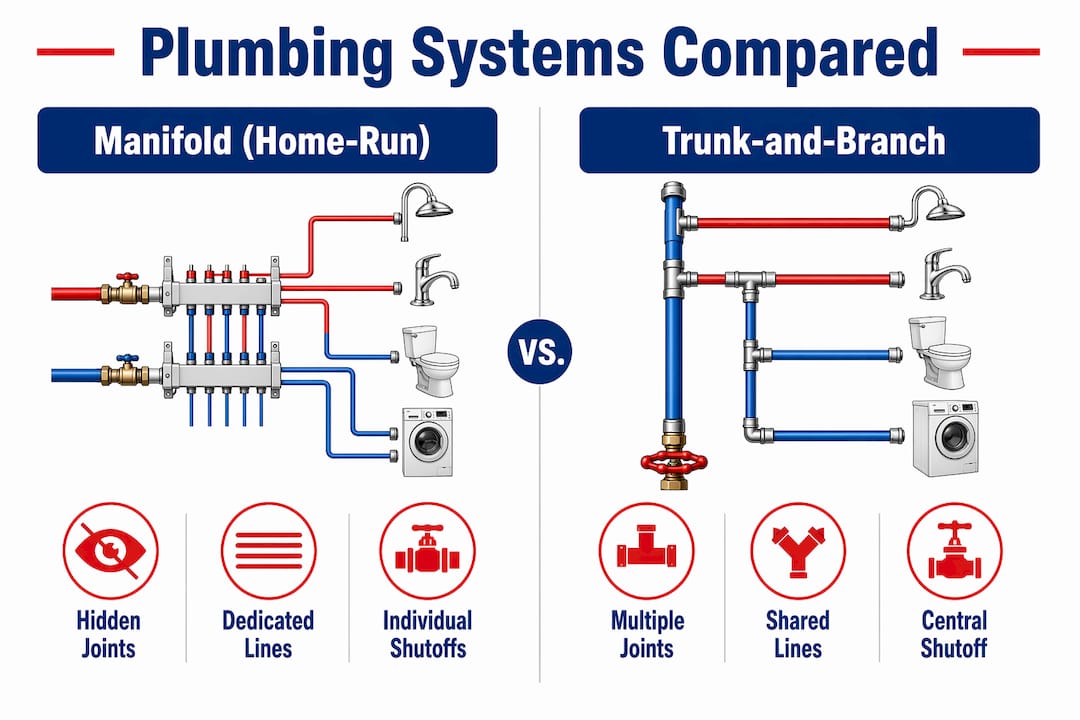
Most modern manifold installations pair the hub with flexible PEX piping, and the manifold itself typically lives in a basement, utility room, or mechanical closet. Building America Solution Center calls this layout a “home-run” or “parallel piping” system, and it has become a standard recommendation in new residential construction for exactly that reason.
Table of Contents
- How does a plumbing manifold system actually work?
- What types of manifold systems will you actually encounter?
- How does a manifold compare to traditional trunk-and-branch plumbing?
- When does a manifold system actually make sense for your home?
- What does manifold installation cost, and how long does it take?
- How do you maintain and troubleshoot a manifold system?
- What safety and code requirements apply to manifold systems in the U.S.?
- What questions should you ask a plumber before installing a manifold?
- When should you call a licensed plumber instead of doing it yourself?
- Key Takeaways
- The case for not overthinking your manifold decision
- Ag-plumbing can assess and quote your manifold project
- FAQ
- Useful sources and further reading
How does a plumbing manifold system actually work?
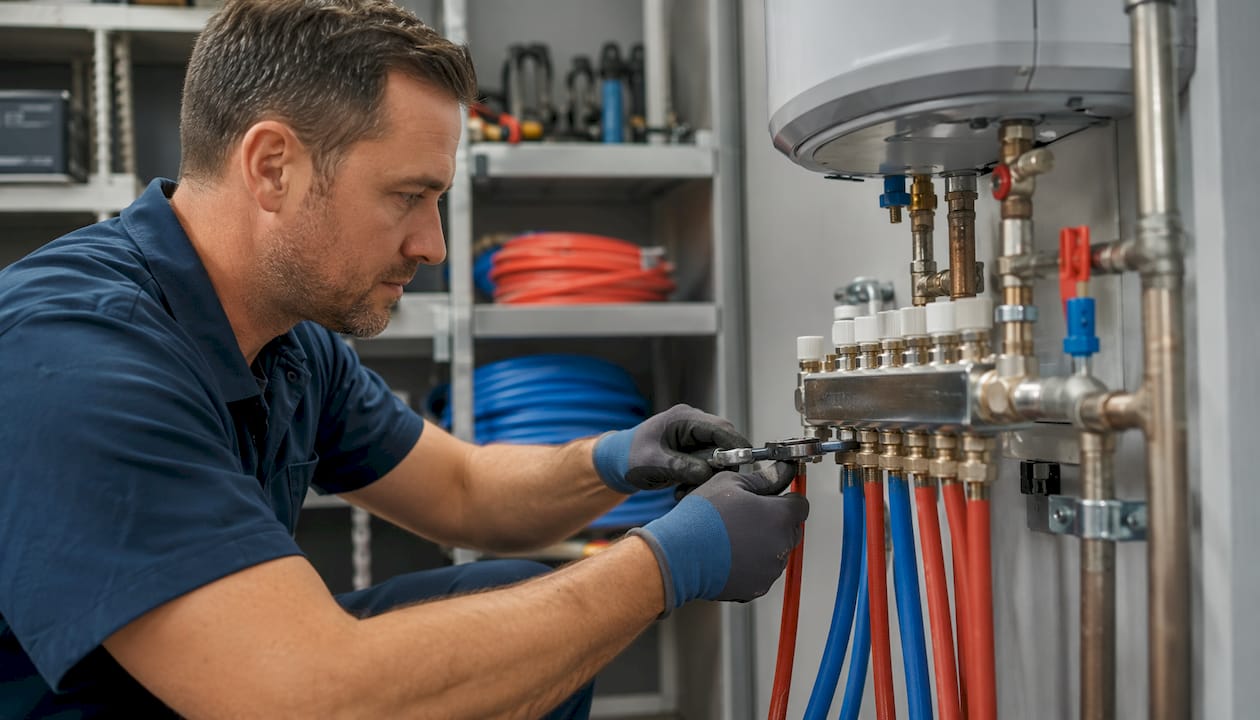
The core mechanic is straightforward. A main supply line (cold water from the meter, hot water from the water heater) feeds into the manifold body. From there, individual lines branch out, one per fixture or appliance, running continuously from the manifold to the endpoint without any tees or elbows along the way.
Main components of a home-run manifold:
- Manifold body — a brass, copper, or engineered plastic housing with multiple ports, available in configurations from 4 to 12+ ports for hot and cold sides
- Individual shutoff valves — one per port, letting you isolate a single fixture without cutting water to the rest of the house; centralized shutoffs like these are a significant safety advantage
- Trunk feed lines — the larger-diameter supply pipes (typically 3/4") connecting the water heater or meter to the manifold
- Branch runs — smaller-diameter PEX lines (typically 1/2") running from each manifold port to its fixture
- Mounting hardware — brackets or a manifold box securing the assembly in an accessible location
A simple example: your water heater sits in the basement. A 3/4" line runs from the heater to the hot side of the manifold, mounted on the utility room wall. A dedicated 1/2" PEX line leaves port 3, travels up through the floor framing, and connects directly to the master bath shower. No joints in between. If that shower needs service, you close port 3 at the manifold, and every other fixture keeps running.
[Diagram recommendation: a simple schematic showing the water heater → manifold → individual PEX runs fanning out to labeled fixtures (kitchen sink, master bath, laundry, etc.), with shutoff valves visible at the manifold ports. This visual makes the “home-run” concept immediately clear.]
What types of manifold systems will you actually encounter?
The term “manifold” covers more ground than just home plumbing. Hydraulic manifolds control fluid power in industrial machinery. Engine intake and exhaust manifolds manage airflow in vehicles. For homeowners, three plumbing-specific types matter most.
PEX home-run manifold
This is the full version: one dedicated line per fixture, all originating from a single central manifold. Fine Homebuilding describes it as the design that uses the most pipe but saves the most water, since each run holds minimal volume and hot water arrives faster. It requires the most drilling through joists and studs, which is why it’s best suited to new construction where framing is open.
Submanifold (zone manifold)
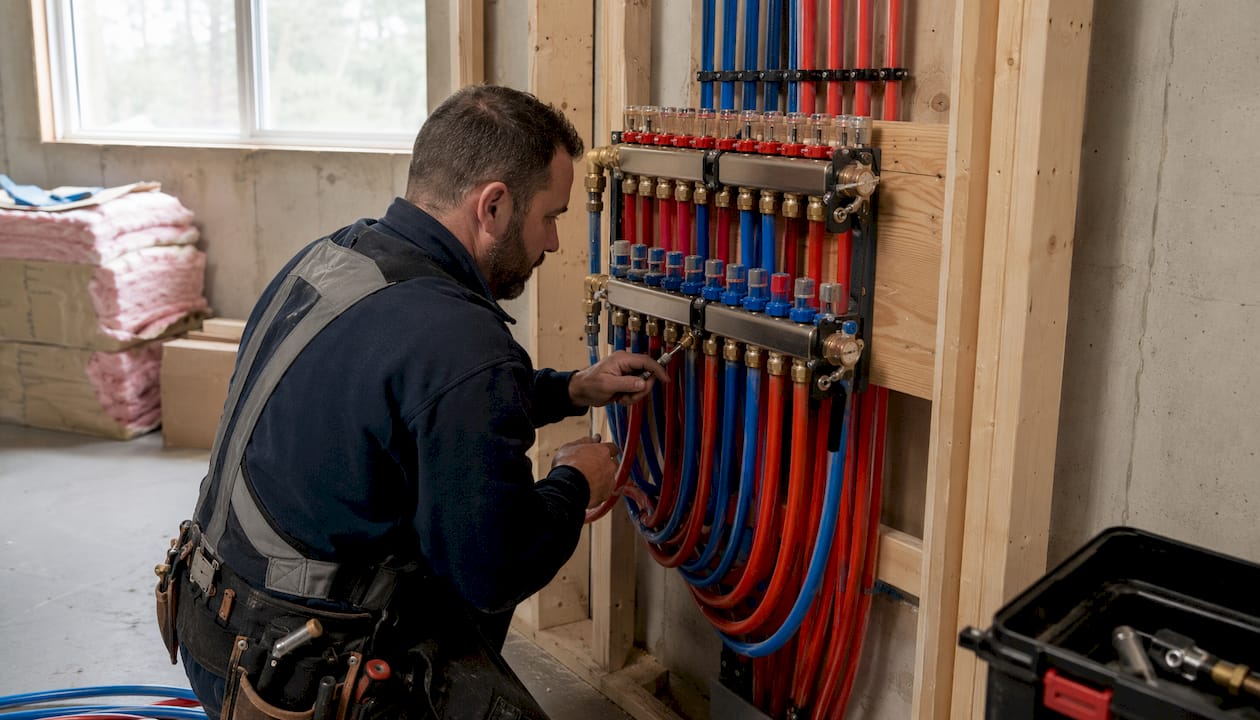
Instead of one master hub, you install smaller manifolds near each wet area — one for the master bath, one for the kitchen, one for the laundry room. Each submanifold is fed by a single line from the main supply. This cuts total pipe length and reduces the number of long runs through framing, making it a practical choice for retrofits where drilling every individual run would be prohibitively disruptive.
Mixing manifolds for radiant heating
Radiant floor heating systems use a dedicated manifold to distribute hot water through loops of tubing embedded in the floor. These manifolds often include flow meters and balancing valves to control temperature zone by zone. The design principles overlap with domestic water manifolds, but the materials and pressure ratings differ, and radiant installations typically add 20%–40% to project cost compared to basic water-distribution PEX work.
How does a manifold compare to traditional trunk-and-branch plumbing?
Traditional trunk-and-branch plumbing runs a large main line through the house with smaller branches tapping off to fixtures. It uses less pipe overall, but every tee and elbow is a potential leak point, and many of those joints end up hidden inside walls. Building science research consistently identifies concealed joints as the primary source of hidden water damage in residential plumbing.
| Category | Manifold (home-run) | Trunk-and-branch |
|---|---|---|
| Hidden joints | None between manifold and fixture | Many (tees, elbows in walls/floors) |
| Fixture isolation | Individual shutoff at manifold | Requires shutting off larger zone or whole house |
| Hot water speed | Faster (small-diameter runs hold less volume) | Slower on long runs |
| Water efficiency | Less water wasted waiting for hot water | More water runs down drain before hot arrives |
| Upfront pipe cost | Higher (more total pipe) | Lower |
| Retrofit difficulty | High (extensive drilling) | Lower |
| Leak diagnosis | Faster (no hidden joints to hunt) | Slower |
For a new build, the tradeoffs lean clearly toward manifold plumbing. The framing is open, drilling is easy, and the long-term benefits — faster hot water, simpler repairs, fewer hidden leaks — pay off over the life of the home. In a 1,200 sq ft home with trunk-and-branch plumbing, the volume to the furthest fixture can exceed 1.5 gallons, meaning more than 90 seconds of running the tap before hot water arrives. A home-run manifold cuts that wait significantly.
For an older home retrofit, the math shifts. Drilling individual runs through finished framing is expensive and disruptive. A submanifold or hybrid approach often delivers most of the benefits at a fraction of the disruption.
One thing a manifold does not do: it won’t fix low incoming pressure. If your main service line is undersized or your municipal pressure is weak, the manifold distributes that limitation equally to every fixture. That’s a separate problem requiring a pressure-boosting solution or service-line upgrade.
When does a manifold system actually make sense for your home?
The short answer: new construction and major gut remodels are the sweet spot. A manifold system is often overkill for a small home with two bathrooms and no plans for significant renovation.
Suitability checklist — a manifold system makes strong sense when:
- You’re building new or doing a major remodel with open framing
- You have space for a manifold in a utility room, basement, or mechanical closet
- You want per-fixture shutoff capability without hunting for zone valves
- Hot water wait times are a real complaint in your current home
- You’re already repiping and the incremental cost of home-run layout is modest
- You’re installing radiant floor heating (a manifold is essentially required)
When to consider a submanifold or hybrid instead:
- Retrofitting an older home with finished walls and limited access
- Budget is tight and the full home-run layout would require significant structural work
- The home is small enough that trunk-and-branch runs are short and fast
Smart plumbing upgrades for Pittsburgh homes often land in the hybrid category, where a submanifold near each bathroom cluster captures most of the isolation and efficiency benefits without the full drilling burden of a whole-house home-run layout.
What does manifold installation cost, and how long does it take?
Manifold installation costs more upfront than trunk-and-branch work, primarily because of the increased pipe volume and labor hours for routing individual runs. Materials alone for a typical PEX home-run job are typically estimated at $900–$1,200; labor hours and total costs vary depending on home access and project scale. See the FAQ for full repipe cost ranges.
All figures are estimates. Actual costs vary by region, access conditions, and contractor.
Timeline:
- New construction: manifold rough-in typically takes 1–2 days for a standard single-family home, with framing open and runs unobstructed
- Retrofit/repipe: 3–5 days for a mid-size home; longer if walls need opening, patching, or structural drilling requires permits
- Permits and inspections add scheduling time — plan for at least one inspection visit after rough-in and before walls close
The biggest cost wildcard in a retrofit is access. A single-story home with a crawlspace is far cheaper to repipe than a two-story with finished ceilings below the runs.
How do you maintain and troubleshoot a manifold system?
Manifolds simplify routine maintenance because all connections are visible and accessible at one location. There are no hidden tees to hunt down when something drips. That said, specific failure modes do occur: valve seals wear out, O-rings degrade, and in rare cases manifold bodies crack, which may require specialist repair or full replacement depending on the material.
Isolation checklist (how to shut off one fixture and restore service):
- Locate the manifold and identify the labeled port for the fixture you need to service.
- Turn the shutoff valve for that port to the closed position (usually a quarter-turn ball valve).
- Open the fixture to relieve pressure and confirm water has stopped.
- Complete your repair or replacement at the fixture.
- Close the fixture, then slowly reopen the manifold shutoff valve.
- Check the fixture and the manifold port for any drips before considering the job done.
Top three troubleshooting scenarios:
- Leak at the manifold body: Check the port fittings and valve seats first. A dripping port is often a worn O-ring or loose compression fitting, not a cracked manifold. For ongoing leak detection in Pittsburgh homes, a licensed plumber can pressure-test individual circuits.
- Pressure drop on one circuit: If one fixture has noticeably lower pressure than others, check whether that port’s shutoff valve is fully open. Partial closure is a common culprit after any service work.
- Slow hot water on far runs: This is a design issue, not a manifold failure. The run may be longer than ideal, or the pipe diameter may be undersized. Adding a recirculation pump is the most effective fix.
For general pipe maintenance and a full seasonal checklist, it’s worth reviewing what your system needs before winter.
Pro Tip: Label every manifold port at installation with a permanent marker or engraved tag — fixture name and floor. Keep a small bag of spare valve cartridges and O-rings sized to your manifold model zip-tied to the manifold itself. When a valve fails at 10 PM, having the right part on hand is the difference between a 20-minute fix and an emergency call.
What safety and code requirements apply to manifold systems in the U.S.?
The bottom line: always verify your installation with the local Authority Having Jurisdiction (AHJ) before work begins. Plumbing codes vary by municipality, and what’s standard in one Pennsylvania county may require additional steps in another.
Key U.S. code checkpoints for manifold installations:
Approved pipe materials. Most jurisdictions accept PEX-A, PEX-B, and PEX-C for potable water, but fitting types matter. Crimp, clamp, and expansion fittings each have specific approval requirements. Confirm your manifold material (brass is most widely approved; some plastic manifolds have restrictions) with your AHJ before purchasing.
Backflow prevention. Many jurisdictions require backflow prevention devices on manifold systems, particularly where the manifold serves both potable and non-potable circuits (like irrigation or radiant heating). Understanding the types of backflow preventers relevant to your system is a smart first step before any installation conversation.
Pressure and expansion. PEX expands and contracts with temperature changes. Manifold installations must account for thermal expansion, especially in long runs. Pressure-reducing valves (PRVs) are required in many jurisdictions when supply pressure exceeds 80 PSI.
Accessible shutoffs. Code generally requires that manifold shutoffs remain accessible — not buried behind drywall. Plan the manifold location with access panels or an open utility space in mind.
Structural drilling. Running individual lines through multiple floors often means drilling through load-bearing framing. When runs require significant structural penetration, a permit is required and, in some cases, a structural engineer’s sign-off. Never assume a plumber can make structural modifications without a separate permit.
What questions should you ask a plumber before installing a manifold?
Get a written plan before any work starts. It should show the manifold location, number of runs, pipe sizes, access strategy, and permit requirements. A contractor who can’t produce that document isn’t ready to start.
Must-ask questions:
- What size will the main feed line be, and is my current service line adequate?
- How many ports does the manifold have, and is there room to add more later?
- What pipe material and fitting type are you specifying, and are they approved by the local AHJ?
- What warranty covers the manifold itself, and what warranty covers your labor?
- How many walls, floors, or ceilings will need to be opened, and who patches them?
- Will you pull the required permits, and will the job be inspected before walls close?
Red flags to watch for in a quote:
- No specific routing plan or vague descriptions of where lines will run
- No mention of permits or inspection
- Manifold ports are unlabeled in the proposal
- A very low fixed-fee quote that doesn’t itemize materials, labor, and permits separately — this almost always means corners will be cut somewhere
When should you call a licensed plumber instead of doing it yourself?
Minor manifold work — closing a shutoff valve, replacing a valve cartridge, or swapping an O-ring — is within reach for a confident homeowner. Full manifold installs, major retrofits, and anything touching gas lines or structural framing should go to a licensed plumber. That’s not a conservative hedge; it’s what the work actually requires.
A licensed plumber’s typical workflow on a manifold install:
- Site inspection: assess existing supply line, pressure, and routing options
- Routing plan: map individual runs, identify drilling points, flag structural concerns
- Permit submission: file with the local AHJ before work begins
- Installation and pressure test: install manifold, run and connect all circuits, pressure-test each run before closing walls
- Labeling and documentation: label every port, provide the homeowner with an as-built diagram
Signs the job definitely needs a pro:
- The home has multiple floors and runs must pass through finished ceilings
- Water service pressure is below 40 PSI or above 80 PSI (pressure regulation required)
- The manifold will integrate with a radiant heating system
- Any run requires drilling through a beam or load-bearing wall
- The existing service line is undersized and needs upgrading alongside the manifold
A manifold won’t resolve underlying supply issues — if pressure or flow is the root problem, that needs its own diagnosis before the manifold goes in.
Key Takeaways
A plumbing manifold system’s core value is eliminating hidden joints, giving every fixture its own shutoff, and delivering hot water faster than a traditional trunk-and-branch layout can.
| Point | Details |
|---|---|
| Core definition | A manifold is a central hub routing individual dedicated lines to each fixture, with no hidden joints in between. |
| Biggest benefit | Fewer concealed joints means fewer hidden leaks and faster, simpler isolation when repairs are needed. |
| Best use case | New construction and major remodels with open framing; submanifolds work better for retrofits. |
| Cost reality | Materials for a typical PEX home-run job are typically estimated at $900–$1,200; full repipe costs depend on home size and access. |
| What it won’t fix | A manifold does not increase water pressure or service-line capacity — those are separate issues. |
| Next step | Ag-plumbing provides on-site assessments and written quotes for manifold installs and retrofits in the Pittsburgh area. |
The case for not overthinking your manifold decision
Most homeowners spend too much time debating home-run vs. submanifold when the real question is simpler: is your framing open or not? If you’re building new or gutting a bathroom down to the studs, a full home-run manifold is almost always worth the extra pipe cost. The per-fixture shutoff alone pays for itself the first time you need to fix a toilet at midnight without cutting water to the whole house.
Where people go wrong is trying to retrofit a full home-run layout into a finished home. The drilling, patching, and labor hours stack up fast, and the result is often a system that costs twice as much as a submanifold hybrid would have, with no meaningful performance difference for a two-bath ranch house. Submanifolds near each wet area capture 80% of the benefit at a fraction of the disruption.
One more thing worth saying plainly: the manifold is not magic. It organizes and simplifies what’s already there. If your incoming pressure is weak, your water heater is undersized, or your service line is corroded, the manifold will distribute those problems efficiently to every fixture. Fix the source first, then design the distribution.
Ag-plumbing can assess and quote your manifold project
Thirty years of Pittsburgh-area plumbing work means Ag-plumbing has seen every variation of manifold install, from clean new-construction rough-ins to tricky retrofits in century-old rowhouses. The difference between a manifold job that runs smoothly and one that blows the budget is almost always the upfront plan: routing mapped before a single hole is drilled, permits pulled before walls close, and every port labeled before the crew leaves.
Ag-plumbing provides on-site assessments and written quotes for manifold installations, PEX repipes, and retrofit upgrades across Pittsburgh and the surrounding areas. You get a licensed plumber, a clear scope of work, and a pressure-tested system with every port labeled before handoff. For plumbing repair and manifold work in Pittsburgh, or to schedule an assessment, visit ag-plumbing.com.
FAQ
What is a manifold system in plumbing?
A plumbing manifold system is a central hub that receives water from the main supply and routes individual dedicated lines to each fixture, with shutoff valves at the hub so you can isolate any fixture without affecting the rest of the house.
How much does it cost to replace a plumbing manifold?
Materials for a typical PEX home-run manifold job are usually estimated at $900–$1,200; full repipes for a mid-size home can cost several thousand dollars, depending on home size, access, and labor hours. Permits and inspections add additional costs depending on your region.
Is a PEX manifold system worth it?
For new construction or a major remodel with open framing, yes. A PEX manifold eliminates hidden joints, speeds hot-water delivery, and gives you per-fixture shutoff control. For a small finished home, a submanifold hybrid often delivers most of the benefits at lower cost and disruption.
Are manifold systems easy to repair?
Routine repairs like replacing a valve cartridge or O-ring are straightforward because all connections are visible and accessible at the manifold. Cracked manifold bodies are less common but may require specialist repair or full replacement depending on the material.
What does a manifold system not fix?
A manifold does not increase your home’s water pressure or service-line capacity. If incoming pressure is low or the main service line is undersized, those problems need to be addressed separately before or alongside the manifold installation.
Useful sources and further reading
-
Building America Solution Center — Core and Manifold Plumbing: The U.S. Department of Energy’s practical guide to home-run and core plumbing strategies, including design principles, pipe sizing, and water efficiency targets. The best starting point for understanding why manifold plumbing is recommended in new construction.
-
Building Science Education (BSESC) — Manifold Plumbing: A concise technical overview of manifold plumbing benefits, focusing on joint elimination and inspection advantages. Useful for understanding the building-science case for manifold systems.
-
Fine Homebuilding — Three Designs for PEX Plumbing Systems: A detailed comparison of home-run, submanifold, and hybrid PEX layouts, with practical guidance on which design suits new construction vs. retrofit. Recommended for anyone comparing design options with a contractor.
-
Current Cost — PEX Cost Guide: A practical breakdown of PEX pipe, fittings, labor, and permit costs with per-foot and per-job ranges. Useful for budgeting and evaluating contractor quotes.
-
Backflow preventer types — Reliable Fire Protection: Explains the types and testing requirements for backflow prevention devices, which are often required alongside manifold installations under local plumbing codes.
-
Angi — What Is a Manifold in Plumbing?: A homeowner-friendly overview covering manifold basics, isolation benefits, and the important caveat that manifolds do not fix supply pressure issues.
Recommended
- What Is a Water Main? A Pittsburgh Homeowner’s Guide – AG-Plumbing
- Plumbing stacks explained: homeowner’s guide (2026) – AG-Plumbing
- What Is PEX Piping? A Homeowner’s Guide for 2026 – AG-Plumbing
- Sanitary drainage explained: A homeowner’s guide to reliability – AG-Plumbing
