

TL;DR:
- Ignoring small household leaks can lead to extensive water waste, mold growth, and structural damage over time. Detecting leaks early with simple home tests or professional tools prevents costly repairs and health issues, saving both money and property integrity. Prompt repairs within 24 to 48 hours are crucial, especially in Pittsburgh homes vulnerable to aging pipes and environmental stressors.
The average household leak wastes nearly 10,000 gallons of water every single year. That is not a burst pipe emergency. That is a slow drip under the sink you have been meaning to get to. Understanding why fix leaks early is not just about saving water. It is about protecting your home’s structure, your family’s health, and your wallet from a bill that grows larger every week you wait. Pittsburgh homeowners deal with aging housing stock, hard water, and freeze-thaw cycles that put extra stress on plumbing. This guide breaks down exactly what happens when a small leak gets ignored and what you can do about it today.
Table of Contents
- Key Takeaways
- Why leaks happen and where to look first
- How leaks escalate damage over time
- Health and financial costs of ignoring a leak
- How to detect leaks early and act on them
- My honest take on why homeowners delay
- Pittsburgh homeowners: get ahead of costly repairs
- FAQ
Key Takeaways
| Point | Details |
|---|---|
| Leaks waste thousands of gallons | A single household leak can waste nearly 10,000 gallons yearly, inflating water bills unnecessarily. |
| Damage spreads fast and invisibly | Water travels behind walls before visible signs appear, meaning the real damage always exceeds what you see. |
| The 24 to 48 hour window is critical | Mold colonization begins within 48 hours of moisture exposure, making rapid response the difference between a repair and a full remediation. |
| Repair costs multiply with delay | A $150 fix can escalate to $5,000 or more once mold, rot, and structural damage enter the picture. |
| Insurance may not cover delayed damage | Insurers can deny claims when homeowners knowingly neglect a leak, leaving you with the full cost out of pocket. |
Why leaks happen and where to look first
Most household leaks do not start as dramatic failures. They start as worn-out parts, corroded fittings, or gradual pressure buildup that nobody notices until a water stain appears on the ceiling.
The most common sources in Pittsburgh homes include:
- Toilets: A flapper that no longer seals correctly can silently waste 200 gallons a day without a single visible drop on the floor.
- Faucets and sink connections: Washers and O-rings degrade over time, especially in homes with hard water, which accelerates corrosion.
- Supply lines: The braided lines running to washing machines, dishwashers, and refrigerators have a lifespan most homeowners never track.
- Pipe joints and elbows: Older Pittsburgh homes often have galvanized or cast iron pipes where joint corrosion quietly creates micro-leaks inside walls.
- Water heaters: Sediment buildup and pressure relief valve wear are leading causes of slow leaks that often go undetected for months.
The reason small leaks are worth taking seriously is that minor leaks are often warning signs of larger underlying problems like elevated water pressure or systemic pipe corrosion. Fixing the symptom without diagnosing the cause means the same leak, or a worse one, will return.
Pro Tip: Check your water meter before bed and again first thing in the morning without running any water in between. If the reading changes, you have an active leak somewhere in your system.
The signs you need to fix leaks are not always wet floors or dripping faucets. Peeling paint, a musty smell in a closed room, unexplained mold on a wall, or a water bill that crept up $20 to $30 without explanation are all telling you something is wrong behind the surface.
How leaks escalate damage over time
This is where the real cost of delay lives. Most homeowners think of a leak as a fixed problem. A pipe drips, you fix the pipe, done. The reality is that water does not stay where you can see it.
Visible damage often lags weeks or months behind the actual leak start date. By the time a stain appears on your drywall, water has already been traveling through insulation, along framing studs, and pooling in subfloors. You are seeing the last stage, not the first.
Here is how damage typically progresses once a leak starts:
- Hours 1 to 24: Water saturates drywall and insulation near the leak source. The material absorbs moisture invisibly. No odor yet. No visible stain in many cases.
- Hours 24 to 48: This is the critical window. Mold spores begin colonizing damp materials within this period. Drywall at moisture levels as low as 17 to 18 percent becomes a viable host. Wood framing begins to swell.
- Days 3 to 7: Mold colonies become established. A musty odor develops. Drywall starts to soften and lose structural integrity. Paint bubbles or peels.
- Weeks 2 and beyond: Wood rot sets in. Subfloor panels delaminate. Structural framing can weaken. What started as a $150 repair now involves mold remediation, drywall replacement, and potentially floor or framing repairs.
“After 48 hours, professional remediation and demolition may be required where simple drying would have been enough in the first day.” — 24-hour water mitigation rule
One mistake Pittsburgh homeowners make is pointing a box fan at a wet area and assuming the problem is solved. Surface drying without dehumidification creates a false sense of security. Moisture persists inside wall cavities, insulation batt, and under flooring where no fan can reach. That hidden moisture keeps feeding mold long after the surface feels dry to the touch.
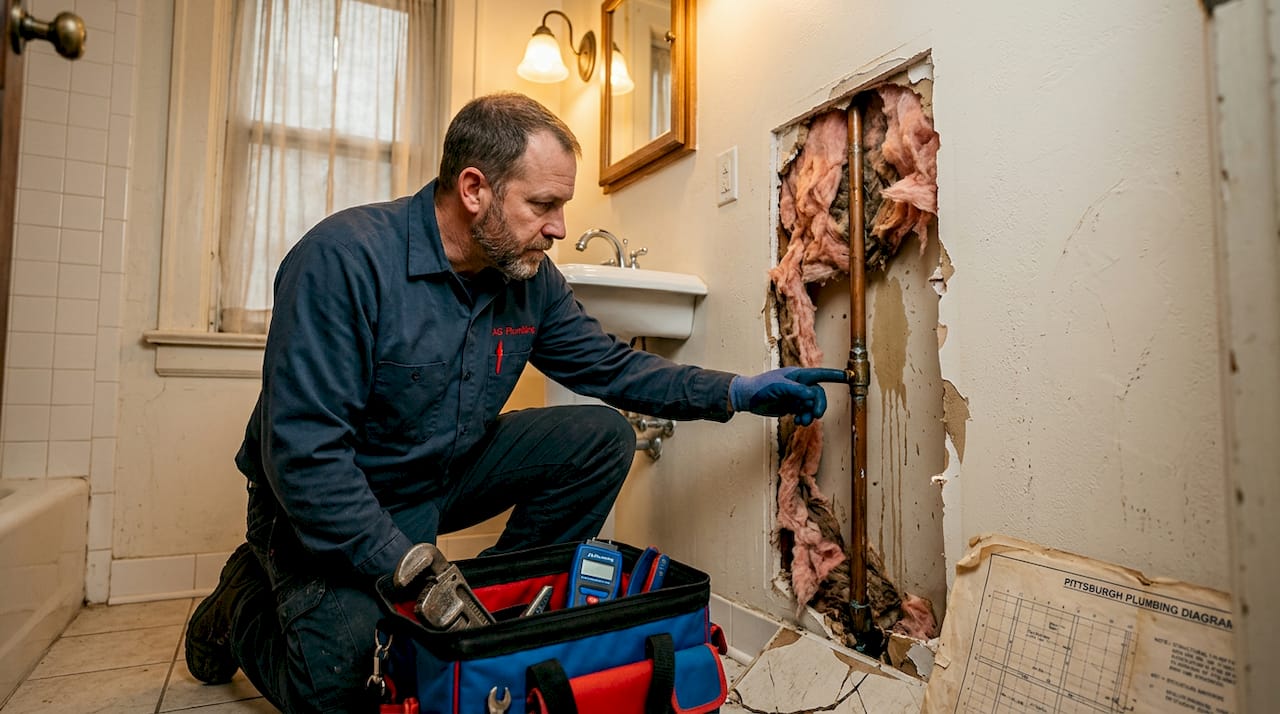
The impact of leaks on property is not always visible right away, but it accumulates. A slow drip behind a bathroom wall for three months is not a minor issue. It is a slow-motion renovation project waiting to bill you.
Health and financial costs of ignoring a leak
The cost of delaying leak repairs goes beyond the plumbing bill. There are two other categories that homeowners consistently underestimate: health and insurance.
What mold does to your family
Mold exposure from household leaks can worsen asthma, trigger allergies, cause recurring headaches, and produce fatigue that doctors often struggle to trace back to the home environment. Children and elderly family members are particularly vulnerable. Pittsburgh’s humid summers and cold winters create indoor condensation conditions that make mold spread faster once moisture is present.
The financial picture
| Scenario | Estimated Cost |
|---|---|
| Fix a dripping faucet or worn flapper today | $50 to $200 |
| Repair with minor drywall patch after short delay | $300 to $800 |
| Remediation after mold establishes in wall cavity | $1,500 to $5,000 |
| Structural repair with framing and subfloor damage | $5,000 to $10,000+ |
A $150 repair can balloon to $5,000 or more once secondary damage enters the equation. That gap is not hypothetical. It reflects what happens in real homes where leaks are treated as low-priority items.
Water waste adds to the financial pressure too. Leaks inflate water utility bills in ways that compound over months. Ten thousand gallons per year at Pittsburgh’s current water rates is not a rounding error on your bill.
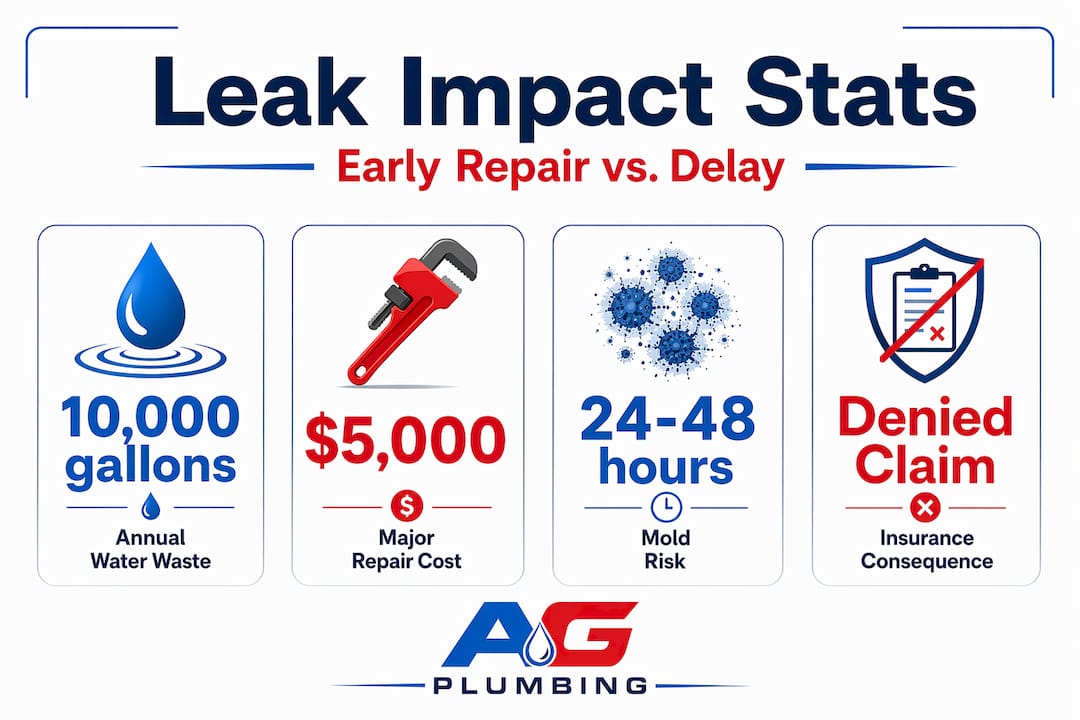
The insurance angle deserves its own attention. Insurers can deny claims when documentation shows a homeowner knew about a leak and failed to act. Negligence exclusions are real, and mold remediation, which can cost several thousand dollars on its own, is frequently the line item that gets cut from a claim when delay is evident. The benefits of fixing leaks before they escalate go well beyond the plumbing itself.
How to detect leaks early and act on them
Early leak detection does not require professional equipment for your first pass. Your own senses and a few habits will catch most household leaks before they become expensive.
Signs to watch for every month:
- Water bills that rise without a change in your household’s water habits
- The sound of running water when every fixture is off
- Soft or discolored spots on ceilings, walls, or floors
- Mold or mildew smell in a room with no obvious moisture source
- A toilet that “runs” briefly on its own without being flushed
Pro Tip: Drop a few drops of food coloring into your toilet tank and wait 10 minutes without flushing. If color appears in the bowl, your flapper is leaking silently. This is one of the most common and easily missed household leaks.
For early leak detection beyond the basics, professional leak detection in Pittsburgh uses acoustic sensors, thermal imaging, and moisture meters to find leaks inside walls without tearing anything open. Homeowners often underestimate how precise these tools are. A plumber can identify a pinhole leak inside a wall cavity in under an hour using thermal imaging, saving far more in labor than the inspection costs.
When it comes to why repair leaks quickly, timing is the clearest answer. The 24 to 48 hour window where drying alone prevents mold is real. Outside that window, the scope of repair grows significantly. Knowing how to identify when plumbing repair is necessary means you can act before you are past that threshold.
A reliable plumbing service contract with scheduled inspections is worth considering for older Pittsburgh homes, particularly those built before 1980 with original plumbing. Preventive maintenance visits catch the kinds of slow-developing problems that homeowners simply cannot see on their own.
My honest take on why homeowners delay
I have watched homeowners lose tens of thousands of dollars on repairs that started as a $100 problem. The pattern is almost always the same. A small stain appears. Someone decides it has not gotten worse. Life gets busy. Six weeks later, a plumber opens the wall and finds the framing is wet six feet in every direction.
The misconception I see most often is that a leak is only serious if water is actively dripping somewhere visible. In my experience, the leaks that cost the most are the ones producing no visible water at all. A slow seep behind a shower tile, a supply line connection that weeps just enough to keep the insulation damp without ever forming a puddle.
People also tend to think that DIY fixes close the case. Wrapping a joint with plumber’s tape or tightening a compression fitting handles the symptom. But without diagnosing the root cause, whether it is water pressure that is too high, a corroding line, or a fitting that has reached the end of its lifespan, the same spot fails again in a few months.
My take is simple: treat a leak as an urgent maintenance item the same week you notice it, not the same season. The cost of a service call is almost never as large as people fear. The cost of waiting frequently is.
— Maayan
Pittsburgh homeowners: get ahead of costly repairs

If anything in this article sounds familiar, whether it is a water bill that crept up, a musty smell in a room, or a drip you have been ignoring, Ag-plumbing is the right call. With 30 years serving Pittsburgh and the surrounding areas, the team at AG Heating, Cooling & Plumbing specializes in early leak detection and plumbing repairs that stop damage before it compounds. From pinhole pipe leaks to full-scale plumbing repair services, Ag-plumbing brings the diagnostic tools and experience to get it right the first time. Pittsburgh homes have their own plumbing challenges, and the Ag-plumbing team understands exactly what to look for. Do not let a $150 fix turn into a $5,000 project. Reach out to AG Heating, Cooling & Plumbing and get a professional set of eyes on it this week.
FAQ
Why is it important to fix leaks early?
Fixing leaks early prevents water from spreading into walls and floors where it causes mold growth, wood rot, and structural damage. A repair that costs $50 to $200 today can escalate to $5,000 or more if left unaddressed.
How fast does mold grow after a water leak?
Mold spores can begin colonizing damp materials within 24 to 48 hours of moisture exposure. Acting within that window is the most effective way to prevent mold without professional remediation.
Can a small leak affect my insurance coverage?
Yes. Insurance providers can deny claims for damage caused by a leak the homeowner knew about but failed to repair. Negligence exclusions apply specifically to secondary damage like mold remediation.
What are the signs you need to fix a leak right away?
Watch for unexplained increases in your water bill, the sound of running water when nothing is in use, soft spots on walls or ceilings, musty odors, and any visible mold or discoloration near plumbing fixtures.
What does early leak detection actually involve?
Professional early leak detection uses acoustic listening devices, thermal imaging cameras, and moisture meters to locate leaks inside walls and under floors without destructive opening. It pinpoints problems quickly so repairs stay targeted and affordable.
Recommended
- Cost-saving plumbing tips for Pittsburgh homeowners – AG-Plumbing
- Leak detection in Pittsburgh: prevent costly damage – AG-Plumbing
- Smart Plumbing Tips Every Pittsburgh Homeowner Needs – AG-Plumbing
- Preventative Plumbing Tips to Protect Your Pittsburgh Home – AG-Plumbing
