
TL;DR:
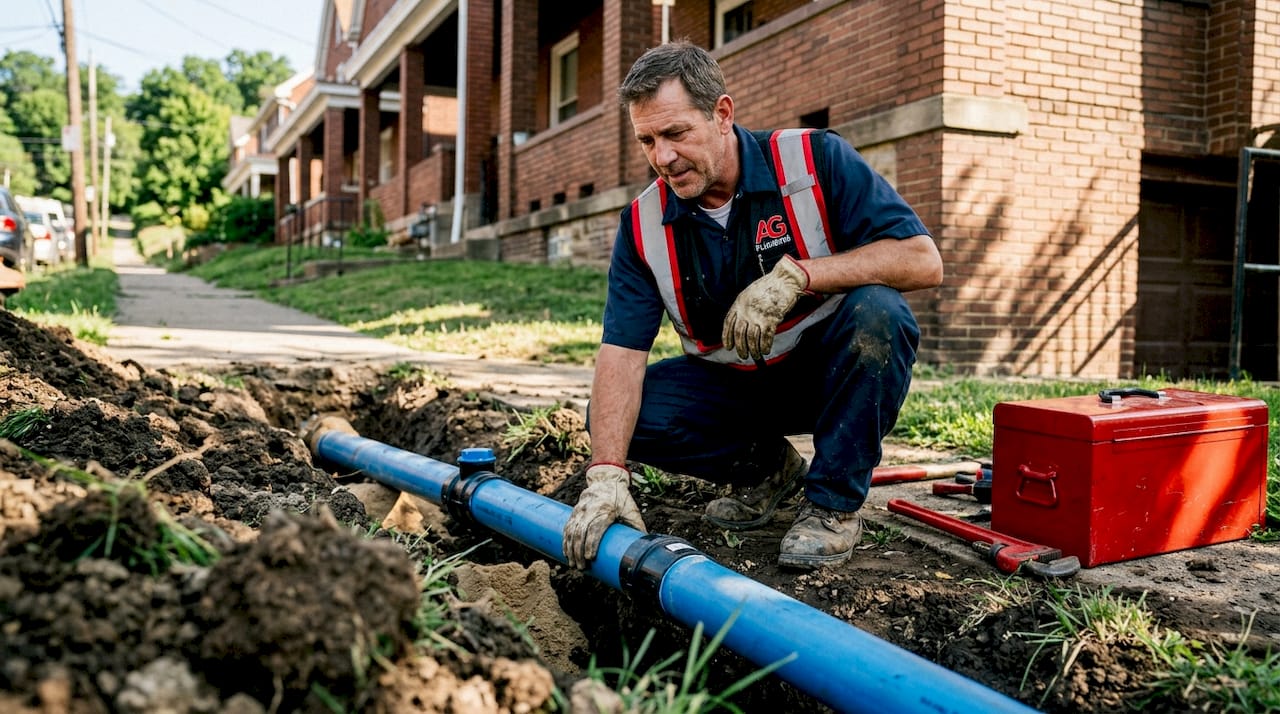
- A failing main water line in Pittsburgh often goes unnoticed until costly damage occurs, especially in older neighborhoods. Homeowners are responsible for repairs from the curb stop to inside their homes, which are not covered by typical insurance, and must follow strict safety and notification protocols before any excavation. The replacement process involves careful planning, excavation, leak testing, and pressure restoration, with experienced plumbers managing potentially unexpected complications like lead lines or soil conditions.
A failing main water line doesn’t send polite warnings. One day you notice low pressure, then damp patches appear in the yard, and suddenly you’re facing thousands of dollars in potential damage with no clear plan. Pittsburgh homeowners deal with this more often than you’d think, especially in older neighborhoods where aging cast iron and galvanized steel lines have long passed their useful life. This guide walks you through everything you need to know, from understanding who owns what portion of the line, to the exact steps involved in a safe, code-compliant replacement that gets your water flowing again.
Table of Contents
- Know your main water line: Pittsburgh context and homeowner responsibilities
- Before you dig: Planning, required notifications, and safety standards
- Step-by-step main water line replacement: How the process works in Pittsburgh
- Testing, lead line rules, and full restoration after replacement
- What most Pittsburgh homeowners miss about main water line replacement
- Professional help for main water line replacement in Pittsburgh
- Frequently asked questions
Key Takeaways
| Point | Details |
|---|---|
| Main line roles clarified | Know which parts of your main water line you are responsible for and when the utility takes over. |
| Plan before digging | You must notify utilities and secure permits before beginning any water line excavation in Pittsburgh. |
| Follow safety protocols | Proper shoring, personal protection, and careful pressure restoration ensure safety in every replacement. |
| Watch for lead programs | If you have a lead service line, utility work may trigger free replacement for both public and private portions. |
| Consider insurance gaps | Typical homeowners insurance will not cover water line replacement costs; check for optional protection plans. |
Know your main water line: Pittsburgh context and homeowner responsibilities
Your main water line is the single pipe that carries fresh water from the public water main under the street all the way into your home. In Pittsburgh, that line typically runs from the curb stop (a shutoff valve located near the edge of your property at the street) through your front yard and into the foundation wall. Understanding water pipes inside the home and how they connect to this exterior line helps you see the full picture.
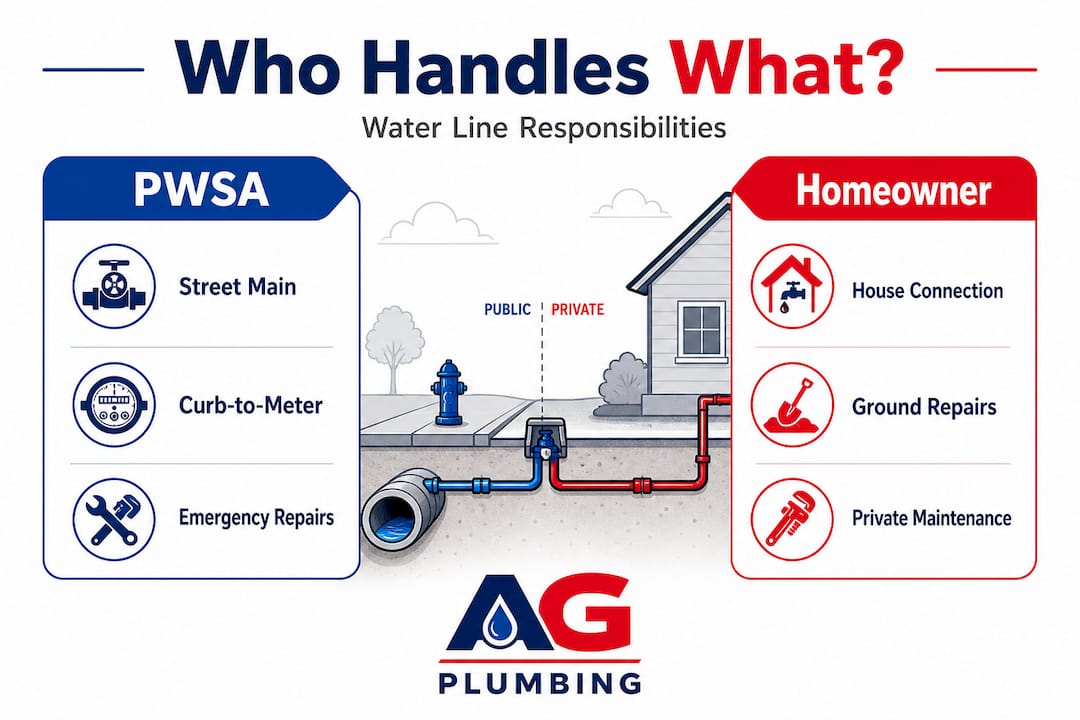
Here’s where responsibility gets complicated. Pittsburgh Water and Sewer Authority (PWSA) owns and maintains the portion of the line from the water main to the curb stop. Everything from the curb stop to your home, and all common plumbing repairs inside, falls on you as the homeowner. That distinction matters enormously when something goes wrong.
| Responsibility area | Pittsburgh Water (PWSA) | Homeowner |
|---|---|---|
| Water main under street | Owns and maintains | No responsibility |
| Service line to curb stop | Owns and maintains | No responsibility |
| Curb stop to home entry | Monitors only | Full repair and replacement cost |
| In-home plumbing | No responsibility | Full repair and replacement cost |
| Lead line replacement (if disturbed by utility work) | Replaces at no cost | No cost in this scenario |
| Routine leak repair on private side | No involvement | Full cost |
Many Pittsburgh homeowners assume their regular homeowners’ insurance will step in if a water line fails. It almost certainly will not. Standard homeowners’ insurance typically does NOT cover repair or replacement of water service lines or sewer lines. Pittsburgh Water does offer optional service line protection programs worth exploring before a crisis hits, not after.
The financial exposure is real. A full main line replacement can run anywhere from $1,500 on the low end to well over $5,000 depending on depth, soil conditions, pipe material, and the length of the run. If a line failure causes water to pool near your foundation or seep into your basement, those damages compound fast. Professional sewer repair services and main water line work often go hand in hand, since trenching for one can reveal problems with the other. Our sewer line repair guide covers that overlap in detail.
With these risks and responsibilities clear, you need to ensure everything is set before any digging or repairs begin.
Before you dig: Planning, required notifications, and safety standards
No one in Pittsburgh should pick up a shovel for main water line work without first calling 811. Pennsylvania’s One Call system legally requires all excavators, including homeowners doing their own work, to notify utilities before breaking ground. This isn’t optional. Hitting an unmarked gas, electric, or telecom line creates life-threatening hazards and serious legal liability.
Here’s what happens when you call 811:
- Your request is logged and assigned a ticket number.
- All relevant utility companies are notified to locate and mark their lines.
- Within three business days, technicians physically mark buried utilities with color-coded flags and spray paint.
- Only after receiving clearance can excavation legally begin.
Key planning steps include 811 (PA One Call) notification, valve isolation, and excavation with shoring per safety standards. Shoring refers to the temporary walls or supports placed inside an excavation trench to prevent collapse. In Pittsburgh’s clay-heavy soil, trench walls can give way with very little warning, and a collapse in a 4-foot-deep trench is fatal.
Pre-replacement checklist:
| Step | Who handles it | Why it matters |
|---|---|---|
| Call 811 (PA One Call) | Homeowner or contractor | Legal requirement, prevents utility strikes |
| Pull excavation permit | Homeowner or licensed contractor | Required by Pittsburgh city code |
| Notify PWSA if near public main | Licensed plumber | Prevents unauthorized utility interference |
| Arrange temporary water supply | Homeowner | Multi-hour jobs leave home without water |
| Install trench shoring | Contractor | OSHA safety requirement for worker protection |
| Confirm lead line status | Plumber + PWSA | Determines replacement eligibility and cost |
Pro Tip: Ask your plumber to schedule the job early in the morning. Main line replacements that start at 7 a.m. have a far better chance of completing within a single day, which means your water service is back on before you go to bed. Jobs that start at noon risk running into extended shutdowns.
Safety note: Trench excavation for water line work is one of the most hazardous residential construction tasks. Never enter an unshored trench of any depth. Soil pressure can shift in seconds, and even a 2-foot collapse can pin and injure a person. Always verify that your contractor follows OSHA shoring standards before work begins.
Understanding the distinction between a water line and a sewer line also matters during planning. Our guide on what is a sewer line explains the differences clearly, since both lines often run through the same area of your property and both require permits and utility coordination. Planning both together, if needed, can reduce total project cost significantly. See our plumbing cost-saving tips for strategies that work in Pittsburgh specifically.
Once everything is legally and safely coordinated, you’re ready for the actual replacement steps.
Step-by-step main water line replacement: How the process works in Pittsburgh
Understanding the actual replacement sequence removes a lot of anxiety. Here’s how a typical main water line replacement unfolds in Pittsburgh:
- Valve isolation. The plumber locates and closes the curb stop valve, cutting water flow to your home. PWSA may also be involved if the work is near the utility side.
- Excavation. Crew digs a trench along the path of the existing line, from the curb stop to the foundation. Shoring is installed progressively as the trench deepens.
- Old pipe removal. The failing pipe, whether galvanized steel, cast iron, or lead, is disconnected and pulled out. This is when lead line discoveries become important.
- New pipe installation. Modern replacements typically use copper or PEX (cross-linked polyethylene) pipe, both of which resist corrosion far better than older materials. Connections to the curb stop fitting and the in-home entry point are made using appropriate fittings.
- Leak testing before backfill. Water is slowly introduced into the new line to check every joint. No backfilling happens until the plumber confirms zero leaks under pressure.
- Backfill and compaction. The trench is filled and compacted in layers to prevent future settling. In Pittsburgh, disturbed sidewalk or driveway sections require proper restoration per city code.
- Pressure restoration. Water is allowed to bleed in slowly rather than surging in at full pressure. This protects new joints and flushes air from the line gradually. Once flow is stable, full pressure is restored.
Emergency water main repairs follow a similar sequence but compress the timeline significantly. Valve isolation, rapid excavation, repair or replacement, backfill, and pressure restoration happen in quick succession. The bleed-in step is still performed, even under urgency, because skipping it risks damaging newly installed fittings.
Unexpected obstacles are common in Pittsburgh’s older neighborhoods. Homes built before 1950 frequently have lead service lines, unknown branch connections, or pipes that have shifted significantly from their original position due to soil movement and frost cycles. The plumber may need to adjust the route mid-project or contact PWSA for guidance on a previously unknown connection.
Understanding the sewer repair process gives useful context here too, because both projects share excavation logistics, permit requirements, and restoration steps. Knowing what to expect across both keeps you from being surprised. You can learn more about our full plumbing repair services to see how we handle these overlapping situations.
Plumbing leaks and water damage create serious safety risks beyond just property damage, including mold, structural weakening, and electrical hazards if water reaches wiring. Speed matters, but not more than doing the job right.
Pro Tip: Fill several large containers with water before the job starts. A main line replacement can leave your home without water for 4 to 8 hours. Having water on hand for drinking, flushing, and basic hygiene makes the process much more manageable.
After your new main line is installed, verifying and restoring service safely is essential.
Testing, lead line rules, and full restoration after replacement
The replacement itself is only part of the job. Proper testing and restoration protect your investment and your family’s health.
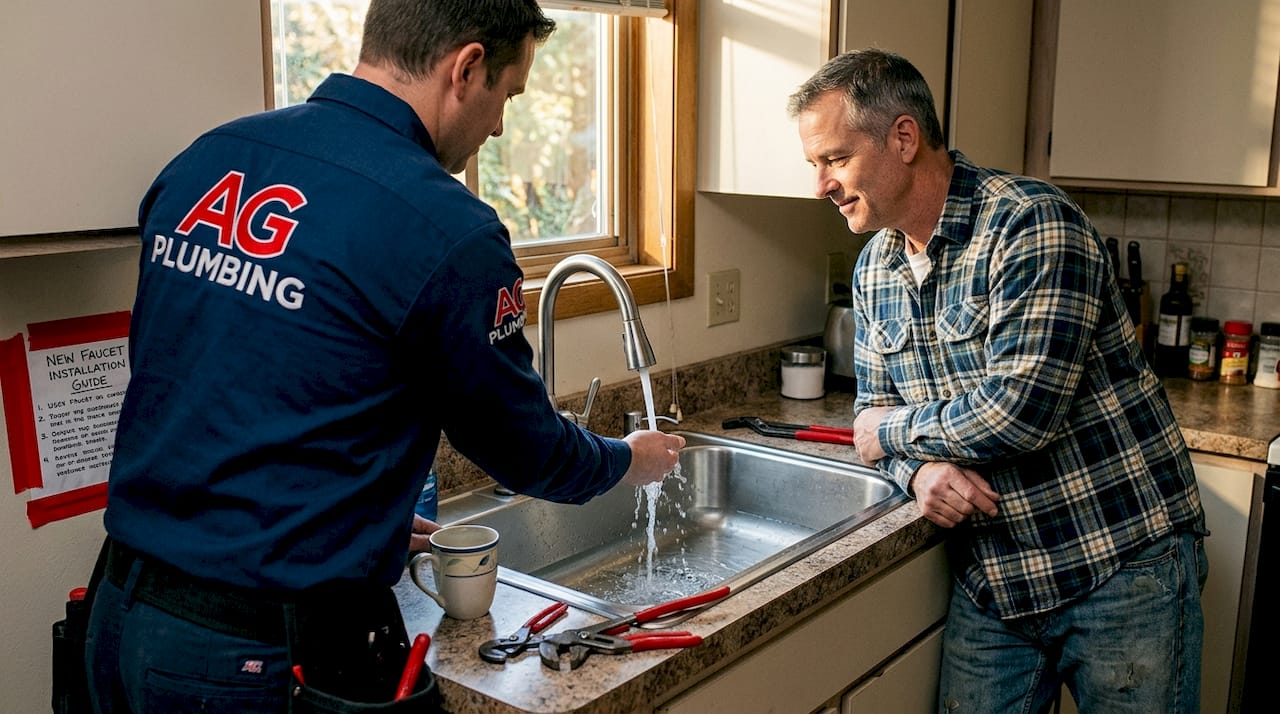
Pressure restoration protocol matters more than most homeowners realize. Rushing pressurization stresses new fittings and can dislodge any debris inside the line, sending sediment into your fixtures and water heater. Slow bleed-in allows the system to equalize, air to escape through faucets left open at the far end of the house, and technicians to visually confirm stable flow before closing the valve fully.
After pressurization, run every cold-water tap in the home for two to three minutes. This flushes the line, clears any disturbed sediment, and confirms flow at all fixtures. Check under sinks and at the main shutoff inside the home for any moisture or drips.
Lead line rules in Pittsburgh are a critical topic. Pittsburgh Water’s lead service line program includes replacing lead service lines on both the publicly and privately owned sides when those lines are disturbed during utility work, at no direct cost to the customer. That’s a significant benefit most homeowners don’t know to ask about.
| Scenario | Utility side replacement | Private side replacement | Homeowner cost |
|---|---|---|---|
| Utility-initiated main work disturbs lead line | Yes, by PWSA | Yes, by PWSA | No cost |
| Homeowner-initiated private line replacement | N/A | By homeowner’s plumber | Full private cost |
| Partial line replacement (no lead disturbed) | Not triggered | Not triggered | Varies |
Final home restoration checklist after replacement:
- Flush all cold-water taps for 2 to 3 minutes
- Inspect the water heater inlet for sediment buildup
- Run the dishwasher through one empty cycle to flush the supply line
- Check all toilet fill valves for proper operation
- Inspect the basement entry point for any signs of moisture around new penetrations
- Review your water lines cleaning guide for ongoing maintenance steps
- Test water pressure at a fixture using a gauge (normal is 40 to 80 PSI)
- Schedule a follow-up inspection within 30 days to confirm no settling or leaks
Now that you understand how the process ends, it’s important to consider the broader lessons and what surprises most homeowners.
What most Pittsburgh homeowners miss about main water line replacement
After 30 years working on Pittsburgh homes, we’ve noticed a consistent pattern. Homeowners come to us after a line failure with two common surprises. First, they genuinely believed their homeowners’ insurance covered this. It almost never does. Second, they had no idea that Pittsburgh’s lead line replacement rules could have saved them thousands of dollars if utility work had been the trigger.
Most people facing a private-side line replacement think about cost purely in isolation: get a quote, pay the bill, move on. But smart homeowners ask one additional question before signing anything: “Is PWSA planning any work in my area that might trigger free lead line replacement on my side of the curb?” That question alone, asked at the right time, can eliminate a $2,000 to $4,000 private-side replacement cost.
The value of an experienced plumber goes beyond labor. A seasoned plumber spots a lead line before the excavation is half done, knows exactly who to call at PWSA to confirm replacement eligibility, and manages the decision logic for both public and private lead lines in a way that protects your interests. Understanding when to call a professional plumber isn’t just about technical skill. It’s about having someone who knows the local utility relationships and can advocate for your financial benefit.
The other thing experienced plumbers manage well is the unexpected. Soil conditions in Pittsburgh vary significantly across neighborhoods. Squirrel Hill, Mount Washington, and the North Side each have their own soil profiles, frost depths, and pipe age patterns. A plumber who has worked across all of them arrives with contextual knowledge that a newer contractor simply doesn’t have.
Pro Tip: Always coordinate with your plumber and PWSA before finalizing your project scope. Confirm whether your property qualifies for lead line replacement under utility-triggered rules before you commit to private-side costs. A 15-minute conversation can change the entire cost picture.
Professional help for main water line replacement in Pittsburgh
Main water line replacement is one of those projects where DIY enthusiasm can create serious consequences. Unpermitted work, improper pipe connections, and missed lead line opportunities all create problems that outlast the project itself.
AG Heating, Cooling & Plumbing has handled main water line replacements across Pittsburgh and surrounding communities for 30 years. Our team manages every stage, from 811 notifications and permit coordination through excavation, installation, testing, and surface restoration. We know Pittsburgh’s soil, Pittsburgh’s utility relationships, and Pittsburgh’s permit requirements. When you work with us, you get a team that handles the paperwork and the hard work, so you’re not caught off guard at any step. Explore our professional plumbing repair services or learn about our essential plumbing services to understand the full scope of what we offer Pittsburgh homeowners.
Frequently asked questions
How do I know if my main water line needs replacement in Pittsburgh?
Common signs include persistent low water pressure, unexplained wet patches in the yard, discolored water, or visible corrosion at the pipe entry point in your basement. A professional inspection can confirm whether repair or full replacement is the right call.
Does Pittsburgh Water replace the main water line for free?
If a lead service line is disturbed during utility-initiated work, Pittsburgh Water replaces both the utility-owned and privately owned lead lines at no direct cost to the homeowner. This does not apply to homeowner-initiated private replacements.
What should I do before replacing my water line in Pittsburgh?
Always call 811 (PA One Call) to have utilities marked, and secure the required excavation permit before any digging begins. PA One Call notification is a legal requirement, not just a recommendation.
Does homeowners’ insurance cover water line replacement in Pittsburgh?
Standard policies typically do not cover repair or replacement of water service lines. Pittsburgh Water offers optional service line protection programs that fill this gap, and enrolling before a failure is far smarter than hoping your regular policy will cover it.
How long does a main water line replacement usually take in Pittsburgh?
Most straightforward replacements are completed within one day. However, utility coordination, unexpected obstacles like lead lines or unknown connections, testing, and surface restoration can extend the timeline. Your plumber should give you a realistic estimate after reviewing the site.
Recommended
- How to clean water lines: Pittsburgh homeowner guide – AG-Plumbing
- Sewer line repair guide for Pittsburgh homeowners – AG-Plumbing
- Smart Plumbing Tips Every Pittsburgh Homeowner Needs – AG-Plumbing
- Install plumbing fixtures: Pittsburgh homeowner guide – AG-Plumbing
