
TL;DR:
- Thermostatic mixing valves automatically blend hot and cold water to deliver safe, consistent temperatures while preventing scalds and Legionella growth. Regular maintenance, proper installation near fixtures, and compliance with safety standards are essential for optimal protection and system performance. Educating homeowners and professionals on TMV benefits and requirements helps ensure reliable, safe plumbing systems in all settings.
A thermostatic mixing valve (TMV) is a safety device that blends hot and cold water to deliver a consistent, scald-free temperature at every tap, shower, and fixture in your home or facility. The role of thermostatic mixing valves goes well beyond simple temperature adjustment. TMVs protect children, elderly residents, and patients from burns while simultaneously allowing your water heater to store water at 140°F, the temperature required to suppress Legionella bacteria growth. Whether you manage a Pittsburgh home or a commercial facility, understanding how these valves work and why they need regular attention is the difference between a safe plumbing system and a liability.
What is the role of thermostatic mixing valves in plumbing?
A TMV sits between your hot and cold water supply lines and the outlet fixture, continuously blending both streams to hit a preset delivery temperature. The industry standard term is “thermostatic mixing valve,” and it is distinct from a basic tempering valve or a manual mixer. Where a manual valve requires you to physically adjust the ratio of hot to cold water, a TMV does it automatically, every second, without any input from you.
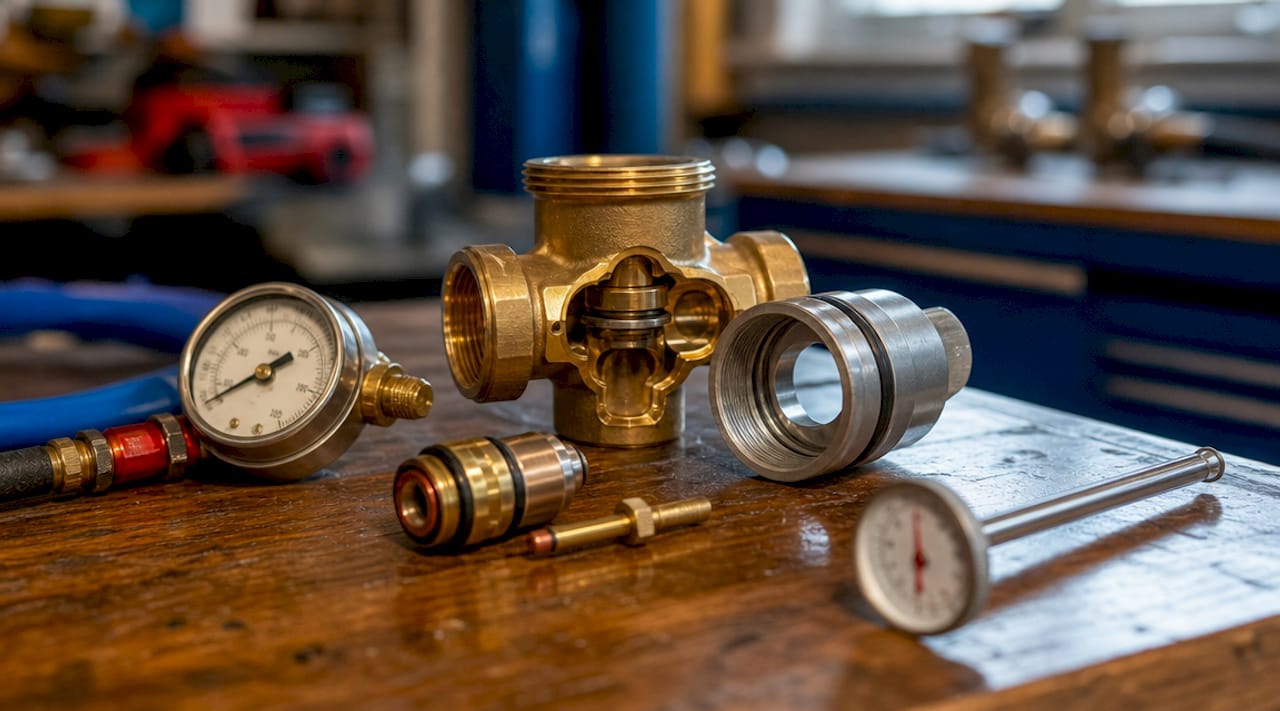
The core component is a thermostatic element, typically a wax capsule or bi-metal strip, that expands and contracts in direct response to water temperature. When the output temperature rises above the setpoint, the element expands and restricts hot water flow. When it drops, the element contracts and opens the hot water port wider. This constant mechanical feedback loop keeps output temperature within ±2°C of the target, regardless of pressure swings in your supply lines.
The fail-safe mechanism is what separates a TMV from every other mixing device. If cold water supply pressure drops suddenly, such as when a toilet flushes or a pipe bursts, a standard valve would deliver a surge of scalding hot water. A TMV shuts off hot water rapidly within seconds, stopping flow entirely until balanced pressure returns. That single feature is the reason TMVs are legally mandated in hospitals, aged care facilities, and accessible bathrooms across the country.
Pro Tip: Set your water heater to 140°F and your TMV to 120°F for residential showers. You get Legionella control at the tank and scald protection at the tap, without compromising either.
- Cold and hot water enter separate inlets on the valve body.
- The thermostatic element senses the blended temperature in the mixing chamber.
- The element adjusts the hot and cold ports to correct any deviation from the setpoint.
- If cold supply fails, the fail-safe shutter closes the hot water port completely.
- Blended water exits at the set temperature to your fixture.
What are the safety benefits of using TMVs?
The most direct benefit is scald prevention. Water at 140°F causes a full-thickness burn in under five seconds. A properly set TMV delivers water at 120°F or below, which dramatically reduces that risk. This protection matters most for young children, elderly adults, and anyone with reduced sensation or mobility, groups that cannot react quickly enough to avoid injury from a sudden temperature spike.
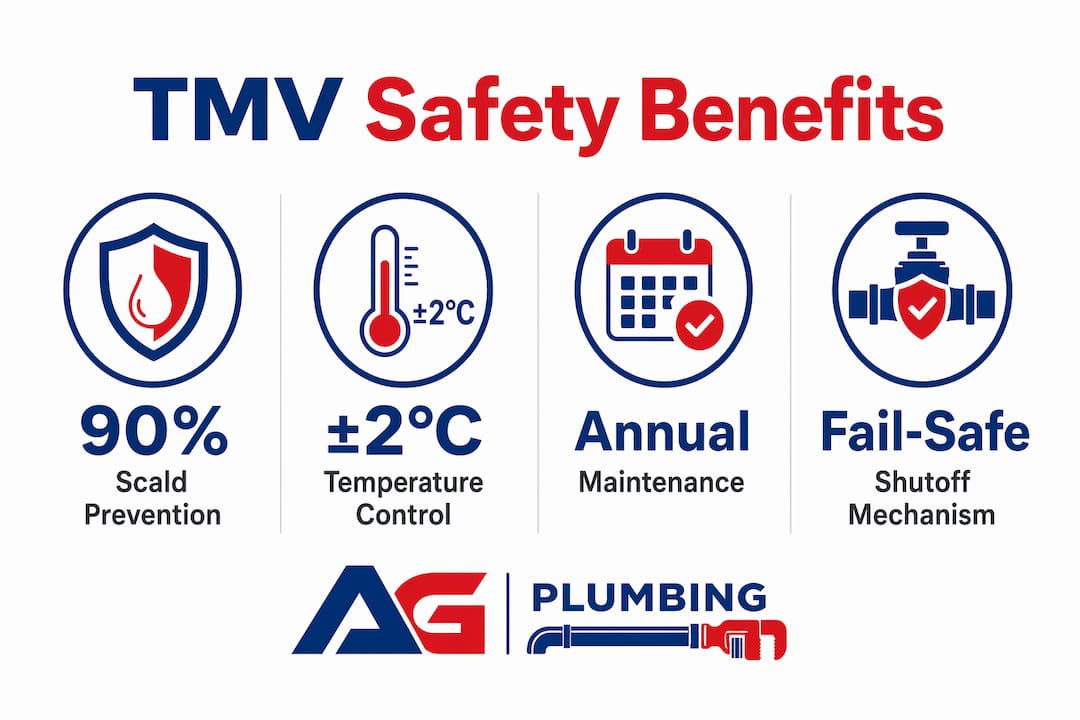
Beyond individual safety, TMVs solve a genuine public health conflict. TMVs enable water storage above 60°C to suppress Legionella while delivering safe temperatures at the point of use. Without a TMV, you face a choice: store water hot enough to kill bacteria and risk scalding users, or store it cool enough to be safe and risk bacterial colonization. A TMV removes that tradeoff entirely. This is why plumbing and health professionals treat TMVs as public health infrastructure, not just plumbing hardware.
TMVs also reduce hot water waste. When a shower runs cold because the hot water hasn’t arrived yet, most people let it run until the temperature stabilizes. A TMV installed close to the fixture delivers the correct temperature almost immediately, cutting the volume of water wasted during warmup. Over a year, that adds up to measurable savings on both water and energy bills.
Certified TMVs are mandatory in high-risk environments under the 2025 National Construction Code and AS 4032.1 standards. Using a tempering valve in these settings is not just a safety risk. It is a compliance violation that exposes facility operators to legal liability.
Key safety advantages at a glance:
- Prevents scalding from sudden hot water surges
- Eliminates thermal shock when cold supply pressure drops
- Allows high-temperature storage for Legionella control without burning users
- Reduces hot water waste at the fixture
- Meets mandatory safety standards for healthcare, childcare, and accessible bathrooms
How do TMVs compare to tempering valves and manual mixers?
The three main types of mixing devices are thermostatic mixing valves, tempering valves, and manual mixers. Each serves a different purpose, and choosing the wrong one for your application creates real safety and compliance problems.
| Feature | Thermostatic mixing valve | Tempering valve | Manual mixer |
|---|---|---|---|
| Automatic temperature adjustment | Yes | Partial | No |
| Fail-safe shutoff on cold supply loss | Yes | No | No |
| Certified for high-risk environments | Yes (AS 4032.1) | No (AS 4032.2) | No |
| Typical residential cost | $30 to $200 | $20 to $100 | $10 to $50 |
| Recommended for aged care, healthcare | Yes | No | No |
Tempering valves lack fail-safe shutoff and will continue delivering dangerously hot water if cold supply is interrupted. That makes them unsuitable for any setting where a vulnerable person could be harmed. They are acceptable in low-risk residential applications such as a laundry tub, but not for showers or baths where children or elderly residents are present.
TMVs automatically adjust to pressure fluctuations using internal wax elements, which is the core technical distinction from basic valves. Residential TMV costs range from $30 to $200, and proper sizing is critical. A half-inch valve suits a single point-of-use fixture. A three-quarter-inch valve handles group installations serving multiple outlets. Undersizing a TMV restricts flow and forces the valve to work outside its calibrated range, which degrades temperature accuracy.
Pro Tip: If you are renovating a bathroom that will be used by children or anyone over 65, specify a certified TMV, not a tempering valve. The cost difference is small. The liability difference is not.
What maintenance do thermostatic mixing valves require?
A TMV installed and then forgotten is a safety device waiting to fail. Annual servicing of filters and strainers is the minimum required for compliance and continued safe operation. In practice, proper maintenance involves more than a quick filter rinse.
Proper maintenance requires competent servicing including cleaning, descaling, disinfection, and detailed documentation, which can take 45 minutes per valve. Rushing this process compromises valve performance and safety. That is not a task for a homeowner with a wrench and 10 minutes. It requires a licensed plumber who understands the valve’s internal components and can verify temperature accuracy after reassembly.
The biological risk is the most underappreciated maintenance issue. Biofilm can develop inside a neglected TMV, turning a safety device into a Legionella breeding ground. The warm, mixed-temperature water inside the valve body creates ideal conditions for bacterial growth if the valve is not flushed, cleaned, and disinfected on schedule. Facility managers overseeing multiple outlets face compounding risk if any single valve in the network is neglected.
Watch for these warning signs that a TMV needs immediate attention:
- Water temperature at the outlet is inconsistent or higher than the setpoint
- Reduced flow rate at the fixture, often caused by a blocked strainer
- Visible scale or discoloration on the valve body or aerator
- The valve fails to shut off flow when cold supply is interrupted
- Any report of a scald incident at a fixture served by the valve
Pro Tip: Keep a maintenance log for every TMV in your building. Record the service date, technician name, temperature readings before and after service, and any parts replaced. This documentation protects you legally and helps identify valves that are failing ahead of schedule.
Where and how should TMVs be installed?
Installation location determines how well a TMV performs. Pipe dead legs should be limited to 1.5 meters downstream of the valve to reduce the risk of bacterial growth in stagnant water. Installing a TMV at the water heater outlet and then running a long pipe to a distant bathroom defeats much of the safety benefit. The valve should be as close to the point of use as practical.
There are two main installation strategies. Point-of-use TMVs serve a single fixture and provide the tightest temperature control. Group TMVs serve multiple outlets from a single valve, which reduces cost but introduces longer pipe runs and slightly less precise temperature management at each individual fixture. For residential bathrooms, point-of-use installation is the better choice. For commercial facilities with many outlets in close proximity, a group TMV with short branch lines is a practical and compliant solution.
- Install the TMV as close to the fixture as possible, ideally within 1.5 meters of the outlet.
- Fit isolation valves on both hot and cold inlets to allow servicing without shutting down the whole system.
- Set the water heater to 140°F and calibrate the TMV to the required delivery temperature.
- Install a check valve on both inlets to prevent crossflow between hot and cold lines.
- Commission the valve by measuring outlet temperature with a calibrated thermometer and adjusting the setpoint if needed.
TMVs pair naturally with water heater upgrades, where the heater runs hotter for efficiency and bacteria control while the TMV protects users at the tap. In commercial kitchens, healthcare facilities, and childcare centers, TMVs are not optional. They are the standard. For Pittsburgh homeowners, adding a TMV during a bathroom remodel is one of the highest-value plumbing upgrades available, combining safety, compliance, and long-term cost savings in a single device.
TMVs also play a broader role in hydronic heating systems, where mixing valves modulate supply temperatures to protect radiant floor systems and enable multi-zone temperature management. A radiant floor designed for 95°F water would be damaged by the 140°F supply from a boiler without a mixing valve in the circuit. This expanded application shows that TMVs are not just bathroom fixtures. They are precision temperature management tools used throughout modern plumbing and HVAC systems.
Key takeaways
Thermostatic mixing valves are the single most effective device for delivering safe water temperatures while maintaining the high storage temperatures needed to control Legionella.
| Point | Details |
|---|---|
| Core function | TMVs blend hot and cold water to maintain output within ±2°C of the setpoint automatically. |
| Fail-safe protection | TMVs shut off hot water flow within seconds if cold supply pressure drops, preventing scalds. |
| Legionella control | Store water at 140°F for bacteria suppression; the TMV delivers safe temperatures at the tap. |
| Compliance requirement | Certified TMVs (AS 4032.1) are mandatory in healthcare, aged care, and accessible bathrooms. |
| Maintenance is non-negotiable | Annual servicing by a licensed plumber prevents biofilm, crossflow, and valve failure. |
Why I think most people underestimate what a TMV actually does
After years of working in plumbing, I still see homeowners treat TMVs as an optional upgrade rather than a safety device. The framing matters. A smoke detector is not optional. A TMV in a home with young children or elderly residents should not be optional either.
The maintenance gap is where I see the most risk. A TMV installed five years ago and never serviced is not protecting anyone. The wax element degrades, strainers clog, and biofilm colonizes the warm mixing chamber. The valve looks fine from the outside. It is not fine on the inside. Facility managers especially need to treat TMV maintenance as a scheduled, documented process, not something that happens when a complaint comes in.
The trend I find encouraging is that more homeowners are asking about TMVs during bathroom remodels and water heater replacements. That is exactly the right time to install or upgrade them. The cost is minimal relative to the total project, and the safety benefit is immediate. If you are planning any plumbing work in 2026, put a TMV on the list before you finalize the scope. You will not regret it.
— Maayan
Get professional TMV installation and service from Ag-plumbing
Ag-plumbing has served Pittsburgh, PA and the surrounding areas for 30 years, and TMV installation, calibration, and maintenance are part of that expertise. Whether you need a single point-of-use valve for a family bathroom or a full assessment of the mixing valve network in a commercial facility, the team at AG Heating, Cooling & Plumbing brings the technical knowledge and licensed experience to get it right.
Do not leave water temperature safety to chance. Ag-plumbing offers plumbing repair and installation services across Pittsburgh, including TMV selection, professional installation, and annual servicing to keep your system compliant and your household safe. Contact Ag-plumbing today to schedule an assessment or discuss a fixture installation project for your home or facility.
FAQ
What does a thermostatic mixing valve do?
A thermostatic mixing valve blends hot and cold water to deliver a consistent, preset temperature at your fixture. It automatically adjusts to pressure and temperature changes in your supply lines, and shuts off hot water flow if cold supply fails.
How is a TMV different from a tempering valve?
A TMV includes a fail-safe mechanism that stops hot water flow if cold supply is lost. A tempering valve does not have this feature and will continue delivering dangerously hot water under the same conditions, making it unsuitable for high-risk environments.
How often does a thermostatic mixing valve need servicing?
Annual servicing is the minimum recommended interval. Each service should include cleaning, descaling, disinfection, and a temperature accuracy check, performed by a licensed plumber with documentation of all work completed.
Can a TMV prevent Legionella growth?
A TMV does not kill Legionella on its own. It allows your water heater to store water at 140°F, which suppresses bacterial growth, while delivering safe temperatures at the tap. Without proper maintenance, the valve body itself can become a site for biofilm and Legionella colonization.
Where should a TMV be installed in a home?
Install a TMV as close to the point of use as possible, with no more than 1.5 meters of pipe between the valve and the outlet. Bathrooms, showers, and any fixture used by children or elderly residents are the highest-priority locations.
Recommended
- Essential plumbing safety tips for Pittsburgh homeowners – AG-Plumbing
- Smart Plumbing Tips Every Pittsburgh Homeowner Needs – AG-Plumbing
- Common Plumbing Repair Issues and How to Fix Them – AG-Plumbing
- Emergency Plumbing Guide: Quick Solutions for Homeowners – AG-Plumbing
