
Expect to pay roughly a low to high tens of thousands of dollars to install new plumbing in a typical U.S. single-family home, with most projects landing in the mid-teens of thousands. Scope, fixture count, and pipe material drive the spread more than square footage alone.
Here are the headline numbers at a glance:
- Low end: low tens of thousands (small home, basic fixtures, PEX, simple layout)
- Typical range: mid-teens of thousands (2,000–2,500 sq ft, standard fixture count, mixed materials)
- High end: upper range of tens of thousands (3,000+ sq ft, premium fixtures, copper, complex layout)
- Rough-in only: a few dollars per square foot for the pipe runs before fixtures are set
The next section shows the full data table and explains what drives those swings.
Key Takeaways
Installing new residential plumbing in the U.S. typically costs $12,000–$18,000 for a standard 2,000–2,500 sq ft home, with layout complexity and fixture count driving the final number more than pipe material alone.
| Point | Details |
|---|---|
| National cost range | A full new plumbing install for a 2,000–3,000 sq ft home typically runs $13,000–$26,000. |
| Biggest cost driver | Layout complexity and wet-wall clustering affect cost more than pipe material choice. |
| Insurance coverage | Standard policies cover sudden pipe failures but rarely cover repiping or aging-pipe replacement. |
| Permit and inspection | Permit fees commonly range from a few hundred to $2,000; skipping permits transfers liability to the homeowner. |
| Ag-plumbing | Ag-plumbing provides written, line-item estimates with permit and restoration scope for Pittsburgh-area projects. |
Table of Contents
- What does new plumbing actually cost nationwide?
- What goes into a plumbing cost estimate line by line?
- How does house size affect your total plumbing bill?
- What does each fixture actually cost to install?
- PEX, copper, or CPVC: which pipe material fits your project?
- What drives plumbing costs higher than the estimate?
- What do permits and inspections cost, and how long do they take?
- Does homeowners insurance cover new plumbing or a repipe?
- How do you get a plumbing estimate you can actually compare?
- Three realistic budget scenarios for new plumbing
- How Ag-plumbing builds a reliable line-item estimate
- The number most homeowners get wrong when budgeting for plumbing
- Ag-plumbing can give you a written estimate for your Pittsburgh project
- Sources
- FAQ
What does new plumbing actually cost nationwide?
National benchmarks for a full residential plumbing install, covering rough-in through trim-out, break down into three reference points. According to Well Built Florida’s construction cost analysis, a typical 2,000–3,000 sq ft home costs a mid to high tens of thousands of dollars depending on scope and materials.
| Scope | Low | Average | High |
|---|---|---|---|
| Full new install (2,000–3,000 sq ft) | ~ low teens of thousands | ~ mid teens of thousands | ~ upper twenties of thousands |
| Rough-in only (per sq ft) | $4 | $6 | $8 |
| Repipe existing home (2,000 sq ft) | $8,000 | ~ mid teens of thousands | $15,000 |
Regional pricing may vary significantly depending on location and market factors. Coastal metros like San Francisco, New York, and Seattle sit at the high end, pushed up by union labor rates, permit fees, and material freight costs. Pittsburgh and similar mid-sized Rust Belt cities tend to track close to the national midpoint, sometimes slightly below.
Two supply-chain factors feed into these averages: copper prices fluctuate with commodity markets, and PEX fittings have seen periodic shortages that briefly inflate material costs.
What goes into a plumbing cost estimate line by line?
Professional estimators break a plumbing project into phases rather than quoting a single flat number. The three phases are underground rough-in (below-slab drain and supply runs), in-wall top-out (vertical and horizontal pipe runs through framing), and trim-out (fixture connections and final testing). That layered structure, noted in Well Built Florida’s estimating breakdown, is what you should expect to see on any credible bid.
| Cost Area | Low | Average | High | Key Drivers |
|---|---|---|---|---|
| Materials (pipe, fittings) | $2,000 | $3,500 | $6,000 | Material type (PEX vs. copper), run length |
| Labor | $4,000 | $7,000 | $12,000 | Layout complexity, crew size, hourly vs. project rate |
| Fixtures (toilets, sinks, showers) | $1,500 | $3,500 | $8,000 | Fixture count and grade |
| Water heater (installed) | $800 | $1,500 | $3,500 | Tank vs. tankless, gas vs. electric |
| Permits and inspections | $300 | $800 | $2,000 | Jurisdiction, project scope |
| Equipment and disposal | $200 | $500 | $1,000 | Dumpster, specialty tools, debris removal |
Common per-fixture installed costs (labor plus material, mid-grade fixture):
- Toilet: $300–$800 installed
- Vanity sink: $250–$600 installed
- Kitchen sink: $400–$900 installed
- Shower stall: $800–$2,500 installed
- Bathtub: $700–$2,000 installed
- Dishwasher hookup: $150–$350
- Washing machine hookup: $200–$450
- Water heater (tank, 40–50 gal): $800–$1,800 installed
Pro Tip: Ask every bidder to include a restoration line item. Drywall patching, painting, and trim replacement after a repipe or retrofit rough-in routinely run $1,500–$4,000 and are almost never included in a plumbing-only quote. A low plumbing bid that omits restoration can end up costing more than a higher bid that covers it.
How does house size affect your total plumbing bill?
Square footage matters, but it is a rough proxy at best. A 2,000 sq ft home with two bathrooms clustered on one wall costs less to plumb than a 1,800 sq ft home with bathrooms on opposite ends of the house. Fixture count and wet-wall placement drive labor and material runs far more than raw floor area.
| House Size | Scope Notes | Low | Average | High |
|---|---|---|---|---|
| 1,600 sq ft | 2 baths, 1 kitchen, clustered layout | $9,500 | $13,000 | $17,000 |
| 2,400 sq ft | 2.5 baths, 1 kitchen, moderate spread | $13,500 | $18,000 | $24,000 |
| 3,500 sq ft | 3.5 baths, 2 kitchens or wet bar, complex layout | $20,000 | $27,000 | $38,000 |
Per Plumbing Tips Today’s 2026 cost guide, a standard 2,000 sq ft home typically runs $12,000–$25,000 for a full plumbing install, which aligns with the mid-range row above.
Clustering wet walls cuts both material runs and labor hours. Back-to-back bathrooms sharing a common wet wall, or a bathroom stacked directly above a kitchen, can reduce total pipe runs by 20–30 linear feet per floor. On a mid-range project, that translates to real savings on both materials and the time a crew spends running and securing pipe.
The per-square-foot framing is most useful as a sanity check on a bid, not as a planning tool. If a contractor quotes $3 per sq ft for a 2,400 sq ft home, that is a red flag. If they quote $9 per sq ft for a simple single-story layout, ask them to justify the labor hours.
What does each fixture actually cost to install?
Fixture costs split into two decisions: the fixture itself and the labor to connect it. Mid-grade fixtures from brands like Kohler, Moen, or American Standard represent the middle of the market. Budget fixtures from big-box stores cut upfront cost but sometimes add labor time due to fit and finish issues. Premium fixtures from brands like Toto or Brizo can triple the fixture cost with minimal change to labor.
Installed cost ranges per fixture (fixture plus labor, mid-grade):
- Toilet: $300–$800
- Vanity sink with faucet: $250–$700
- Kitchen sink with faucet: $400–$900
- Shower stall (prefab): $800–$2,000
- Custom tile shower: $2,500–$6,000+
- Bathtub (alcove): $700–$1,800
- Freestanding soaking tub: $2,000–$5,000+
- Water heater (tank, 40–50 gal): $800–$1,800
- Tankless water heater: $1,500–$3,500
- Laundry hookups (washer/dryer): $200–$500
Three sample fixture packages show how choices compound:
- Basic package (2 baths, 1 kitchen, standard tank water heater, prefab shower, builder-grade fixtures): $4,500–$7,000 in fixtures and connections
- Mid-range package (2.5 baths, 1 kitchen, tankless water heater, tile shower in primary bath, mid-grade fixtures throughout): $9,000–$14,000
- Luxury package (3.5 baths, 2 kitchens or wet bar, custom tile showers, freestanding tubs, premium fixtures, tankless water heater): $18,000–$30,000+
A higher fixture spend makes sense when you are building a primary residence you plan to hold for 10+ years, targeting resale value in a competitive market, or finishing a primary bath where daily use justifies the quality. For a rental property or a spec build, the mid-range package almost always delivers the best return. You can explore how plumbing upgrades affect remodeling ROI before committing to a fixture tier.
PEX, copper, or CPVC: which pipe material fits your project?
Pipe material is one of the clearest levers you have on total cost. PEX has become the dominant choice for new residential construction because it installs faster than copper and costs less per linear foot. Copper remains the premium option, valued for its lifespan and resale perception. CPVC sits in between, mostly used in retrofit situations or where local code limits PEX.
| Material | Relative Cost | Expected Lifespan | Best Uses | Pros | Cons |
|---|---|---|---|---|---|
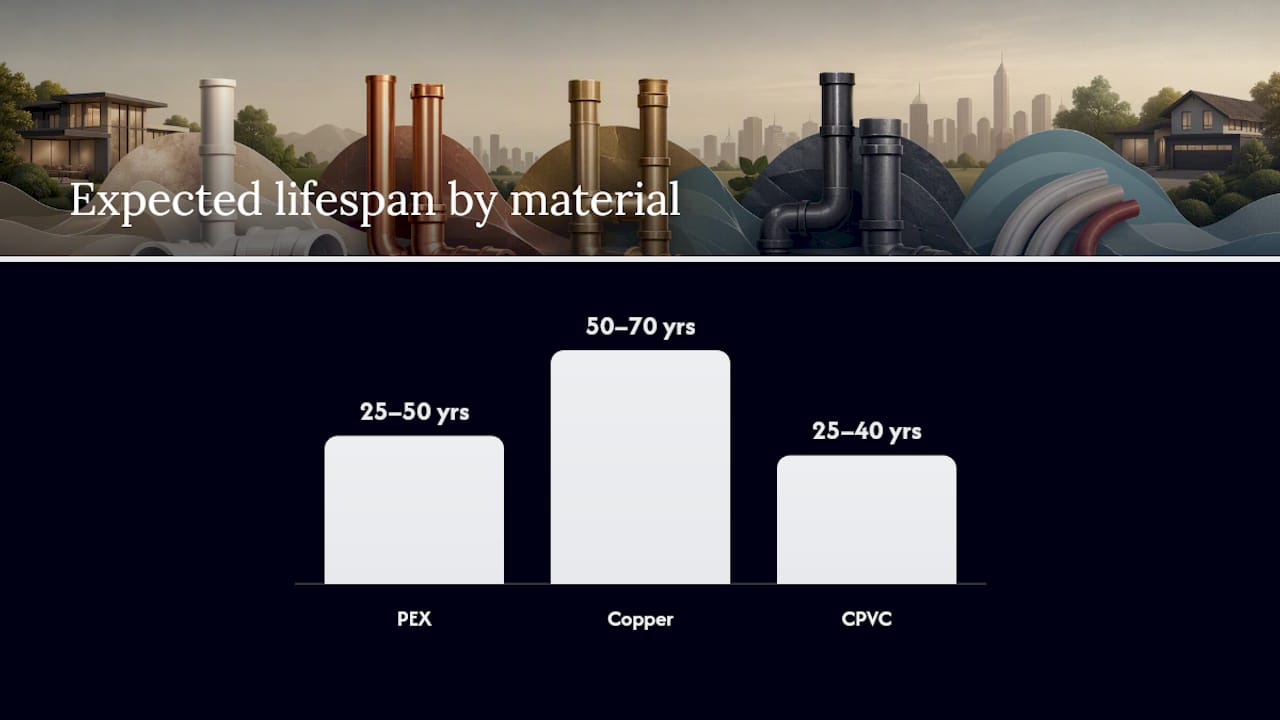
| PEX | Low | 25–50 years | New construction, repipes | Flexible, fast install, freeze-resistant | UV-sensitive, not for outdoor use |
| Copper | High | 50–70 years | New builds, premium repipes | Durable, code-accepted everywhere, resale value | Higher material and labor cost, requires soldering |
| CPVC | Medium | 25–40 years | Retrofits, hot water lines | Cheaper than copper, rigid | Brittle in cold, fewer fittings available |
For a deeper look at PEX piping properties and installation benefits, or the case for copper piping in Pittsburgh homes, those resources cover the trade-offs in detail.
Pro Tip: When a bid mixes materials (PEX supply lines, copper at manifold connections, CPVC for a specific hot-water run), confirm that the fittings and transitions are code-compliant for your jurisdiction. Transition fittings between PEX and copper require specific brass or stainless push-fit connectors. A bid that skips this detail or uses incompatible fittings is a rough-in inspection failure waiting to happen.
PEX installs roughly 30–40% faster than copper on a typical residential project because it bends around framing without elbows and connects with crimp or clamp fittings rather than solder. That speed difference shows up directly in the labor line. On a 2,400 sq ft home, choosing PEX over copper can reduce labor hours by a meaningful amount, though the exact savings depend on crew experience and layout complexity.
What drives plumbing costs higher than the estimate?
Layout decisions made at the design stage have more impact on final cost than almost any other variable. Here are the six factors that most reliably inflate a plumbing bid:
- Layout complexity: Bathrooms spread across multiple wings or floors require longer pipe runs, more fittings, and more labor hours. Every additional 10 linear feet of supply run adds material and time.
- Access constraints: Slab foundations require saw-cutting concrete to reach drain lines, adding $500–$2,000 or more in access costs alone. Crawl spaces add labor time; finished walls in a retrofit require opening and restoring drywall.
- Multi-story stacks: Each additional story adds a vertical drain stack, vent stack, and supply riser. A three-story home can add $3,000–$6,000 in stack work versus a single-story plan.
- High-efficiency systems: Tankless water heaters, recirculation loops, and manifold distribution systems cost more upfront but reduce long-term operating costs. The install premium runs $500–$2,500 depending on system type.
- Specialty piping: Radiant floor heating, gas lines for ranges or fireplaces, and outdoor irrigation connections each add scope and cost outside the standard plumbing estimate.
- Inspection failures and rework: Incorrect drain fittings are a common cause of failed rough-in inspections. The 135 Rule requires using long-sweep fittings or paired 45-degree fittings on horizontal drain turns to prevent debris traps and clogs. A failed inspection means re-inspection fees, schedule delays, and sometimes material rework.
A retrofit that requires opening finished walls costs substantially more than new-build rough-in for the same pipe run. In a new build, a plumber runs pipe through open framing in minutes. In a finished home, that same run requires cutting drywall, fishing pipe, patching, priming, and painting. The restoration work often costs as much as the plumbing itself.
Three practical ways to contain scope: consolidate wet walls during design, standardize fixture models across bathrooms to reduce special-order delays, and limit premium finishes to the primary bath where they have the most impact on resale value.
What do permits and inspections cost, and how long do they take?
Permit fees vary widely by jurisdiction. Most residential plumbing permits fall somewhere between a few hundred dollars and $2,000, with the fee typically tied to project valuation or fixture count rather than a flat rate. Some municipalities bundle inspections into the permit fee; others charge separately for each inspection visit.
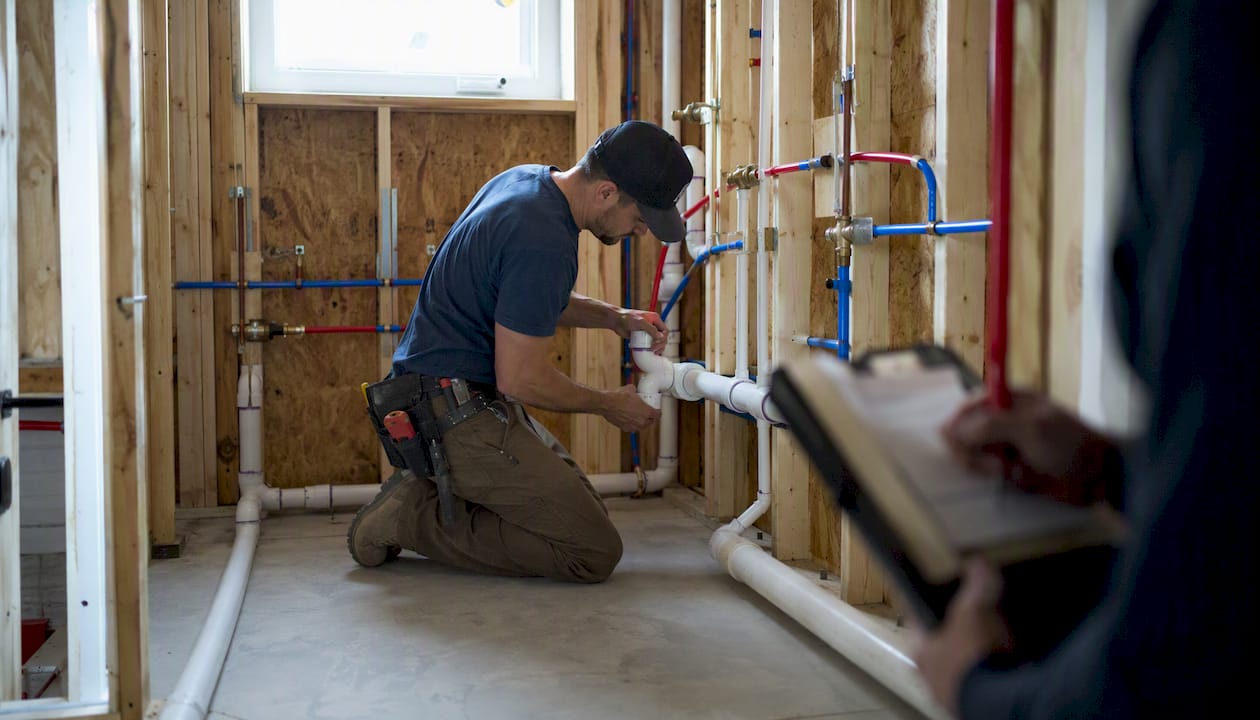
A typical new plumbing project moves through four inspection stages. First, the permit is submitted with a fixture schedule and riser diagram. Plan review takes one to three weeks in most jurisdictions, longer in busy metro areas. Once approved, rough-in work begins. The rough-in inspection happens after pipe is run and before walls are closed. Inspectors check pipe sizing, slope, support spacing, and fitting types. A passed rough-in inspection is the green light to close walls.
The top-out or pressure test comes next, confirming supply lines hold pressure and drain lines are properly vented. After fixtures are set, a final trim inspection closes out the permit. From permit submission to final inspection, a straightforward new-build plumbing project typically takes six to twelve weeks. A repipe in an occupied home often runs four to eight weeks because scheduling around residents adds time.
Delays compound costs. A failed rough-in inspection adds a re-inspection fee (often $75–$200), pushes the framing and insulation crews back, and can cascade through the entire construction schedule. Plan changes after permit submission trigger a revision review that can add two to four weeks.
Pro Tip: Submit a complete fixture schedule and a plumbing riser diagram with your permit application. Incomplete applications are the single most common cause of plan-review delays. A licensed plumber who pulls the permit should handle this, but confirm it before they submit.
Does homeowners insurance cover new plumbing or a repipe?
Standard homeowners insurance covers sudden, accidental water damage. A pipe that bursts overnight and floods your basement is a covered event under most policies. The insurer pays for the resulting water damage, and often for the pipe repair itself. According to GEICO’s homeowners insurance guidance, policies generally do not pay to replace aging or failing plumbing systems, which insurers treat as a maintenance issue.
What is typically covered vs. not covered:
- Usually covered: Sudden burst pipe damage, accidental overflow from a fixture, water damage resulting from a covered plumbing failure
- Usually not covered: Replacing old galvanized or polybutylene pipes, routine repipes, slow leaks that developed over time, maintenance-related failures
- Depends on endorsements: Sewer backup, water backup from a sump pump failure, service-line breaks between the street and your home
NerdWallet’s insurance analysis confirms that slow leaks and routine maintenance are almost universally excluded, and that optional endorsements for water backup and service-line coverage can materially change what gets paid.
Before filing a claim, run through this checklist:
- Document all visible damage with photos and video before any cleanup
- Note the cause clearly (sudden burst vs. slow leak) because cause determines coverage
- Check your policy’s water-backup and service-line endorsements
- Review your deductible against the repair estimate before filing a small claim
- Ask your insurer whether ordinance-or-law coverage applies if code upgrades are required
LegalClarity’s repiping insurance guide notes that a full home repipe is almost never covered as a standard claim, though ordinance-or-law endorsements can sometimes require and fund code-driven upgrades after a covered loss. Progressive explains how these endorsements work: if a covered event triggers a code-required upgrade, the endorsement may pay a portion of the upgrade cost that a standard policy would not.
How do you get a plumbing estimate you can actually compare?
The biggest mistake homeowners make is sending three contractors the same vague request and comparing the numbers they get back. Without a defined scope, you are comparing three different projects, not three prices for the same one.
Share these items with every bidder before they quote:
- Architectural plans or a dimensioned sketch showing fixture locations
- A fixture schedule listing every fixture by type, brand, and model (or grade)
- Pipe material preference or a request for alternatives with cost differences noted
- Access constraints (slab foundation, finished walls, crawl space height)
- Electrical and gas requirements tied to plumbing (tankless water heater, gas range)
- Whether permits are included in the bid or billed separately
- Whether restoration work (drywall, paint) is in scope
Red flags on a quote:
- Vague line items like “plumbing work” with no phase breakdown
- Heavy use of “allowances” without defined specs
- No permits line or a note that permits are “the owner’s responsibility”
- Missing restoration scope on a retrofit job
- No proof of license or insurance on the bid document
A simple scope template you can copy into an email to bidders:
“Please quote the following scope: [number] bathrooms, [number] kitchen(s), [fixture list with brands/grades], [pipe material preference], [foundation type], [permit included Y/N], [restoration scope Y/N]. Please provide a line-item breakdown by phase (rough-in, top-out, trim) and list any exclusions.”
Avoiding common renovation plumbing mistakes starts with a well-defined scope before the first contractor walks through the door.
Three realistic budget scenarios for new plumbing
These scenarios cover the most common situations homeowners and builders face. Each includes a contingency note because real projects rarely finish exactly at the estimate.
| Scenario | Scope | Low | Average | High |
|---|---|---|---|---|
| Lean new-build | 1,600 sq ft, 2 baths, 1 kitchen, clustered layout, builder-grade fixtures | $9,500 | mid-teens of thousands | mid-teens of thousands |
| Mid-range new-build | 2,400 sq ft, 2.5 baths, 1 kitchen, PEX/copper mix, standard layout, mid-grade fixtures, tankless water heater | $15,000 | mid-teens of thousands | $25,000 |
| Luxury or complex layout | 3,500 sq ft, 3.5 baths, wet bar, copper, spread layout, premium fixtures, radiant heat rough-in | upper twenties of thousands | upper range of tens of thousands | upper range of tens of thousands |
The lean new-build suits a first-time builder or investor prioritizing cost control. The main change-order risk here is site conditions: if the lot requires deeper underground runs due to grade or soil type, rough-in costs climb fast.
The mid-range scenario fits most custom home builds and whole-home remodels. Hidden damage in a remodel (corroded drain lines, undersized supply mains) is the most common driver of cost increases.
The luxury scenario applies to large custom builds or high-end renovations. Premium fixture lead times and specialty system coordination (radiant heat, recirculation loops) are the main schedule risks.
How Ag-plumbing builds a reliable line-item estimate
A credible plumbing estimate starts with a site walk, not a phone call. Here is the checklist Ag-plumbing uses when building a written, line-item quote for a Pittsburgh-area homeowner or builder:
- Site walk: Measure actual pipe run distances, confirm foundation type, and identify access constraints (finished walls, slab sections, crawl space clearance)
- Fixture count and schedule: List every fixture by type, location, and specified grade
- Riser diagram: Sketch the vertical stack layout to confirm vent sizing and drain slope compliance
- Material specification: Confirm pipe material, fitting types, and any code-specific requirements for the jurisdiction
- Pressure testing plan: Note when and how supply lines will be tested before walls close
- Permit review: Confirm which inspections are required and who pulls the permit
- Restoration scope: Identify any drywall, tile, or finish work required after rough-in
- Contingency line: Flag known unknowns (e.g., condition of existing drain lines in a partial repipe) with a defined contingency amount
A practical example of how this plays out: a homeowner in the Pittsburgh area requested a quote for a bathroom addition. The initial phone estimate assumed open framing. The site walk revealed the new bath was on the opposite end of the house from the existing wet wall, requiring a 35-foot supply run through a finished ceiling. That single discovery added roughly $1,200 in labor and restoration costs to the estimate. Without the site walk, that cost would have surfaced as a change order mid-project.
Ag-plumbing has 30 years of experience in the Pittsburgh market and provides written, line-item estimates that include permit fees, material specs, and restoration scope. You can review common plumbing issues in Pennsylvania to understand what local conditions typically add to a project before requesting your estimate.
The number most homeowners get wrong when budgeting for plumbing
The most common budgeting mistake is treating the plumbing quote as the total project cost. It is not. Plumbing is one trade in a sequence, and the decisions made in the plumbing phase ripple into framing, insulation, drywall, tile, and paint. A low plumbing bid that skips restoration scope, omits permit fees, or uses an allowance for fixtures instead of real specs is not a savings. It is a deferred cost.
The second mistake is optimizing for pipe material cost instead of layout efficiency. Choosing PEX over copper saves money. Clustering your wet walls saves more. A well-designed layout with PEX costs less than a sprawling layout with copper, but it also costs less than a sprawling layout with PEX. The pipe is not the expensive part. The labor to run it through a complicated floor plan is.
There is also a tendency to underestimate the permit and inspection process. Permits exist because plumbing failures cause real damage, and inspections catch the mistakes that cause those failures. The 135 Rule, for instance, is not bureaucratic overhead. It prevents the kind of drain-line clog that backs up into a finished basement two years after move-in. A contractor who suggests skipping permits to save money is offering to transfer their liability to you.
Keep copies of every permit and receipt. Those documents matter for resale disclosures and insurance claims years down the road.
Ag-plumbing can give you a written estimate for your Pittsburgh project
Thirty years of residential and commercial plumbing work in Pittsburgh and the surrounding areas means Ag-plumbing has seen every layout challenge, access constraint, and code variation the region produces. The services relevant to new plumbing installs include rough-in, repipe, fixture installation, water heater installation, and permit coordination.
A site visit from Ag-plumbing covers the full estimating checklist: on-site measurements, fixture schedule review, riser diagram, material spec confirmation, and a clear restoration scope. You get a written, line-item estimate, not a ballpark number over the phone. For water heater questions specifically, the Pittsburgh water heater guide covers tank vs. tankless trade-offs before you commit to a spec.
Ready to get a written estimate for your project? Contact Ag-plumbing to schedule a site visit and receive a line-item quote that covers every phase of your plumbing install.
Sources
- Estimating Plumbing Cost for New Construction: Price Ranges and Drivers 2026 – Well Built Florida
- Does homeowners insurance cover plumbing? | GEICO
- How Much To Plumb A 2000 Sq Ft House? (2026 Guide) – Plumbing Tips Today
- Does Homeowners Insurance Cover Repiping Costs? – LegalClarity
- What Is The 135 Rule For Plumbing? | The Platinum Plumber
FAQ
How much does it cost to plumb a 2,000 sq ft house?
Plumbing a standard 2,000 sq ft home typically runs $12,000–$25,000 for a full install, depending on fixture count, pipe material, and layout complexity. Repiping an existing 2,000 sq ft home generally costs $8,000–$15,000.
What is the 135 Rule in plumbing?
The 135 Rule requires using long-sweep fittings or paired 45-degree fittings on horizontal drain turns to prevent debris traps and clogs. Many local codes adopt this standard, and violations are a common cause of failed rough-in inspections.
Does homeowners insurance cover replacing plumbing pipes?
Standard homeowners insurance almost never covers replacing aging or failing pipes, which insurers treat as a maintenance issue. Policies typically cover sudden, accidental damage from a burst pipe but not proactive repiping or slow-leak repairs.
How much should you expect to pay a plumber per hour?
Plumber hourly rates in the U.S. generally range from $75 to $150 per hour for residential work, with rates in high-cost metros running higher. Most new installation projects are quoted as project-based bids rather than hourly, so ask bidders to break out labor hours and rate separately so you can compare.
Recommended
- Replace Plumbing: What Every Homeowner Needs to Know – AG-Plumbing
- Plumbing upgrades that save Pittsburgh homes money – AG-Plumbing
- Install plumbing fixtures: Pittsburgh homeowner guide – AG-Plumbing
- Maximize your remodeling investment with plumbing upgrades – AG-Plumbing
