
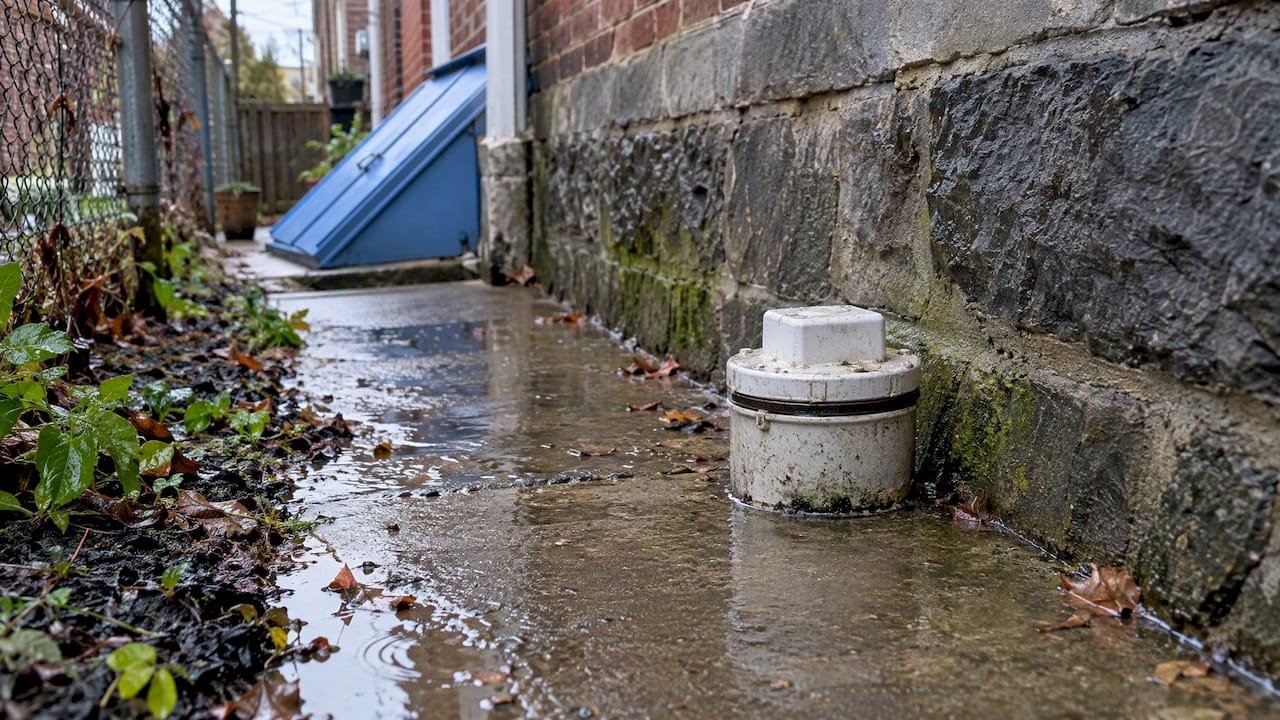
A sewer smell after rain usually comes from one of a few places: a dried-out drain trap, a blocked or leaking roof vent, a loose cleanout cap, or a sewer line that is cracked or swamped by stormwater. Some of these take two minutes and a jug of water to fix. Others mean sewage is close to backing up into your home, and that needs a plumber. This guide shows you how to tell which one you have, what you can safely check, and when to stop and call.
TL;DR
- Rain can push sewer gas into your home through dry floor drains, blocked roof vents, foundation cracks or a damaged sewer line.
- Start with the easy fix: pour about a gallon of water into every drain, especially floor drains and rarely used sinks and tubs.
- Notice where the smell is strongest. A basement floor drain, a single bathroom and the yard each point to a different cause.
- Sewage coming up through a drain, gurgling fixtures or a smell that lasts more than a day or two after the rain stops means a professional inspection.
- Headaches, dizziness, nausea or eye irritation with the smell: leave the area and ventilate.
Table of Contents
- Why rain makes the smell worse
- The most common causes, from easiest to hardest
- Where the smell is strongest tells you where to look
- Safe checks you can do in 15 minutes
- Is the smell dangerous?
- When to stop troubleshooting and call a plumber
- What a plumber actually does about it
- Our perspective
- Need it looked at? Here is how we help
- Keeping the smell from coming back
- FAQ
- Sources
Why rain makes the smell worse
Your plumbing is built so that waste and the gases it gives off travel in one direction, away from the house. According to InterNACHI, when something in that system fails, sewer gases can flow back into the building. Rain does not create the gas. It exposes weak spots that were already there.
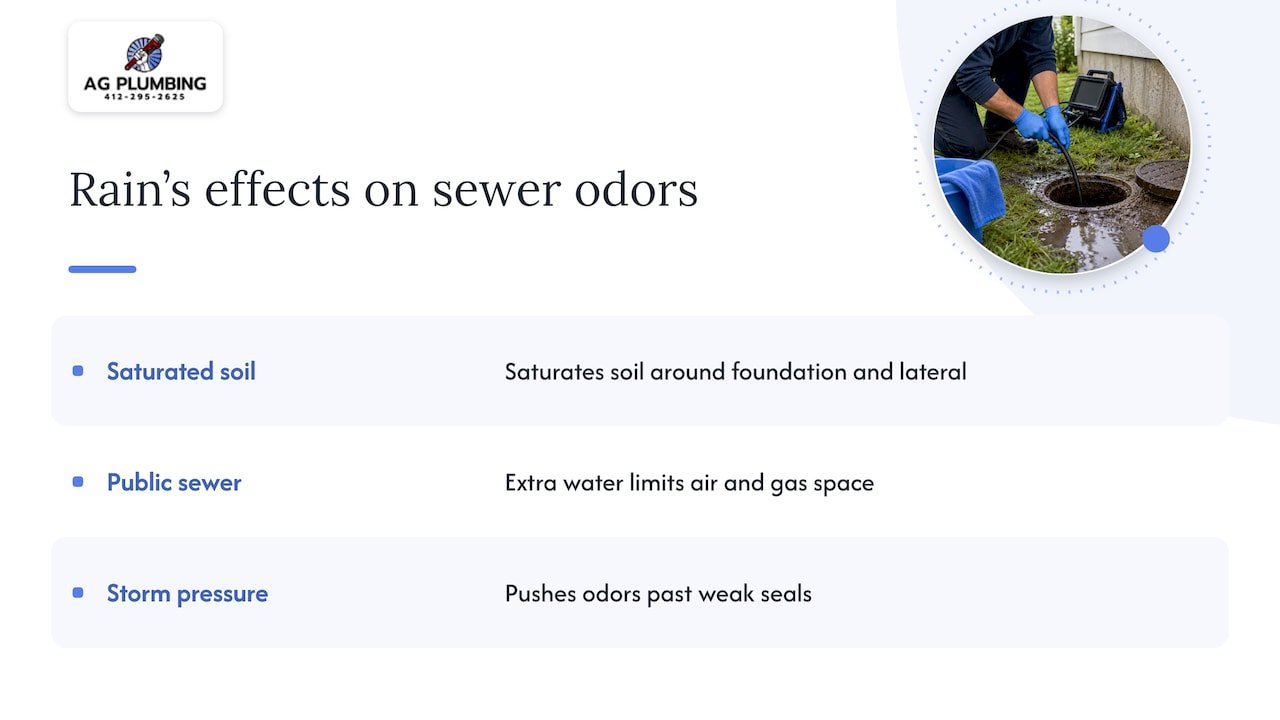
Heavy rain does three things at once. It fills the soil around your foundation and your sewer lateral, the pipe that runs from your house to the main. It sends extra water into the public sewer, which can leave less room for air and gas to move. And storm weather changes air pressure, which can nudge odors out of places they normally stay sealed.
The Wisconsin Department of Health Services lists the typical entry points: dried-out floor drains, leaking or blocked rooftop plumbing vents, and foundation cracks when gases are present in the surrounding soil. In some places the problem is bigger than one house. Fairfax County, Virginia notes that sewage odors or basement backups during rainstorms can mean the sanitary sewer lateral is being overwhelmed by rainwater entering the system through inflow or infiltration. Older neighborhoods with aging pipes, which describes plenty of Pittsburgh streets, are where we see this most.
The most common causes, from easiest to hardest
A dry P-trap
Every sink, tub, shower and floor drain has a U-shaped bend that holds a small plug of water. That water is the seal that keeps sewer gas out. If a drain goes unused for weeks, the water evaporates and the seal is gone. NDSU Extension specifically points to dry traps in infrequently used drains as a way for sewer gas to enter a home.
The usual culprits are a basement floor drain, a guest bathroom, a utility sink, or a laundry standpipe. If the smell shows up only after rain and only near one drain, start here. Our guide to the role of P-traps in home plumbing explains how the seal works and why it fails.
A blocked or leaking plumbing vent
Your drains need air to flow. Vent pipes run up through the roof so wastewater can move without pulling the trap seals dry, and so gases have a path to escape above the roofline. A leaf clog, a bird nest or, in winter, ice can block that path. NDSU’s agricultural engineers note that in cold weather, condensation can freeze in rooftop vents and create blockages that force sewer gas back into the home’s plumbing.
A partly blocked vent often shows up as slow drains, gurgling after you flush, and a smell that comes and goes with the weather. A cracked or disconnected vent inside a wall or attic can leak gas into living space. You will not find that one by sniffing around, which is why a pro with the right tools matters.
A loose or missing cleanout cap
The cleanout is a capped access pipe, usually in the basement, crawl space or outside near the foundation. If the cap is cracked, loose or missing, gas escapes, and surface water can run straight into the line during a storm. It is a small part with a big effect, and it is worth a look on any wet-weather odor call.
Cracked pipes, loose joints and failed seals
If pouring water into drains does nothing, the Metropolitan Sewer District of Greater Cincinnati says professional investigation for pipe cracks, loose joints or damaged toilet seals may be needed. A toilet with a worn wax ring can leak gas at the base without any visible water. Cracks in cast iron or clay pipe under a slab let gas seep up, and they also let groundwater in when the soil is saturated.
Tree roots and a failing sewer lateral
Roots find tiny gaps in old clay and cast-iron pipe, grow into them and slowly choke the line. When rain saturates the ground, a partly blocked lateral slows even more. The first signs are often a smell, slow drains and gurgling. We cover the full picture in sewer line warning signs every homeowner should know, and in signs of a collapsed sewer line if things have gone further.
A septic system under stress
Most Pittsburgh-area homes are on public sewer, but some outlying properties use septic. The US EPA notes that a downdraft or other location-specific conditions can create a septic odor inside or outside a home, and that a tank should generally be inspected every one to three years and pumped every three to five. A flooded drainfield after a storm can also push sewage toward the house. If you notice a smell mainly in the yard, see our piece on a wet yard with a sewage smell.
Where the smell is strongest tells you where to look
| Where you smell it | Most likely cause | First move |
|---|---|---|
| Basement floor drain | Dry trap, or a sewer line backing up | Pour in a gallon of water; watch for water rising |
| One bathroom or sink | Dry trap, worn toilet seal, vent problem | Run water in every fixture there; check the toilet base |
| Whole house, comes and goes with weather | Blocked vent or overwhelmed lateral | Look for gurgling and slow drains; call if it repeats |
| Near the foundation or yard | Cleanout cap, cracked lateral, septic issue | Check cap; avoid standing water |
| Laundry drain | Dry standpipe trap or a clog | Run water; see if it drains fast |
If the odor is in a laundry room specifically, a clog or a dry standpipe is common. We walk through that in fixing a laundry drain clog without caustic cleaners.
Safe checks you can do in 15 minutes
These steps need no tools and carry no risk if you stop when something looks wrong.
- Find the smell. Walk the house and note which room, drain or corner is worst. Write it down. A plumber will ask.
- Refill the traps. Pour about a gallon of water into each drain, including floor drains, guest tubs and utility sinks. The Cincinnati sewer district advises repeating this about once a month if it solves the problem.
- Check the toilet bases. Look for staining, a rocking toilet, or dampness at the floor line.
- Look at the cleanout. Make sure the cap is present, intact and snug. Do not open it if water or sewage is visible.
- Listen. Flush a toilet or run a sink and listen for gurgling in a nearby drain. Gurgling points to venting or a partial blockage.
- Look at the roof vents from the ground. Do not climb onto a wet roof. If you can see debris or a bird nest, or snow or ice in winter, tell your plumber.
- Wait and recheck. If the smell fades within a day of the rain ending and a filled trap fixed it, you likely have your answer.
Skip pouring chemical drain cleaners or bleach into drains as a smell fix. They do not repair a seal or a crack, and they can damage pipes or create hazards when mixed.
Is the smell dangerous?
Most of the time, a faint odor is a nuisance, not an emergency. The Delaware Division of Public Health says in its guidance on sewage backups that sewage odors themselves are generally not harmful, but the pathogens in raw sewage backups pose a significant disease risk. So the smell matters less than whether actual sewage is entering your living space.
Sewer gas is a mixture, though, and it deserves respect. The Wisconsin Department of Health Services lists headaches, dizziness, nausea, drowsiness, and respiratory or eye irritation as common signs of exposure. It also warns that at high concentrations hydrogen sulfide can dull your sense of smell, so a smell that seems to disappear is not proof the air is clean. Methane displacing oxygen can lead to rapid suffocation in enclosed spaces. InterNACHI adds that methane and hydrogen sulfide are both explosive.
What that means in practice:
- If you feel unwell with a strong odor, leave, open doors and windows, and call a plumber. If symptoms are severe, or someone is faint or confused, call 911.
- Do not light candles, run a gas appliance or flip switches in a closed space that smells strongly of rotten eggs. If you smell natural gas, which is also described as rotten eggs, leave the building and call your gas utility from outside.
- Keep children, older adults and pets out of a basement where sewage has come up.
For a deeper explanation, read what sewer gas is and the risks it carries.
When to stop troubleshooting and call a plumber
The EPA is blunt on this point: sewer odors are often only a nuisance, but you cannot pin down the exact cause from a distance, and it usually takes a plumber or septic service to find it. Call if you see any of these:
- Water or sewage rising from a floor drain, tub or toilet during or after rain.
- Several fixtures gurgling or draining slowly at the same time.
- A smell that returns after you have refilled every trap.
- A smell that lasts more than a day or two after the rain has stopped.
- A wet or sunken patch in the yard, or a strong odor outdoors near your lateral.
- Any symptoms of exposure listed above.
Backups should not wait. The Seattle Public Utilities guide stresses that sewer backups need to be stopped and cleaned quickly to limit exposure to potentially harmful bacteria and viruses. The Delaware health department adds that heavy storms, blockages, sewer-pipe or septic-tank breakdowns and flooded leach fields can all send sewage back up through floor drains and fixtures.
If you do have a backup, our guides on why sewer backups occur and stopping damage from a basement floor drain backup cover what to do in the first hour.
One more call to make
If neighbors on your street have the same smell or backups, the problem may be in the public main rather than your pipe. Contact your municipal sewer authority as well. A plumber can tell you quickly whether the trouble sits on your side of the property line, which is the part you are responsible for.
What a plumber actually does about it
A good diagnosis does not start with digging. It starts with questions: when does the smell appear, which drain, how long after the rain. Then comes a check of traps, toilet seals, cleanouts and vents, and often a camera run through the lateral. Fairfax County calls CCTV examination the best way to assess the condition of a sanitary sewer lateral, and it is also how you avoid guessing.
What comes after depends on what the camera shows:
- Roots or buildup: cleaning the line. When roots are the issue, we look first and jet second. See our note on camera-first hydro jetting for roots.
- Cracks, offsets or a collapsed section: repair or replacement. Your top sewer line repair options and the sewer repair process from start to finish explain what to expect.
- Leaking seals, vents or fittings: targeted plumbing repair, often the same day.
Our perspective
We have worked on Pittsburgh plumbing for 30 years, and the pattern with wet-weather smells is consistent. Homeowners wait. The odor shows up with a storm, disappears when it dries out, and gets filed under “weird.” Then one heavy rain, the floor drain overflows.
Our view is simple. A smell is information. If a gallon of water in each drain solves it, great, you have saved a service call and you now have a monthly habit. If it does not, the smell is usually telling you something about the line, the vent or the seals, and a camera inspection costs far less than a flooded basement.
We also think homeowners deserve a plain explanation before any work starts. You should see what we see, understand the options, and decide with clear information. Not every smell needs a new sewer line, and we will tell you when it does not.
— Maayan
Need it looked at? Here is how we help
If the easy fixes did not work, AG Heating, Cooling & Plumbing handles the next steps for homes and businesses in Pittsburgh and the surrounding areas: drain cleaning, hydro jetting for stubborn buildup, sewer repair when the line itself is damaged, and plumbing repair for seals, vents and fixtures. Our staff is licensed and certified, we are BBB accredited, and we offer discounts for seniors, military, new customers and referrals. Tell us where and when you smell it, and we will start from there.
Keeping the smell from coming back
- Run every drain monthly. Add a gallon of water to floor drains and unused fixtures. Put a reminder on your calendar.
- Keep the cleanout capped and clear. Do not bury it under mulch or storage.
- Do not flush wipes, grease or hygiene products. They build blockages that rain turns into backups.
- Schedule periodic drain cleaning. Why drain cleaning prevents blockages shows how routine cleaning cuts the odds of an emergency.
- Consider a backwater valve. In homes prone to backups, a valve and annual check are covered in our sewer backup prevention guide.
- Mind the septic schedule. If you are on septic, follow the EPA’s inspection and pumping intervals above.
- Fix small leaks early. Our list of common plumbing repair issues helps you spot them.
For more habits worth building, see essential plumbing safety tips for Pittsburgh homeowners.
FAQ
How do you get rid of sewer smell when it rains?
Start by pouring about a gallon of water into every drain, especially floor drains and fixtures you rarely use, to restore the water seal. Check that the cleanout cap is secure and the toilets are sealed at the base. If the smell returns, the cause is likely a vent, a cracked pipe or a stressed sewer line, and a plumber should inspect it.
What are the first signs of sewer gas poisoning?
The Wisconsin Department of Health Services lists headaches, dizziness, nausea, drowsiness, and eye or respiratory irritation. Get into fresh air right away and ventilate the space. If symptoms are serious or do not ease outside, seek medical help.
How long does a sewage smell take to go away?
If a dry trap is the cause, the smell usually fades soon after the drain is refilled. If it lingers more than a day or two after the rain stops, or comes back with each storm, something in the system is failing and needs a professional look. Any visible sewage should be dealt with immediately.
Why does my basement smell like sewage after it rains?
Basements sit lowest, so they catch the first sign of trouble: a dry floor drain trap, a loose cleanout cap, foundation cracks, or a sewer lateral filling with stormwater. If water or sewage comes up through the floor drain, keep people out of the area and call a plumber. Our guide to sewer smell sources and sewer line warning signs can help you narrow it down.
Sources
- Air: Sewer Gas, Wisconsin Department of Health Services
- Sanitary Sewer House Lateral, Fairfax County
- Frequent Questions on Septic Systems, US EPA
- Prevent Sewer Gas Backup, NDSU Extension
- Sewer Gases in the Home, InterNACHI
- When Sewage Backs Up Into Your Home, Delaware Division of Public Health
- Troubleshooting Your Sewer Problem, Seattle Public Utilities
- Sewer Backups and Other Issues, Metropolitan Sewer District of Greater Cincinnati
Recommended
- Wet Yard Sewage Smell: Diagnose and Stop It Fast
- Sewer Line Warning Signs Every Homeowner Should Know
- Understanding the Sewer Repair Process From Start to Finish
- What Is Sewer Gas? Risks, Causes, and Safety Tips
